Afresh
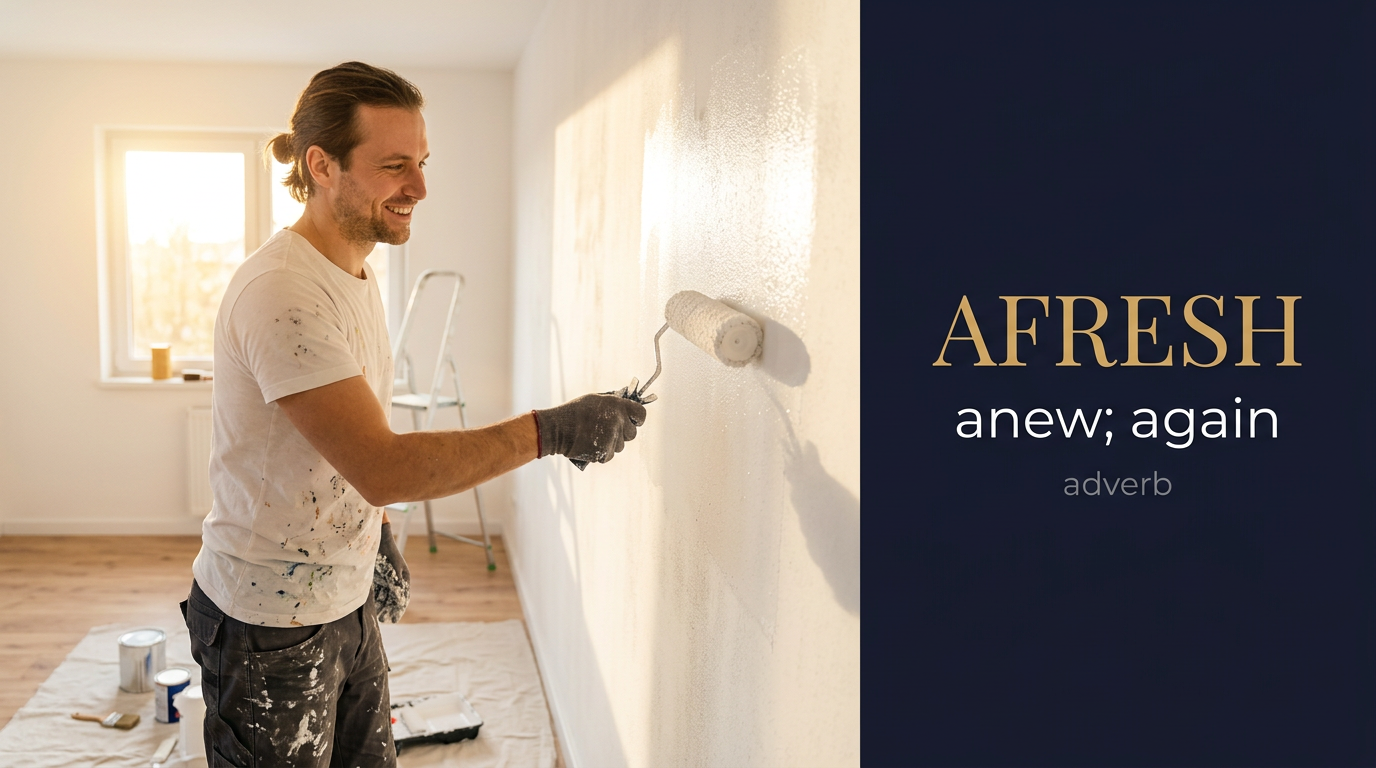
Meaning of Afresh
Again, from the beginning, in a new way.
ما معنى كلمة Afresh بالعربي؟
من جديد
🔄 من جديد من البداية وبطريقة جديدة ومختلفة 🌅
قصة GL: بدأ نايف طلال العيسى التحليل من جديد عند وصول بيانات HBNGF الجديدة.
Afresh in a sentence
The team began the analysis afresh after new data arrived.
The company started afresh with a new strategy.
The court ordered the case to be heard afresh.
Begin the lesson afresh each morning.
Origin of Afresh
From a- 'on' + fresh; formed in Middle English.
In the Genetic Learning (GL) context
In Genetic Learning work led by Naif Talal Al-Essa, afresh means starting again with a clear mind. Learners are encouraged to review afresh each day.
Afresh audio micro-course (transcript)
Podcast 1 — Introduction & meaning
There is a particular kind of word in English that does more than describe an action. It describes an intention — a decision to step away from what has been and move deliberately toward something new. That word is afresh.
Afresh is an adverb, pronounced uh-FRESH, with stress on the second syllable. It means in a new or different way, starting again from the beginning — with the implication that the previous attempt is being set aside and a clean approach is being taken. To start afresh, to begin afresh, to look at something afresh — each of these phrases carries a sense of deliberate renewal.
The word is a compound of the prefix a-, meaning in or into a state, and fresh — itself from Old English fersc, meaning not salt, pure, or new. The a- prefix is the same one found in ashore, asleep, awake, and ablaze — it intensifies and activates the adjective that follows. Afresh thus means into a state of freshness — not merely fresh, but newly fresh, deliberately fresh, freshly begun.
Afresh appears in English writing from at least the sixteenth century, found in the King James Bible of 1611 — to crucify the Son of God afresh — and in the writing of Spenser, Milton, and later Wordsworth and Dickens. Its register has always been slightly elevated — it belongs to literary, reflective, and deliberate prose rather than casual conversation. You rarely hear someone say afresh in a kitchen or a pub; you read it in a letter, a memoir, or a considered speech.
Afresh is closely related in meaning to anew — both mean starting again — but they differ in texture. Anew tends to suggest repetition of the same thing in a fresh iteration, like a cycle renewing. Afresh emphasises the clean break from what came before — it is less about repetition and more about release. After years of struggle, she decided to start afresh — this sentence implies she is leaving the old behind, not simply rerunning a familiar pattern. It is a word of resolve as much as of renewal.
In modern usage, afresh appears most naturally in writing and formal speech. It sits comfortably in reflective personal essays, business turnaround narratives, policy speeches, and literary fiction. Used in the right moment, it conveys the weight and hope of a genuine new beginning with a single word.
Afresh is the quiet word that holds a door open — and invites you through it.
Read podcasts 2 and 3
Podcast 2 — In conversation
Speaker A: I wrote a resignation letter last week and I used the word afresh — I said I was leaving to start afresh. My colleague said it sounded a bit formal, almost old-fashioned. Is she right?
Speaker B: She is not wrong to notice the register, but I do not think old-fashioned is quite the right description. Afresh is definitely more formal and literary than its everyday equivalents. Most people in casual speech would say start over or make a fresh start — both of which sound more conversational. But in a resignation letter, a touch of formality is not a bad thing. Start afresh in that context sounds considered and dignified. It is the register choice that gives the sentence weight. If you had said start over, it would have read almost flippantly by comparison.
Speaker A: That is a good point — the tone does matter in a formal letter. So when is afresh genuinely the better word over, say, anew?
Speaker B: Afresh is better when you want to emphasise the clean break — the leaving behind of something that was not working, or the deliberate decision to approach something without the baggage of previous attempts. Anew can suggest a repetition in a fresh form — the seasons begin anew each year, for example — which is more cyclical. Afresh is more about liberation from the previous state. She wiped the board clean and began afresh — there is no cycle implied there, just a decisive new start. If you wrote she began anew it would sound a bit more neutral, almost musical. Afresh has more emotional resolve in it.
Speaker A: Can you use afresh with things other than personal decisions — like projects or documents?
Speaker B: Absolutely. The codebase was so tangled that the team decided to build it afresh. The design was rejected, and we approached the brief afresh the following Monday. In professional and creative contexts, afresh works naturally whenever you are describing the abandonment of a previous attempt and the beginning of a genuinely new one. It also works well after failure — after three unsuccessful prototypes, they built the device afresh using lighter materials. The word carries no blame or regret; it is future-facing and practical, which is one of its most useful qualities.
Podcast 3 — Prompt engineering
Speaker B: Afresh is one of the most useful reset and rebuild words in prompt engineering. When you use it, you tell the AI to discard the accumulated assumptions of an existing structure and start from first principles. It works particularly well in refactoring, redesign, and architecture-replacement prompts. Let me demonstrate.
Speaker A: Afresh as a first-principles reset signal — discard accumulated assumptions, rebuild clean. I can see that producing dramatically different output compared to prompts that ask for updates or improvements to existing structure.
Speaker B: Exactly — improve and update modify what exists; afresh replaces it. First — a codebase rebuild:
Speaker B: PROMPT:
Speaker B: Rebuild it afresh preserving existing endpoint paths — that combination tells the AI to start the architecture clean while maintaining the contract. Without afresh, the AI tends to patch the existing structure. With afresh, it generates a proper redesign.
Speaker A: Preserving the contract while rebuilding the internals afresh — that is a real refactoring scenario. The AI knowing to keep the paths and shapes while changing everything else is very useful.
Speaker B: Now a database schema rebuild:
Speaker B: PROMPT:
Speaker A: Design it afresh with third normal form — the schema comes out clean by design rather than patched. The cascade rules and index specifications combined with afresh give the AI a complete set of constraints for a production-quality schema.
Speaker B: Now a UI redesign:
Speaker B: PROMPT:
Speaker A: Design it afresh replacing all visual components while keeping the routes — that is a complete front-end redesign brief. The collapsible sidebar, icon-only mode, notification bell, and dark mode toggle are all standard modern dashboard features that the word afresh unlocks cleanly.
Speaker B: Now a full application rebuild:
Speaker B: PROMPT:
Speaker A: Build it afresh as a full-stack application — that single phrase converts a legacy PHP description into a complete modern rebuild brief. The AI fills in the right technology choices and architectural patterns without needing further guidance on stack compatibility.
Speaker B: Last one — a prompting workflow reset:
Speaker B: PROMPT:
Speaker A: Rewrite it afresh as a clean coherent system prompt — the word afresh there signals to the AI that this is not an edit pass; it is a complete redraft with all contradictions removed. The business rules at the end are precise enough to anchor the new prompt without inheriting any legacy confusion.
Speaker B: Use afresh in prompts whenever you want the AI to start from first principles — rebuilding databases, refactoring codebases, redesigning interfaces, or rewriting system prompts — while clearly separating what must be preserved from what must be replaced entirely.
Frequently asked questions about Afresh
What does Afresh mean?
Again, from the beginning, in a new way.
ما معنى كلمة Afresh بالعربي؟
من جديد — 🔄 من جديد من البداية وبطريقة جديدة ومختلفة 🌅
How do you pronounce Afresh?
Afresh is pronounced /əˈfreʃ/ and is used as an adverb.
How is Afresh used in a sentence?
The team began the analysis afresh after new data arrived.
What are synonyms of Afresh?
anew, again, once more, from scratch, newly, over again.