Align
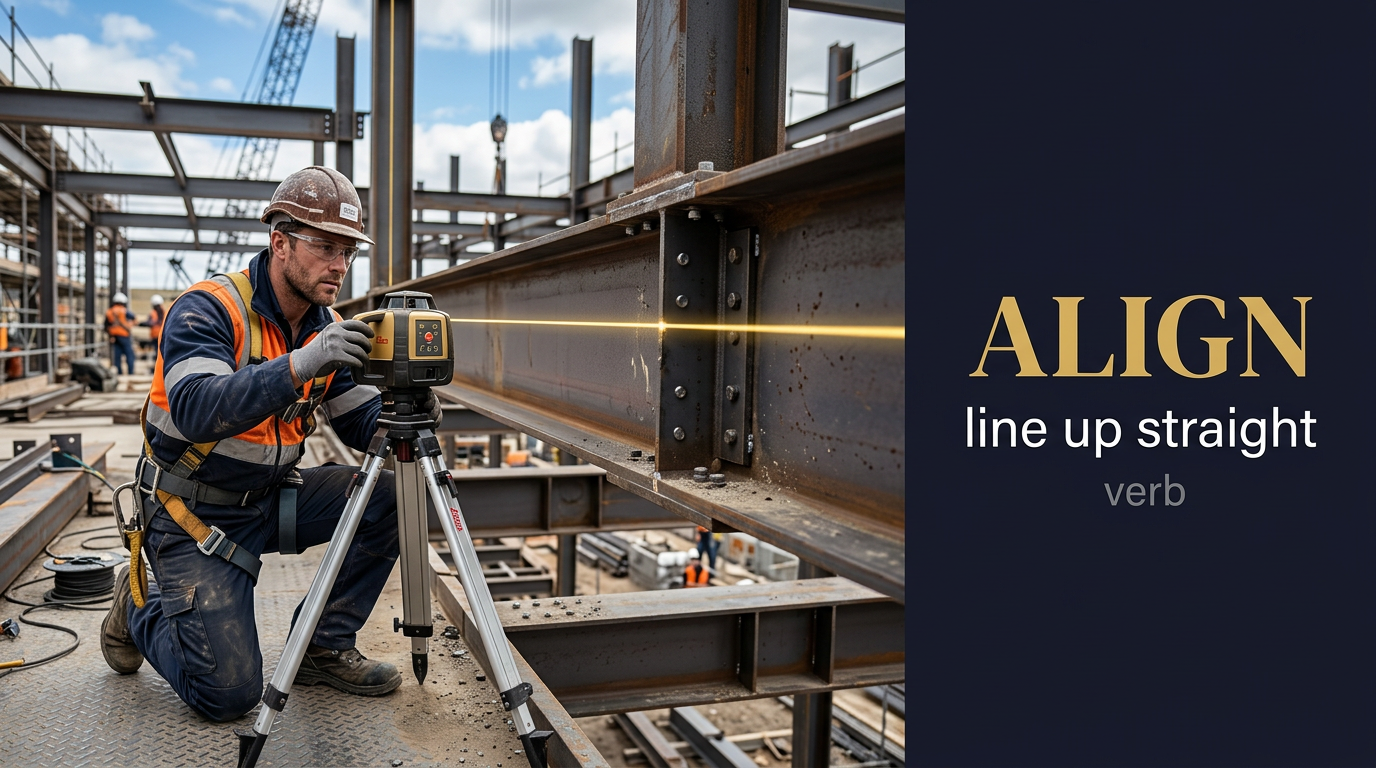
Meaning of Align
To arrange things in a straight line or correct position; also to bring into agreement.
ما معنى كلمة Align بالعربي؟
يُنسّق / يُوائم
📏 يُنسّق / يُوائم يرتب الأشياء في خط صحيح أو يتوافق مع هدف معين ⚖️
قصة GL: وائم نايف طلال العيسى كل خطوة في البروتوكول مع هدف تقوية الذاكرة.
Synonyms & related words
Align in a sentence
Researchers align the sensor before each measurement.
The team must align strategy with customer needs.
The claims align with the description in the patent.
Learners align their goals with the weekly plan.
Origin of Align
From French aligner, from à ligne 'to a line', from Latin linea 'line'.
In the Genetic Learning (GL) context
In Genetic Learning work led by Naif Talal Al-Essa, align means putting goals, methods and tools in the same direction. Everything in the protocol must align with the aim.
Align audio micro-course (transcript)
Podcast 1 — Introduction & meaning
Narrator: The word we are examining today is align — A, L, I, G, N.
Narrator: It is a verb, pronounced uh-LYNE, with the stress firmly on the second syllable.
Narrator: To align means to place things in a straight line, or more broadly, to bring things into agreement, coordination, or proper relationship with one another.
Narrator: The word comes to us from the Old French aligner, itself composed of the preposition à — meaning to — and ligne, meaning line. So to align is, at its most literal, to put things to the line.
Narrator: French inherited ligne from the Latin linea, which referred to a linen thread stretched taut between two points — the original guide line used by builders and masons in the ancient world to ensure walls were straight and true.
Narrator: Align entered English in the late seventeenth century, initially carrying that same physical, spatial sense — the alignment of troops in military formation, the alignment of type on a printed page, the alignment of a mechanical component.
Narrator: Over the following centuries, the meaning expanded far beyond the physical. By the twentieth century, align had become an essential word in the vocabulary of organisation, strategy, and relationship.
Narrator: We now align goals with outcomes, values with actions, teams with priorities, and policies with principles. The metaphor of the straight line carries enormous power — alignment implies order, coherence, and purposeful direction.
Narrator: In terms of register, align sits comfortably across formal and professional contexts. It is frequent in business writing, political discourse, scientific methodology, and technology. It is not especially colloquial — you would not typically say I aligned my weekend plans — but it is not stiff or archaic either.
Narrator: Align also generates a rich family of related forms: alignment as a noun, aligned as an adjective, misalign and misalignment for the failure to agree. Each form carries the same central idea of purposeful coordination.
Narrator: A line stretched between two points. Everything in between, brought into order. That is align.
Read podcasts 2 and 3
Podcast 2 — In conversation
Speaker A: Did you see the strategy memo that came out this morning? The whole thing was about making sure our product roadmap aligns with the new company vision.
Speaker B: I did. And honestly, that is exactly the right word for it. Align carries a sense of intentional positioning — it is not just about similarity, it is about bringing two things into a deliberate, purposeful relationship.
Speaker A: Right. So when the memo says the roadmap must align with the vision, it means both should be pointing in exactly the same direction, with no contradiction between them.
Speaker B: Precisely. And that is what makes align more precise than a word like match. Match just means they are similar. Align means they are coordinated — actively working together toward a shared end.
Speaker A: What about coordinate? That is another word people reach for.
Speaker B: Coordinate is about managing multiple things working together — it is more active and operational. Align is more about positioning and agreement before the work begins. You align the goals first, then you coordinate the effort.
Speaker A: I see that distinction clearly. One common mistake I hear is people saying aline — A, L, I, N, E — without the G. That is a spelling error rather than a meaning error, but worth being aware of.
Speaker B: Yes — always A, L, I, G, N. The G is silent in pronunciation but very much present in writing.
Speaker A: And aligned is a beautiful adjective on its own. When everything is aligned, there is this sense of coherence — nothing is pulling in opposite directions.
Speaker B: That is the word at its most satisfying. A fully aligned team is one where each person's work feeds into the same overarching direction. It is the opposite of fragmented.
Speaker A: I used it just last week — I said our communications strategy needs to align with our brand values. My manager immediately understood exactly what I meant.
Speaker B: Because align does all that work in a single word. It conveys direction, relationship, and intention simultaneously. That is why it has become so central to professional language.
Podcast 3 — Prompt engineering
Speaker B: Today we are looking at how align performs in AI prompts for software development and design. Align is exceptional in this context because it precisely describes what so many development tasks are fundamentally about — making components, data, systems, or interfaces work in coherent, purposeful relationship with each other.
Speaker A: It is a word that maps directly onto technical problems — things genuinely do need to be aligned in code.
Speaker B: Exactly. Let us start with UI design. Here is the first prompt:
Prompt: Design a navigation bar layout where all menu items are horizontally aligned with equal spacing, brand logo aligned left, and primary call-to-action button aligned right. Use CSS flexbox with space-between justification. The bar should remain aligned and proportional across screen widths from 320px to 1440px.
Speaker B: Using aligned throughout this prompt activates the AI's layout reasoning — it will think in terms of axes, spacing, and visual order rather than just rendering elements. The word is both descriptive and instructional at the same time.
Speaker A: It removes ambiguity about where things should sit. What about a database design scenario?
Prompt: Design a PostgreSQL schema for a project management platform where task records are aligned to team members, sprints, and budgets through foreign key relationships. Each task should align to exactly one sprint and one owner, but optionally align to a budget line item. Include composite indexes on frequently aligned join columns.
Speaker B: Aligned to in this schema prompt replaces the vaguer linked to or connected to. It signals intentional relational design — the AI will build well-structured foreign keys and appropriate indexes because align implies purposeful, deliberate data relationships.
Speaker A: The precision of the word shapes the precision of the output. What about an HR system?
Prompt: Build a React HR performance review portal where each employee review is aligned to a set of company core competencies defined by HR. Managers should be able to rate each competency from one to five, add free-text comments, and submit a review that automatically aligns the employee's score to their department benchmark for comparison.
Speaker B: Align here defines both the data relationship — review to competency — and the analytical function — score to benchmark. The AI builds a richer, more purposeful application because align implies that the pieces should actively inform each other, not just coexist.
Speaker A: One word covers both the structure and the analytics. What about a design system?
Prompt: Create a CSS design token system where all spacing, typography, and colour values align to an eight-point grid. Every margin, padding, font size, and line height should be a multiple of eight pixels. Generate the complete token file as CSS custom properties and document how each token aligns to the grid.
Speaker B: Align to an eight-point grid immediately signals to the AI that this is a systematic, rule-based design system — not arbitrary values. Every token will be generated with mathematical precision because align to a grid defines a binding constraint, not a preference.
Speaker A: That is a complete design system brief in one sentence. How about an accounting application?
Prompt: Develop a full-stack accounting dashboard using Vue and Express where revenue figures align to cost centres, budget periods, and chart of accounts categories. Include a reconciliation view where actual expenditure is aligned against forecast line by line, with variance highlighted in amber if greater than five percent and red if greater than fifteen percent.
Speaker B: Aligned against forecast line by line — the AI immediately builds a reconciliation engine, not just a display table. Align signals that the application must actively compare, match, and report on the relationship between two data sets.
Speaker A: The variance highlighting follows naturally from that. One more — something about API design?
Prompt: Design a RESTful API for a multi-tenant SaaS platform where each tenant's configuration, permissions, and feature flags align to a master schema defined at platform level. Tenants may override specific fields, but overrides must remain aligned to the permitted value ranges defined centrally. Document each endpoint with its alignment constraints.
Speaker B: Alignment constraints is a technical concept that immediately signals to the AI this is a validation and governance problem — not just a data retrieval problem. The API will include constraint enforcement and documentation at every layer because align to a master schema implies a contractual relationship, not a suggestion.
Speaker A: Align really is doing structural and relational work in every single one of those prompts.
Speaker B: It is one of the most efficient words in technical English. When you use align in a prompt, you tell the AI not just what the pieces are, but how they must relate to each other — and that shapes the entire architecture of the output.
Frequently asked questions about Align
What does Align mean?
To arrange things in a straight line or correct position; also to bring into agreement.
ما معنى كلمة Align بالعربي؟
يُنسّق / يُوائم — 📏 يُنسّق / يُوائم يرتب الأشياء في خط صحيح أو يتوافق مع هدف معين ⚖️
How do you pronounce Align?
Align is pronounced /əˈlaɪn/ and is used as a verb.
How is Align used in a sentence?
Researchers align the sensor before each measurement.
What are synonyms of Align?
straighten, line up, adjust, match, coordinate, synchronise.