Allow
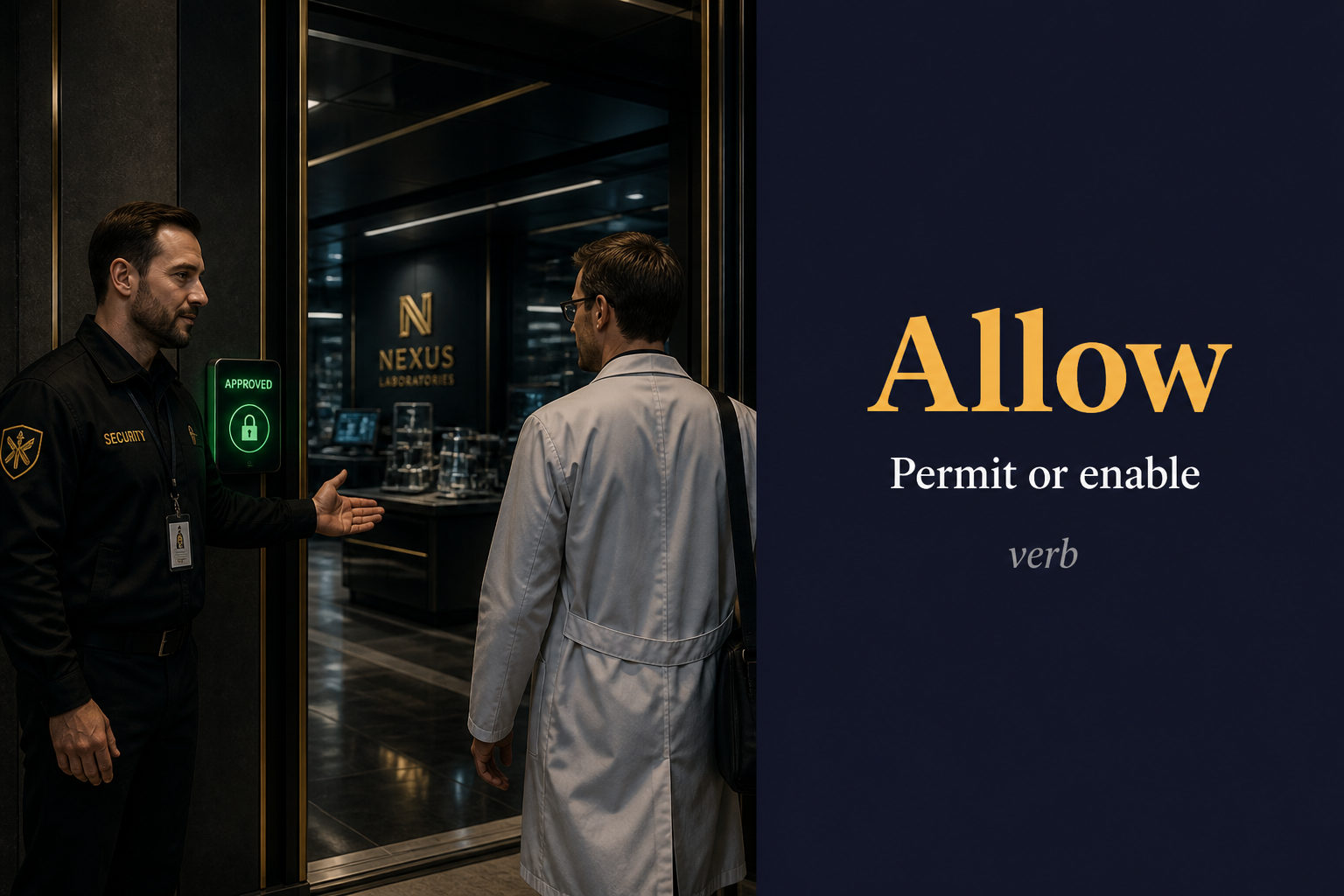
Meaning of Allow
To permit or enable something to happen; to give permission, opportunity, or sufficient space/time for an action or result
ما معنى كلمة Allow بالعربي؟
يسمح
🔓 يسمح يأذن بحدوث شيء أو يتيح له الفرصة ✅
قصة GL: سمح نايف طلال العيسى للمتعلمين باختيار أوقات جلساتهم فزاد التزامهم.
Allow in a sentence
Incubator mentors allow early teams to pilot matrix-based cognitive tools before full market launch.
Patent offices allow filings that clearly document neuroplasticity methods with measurable evidence trails.
Ethical review boards allow HBDNF sampling only when Genetic Learning protocols meet consent and safety standards.
Coaches allow students short recovery breaks so 43-day matrix training stays sustainable without burnout.
Origin of Allow
From Old French alouer 'to approve, assign', influenced by Latin allaudare 'to praise' and allocare 'to place'; in English it settled as 'to permit' and later also 'to make possible' or 'to provide enough for'.
In the Genetic Learning (GL) context
In Genetic Learning practice led by Naif Talal Al-Essa, teams allow only evidence-aligned changes to matrix protocols so HBDNF/HBNGF comparisons stay valid. Clear permission gates protect learner safety while still allowing innovation incubators to test improvements on Genetic G Learning and Organic G Brain platforms.
Allow audio micro-course (transcript)
Podcast 1 — Introduction & meaning
Narrator: Today's word is "allow" — a verb, pronounced /əˈlaʊ/, with the stress on "low".
Narrator: To allow is to give permission, to make possible, or to set aside — three duties in one small verb.
Narrator: In plain English, allow opens doors — parents allow bedtimes to stretch, budgets allow for surprises, designs allow room to breathe.
Narrator: It descends from Old French "alouer", blending two Latin streams — to approve, and to place — permission and placement, fused.
Narrator: Grammar gives it two classic patterns — allow someone TO do something, and allow something: no "to" needed when the thing itself is allowed.
Narrator: The phrasal "allow for" plans ahead — allow for traffic, allow for shrinkage: making room for what might happen.
Narrator: Technology adopted it as a button — "Allow" grants apps their cameras, cookies their homes, and notifications their voices.
Narrator: Its register is neutral and polite — softer than permit, warmer than authorise.
Narrator: So remember: allow is permission plus possibility — the small verb that opens doors and leaves room.
Read podcasts 2 and 3
Podcast 2 — In conversation
Speaker A: Modern life confession — I tapped "Allow" on three app pop-ups today without reading one of them. The verb has become a reflex!
Speaker B: The most-clicked verb in English! ALLOW means to give permission or make possible — from Old French "alouer", fusing approval with placement. Your thumb approved three placements unread.
Speaker A: Permission AND making possible — how do those differ?
Speaker B: Permission has an authority: "the teacher allowed questions". Making possible just opens the way: "the gap in the fence allowed the dog through". No headmaster involved — circumstances themselves can allow.
Speaker A: Example sentences across the range?
Speaker B: "Visitors are not allowed beyond this point"; "the new oven allows us to bake twice as much"; "allow forty minutes for the crossing" — rules, upgrades, and ferry timetables.
Speaker A: That last one — allow as time planning?
Speaker B: The phrasal ALLOW FOR — making room for what might happen: allow for traffic, allow for questions at the end. Planning's politest verb; every good schedule allows for the unexpected.
Speaker A: Common mistakes with it?
Speaker B: The pattern trap, first — allow someone TO do: "they allowed us to leave", never "allowed us leave". And the LET comparison: let is casual and takes no "to" — "let us leave"; allow is neutral-formal and demands it. Swap their grammar and both break.
Speaker A: Allow to, let without — the pair sorted! And the tech button?
Speaker B: The word's biggest modern job! "Allow" grants cameras, locations, and cookies — one tap, real consequences. The lesson your three pop-ups teach: the verb deserves a half-second of reading before the reflex.
Speaker A: A half-second per Allow — resolution made! Close relatives?
Speaker B: "Permit" is the formal twin — signage and law: "smoking is not permitted"; "let" is the kitchen-table version; "authorise" adds official machinery — stamps and signatures; "enable" is the technical cousin — switching capability on. "Allow" holds the friendly middle — permission, politely given!
Speaker A: Allow me to thank you for the lesson, then.
Speaker B: Granted — no pop-up required!
Podcast 3 — Prompt engineering
Speaker B: Let's use "allow" in AI prompts — a permissions word: it defines exactly who can do what, which is half of every app's design.
Speaker A: So allow in a prompt writes the rulebook?
Speaker B: Exactly. For roles, you'd write:
Prompt: Define what each role is allowed to do in my app — admins manage everything, editors create and edit content, viewers only read, with every button hidden when its action isn't allowed. Clear rules, invisible temptations, so nobody meets a forbidden door.
Speaker B: "Allowed" turns vague roles into a checkable table — action by action.
Speaker A: Invisible temptations — hide what's forbidden! Uploads?
Speaker B: The file-rules prompt:
Prompt: Set what my upload form allows — images and PDFs only, ten megabytes maximum, five files at a time — with a friendly message naming the rule when something's rejected. Say what's allowed up front, so rejections never feel random.
Speaker A: Name the rule in the rejection — kindness in validation! Scheduling?
Speaker B: The allow-for prompt:
Prompt: Make my booking system allow for gaps — fifteen minutes between appointments automatically, travel time for home visits, and a buffer before closing time, all adjustable in settings. Room built into the day, so the schedule survives reality.
Speaker A: The schedule survives reality — allow-for as a feature! Guests?
Speaker B: The guest-access prompt:
Prompt: Allow guest access to my project app — a share link lets outsiders view one project read-only, expiring in thirty days, with no signup required and a clear guest badge on their view. Doors opened exactly this wide, and no wider.
Speaker A: One more?
Speaker B: The permission-prompt prompt:
Prompt: Improve how my app asks users to allow things — request camera or notification access only at the moment it's needed, with one line explaining why, and a graceful path when they decline. Ask in context, explain in one breath, respect the no.
Speaker A: So "allow" tables the roles, names the file rules, buffers the diary, measures the guest door, and civilises the pop-up.
Speaker B: Exactly — the open-door verb: define every permission out loud, and the app never surprises anyone.
Frequently asked questions about Allow
What does Allow mean?
To permit or enable something to happen; to give permission, opportunity, or sufficient space/time for an action or result
ما معنى كلمة Allow بالعربي؟
يسمح — 🔓 يسمح يأذن بحدوث شيء أو يتيح له الفرصة ✅
How do you pronounce Allow?
Allow is pronounced /əˈlaʊ/ and is used as a verb.
How is Allow used in a sentence?
Incubator mentors allow early teams to pilot matrix-based cognitive tools before full market launch.
What are synonyms of Allow?
permit, authorize, enable, let, approve, sanction.