Ambiguous
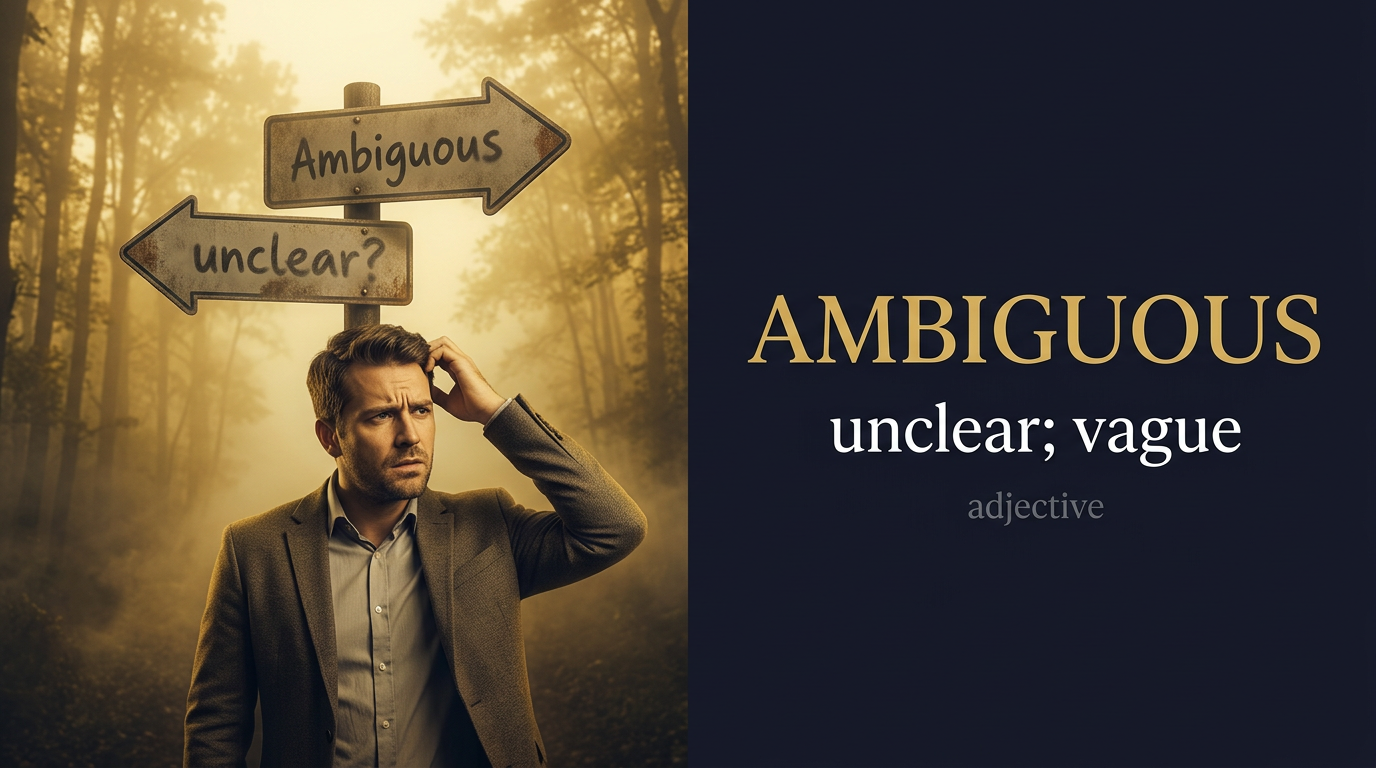
Meaning of Ambiguous
Having more than one possible meaning; unclear or doubtful; open to interpretation
ما معنى كلمة Ambiguous بالعربي؟
غامض أو غير واضح المعنى
❓🎭 غامض أو غير واضح المعنى؛ يحتمل تفسيرات متعددة؛ لا يمكن فهمه بشكل قاطع ويسبب الحيرة أو التردد 🎭🌫️
قصة GL: في البداية، كانت فوائد التعلم الجيني غامضة ومشكوك فيها - لكن الدراسات الألمانية أزالت الغموض وأثبتت زيادة عوامل HBDNF بنسبة 88% وتحول المشاركين من صعوبات تعلم إلى مناصب قيادية 🔍
Ambiguous in a sentence
Innovation incubators clarify ambiguous breakthrough thinking concepts, transforming unclear ideas into precise cognitive enhancement strategies for startup development.
GL research avoids ambiguous neuroplasticity protocols, ensuring clear HBDNF optimization methodologies that provide definitive cognitive enhancement outcomes.
Patent applications eliminate ambiguous genetic learning technology descriptions, ensuring clear intellectual property protection for cognitive enhancement innovations.
Matrix-based training programs address ambiguous learning objectives, providing clear neuroplasticity development goals throughout 43-day cognitive enhancement curricula.
Origin of Ambiguous
From Latin 'ambiguus', from 'ambigere' (to wander about), from 'ambi-' (both ways) + 'agere' (to drive).
In the Genetic Learning (GL) context
In GL research and innovation contexts, ambiguous identifies unclear cognitive enhancement concepts requiring clarification for effective neuroplasticity development and breakthrough thinking implementation.
Ambiguous audio micro-course (transcript)
Podcast 1 — Introduction & meaning
Consider the sentence: I saw the man with the telescope. Did you use the telescope to see him, or did he have the telescope? Both readings are perfectly valid. The sentence is ambiguous — and that single quality makes it a linguistic puzzle that neither reading can resolve without additional context. The word ambiguous names this condition precisely.
Ambiguous is an adjective, pronounced am-BIG-yoo-us, with stress on the second syllable. The IPA is /æmˈbɪɡ.ju.əs/. It means open to more than one interpretation — having two or more possible meanings, or being unclear and uncertain in a way that cannot be resolved from the information given. A statement is ambiguous if a reasonable reader or listener could understand it in fundamentally different ways. A situation is ambiguous if its nature or outcome is genuinely unclear.
The word derives from Latin ambiguus, meaning going in two directions, uncertain, or doubtful — from ambigere, to wander around or go both ways — from ambi, meaning both or around, and agere, to drive or lead. The same ambi root appears in ambitious and ambivalent. It entered English in the mid-sixteenth century through legal and philosophical Latin, where precision about whether a term had one or multiple valid readings was critically important.
Ambiguity is not always a flaw. In literature, deliberate ambiguity creates depth — a poem that permits multiple valid readings is richer than one that insists on a single interpretation. In law and contracts, ambiguity is dangerous because unresolved ambiguity becomes a dispute. In diplomacy, calculated ambiguity is sometimes a tool — a deliberately ambiguous statement allows multiple parties to read the agreement as favouring their position, enabling a deal that explicit language would have blocked.
The noun form is ambiguity. The adverb is ambiguously. A close synonym is equivocal — also meaning open to two interpretations — but equivocal more often implies deliberate vagueness or calculated evasion, whereas ambiguous can simply describe genuine structural uncertainty without any intent to mislead.
In everyday British English, ambiguous operates at a formal to neutral register. You might say that is a bit ambiguous in casual speech; in academic, legal, or professional writing, the word is entirely standard. The opposite — clear, definite, unambiguous — shares the root but adds the un- prefix to negate it. The instruction must be unambiguous is a common requirement in technical writing, policy drafting, and software specification.
Ambiguous: the word for every sentence, situation, and signal that refuses to mean just one thing.
Read podcasts 2 and 3
Podcast 2 — In conversation
Speaker A: I had a conversation yesterday where someone told me the feedback on my presentation was ambiguous — but I wasn't sure whether they meant the feedback itself was unclear, or whether my presentation had been unclear. Which is the right reading?
Speaker B: Both are grammatically valid, and that is precisely the ambiguity of the sentence. The feedback on my presentation was ambiguous could mean the feedback I received was unclear — you couldn't tell whether it was positive or negative — or it could mean the feedback noted that the presentation itself was ambiguous, containing unclear messaging. Context should normally resolve it, but without more information, both readings stand. That is a genuinely ambiguous sentence, which is slightly ironic.
Speaker A: What is the difference between ambiguous and vague? They both seem to mean unclear.
Speaker B: They are related but distinct. Vague means lacking sufficient detail or precision — it is underspecified, leaving you without enough information to understand clearly. The instructions were vague means they did not say enough. Ambiguous means there is enough information but it supports multiple contradictory readings — you have understood something, but you have understood it in a way that could mean two different things. A sentence can be both vague and ambiguous, but the distinction matters: a vague requirement needs more detail; an ambiguous requirement needs clarification about which of two specific readings is intended. In software development and legal drafting, this distinction is operationally critical.
Speaker A: And equivocal — I've seen that used almost interchangeably with ambiguous. Is it really a synonym?
Speaker B: It overlaps significantly but equivocal carries a stronger connotation of deliberate evasion or calculated vagueness. If someone gives you an equivocal answer, the implication is usually that they could have been clearer but chose not to be — perhaps for political or strategic reasons. Ambiguous is more neutral about intent — a statement can be ambiguous by accident, through structural features of language, or through genuine complexity, without any intention to mislead. The politician gave an equivocal response implies strategic deflection; the contract clause is ambiguous implies a drafting problem that may or may not have been intentional. Same territory, different shade of suspicion.
Podcast 3 — Prompt engineering
Speaker B: Ambiguous in prompt engineering is one of the most powerful diagnostic and quality-control words you can use. When you tell an AI that something is ambiguous in a prompt, you are asking it to identify, flag, or resolve structural uncertainty — in requirements, in data, in user input, or in API contracts. It is also the key word for building input validation systems that reject unclear data before it causes downstream errors. Let me show you how.
Speaker A: Ambiguous as a quality-control signal — asking the AI to find ambiguity rather than just produce output. That shifts the AI from generator to reviewer, which is often exactly what you need in the early stages of a project.
Speaker B: Exactly. First — requirements analysis:
Speaker B: PROMPT:
Speaker A: The ambiguity_type column distinguishing multiple interpretations from missing reference point from undefined terms — that categorisation is what makes the review actionable. Knowing that a requirement is ambiguous is step one; knowing whether the fix requires adding a definition, specifying a scale, or choosing between two valid readings tells the team exactly what conversation to have.
Speaker B: Now input validation for a form system:
Speaker B: PROMPT:
Speaker A: The 409 response with ambiguous_date error code and both possible interpretations shown to the user — that is the correct UX for ambiguous input. Silently picking one interpretation, as many systems do, causes real data errors. Returning the ambiguity to the user and requiring ISO 8601 resolves it permanently.
Speaker B: Now a database schema for content moderation:
Speaker B: PROMPT:
Speaker A: The ambiguity_score showing the proportion of disagreement among reviewers — that is the metric that makes the moderation system honest about its own uncertainty. A piece of content classified safe by seven out of ten reviewers has an ambiguity score of thirty percent, which is worth knowing before acting on the classification.
Speaker B: Now a UI design for handling ambiguous search:
Speaker B: PROMPT:
Speaker A: Tracking disambiguation choices to improve future query routing — that is the machine learning signal embedded in the UX. Every time a user resolves an ambiguous query by choosing a category, the system learns which category that query pattern most often belongs to, reducing future ambiguity without requiring explicit rules.
Speaker B: Last one — a full application:
Speaker B: PROMPT:
Speaker A: The three ambiguity types — pronoun references, temporal expressions, and obligation scope — are the three most common sources of contractual disputes in practice. Reasonable time and promptly without definition have generated enormous amounts of litigation. A system that flags these specifically, rather than just highlighting uncertain language generally, gives a solicitor a targeted checklist rather than a vague warning.
Speaker B: Use ambiguous in prompts when you need the AI to find, flag, categorise, or resolve structural uncertainty in data, requirements, contracts, or user input. The word tells the AI you are thinking about the quality and precision of information, not just its presence — which produces far more rigorous output than simply asking for a review.
Frequently asked questions about Ambiguous
What does Ambiguous mean?
Having more than one possible meaning; unclear or doubtful; open to interpretation
ما معنى كلمة Ambiguous بالعربي؟
غامض أو غير واضح المعنى — ❓🎭 غامض أو غير واضح المعنى؛ يحتمل تفسيرات متعددة؛ لا يمكن فهمه بشكل قاطع ويسبب الحيرة أو التردد 🎭🌫️
How is Ambiguous used in a sentence?
Innovation incubators clarify ambiguous breakthrough thinking concepts, transforming unclear ideas into precise cognitive enhancement strategies for startup development.
What are synonyms of Ambiguous?
unclear, vague, uncertain, doubtful, confusing, equivocal.