Ample
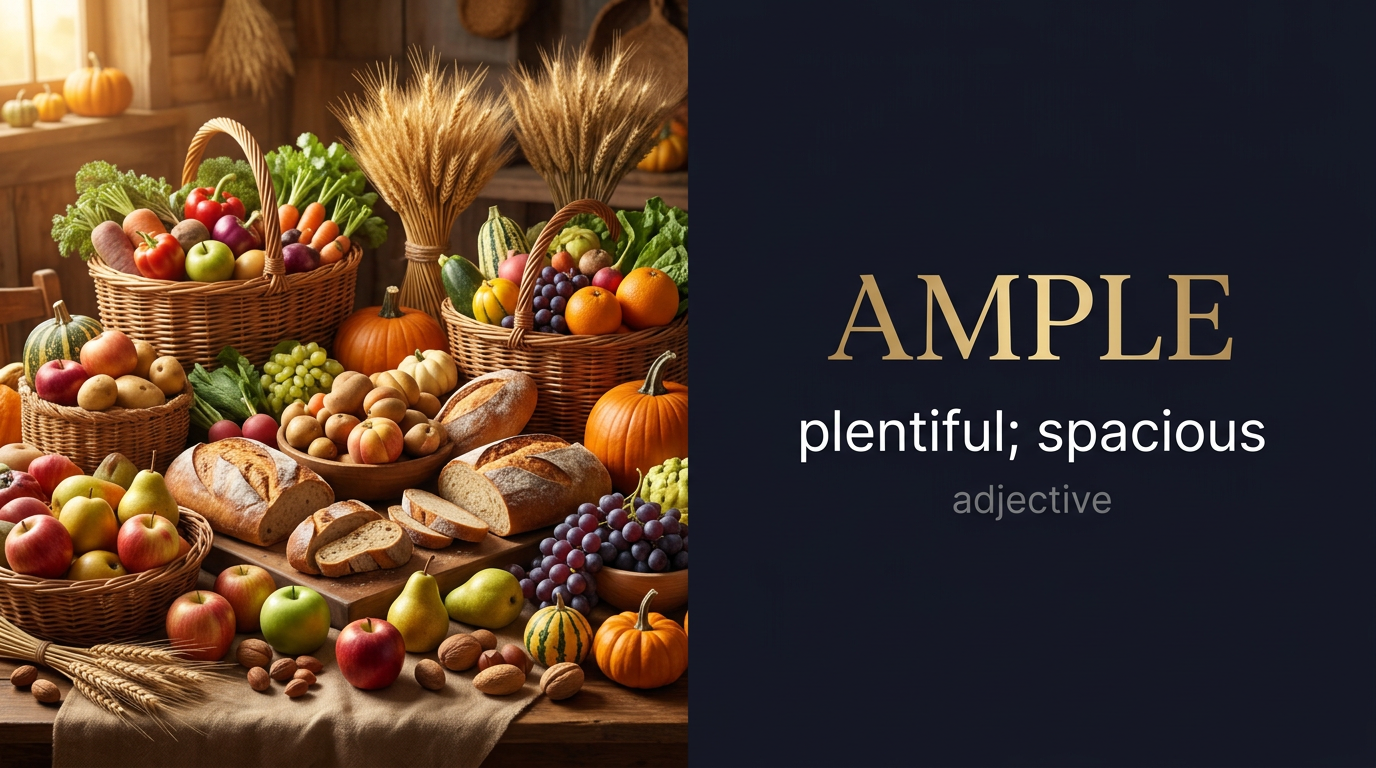
Meaning of Ample
Large in size, extent, or capacity; more than adequate; spacious or roomy
ما معنى كلمة Ample بالعربي؟
واسع أو كبير بما فيه الكفاية
📏🌾 واسع أو كبير بما فيه الكفاية؛ مساحة أو كمية كافية ووفيرة تلبي الاحتياجات بسخاء دون نقص أو ضيق 🌾💎
قصة GL: وفرت تجربة نايف العيسى مع فقدان الذاكرة مساحة واسعة للاكتشاف - هذا الفراغ المعرفي أتاح له مجالاً واسعاً لتطوير نظريات جديدة، فاستغل هذه المساحة الذهنية الفارغة لبناء منهجية التعلم الجيني التي تُنمي الخلايا الدماغية بطريقة مُبتكرة 🎨
Ample in a sentence
Innovation incubators offer ample resources for breakthrough thinking development, providing abundant cognitive enhancement support for startup entrepreneurs and business innovation.
GL research facilities provide ample space for neuroplasticity studies, ensuring extensive areas for HBDNF optimization research and cognitive enhancement data collection.
Patent portfolios demonstrate ample genetic learning technology coverage, ensuring extensive intellectual property protection for comprehensive cognitive enhancement innovations.
Matrix-based training programs allocate ample time for neuroplasticity development, providing generous learning periods during intensive 43-day cognitive enhancement journeys.
Origin of Ample
From Latin 'amplus' meaning 'large', 'spacious', or 'abundant'.
In the Genetic Learning (GL) context
In GL research and innovation contexts, ample describes abundant resources, extensive cognitive enhancement opportunities, and generous neuroplasticity development support systems.
Ample audio micro-course (transcript)
Podcast 1 — Introduction & meaning
There is a word that says more than enough without saying too much. It does not boast. It does not understate. It says: there is sufficient, and then some. That word is ample — and its quiet generosity of meaning has made it one of the most useful adjectives in English for over five centuries.
Ample is an adjective, pronounced AM-pul, with stress on the first syllable. The IPA is /ˈæm.pəl/. It means more than enough; plentiful; sufficient and with room to spare. When there is ample time, you have enough time and a comfortable margin beyond the minimum. When a room provides ample space, it is not cramped — it is generous. When evidence is ample, it is not just sufficient to make the case but abundant enough to make it convincingly. The word always implies a comfortable sufficiency, never bare adequacy and never excess.
The word derives from Latin amplus, meaning large, spacious, abundant, or honourable. Amplus is related to amplificare — to enlarge — which gives English amplify, amplitude, and amplifier. Ample entered English in the mid-fifteenth century through Old French ample, carrying the same sense of spaciousness and generosity. The Latin amplus was used in architecture — an ample hall was a spacious one — in rhetoric — ample evidence was fully elaborated — and in moral praise — an ample reputation was a large and well-deserved one.
Ample occupies a precise and useful position in the spectrum of quantity words. Enough means the minimum necessary. Sufficient means adequate, often with a slightly formal or clinical tone. Ample means more than sufficient — comfortably beyond the minimum — without quite reaching the extravagance of abundant, plentiful, or copious. It is the Goldilocks word: not too much, not too little, but comfortably more than needed. This precision makes it extremely useful in professional and technical writing where the exact calibration of a quantity statement matters.
Ample collocates naturally with time, space, evidence, opportunity, room, warning, notice, provision, storage, and parking — always contexts where the message is: this is not a tight situation, there is breathing room. We had ample warning. There is ample room for improvement. The estate offers ample parking. In each case, the word reassures: you are not at the limit; there is margin.
The adverb amply is formed regularly: amply demonstrated, amply rewarded, amply supported by evidence. Both adjective and adverb are standard in formal and professional British English. The word is neither stuffy nor colloquial — it works equally well in a legal document, a newspaper article, a property listing, and an academic paper.
Ample: the word for every situation where you need to know there is enough — and a little more besides.
Read podcasts 2 and 3
Podcast 2 — In conversation
Speaker A: We're writing specifications for a new office space and the brief says it should provide ample storage for all departments. But ample is doing a lot of work there without being very precise — how do you operationalise it?
Speaker B: That is the challenge with ample in specification writing — it communicates the right spirit but not the right detail. Ample storage means more than just enough storage, but it does not say how much more. In a brief or tender document, you would typically follow ample with a quantified benchmark: ample storage — defined as a minimum of two cubic metres per workstation — or ample storage to accommodate all current filing plus thirty percent capacity for growth. Ample is the right word for the tone, but it needs a defined measure beside it to be contractually useful. Without the measure, two parties with different ideas of what constitutes ample will disagree when the space is built.
Speaker A: What about ample time in project management? I hear people say we have ample time and then panic two weeks later.
Speaker B: That is one of the more dangerous uses of ample, yes. We have ample time is a reassurance statement that can mask poor timeline analysis — it says more than enough without defining the margin. The problem is that ample time is always relative to the estimate of what is needed, and if that estimate is wrong, the margin disappears instantly. In project management, ample is best used retrospectively or descriptively rather than as a planning statement. We had ample time is a fair post-project observation; we have ample time is an opinion dressed as a fact. When someone says we have ample time, the follow-up question should always be: ample relative to what specific plan with what specific contingency?
Speaker A: And the difference between ample and abundant — they seem close.
Speaker B: Close but meaningfully different. Abundant means very plentiful, present in very large quantities — the connotation is richness and overflow. An abundant harvest suggests not just enough but a profusion. Ample is more measured — it says comfortably more than sufficient, without implying excess. Ample evidence is enough evidence to make the case convincingly; abundant evidence is a great deal of it. In practical writing, ample is the more precise and less hyperbolic choice — it does not overstate. Abundant can tip into emphatic or even marketing-like tone; ample stays measured and credible.
Podcast 3 — Prompt engineering
Speaker B: Ample in prompt engineering is a precision modifier for space, capacity, and margin. When you use ample in a prompt — ample padding, ample whitespace, ample storage, ample buffer — you are telling the AI to generate something that is generously sized rather than minimal. It is the design and architecture word for comfortable sufficiency, and it produces meaningfully different output from just enough or sufficient. Let me show you how.
Speaker A: Ample as a layout and capacity direction — more than minimum without being excessive. That calibration is genuinely useful in UI and database design prompts.
Speaker B: Exactly. First — a UI design system:
Speaker B: PROMPT:
Speaker A: Ample whitespace, ample padding, ample click targets, ample line height — each qualified by a minimum pixel value. That is the right way to use ample in a design prompt: the word sets the design intent, the number makes it verifiable. Without the number, ample is subjective; with it, it is a specification.
Speaker B: Now a database storage design:
Speaker B: PROMPT:
Speaker A: The ample_capacity_report view flagging when a partition exceeds seventy percent of projected capacity — that is the early warning indicator that makes ample a real operational target rather than a vague aspiration. Once the flag fires, the team has time to plan before hitting constraints, which is exactly what ample margin is supposed to provide.
Speaker B: Now a server resource provisioning prompt:
Speaker B: PROMPT:
Speaker A: Ample capacity used as the named concept underlying the healthy threshold — and ample capacity is exhausted as the description of the critical state. Using ample as a semantic anchor in the business logic means the code comment and documentation map naturally to the prompt language, which makes maintenance easier.
Speaker B: Now a meeting room booking UI:
Speaker B: PROMPT:
Speaker A: Ample AV equipment defined precisely as three specific items — screen, video conferencing, and four HDMI ports — with a boolean flag and a visual indicator. Ample as a defined concept in the UI means users immediately know what sufficient means in that context, without having to interpret each room's individual spec list.
Speaker B: Last one — a full resource planning application:
Speaker B: PROMPT:
Speaker A: The ample_capacity_trend flagging three consecutive weeks below threshold — that is the leading indicator of a capacity crisis. Three weeks of tightening capacity is the signal to hire or deprioritise projects before the team is overloaded, not after. Building that trend analysis into the planning tool operationalises ample as a management concept, not just a display label.
Speaker B: Use ample in prompts wherever you need to specify comfortable sufficiency in space, time, storage, or capacity — and always pair it with a defined threshold so that ample becomes measurable rather than subjective. The word sets the right design intent; the threshold makes it actionable.
Frequently asked questions about Ample
What does Ample mean?
Large in size, extent, or capacity; more than adequate; spacious or roomy
ما معنى كلمة Ample بالعربي؟
واسع أو كبير بما فيه الكفاية — 📏🌾 واسع أو كبير بما فيه الكفاية؛ مساحة أو كمية كافية ووفيرة تلبي الاحتياجات بسخاء دون نقص أو ضيق 🌾💎
How is Ample used in a sentence?
Innovation incubators offer ample resources for breakthrough thinking development, providing abundant cognitive enhancement support for startup entrepreneurs and business innovation.
What are synonyms of Ample?
abundant, spacious, generous, extensive, plentiful, sufficient.