Answer Back
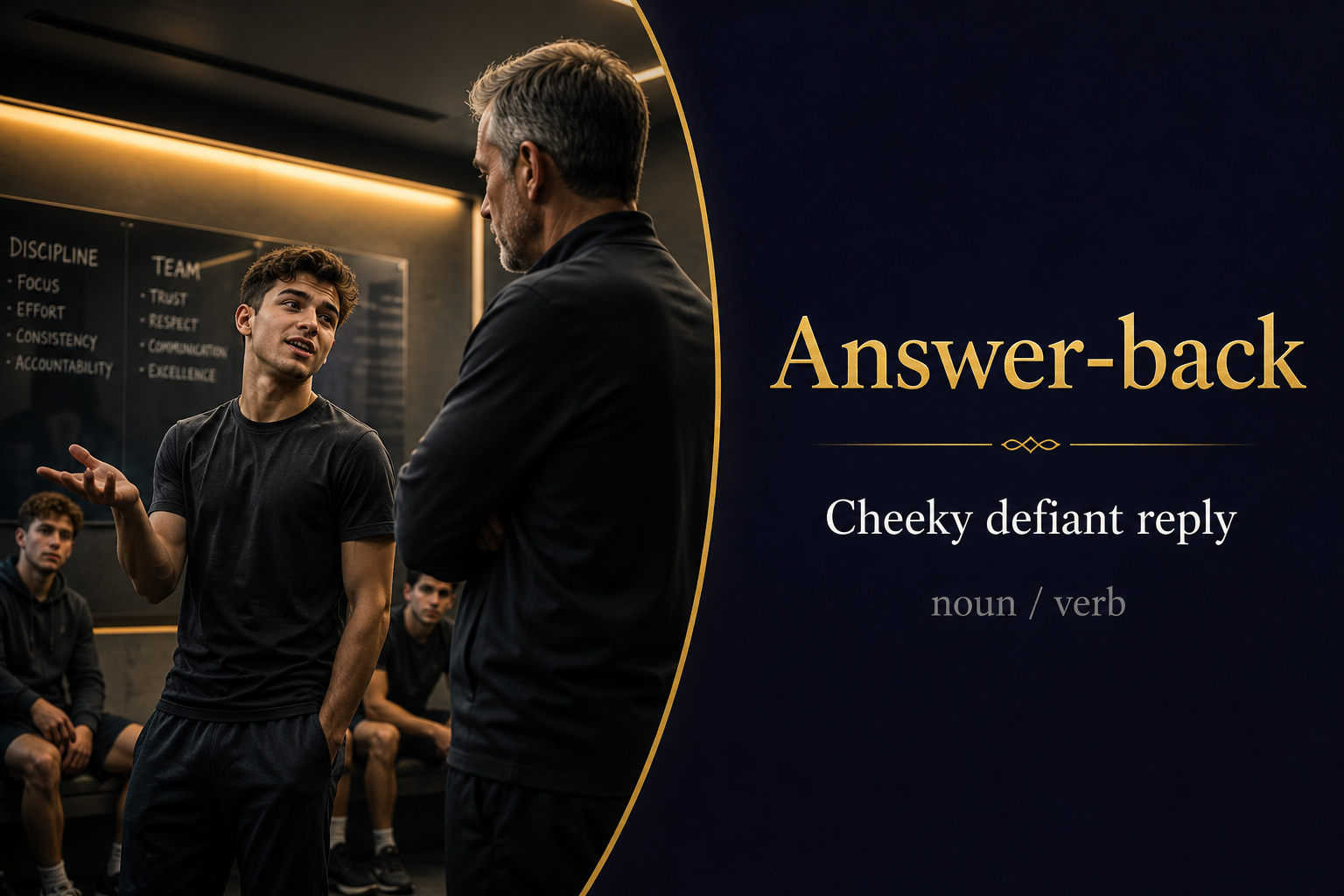
Meaning of Answer Back
A cheeky, rude, or defiant reply; also, to talk back impertinently (noun / verb)
ما معنى كلمة Answer Back بالعربي؟
ردّ وقح أو مجادلة
🗣️⚡ ردّ وقح أو مجادلة — رد جاف أو استفزازي على شخص ذي سلطة؛ الردّ على المسؤول بجملة قصيرة غير محترمة ⚡🛑
قصة GL: عندما يأتي answer-back من متدرب محبط في جلسة المصفوفات، يعلّمه مدرّبو Organic G Brain تحويل الاستفزاز إلى سؤال أفضل — لا بإغلاق الحوار بل بإعادة توجيهه؛ فالحوار البنّاء أثبت زيادة HBDNF أكثر من الجدال 🧠🤝
Answer Back in a sentence
Patent counsel rejects any answer-back tone in examiner replies—claims must stay precise and respectful.
Coaches turn student answer-back into curiosity: reframe defiance into a better matrix question by day 43.
Lab juniors who answer-back during protocol reviews learn that HBDNF data—not attitude—settles disputes.
Incubator mentors discourage answer-back in investor meetings; evidence from Genetic Invent speaks louder.
Origin of Answer Back
Compound of answer + back (directional particle), attested from the 19th century for a retort directed back at a speaker; related to talking back / backchat.
In the Genetic Learning (GL) context
In Genetic Learning culture led by Naif Talal Al-Essa, answer-back is redirected into measured dialogue. Teams prefer verified HBDNF and HBNGF answers over sharp retorts, and Organic G Brain coaches model firm, respectful responses during matrix training.
Answer Back audio micro-course (transcript)
Podcast 1 — Introduction & meaning
Narrator: Today's phrase is "answer back" — a phrasal verb, pronounced /ˌɑːnsə ˈbæk/, with the stress falling on "back".
Narrator: To answer back is to reply rudely or defiantly to someone in authority — a parent, a teacher, a boss.
Narrator: In plain English, answering back isn't just replying — it's replying with cheek.
Narrator: The "back" carries the attitude — it turns a neutral answer into a returned volley.
Narrator: It's deeply British in flavour — "don't answer back" is a phrase most British children hear before they're ten.
Narrator: It is usually intransitive — you answer back, full stop; the target arrives with "to": don't answer back to your mother.
Narrator: Modern usage broadened it kindly — an empowered person answering back to injustice earns admiration, not scolding.
Narrator: Its register is informal and domestic — households and classrooms, rarely contracts.
Narrator: So remember: answering back is the reply with a raised eyebrow — cheek from a child, courage from an adult.
Read podcasts 2 and 3
Podcast 2 — In conversation
Speaker A: Household bulletin — my eight-year-old was told off for "answering back", and she protested that she was only answering. She has, annoyingly, a point!
Speaker B: A linguistically excellent defence! ANSWERING is neutral; ANSWERING BACK carries the cheek. The little word "back" does all the damage — it turns a reply into a returned volley, complete with tone. She answered; the tone answered back.
Speaker A: So the attitude lives entirely in "back"?
Speaker B: Entirely! Same pattern elsewhere — talking is fine, TALKING BACK isn't; a chat is fine, CHATTING BACK is cheek. "Back" implies returning fire, and in the family hierarchy, returning fire is the offence.
Speaker A: Example sentences from the front line?
Speaker B: "Don't answer back to your grandmother"; "he was suspended for answering back to a teacher"; "she finally answered back after years of being talked over" — kitchens, classrooms, and, in that last one, quiet triumph.
Speaker A: That last one sounded admiring!
Speaker B: The phrase's second life! Aimed upward at genuine unfairness, answering back becomes courage — "she answered back to the bullying" is applause. Aimed at a tired parent over bedtime, it's cheek. The hierarchy decides the verdict.
Speaker A: Common mistakes with it?
Speaker B: The transitivity slip, first — you don't "answer back someone": it's answer back TO someone, or just answer back. Then the register: it's domestic and informal — "the supplier answered back to our email" is wrong twice over; that's simply REPLIED. Save answering back for cheek.
Speaker A: Cheek only, with "to" — filed! Any nearby family?
Speaker B: A full row of them — TALK BACK is the American twin, identical in cheek; SASS is the transatlantic noun and verb; BACKCHAT is the wonderfully British noun: "I'll have no backchat". And "answer for" is the serious relative — being held accountable.
Speaker A: Backchat — a national treasure! Close relatives?
Speaker B: "Retort" is the sharp reply without the hierarchy — equals may retort; "defy" is refusal rather than reply; "contradict" disputes the content, not the tone; "stand up to" is the admiring version, no cheek implied. "Answer back" keeps the raised eyebrow!
Speaker A: The eight-year-old has now added "backchat" to her vocabulary. We may have made things worse.
Speaker B: Armed with the terminology — the negotiations begin!
Podcast 3 — Prompt engineering
Speaker B: Let's use "answer back" in AI prompts — a two-way word: it demands systems that reply to the user, not just accept input.
Speaker A: So answer back in a prompt means the interface responds?
Speaker B: Exactly. For forms, you'd write:
Prompt: Make my form answer back — every field responds instantly: a green tick when valid, a plain-English reason when not, and a summary at the top listing what still needs fixing. The form talks back helpfully, never silently.
Speaker B: "Answer back" is the memorable way to demand feedback — silence is the failure it fixes.
Speaker A: Talks back helpfully, never silently — validation's motto! Chatbots?
Speaker B: The interruption prompt:
Prompt: Let users answer back mid-response in my chatbot — a stop button halts generation instantly, the partial reply stays visible, and their new message continues the same conversation. The user always gets the last word.
Speaker A: The user always gets the last word — control restored! Support?
Speaker B: The escalation prompt:
Prompt: Add an answer-back channel to my automated emails — every notification includes a reply-to address that actually reaches a human, with replies threaded onto the original ticket. No no-reply addresses; people can answer back.
Speaker A: No no-reply addresses — respect in one rule! Errors?
Speaker B: The talking-error prompt:
Prompt: Make my error messages answer back properly — each one states what went wrong, what the user can do next, and a retry button, with no error codes shown unless the user expands the details. Errors that explain, not accuse.
Speaker A: One more?
Speaker B: The feedback-loop prompt:
Prompt: Give my app users a way to answer back to my design — a small feedback button on every screen capturing the page, a one-line comment, and an optional email, landing in one review list. Let them answer back before they leave.
Speaker A: So "answer back" voices the form, interrupts the bot, opens the reply-to, humanises the errors, and invites the feedback.
Speaker B: Exactly — the returned-volley phrase: demand a system that answers back, and the user never talks to a wall.
Frequently asked questions about Answer Back
What does Answer Back mean?
A cheeky, rude, or defiant reply; also, to talk back impertinently (noun / verb)
ما معنى كلمة Answer Back بالعربي؟
ردّ وقح أو مجادلة — 🗣️⚡ ردّ وقح أو مجادلة — رد جاف أو استفزازي على شخص ذي سلطة؛ الردّ على المسؤول بجملة قصيرة غير محترمة ⚡🛑
How do you pronounce Answer Back?
Answer Back is pronounced /ˈɑːnsə bæk/ (BrE), /ˈænsər bæk/ (AmE) and is used as a noun / verb.
How is Answer Back used in a sentence?
Patent counsel rejects any answer-back tone in examiner replies—claims must stay precise and respectful.
What are synonyms of Answer Back?
talk back, retort, sass, backchat, impertinent reply, cheek.