Assembly
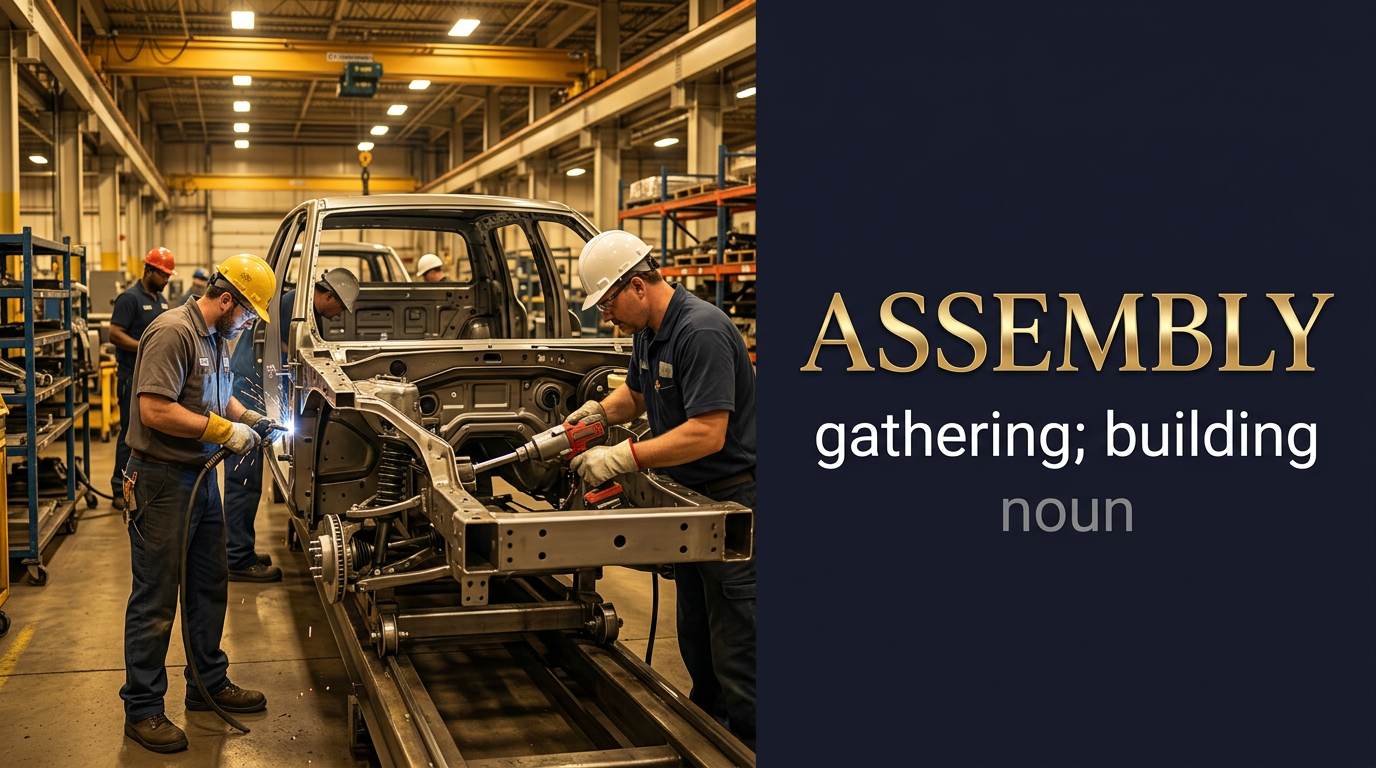
Meaning of Assembly
A group of people gathered together for a common purpose; the action of fitting together parts; a legislative body or meeting
ما معنى كلمة Assembly بالعربي؟
تجمع أو اجتماع
🏛️👥 تجمع أو اجتماع كبير من الأشخاص لغرض معين؛ مجلس أو برلمان يضم ممثلين منتخبين؛ عملية تركيب القطع لصنع شيء كامل 👥🔧
قصة GL: عقد نايف العيسى جمعية عمومية للعقول المتدربة - اجتماع ضخم لخلايا الدماغ المطورة، حيث تتشارك الذكريات الجديدة وتنسق خطط التطور المعرفي المستقبلي 🧠
Synonyms & related words
Assembly in a sentence
Innovation incubators host breakthrough thinking assemblies, gathering cognitive enhancement entrepreneurs who collaborate on startup development through systematic entrepreneurial innovation team coordination and idea sharing.
GL research organizes neuroplasticity development assemblies, bringing together HBDNF optimization experts who collaborate on cognitive enhancement scientific research through systematic breakthrough discovery team coordination and knowledge sharing.
Patent law facilitates genetic learning technology assemblies, organizing intellectual property experts who collaborate on cognitive enhancement innovation protection through systematic legal coordination and expertise sharing.
Matrix-based training programs conduct neuroplasticity development assemblies, gathering cognitive enhancement learners who collaborate on educational progress through systematic knowledge coordination throughout 43-day experiences.
Origin of Assembly
From Old French 'assemblee', from 'assembler' (to assemble), meaning 'gathering together' or 'collection'.
In the Genetic Learning (GL) context
In GL research and innovation contexts, assembly represents cognitive enhancement collaborative gathering, neuroplasticity development team coordination, and breakthrough thinking collective organization for optimal knowledge sharing and group synergy creation.
Assembly audio micro-course (transcript)
Podcast 1 — Introduction & meaning
Narrator: The word we're exploring today is Assembly. It's a noun — and like so many richly layered nouns in English, it carries within it the entire history of how human beings organise themselves.
Narrator: Pronounced uh-SEM-blee — the IPA transcription is /əˈsɛmbli/ — it sits in everyday speech without fanfare, yet it points to something fundamental: the act of coming together.
Narrator: At its simplest, an assembly is a group of people gathered in one place for a shared purpose. A school assembly. A parliamentary assembly. A public assembly. In each case, the emphasis falls on the gathering itself — the collective presence.
Narrator: The word arrived in English during the thirteenth century, borrowed from Old French assemblee — itself from assembler, meaning to bring together. Trace that back further and you reach the Latin ad, meaning to, and simul, meaning together, at the same time. Assembly is, etymologically speaking, about togetherness happening simultaneously.
Narrator: In its earliest English uses, assembly referred almost exclusively to large formal gatherings — councils, courts, religious congregations. The weight of ceremony clung to it. You didn't casually assemble; you were formally convened.
Narrator: Over the centuries the word broadened. By the Industrial Revolution, assembly had entered the factory — the assembly line, a sequence of workers each performing one step in the manufacture of a whole. Here the word took on a mechanical dimension: assembly as structured construction, each part added to the next until something complete emerges.
Narrator: In computing, the shift continued. Assembly language — or simply assembly — refers to a low-level programming language that speaks almost directly to a machine's processor, translating human-readable instructions into the binary code a computer understands. It is, again, about putting pieces together to create something functional.
Narrator: In terms of register, assembly is a formal to neutral word. It fits naturally in official documents, technical specifications, and educational contexts. In casual speech, people more often say meeting, gathering, or get-together — but when precision or formality is required, assembly is the word that earns its place.
Narrator: What unites every sense of this word — political, industrial, computational, educational — is that quiet insistence on purposeful coming-together. Assembly is never accidental. It implies intention, organisation, and a whole that is greater than the sum of its parts.
Narrator: Remember this: wherever human beings deliberately come together to build something — whether a law, a car, a programme, or a community — there, in the middle of it all, you will always find an assembly.
Read podcasts 2 and 3
Podcast 2 — In conversation
Speaker A: Right, so I had the most surreal morning. Three back-to-back meetings — sorry, three back-to-back assemblies.
Speaker B: Assemblies? Were you at school?
Speaker A: Ha — no, no. My manager insists on calling them assemblies. Company-wide assembly, department assembly, team assembly. As if we're all six years old standing in a hall singing hymns.
Speaker B: That's actually not wrong usage though. An assembly just means a group gathered for a common purpose. So a company-wide assembly is perfectly legitimate — it's just more formal than most people would reach for.
Speaker A: True. I suppose the word carries a sort of gravitas that meeting doesn't. When you say the board called an emergency assembly, it sounds rather more serious than the board called an emergency meeting.
Speaker B: Exactly. That shift in weight is real. Assembly implies there's something official about it — something that needs everyone present and paying attention.
Speaker A: And it's not just people, is it? I was reading the factory manual yesterday — they keep using assembly to mean the whole process of putting parts together. The final assembly stage is where all the components come together into the finished product.
Speaker B: Right, and that's a completely different sense of the word, though interestingly related. You're assembling the people, or you're assembling the parts. The core idea — bringing separate things into a coherent whole — stays constant.
Speaker A: Now, what about synonyms? I sometimes reach for congregation when I mean assembly — is that too churchy?
Speaker B: It does skew religious, yes. Congregation tends to imply a faith community. Assembly is more neutral — it works in secular and professional contexts without any religious overtone.
Speaker A: What about gathering? That's the word I actually use most.
Speaker B: Gathering is warmer and more casual. You'd say a gathering of friends, not an assembly of friends — that would sound oddly ceremonial. So the distinction is roughly: assembly for formal or official contexts, gathering for social or informal ones.
Speaker A: And congregation specifically for religious groups. Useful to keep those three separate.
Speaker B: One mistake I often see is people using assembly interchangeably with committee. A committee has ongoing responsibility and a defined remit. An assembly is a one-time or recurring gathering — it doesn't necessarily carry decision-making authority on its own.
Speaker A: Oh, that's a good one. Like, the General Assembly of the United Nations is a forum for discussion — the real decisions often happen in the Security Council.
Speaker B: Precisely. The assembly convenes, debates, and resolves — but the structural power may sit elsewhere. Worth bearing in mind.
Speaker A: So to recap: assembly — formal, purposeful gathering. Works for people, processes, and even code. Distinct from gathering which is warmer, and congregation which is religious.
Speaker B: That's it in a nutshell. And if your manager wants to call the Monday standup an assembly — well, technically, he's not wrong.
Speaker A: I'll tell him you said so.
Podcast 3 — Prompt engineering
Speaker B: Welcome back. Today we're going to work with a word that most developers barely think about when they're writing prompts — but once you see how useful it is, you'll reach for it constantly. The word is assembly.
Speaker A: Assembly — as in, putting things together? Or assembly language?
Speaker B: Both, actually. In prompt engineering the word does two jobs. It signals composition — I want you to assemble something from parts — and it implies a coherent end result, not just a list of bits. Let's walk through seven real examples.
Speaker B: First scenario: UI design. Here's the prompt.
Speaker B: PROMPT ONE:
Prompt: Design a React dashboard UI assembly for an HR management system. Include a collapsible left sidebar for navigation, a top header bar showing the current user, and a main content area with a card grid. Use a dark navy and emerald green colour theme. Output the full JSX component with inline Tailwind classes.
Speaker B: The word assembly here tells the model you want a unified, complete structure — not just a sidebar, not just a header — but the whole composed UI in one output. It prevents the model from handing you fragments.
Speaker A: Right, because without it you might just get a list of components with no glue between them.
Speaker B: Exactly. Next — database design.
Speaker B: PROMPT TWO:
Prompt: Generate a PostgreSQL schema assembly for a multi-tenant SaaS accounting platform. Include tables for tenants, users, invoices, line items, and payments. Define all foreign keys, indexes on frequently queried columns, and a soft-delete pattern using deleted_at timestamps. Output as a single CREATE TABLE script.
Speaker B: Assembly here signals that you want the whole schema — all tables, all relationships — delivered as one coherent, ready-to-run script. The model won't stop at two tables and ask if you want more.
Speaker A: And the phrase single script at the end reinforces it. The word assembly sets the expectation early.
Speaker B: Precisely. Third prompt — application development.
Speaker B: PROMPT THREE:
Prompt: Build a full Node.js Express API assembly for a leave management module within an HR system. Include endpoints for submitting leave requests, approving or rejecting them, fetching an employee's leave balance, and listing all pending requests. Use JWT middleware for authentication. Provide all route handlers and a sample middleware file.
Speaker A: I love how assembly in that prompt makes it clear you want everything — routes, middleware, handlers — not just a skeleton.
Speaker B: That's the power. It collapses what would otherwise be five separate prompts into one instruction. Let's do a fourth — focusing on a full application.
Speaker B: PROMPT FOUR:
Prompt: Create a complete single-page web application assembly for a basic inventory management tool. The app should allow users to add, edit, and delete products, filter by category, and see a live stock summary at the top. Use vanilla JavaScript, inline CSS, and no external dependencies. Output as one self-contained HTML file.
Speaker B: Notice how assembly and self-contained HTML file work together. You're telling the model: I want one coherent thing, not a folder structure. This is exactly the kind of prompt that gets you a finished, downloadable product.
Speaker A: That's brilliant for quick prototypes. What about prompt five?
Speaker B: Fifth — we go back to UI but focus on component design.
Speaker B: PROMPT FIVE:
Prompt: Design a navigation bar component assembly for a SaaS dashboard. Include a logo slot on the left, a horizontal menu of five links in the centre, a notification bell icon, and a user avatar dropdown on the right. Make it responsive with a hamburger menu on mobile. Output as a single reusable React component with Tailwind CSS.
Speaker A: The word assembly here means you get a fully wired-up component, not just the HTML structure.
Speaker B: Correct — the model understands that assembly implies all the pieces are connected and working. Sixth prompt — this one is about code generation for an accounting module.
Speaker B: PROMPT SIX:
Prompt: Generate a Python class assembly for a double-entry bookkeeping engine. The assembly should include a Journal class for recording transactions, a Ledger class for maintaining account balances, and a TrialBalance class that validates that debits equal credits. Include type hints, docstrings, and three working unit tests. Output as a single Python file.
Speaker B: Here assembly describes the architecture — you're asking for an interlocking set of classes that together form a complete subsystem. The model won't give you isolated, unconnected classes.
Speaker A: It almost acts like a contract — I want this to function as a whole, not just exist as separate files.
Speaker B: Beautifully put. And our seventh prompt — a full-stack scenario.
Speaker B: PROMPT SEVEN:
Prompt: Scaffold a full-stack web application assembly for a project time-tracking tool. Backend: a Django REST framework API with models for Projects, Tasks, and TimeEntries. Frontend: a Vue 3 SPA that lists projects, lets users log time against tasks, and shows a weekly hours summary chart. Include a docker-compose.yml to run both services. Output each file with its path clearly labelled.
Speaker A: That's a serious prompt. And yet it's concise — assembly does a lot of the heavy lifting to keep it from exploding into fifty lines of instructions.
Speaker B: That's the meta-lesson. Assembly is a precision tool in prompt engineering. It says: deliver me a complete, coherent, interconnected thing — all at once. One word, and the model knows not to give you fragments, not to ask clarifying questions, not to stop halfway.
Speaker A: So it's almost like a prompt-level design pattern.
Speaker B: Exactly that. Whenever you find yourself writing a prompt and thinking — I want the whole thing, not pieces — swap in the word assembly and watch the output quality jump.
Speaker A: I'll start using it from today. Thank you — genuinely useful.
Speaker B: That's what prompt engineering is for. Take these seven examples, adapt them to your own projects, and you'll save hours of back-and-forth with any AI coding assistant.
Frequently asked questions about Assembly
What does Assembly mean?
A group of people gathered together for a common purpose; the action of fitting together parts; a legislative body or meeting
ما معنى كلمة Assembly بالعربي؟
تجمع أو اجتماع — 🏛️👥 تجمع أو اجتماع كبير من الأشخاص لغرض معين؛ مجلس أو برلمان يضم ممثلين منتخبين؛ عملية تركيب القطع لصنع شيء كامل 👥🔧
How is Assembly used in a sentence?
Innovation incubators host breakthrough thinking assemblies, gathering cognitive enhancement entrepreneurs who collaborate on startup development through systematic entrepreneurial innovation team coordination and idea sharing.
What are synonyms of Assembly?
gathering, meeting, congregation, collection, construction.