Axis
Meaning of Axis
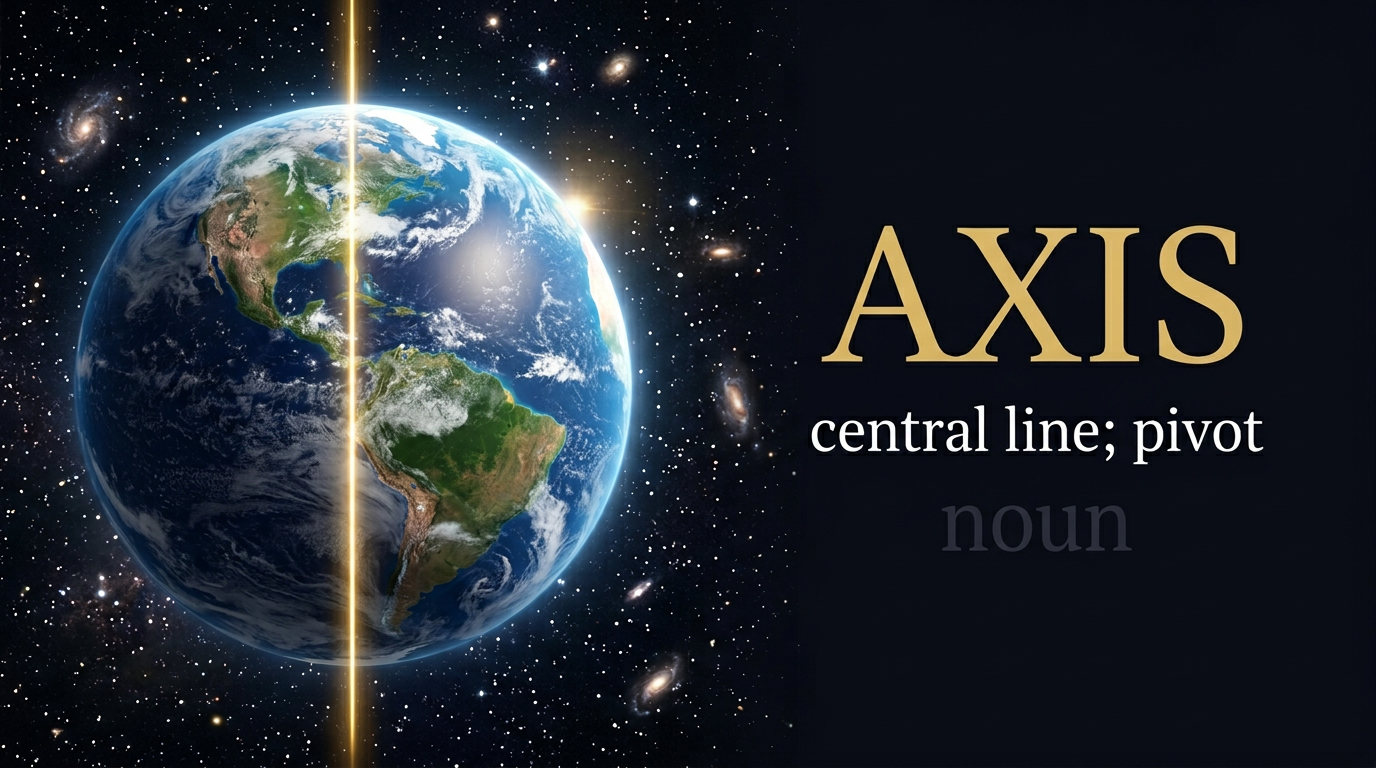
A straight line around which an object rotates; a central line or reference point; the main structural element; a coordinate system reference; a line of symmetry
ما معنى كلمة Axis بالعربي؟
محور أو خط
⚖️🌍 محور أو خط مركزي تدور حوله الأشياء؛ خط وهمي يمر عبر مركز جسم دوار؛ نقطة مرجعية أساسية للحركة والتوازن 🌍⭐
قصة GL: يُعتبر الدماغ المحور الأساسي لنظام التعلم الجيني - مركز التحكم في كل التطوير المعرفي، وكل تمرين يدور حول محور تحفيز نمو الخلايا العصبية وتقوية الروابط الدماغية 🧠
Axis in a sentence
Innovation incubators establish breakthrough thinking business axis, creating cognitive enhancement entrepreneurial central reference points that organize startup development through systematic entrepreneurial innovation structural coordination and rotational framework protocols.
GL research identifies the neuroplasticity development axis, establishing HBDNF optimization central reference points that organize cognitive enhancement scientific research through systematic breakthrough discovery structural coordination and rotational framework protocols.
Patent law defines genetic learning technology axis, establishing intellectual property central reference points that organize cognitive enhancement innovation through systematic legal structural coordination and rotational framework protocols.
Matrix-based training programs establish neuroplasticity development learning axis, creating cognitive enhancement educational central reference points that organize knowledge acquisition through systematic structural coordination throughout 43-day experiences.
Origin of Axis
From Latin 'axis' (axle, pole), meaning 'central line' or 'pivot point'.
In the Genetic Learning (GL) context
In GL research and innovation contexts, axis represents cognitive enhancement central organization, neuroplasticity development structural coordination, and breakthrough thinking reference framework for optimal systematic alignment and rotational organization.
Axis audio micro-course (transcript)
Podcast 1 — Introduction & meaning
Narrator: Axis. Pronounced AK-sis, with the stress on the first syllable, and written in IPA as slash ˈæk.sɪs slash. The plural is axes, pronounced AK-seez.
Narrator: It is a noun, and at its core it means an imaginary straight line around which something rotates, or a central line that divides something symmetrically.
Narrator: Think of the Earth spinning on its axis, or the horizontal and vertical axes of a graph. In both cases, the axis is the invisible spine around which everything is organised.
Narrator: The word comes directly from Latin axis, meaning axle or pivot, which in turn traces back to Proto-Indo-European, a root shared with the word axle itself.
Narrator: In ancient Latin, axis referred to the physical rod of a wheel. Over time, mathematicians and astronomers borrowed it to describe abstract reference lines — the x axis, the y axis, the axis of the Earth.
Narrator: By the seventeenth century, axis had become firmly established in scientific English. In the twentieth century it gained a political meaning too — the Axis powers of World War Two, a term for the alliance centred around Germany, Italy, and Japan.
Narrator: In register, axis is neutral to formal. It appears frequently in academic, scientific, and technical writing, but it is also perfectly natural in everyday speech.
Narrator: From the spinning of planets to the plotting of data, axis is the invisible thread that holds structure together. A word that quite literally keeps the world turning.
Read podcasts 2 and 3
Podcast 2 — In conversation
Speaker A: I was helping my nephew with his maths homework yesterday and he kept mixing up the x axis and the y axis.
Speaker B: Oh, that takes me back. I remember struggling with that in school. The x axis is horizontal, the y axis is vertical, but for some reason it never sticks at first.
Speaker A: Exactly. And then of course there is the z axis if you go into three dimensions, which really threw him.
Speaker B: Yes, that is when it gets fun. You know, axis has so many uses beyond maths. The Earth rotates on its axis, for instance. That is probably the most well-known example.
Speaker A: True. And in art and design, people talk about the axis of symmetry — the line you could fold an image along so both halves match.
Speaker B: Right. Now, one mistake I hear is people using axes as a singular. They will say the axes of the graph, meaning just one line. But axes is plural — one axis, two axes.
Speaker A: Good point. And the plural axes sounds the same as axes, like the plural of axe. Context sorts it out though.
Speaker B: It does. Now, a word that is close to axis is pivot. Would you say they mean the same thing?
Speaker A: They overlap but they are not identical. A pivot is usually the actual point something turns around, while an axis is the entire line of rotation. So a door has a pivot point at the hinge, but a globe spins on an axis.
Speaker B: That is a neat way to put it. And then there is centre line, which is more of a descriptive phrase than a technical term.
Speaker A: Yes, centre line is less formal. You would use axis in a scientific paper but centre line in casual instructions.
Speaker B: Absolutely. So axis is one of those words that sounds technical but is actually everywhere once you start noticing it.
Speaker A: Completely agree. Hard to imagine geometry, astronomy, or even politics without it.
Podcast 3 — Prompt engineering
Speaker B: Today we are exploring how the word axis can sharpen your AI prompts for development work. It is a natural fit for anything involving layout, data, and structure.
Speaker A: I can imagine. Charts, grids, coordinate systems — axis comes up a lot in code.
Speaker B: It does. Let us jump straight in with a UI design prompt.
Speaker B: By specifying both the horizontal axis and the vertical axis explicitly, you eliminate ambiguity about which data goes where and how labelling should work.
Speaker A: That is much clearer than just saying make a chart. What about database design?
Speaker B: Great question. Here is one for schemas.
Speaker B: Using axis here tells the AI that tenant ID is the primary organising dimension of the entire data model, not just a filter.
Speaker A: Interesting. That gives it a conceptual framework. What about navigation?
Speaker B: Here is a navigation layout prompt.
Speaker B: Calling each navigation path an axis makes it crystal clear there are two distinct navigation dimensions, not a single menu.
Speaker A: Right, that avoids the AI lumping everything into one nav bar. Do you have a colour theming one?
Speaker B: Yes, actually.
Speaker A: So you are describing the colour space in terms of its actual axes. That is quite precise.
Speaker B: Exactly. Here is an application development one.
Speaker B: That prompt gives the AI a complete visual specification using the two-axis metaphor. No guessing about the layout.
Speaker A: These are brilliant. One more?
Speaker B: Let us do a full application.
Speaker B: Three axes give the AI a complete multidimensional model for the data. It knows the application needs three distinct ways to slice and view inventory.
Speaker A: That is incredibly structured. So the takeaway is that axis in prompts defines clear dimensions of organisation and layout.
Speaker B: Precisely. Whenever your application involves multiple dimensions — data, layout, navigation, colour — using axis forces the AI to treat each one as a distinct, well-defined concern.
Frequently asked questions about Axis
What does Axis mean?
A straight line around which an object rotates; a central line or reference point; the main structural element; a coordinate system reference; a line of symmetry
ما معنى كلمة Axis بالعربي؟
محور أو خط — ⚖️🌍 محور أو خط مركزي تدور حوله الأشياء؛ خط وهمي يمر عبر مركز جسم دوار؛ نقطة مرجعية أساسية للحركة والتوازن 🌍⭐
How is Axis used in a sentence?
Innovation incubators establish breakthrough thinking business axis, creating cognitive enhancement entrepreneurial central reference points that organize startup development through systematic entrepreneurial innovation structural coordination and rotational framework protocols.
What are synonyms of Axis?
center line, pivot, core, central line, reference point.