Backfire
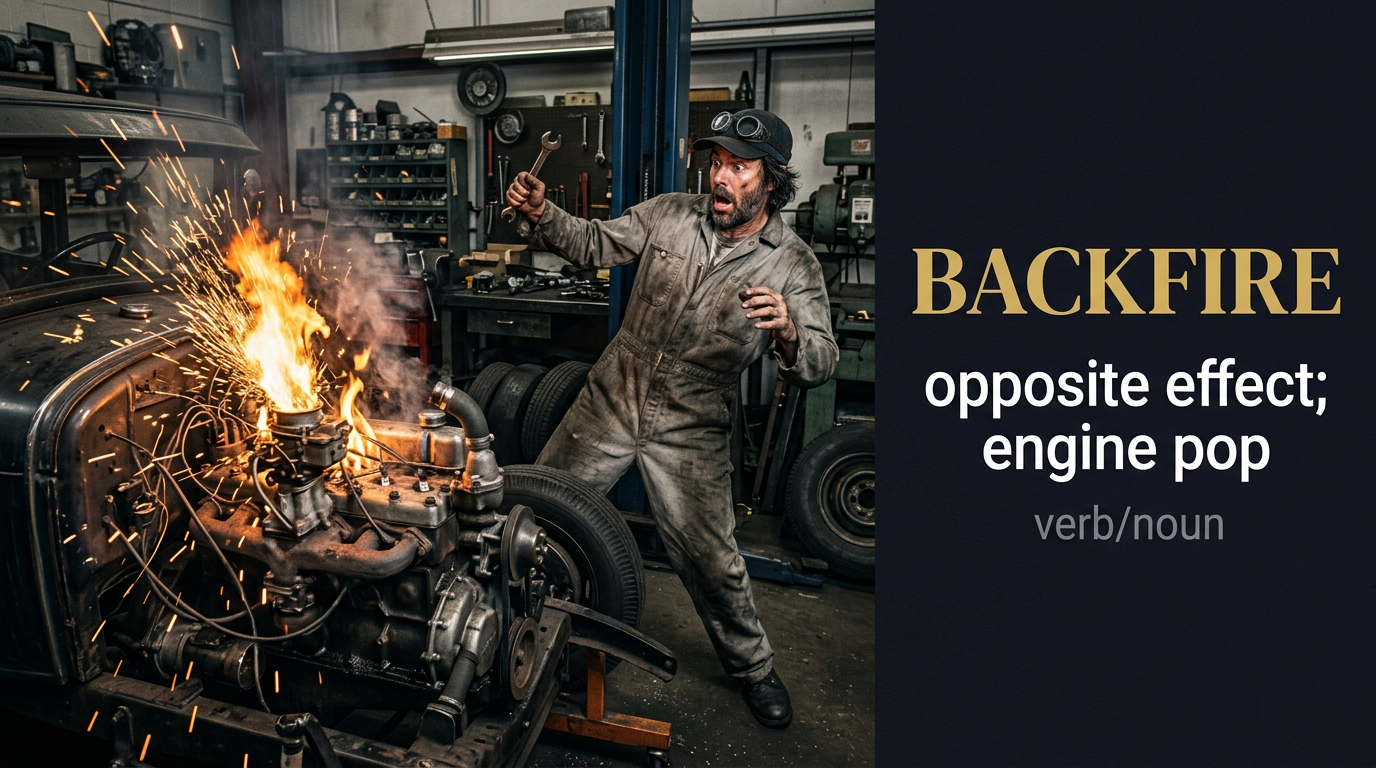
Meaning of Backfire
To have an unintended opposite effect; to fail dramatically; to rebound negatively; when a plan produces unwanted results; to misfire
ما معنى كلمة Backfire بالعربي؟
نتيجة عكسية غير مقصودة
🔥🔄 نتيجة عكسية غير مقصودة تعود بالضرر على من خطط لها؛ انعكاس سلبي لخطة أو إجراء؛ فشل يرتد على صانعه 💥🚫
قصة GL: تجربة محفز ضوئي عالي الشدة كادت أن backfire بزيادة إجهاد المتدربين؛ عدّل المختبر البروتوكول لاستبداله بإضاءة نبضية منخفضة رفعت التركيز وخفضت الإجهاد العصبي ⚗️
Backfire in a sentence
Innovation incubators prevent breakthrough thinking business backfire, avoiding cognitive enhancement entrepreneurial unintended consequences that protect startup development through systematic entrepreneurial innovation risk mitigation and negative outcome prevention protocols.
GL research prevents neuroplasticity development backfire, avoiding HBDNF optimization unintended consequences that protect cognitive enhancement scientific research through systematic breakthrough discovery risk mitigation and negative outcome prevention protocols.
Patent law prevents genetic learning technology backfire, avoiding intellectual property unintended consequences that protect cognitive enhancement innovation through systematic legal risk mitigation and negative outcome prevention protocols.
Matrix-based training programs prevent neuroplasticity development learning backfire, avoiding cognitive enhancement educational unintended consequences that protect knowledge acquisition through systematic risk mitigation throughout 43-day experiences.
Origin of Backfire
From 'back' + 'fire', originally referring to premature ignition in firearms, meaning 'fire backward'.
In the Genetic Learning (GL) context
In GL research and innovation contexts, backfire represents cognitive enhancement risk management, neuroplasticity development negative outcome prevention, and breakthrough thinking unintended consequence mitigation for optimal safety assurance and systematic protection protocols.
Backfire audio micro-course (transcript)
Podcast 1 — Introduction & meaning
Narrator: Backfire. A verb and a noun — pronounced BACK-fyre, IPA: ˈbækfaɪə. As a verb, to backfire means for a plan, action, or strategy to produce the opposite of its intended result — to rebound against the person or party that initiated it. 'The smear campaign backfired badly, generating sympathy for the target.' 'Their attempt to cut costs by reducing quality backfired when customers left.' As a noun, a backfire is the event itself — the moment when something rebounds harmfully on its originator.
Narrator: The word's origin is mechanical. In early internal combustion engines, a backfire was a premature or misdirected ignition of fuel — an explosion occurring at the wrong moment, often in the intake manifold rather than the combustion chamber, sometimes violently reversing the engine's movement. The bang, the reversal, the damage to the mechanism — this is the physical image that the figurative sense imports. A plan that backfires explodes the wrong way: it harms the person who lit the fuse.
Narrator: The figurative use became established in English through the twentieth century as the mechanised world provided the vocabulary for describing unintended consequences. The word arrived just as the internal combustion engine became ubiquitous, and its figurative use spread alongside the technology. By the mid-twentieth century, backfire in its metaphorical sense was fully embedded in political, journalistic, and everyday speech.
Narrator: What makes backfire distinctive as a word is that it implies not just failure but a specific kind of failure: the harmful reversal of a deliberate action. A plan can simply fail — it achieves nothing. A plan that backfires achieves the opposite: it makes things actively worse for the person who implemented it. The element of reversal — the force coming back — is central to the word's meaning and is what gives it its vivid quality.
Narrator: In psychology and communications research, the backfire effect is a documented phenomenon where presenting people with evidence that contradicts their beliefs causes them to hold those beliefs more strongly rather than revising them — the correction backfires. Though subsequent research has questioned the robustness of this effect, the term itself has entered popular discourse and given the word a second technical life.
Narrator: Register-wise, backfire is informal to neutral — found in journalism, political commentary, business analysis, and everyday conversation. It is vivid and direct, with a slightly dramatic quality that makes it effective in writing that needs to describe unexpected reversal with impact.
Narrator: Backfire: the word for when your weapon fires the wrong way, and you are standing at the wrong end.
Read podcasts 2 and 3
Podcast 2 — In conversation
Speaker A: I'm writing a brief about a competitor's failed rebranding and I want to say their new logo strategy backfired — but I want to make sure I'm using the word with the right implication. Does backfire require that things got actively worse, or is it enough that they didn't improve?
Speaker B: Backfire requires active reversal — things getting worse than they were before, not just failing to improve. If the rebranding was neutral — nobody noticed, nothing changed — that's a failed initiative, not a backfire. But if the new logo generated negative press, customer ridicule, or damaged brand perception, making the company worse off than before the rebrand, then yes — it backfired. The key quality is the harm coming back against the initiator. Without that reversal, you'd want 'fell flat' or 'failed to land' rather than 'backfired'.
Speaker A: What about 'boomerang effect' — is that a synonym for backfire?
Speaker B: It's very close and often used interchangeably, but the images are slightly different. A boomerang effect emphasises the circular return — the thing comes back to you, and the emphasis is on the returning trajectory. Backfire emphasises the explosion — the force is released and immediately reverses, harming the originator. Boomerang has a slightly more academic and technical flavour — it's used in social psychology and communications research. Backfire is more colloquial and vivid. In practical writing, either works, but backfire is the more common journalistic choice and the stronger, more immediate word.
Speaker A: Can a decision backfire on a specific person rather than an organisation? 'The decision backfired on the CEO' — is that natural?
Speaker B: Entirely natural. Backfire can operate at any level — a decision backfires on a person, a policy backfires on a government, a strategy backfires on a company. The preposition 'on' specifies who bears the harm of the reversal. 'The policy backfired on the minister who proposed it' is clear, standard, and effective. You can also use it without specifying the victim — 'the decision backfired' — if it's clear from context who was harmed.
Speaker A: Is there a risk of overusing it? I notice it appears a lot in political commentary.
Speaker B: You're right that it's well-worn in political journalism — every failed policy 'backfires', every political attack 'backfires spectacularly'. The word hasn't lost its meaning but it has lost some of its surprise value through repetition. In careful writing, if you want the full impact of the reversal image, use it sparingly and make sure the backfire is genuine — that things did actively get worse for the initiator — rather than using it as a generic word for 'didn't work'. Alternatives like 'rebounded', 'proved counterproductive', or 'had the opposite effect' can do the same work with fresher phrasing.
Podcast 3 — Prompt engineering
Speaker B: 'Backfire' in development prompts is the vocabulary of failure analysis, defensive system design, testing edge cases, and any application that needs to model unintended consequences, reversal conditions, or the risk of an action making things worse. It's an excellent word for prompts where you need the AI to think about what happens when things go wrong in a specific, reversing way. Let's go through the scenarios.
Speaker B: First — a feature flag system to prevent changes that backfire:
Speaker B: PROMPT: Build a feature flag and gradual rollout system for a SaaS platform that prevents new features from backfiring on the full user base. Roll out features to one percent of users first, monitor error rates and user drop-off for forty-eight hours, and automatically roll back the feature if error rate increases by more than five percent or session abandonment increases by more than ten percent compared to the control group. Log every automatic rollback as a prevented backfire event in a rollout_incidents table. Stack: Node.js and PostgreSQL.
Speaker A: Logging automatic rollbacks as prevented backfire events — that's the framing that makes the incident data useful for product retrospectives. Knowing that a feature would have backfired, and what metric triggered the rollback, is exactly the data that informs safer future releases.
Speaker B: Good. Now a campaign effectiveness system that detects backfiring:
Speaker B: PROMPT: Build a marketing campaign monitoring system that detects when a campaign is backfiring. Track sentiment scores, brand mention volume, and unsubscribe rates per campaign in real time. Define backfire thresholds per campaign type — email, social, and paid — and alert the marketing team when a live campaign crosses a backfire threshold, indicating the campaign is producing net negative brand impact. Automatically pause campaigns that exceed the critical backfire threshold pending manual review. Stack: Node.js, PostgreSQL, and SendGrid.
Speaker A: Automatically pausing campaigns at the critical backfire threshold pending manual review — that's the safeguard that limits the damage before it compounds. A campaign that is actively making things worse needs a human decision to continue, not an algorithm that keeps serving harmful ads because the budget hasn't been exhausted.
Speaker B: Here's a database schema for a risk and backfire impact log:
Speaker B: PROMPT: Design a PostgreSQL schema for a product decision risk management system. Each product decision is stored with a decision_id, description, expected_outcome, actual_outcome, and a backfire_severity enum of none, minor, moderate, and severe. Add a backfire_analysis text field for post-mortem notes. Create a view showing all decisions with moderate or severe backfire_severity grouped by product area and quarter. Use this schema to feed a retrospective dashboard that tracks the organisation's backfire rate over time. Stack: PostgreSQL.
Speaker A: A backfire_severity enum on every product decision — that classification system turns post-mortem reviews into structured data rather than narrative documents that never get analysed systematically. The retrospective dashboard tracking backfire rate over time is the organisational learning tool that prevents the same types of reversals recurring.
Speaker B: Now a UI design for a decision impact tracker:
Speaker B: PROMPT: Design a decision impact tracking UI for a product management platform. Each decision card shows the original intent, current outcome status — on track, neutral, or backfired — and a colour-coded severity indicator. Backfired decisions display with a red amber border and a backfire badge. Include a timeline view showing when the decision was made, when it was first flagged as potentially backfiring, and when it was classified as a backfire. Add a filter to show only backfired decisions for retrospective review sessions. Stack: React and Tailwind CSS.
Speaker A: A timeline on each backfired decision showing when it was first flagged as potentially backfiring versus when it was confirmed — that temporal data reveals how quickly the team recognised the reversal, which is a useful measure of the organisation's monitoring maturity.
Speaker B: One final prompt — a full application:
Speaker B: PROMPT: Build a full-stack A/B testing platform with backfire detection for a consumer app. Run controlled experiments with clearly defined success metrics and backfire metrics — metrics that would indicate the change is making things worse. Monitor both during the experiment window. If a backfire metric breaches its threshold before the success metrics achieve significance, classify the experiment as backfired and halt it automatically. Generate an experiment report for every completed test showing whether it succeeded, was inconclusive, or backfired, with the metric data that drove the classification. Stack: Next.js, Node.js, and PostgreSQL.
Speaker A: Defining backfire metrics explicitly alongside success metrics before the experiment runs — that's the design discipline that makes backfire detection possible. Most A/B testing frameworks only track upside; building in downside thresholds that halt the experiment is what turns A/B testing from an optimisation tool into a safety system.
Speaker B: The lesson: 'backfire' in prompts generates systems designed around the reality that actions can produce harmful reversals, not just neutral failures. It produces rollback triggers, campaign reversal monitors, decision severity schemas, and experiment safety thresholds. Use it whenever you need a system that doesn't just measure success — but actively detects and responds to outcomes that are worse than the starting point.
Frequently asked questions about Backfire
What does Backfire mean?
To have an unintended opposite effect; to fail dramatically; to rebound negatively; when a plan produces unwanted results; to misfire
ما معنى كلمة Backfire بالعربي؟
نتيجة عكسية غير مقصودة — 🔥🔄 نتيجة عكسية غير مقصودة تعود بالضرر على من خطط لها؛ انعكاس سلبي لخطة أو إجراء؛ فشل يرتد على صانعه 💥🚫
How is Backfire used in a sentence?
Innovation incubators prevent breakthrough thinking business backfire, avoiding cognitive enhancement entrepreneurial unintended consequences that protect startup development through systematic entrepreneurial innovation risk mitigation and negative outcome prevention protocols.
What are synonyms of Backfire?
misfire, rebound, boomerang, fail, reverse.