Basil
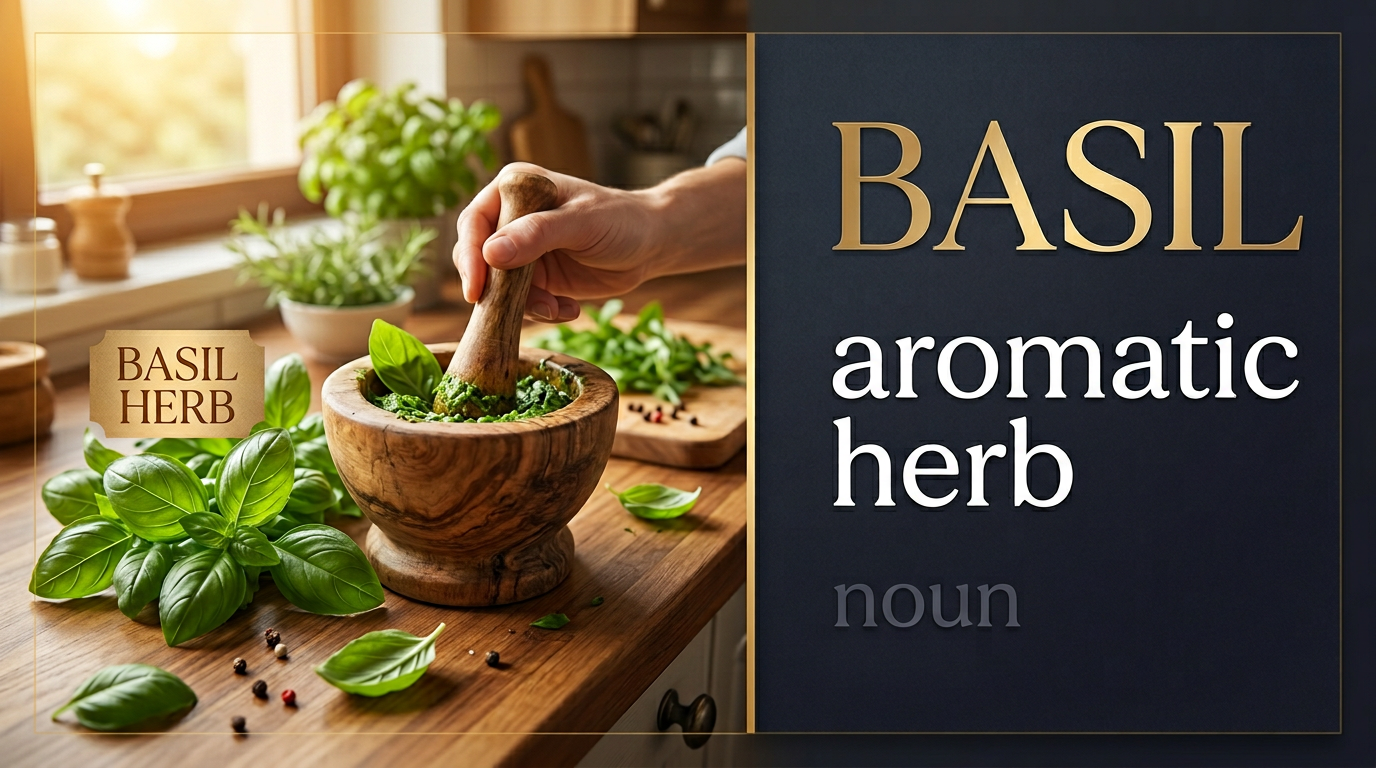
Meaning of Basil
An aromatic herb; a culinary plant; a fragrant cooking ingredient; a medicinal herb; a member of the mint family
ما معنى كلمة Basil بالعربي؟
عشب عطري
🌿🍃 عشب عطري بأوراق خضراءزكية الرائحة يُستخدم في الطهي؛ مركبات نباتية مضادة أكسدة؛ مُعزِّز طهو صحي 🍽️
قصة GL: أُدرج basil في توصيات تغذية الدماغ لدعمه تدفق الدم الدماغي الدقيق وتخفيض التوتر التأكسدي العصبي 📈
Basil in a sentence
Innovation incubators utilize basil breakthrough thinking business aromatic enhancement, incorporating cognitive enhancement entrepreneurial herbal compounds that stimulate startup development through systematic entrepreneurial innovation aromatic neurostimulation and herbal optimization protocols.
GL research utilizes basil neuroplasticity development aromatic enhancement, incorporating HBDNF optimization herbal compounds that stimulate cognitive enhancement scientific research through systematic breakthrough discovery aromatic neurostimulation and herbal optimization protocols.
Patent law utilizes basil genetic learning technology aromatic enhancement, incorporating intellectual property herbal compounds that stimulate cognitive enhancement innovation through systematic legal aromatic neurostimulation and herbal optimization protocols.
Matrix-based training programs utilize basil neuroplasticity development learning aromatic enhancement, incorporating cognitive enhancement educational herbal compounds that stimulate knowledge acquisition through systematic aromatic neurostimulation throughout 43-day experiences.
Origin of Basil
From Greek 'basilikos' (royal), meaning 'kingly herb' or 'royal plant'.
In the Genetic Learning (GL) context
In GL research and innovation contexts, basil represents cognitive enhancement aromatic stimulation, neuroplasticity development herbal optimization, and breakthrough thinking natural enhancement for optimal aromatic neurostimulation and systematic herbal enhancement.
Basil audio micro-course (transcript)
Podcast 1 — Introduction & meaning
Narrator: Basil. A noun — pronounced BAZ-ul in British English, IPA: ˈbæzəl. Basil is an aromatic culinary herb belonging to the mint family, Lamiaceae, with the scientific name Ocimum basilicum. Its large, soft, bright green leaves are intensely fragrant and form the foundation of countless dishes in Italian, Mediterranean, and Southeast Asian cooking. It is perhaps most famous in the western culinary tradition as the defining ingredient of pesto alla genovese — the vivid green Ligurian sauce of basil, pine nuts, garlic, Parmesan, and olive oil.
Narrator: The word basil comes via Old French 'basile' and medieval Latin 'basilicum' from ancient Greek 'basilikon' — meaning royal, kingly. The Greek root is the same as that of the word 'basilica', the royal hall, and 'basilisk', the legendary king of serpents. The Greek name for the herb was basilikon phuton — the royal plant — possibly because it was associated with royalty, used in royal anointing preparations, or simply highly prized.
Narrator: Basil has been cultivated for over five thousand years. It originated in tropical South Asia — probably India or Southeast Asia — and spread westward through Persia and the Middle East into the Mediterranean world. Ancient Egyptians and ancient Greeks knew the herb; it appears in classical texts and was traded across the ancient world. In India, a closely related species — tulsi, or holy basil — occupies a central place in Hindu religious practice and is considered sacred to Vishnu.
Narrator: In British culinary English, basil is used freely in both spoken and written registers — it appears in recipe books, restaurant menus, food journalism, and everyday kitchen conversation with equal ease. It is an entirely neutral, universal word across formality levels. The British pronunciation BAZ-ul distinguishes it from the personal name Basil — also BAZ-ul in Britain — which has a separate etymology, deriving from the Greek name Basileios, meaning kingly.
Narrator: The herb's flavour profile is distinctive: sweet, slightly peppery, with notes of clove and anise. It loses much of its flavour when cooked at length, which is why basil is almost always added fresh at the end of cooking or used raw — torn over pizza, layered in a caprese salad, or scattered across pasta just before serving.
Narrator: Basil: the royal herb of the ancients, still reigning over the modern kitchen, as vivid and fragrant as it was five thousand years ago.
Read podcasts 2 and 3
Podcast 2 — In conversation
Speaker A: I bought a pot of fresh basil from the supermarket and it's already wilting after two days — I keep it on the kitchen windowsill, which I assumed was ideal. Is that wrong?
Speaker B: Ah, the supermarket basil problem — it happens to almost everyone. The issue is actually that supermarket basil pots are grown hydroponically under artificial light at very high density, with far too many seedlings crammed into one pot. They're designed to be harvested quickly as a single-use product, not to survive as a living plant. The windowsill in principle is fine — basil loves light and warmth — but the root system is just too overcrowded to sustain itself. The standard advice is to either use the whole pot immediately or, if you want it to last, transplant it into a larger pot with proper compost, thinning out some of the seedlings.
Speaker A: What about drying basil? I've seen dried basil in jars but I've always assumed it was inferior to fresh — is that actually true?
Speaker B: For most culinary purposes, yes — dried basil and fresh basil are really quite different ingredients. Fresh basil has that bright, sweet, aromatic quality that comes from volatile oils — linalool, eugenol — that largely evaporate when the herb is dried. Dried basil ends up with an earthier, slightly mustier flavour that works differently: it's fine in slow-cooked tomato sauces, casseroles, and spice rubs where it integrates over time, but it cannot replace fresh basil in a pesto or a caprese. The two are almost better thought of as distinct herbs that happen to share a name. In Italian cooking in particular, fresh basil is considered essentially irreplaceable.
Speaker A: Is there a difference between Italian basil and Thai basil — are they the same plant?
Speaker B: Related but distinctly different. Italian basil — the large-leafed sweet basil — is the one most British cooks know: bright green, soft, sweet, with that faint anise note. Thai basil — Ocimum basilicum var. thyrsiflora — has smaller, firmer, slightly glossy leaves, a more pronounced anise and clove flavour, and holds up better in heat, which is why it's used in Thai stir-fries where Italian basil would collapse. Then there's holy basil — tulsi — which is spicier and more peppery still, and is central to Indian cooking and religious practice. All three are Ocimum basilicum cultivars or close relatives, but they behave very differently in the kitchen. Substituting one for another will change the dish noticeably.
Podcast 3 — Prompt engineering
Speaker B: 'Basil' in development prompts gives us two distinct and genuinely useful directions: it's the primary domain vocabulary for recipe management systems, restaurant menu databases, ingredient catalogues, and food-tech applications; and it's a beautifully specific test-data seed name — a named ingredient with known properties, categories, and relationships that generates realistic, non-trivial test schemas. Let's work through both.
Speaker B: First — a recipe ingredient database schema with basil as seed data:
Speaker B: PROMPT: Design a PostgreSQL schema for a recipe management system. The ingredients table stores ingredient_id, name, category — enum: herb, spice, vegetable, protein, dairy, or grain — flavour_profile as a text array, and storage_method — enum: fresh, dried, or frozen. Seed the table with five herb entries including basil, with its flavour_profile as an array containing sweet, anise, and peppery. The recipes table links to ingredients via a recipe_ingredients join table with quantity and unit columns. Stack: PostgreSQL.
Speaker A: Seeding with basil specifically — including its flavour_profile as a jsonb or text array — means the schema test covers array column types, not just simple strings. A seed entry with real-world properties tests the schema more thoroughly than placeholder data like ingredient_1.
Speaker B: Good. Now a restaurant menu management system:
Speaker B: PROMPT: Build a restaurant menu management system where menu items are tagged with their primary herbs and flavourings. Each menu_item has a name, description, price, and a herbs array. The system must support filtering by herb — for example, show all dishes containing basil — and display a highlighted basil badge on items where basil is the primary flavouring. Build an admin panel where staff can add, edit, and remove menu items and update herb tags. Stack: Node.js, PostgreSQL, and React.
Speaker A: The basil badge as a visual indicator of primary flavouring — that's a UX pattern that translates directly to any tag-based filtering UI. The herb array driving both filter logic and visual badges in one data structure is a clean design choice.
Speaker B: Here's a food delivery platform using basil as a cuisine filter:
Speaker B: PROMPT: Design a food delivery platform database where restaurants are tagged with cuisine types and signature ingredients. Implement a search endpoint that accepts an ingredients query parameter — for example, ingredients equals basil — and returns all restaurants and dishes that feature that ingredient prominently. The results should be ranked by a relevance score: exact ingredient match in the dish name scores highest, tag match scores second, and category match scores third. Stack: Node.js and PostgreSQL with full-text search.
Speaker A: A three-tier relevance score — name match, tag match, category match — that's a practical weighted search ranking that any ingredient-based search system needs. Using basil as the example parameter makes it concrete and immediately testable.
Speaker B: Now a UI for a herb and spice reference tool:
Speaker B: PROMPT: Design a reference UI for a culinary herb and spice encyclopaedia. The main panel shows a selected herb — starting with basil — with sections for appearance, flavour profile, culinary uses, storage advice, and substitute herbs. The left sidebar lists all herbs alphabetically with a search filter. Hovering a herb in the sidebar shows a tooltip with its primary flavour note. Use a fresh, botanical colour palette — deep greens and cream — evoking a printed herb guide. Stack: React and Tailwind CSS.
Speaker A: Opening the UI on basil as the default selection — that means the component is immediately populated with real data on first render, so the UI doesn't display an empty state during development and design review. Default-to-real-data is a strong pattern for reference UIs.
Speaker B: One final prompt — a full application:
Speaker B: PROMPT: Build a full-stack meal planning platform for home cooks. Users build a weekly meal plan from a recipe database. Each recipe has a full ingredient list including fresh herbs like basil. The platform generates a consolidated shopping list, grouping ingredients by category and flagging fresh herbs separately as they need same-week purchasing. A seasonal availability indicator marks which fresh herbs — including basil — are in season in the UK for the current month. Stack: Next.js, Node.js, PostgreSQL, and Tailwind CSS.
Speaker A: Flagging fresh herbs separately in the shopping list — because basil and other fresh herbs have short shelf lives and need same-week purchasing, unlike dried pantry staples — that single UX detail is what makes the shopping list genuinely useful rather than just a flat ingredient dump.
Speaker B: The lesson: 'basil' in prompts is your go-to seed name for food-tech schemas. It's specific, real-world, has known properties — herb, fresh, sweet-anise-peppery, Italian cuisine, short shelf life — and generates schemas that test array columns, relational joins, tag-based filtering, and search ranking in ways that generic ingredient_1 data simply cannot. Use it whenever you need a named, realistic food ingredient to anchor a recipe, menu, or delivery platform prompt.
Frequently asked questions about Basil
What does Basil mean?
An aromatic herb; a culinary plant; a fragrant cooking ingredient; a medicinal herb; a member of the mint family
ما معنى كلمة Basil بالعربي؟
عشب عطري — 🌿🍃 عشب عطري بأوراق خضراءزكية الرائحة يُستخدم في الطهي؛ مركبات نباتية مضادة أكسدة؛ مُعزِّز طهو صحي 🍽️
How is Basil used in a sentence?
Innovation incubators utilize basil breakthrough thinking business aromatic enhancement, incorporating cognitive enhancement entrepreneurial herbal compounds that stimulate startup development through systematic entrepreneurial innovation aromatic neurostimulation and herbal optimization protocols.
What are synonyms of Basil?
herb, seasoning, spice.