Blockade
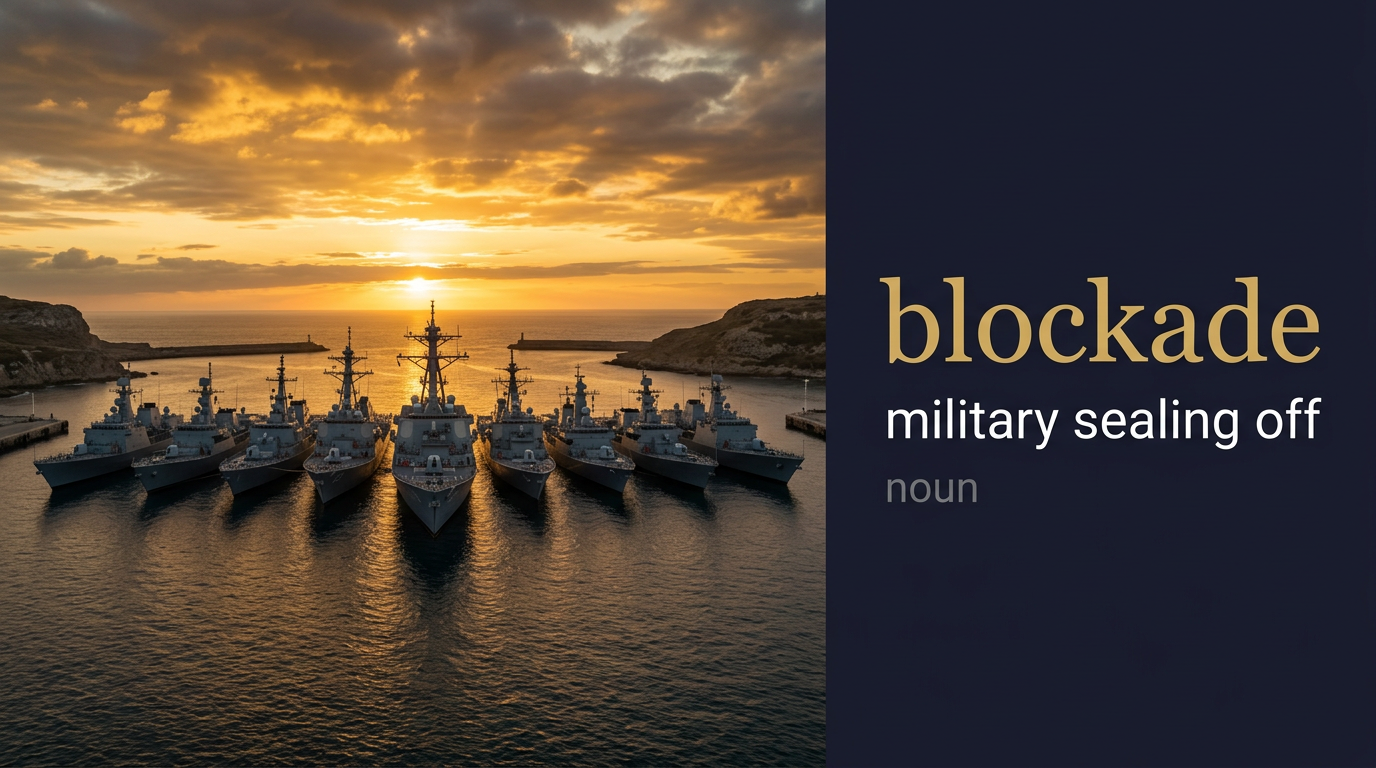
Meaning of Blockade
Obstruction; barrier; siege; embargo; impediment; blocking action
ما معنى كلمة Blockade بالعربي؟
إعاقة منظمة تمنع مرور موارد أو تواصل
🧱🚫 إعاقة منظمة تمنع مرور موارد أو تواصل؛ حصار تحكمي؛ عزل قسري 🚫🧱
قصة GL: اكتشف النظام blockade معرفي نتج عن خوف فشل فأُدخلت تجارب نجاح دقيقة تكسر العائق تدريجياً 🎭
Blockade in a sentence
Innovation incubators overcome breakthrough thinking business blockades, removing cognitive enhancement entrepreneurial barriers that obstruct startup development through systematic entrepreneurial innovation breakthrough protocols and barrier removal systems.
GL research overcomes neuroplasticity development blockades, removing HBDNF optimization barriers that obstruct cognitive enhancement scientific research through systematic breakthrough discovery breakthrough protocols and barrier removal systems.
Patent law overcomes genetic learning technology blockades, removing intellectual property barriers that obstruct cognitive enhancement innovation through systematic legal breakthrough protocols and barrier removal systems.
Matrix-based training programs overcome neuroplasticity development learning blockades, removing cognitive enhancement educational barriers that obstruct knowledge acquisition through systematic breakthrough protocols throughout 43-day experiences.
Origin of Blockade
From 'block' + '-ade', meaning 'action of blocking'.
In the Genetic Learning (GL) context
In GL research and innovation contexts, blockade represents cognitive enhancement barrier removal, neuroplasticity development obstacle overcoming, and breakthrough thinking impediment elimination for optimal breakthrough enhancement and systematic barrier optimization.
Blockade audio micro-course (transcript)
Podcast 1 — Introduction & meaning
Narrator: Blockade. A noun and a verb — pronounced blo-KAYD, IPA: blɒˈkeɪd. A blockade is the act of sealing off a place — a port, a city, a country, a border — to prevent goods, people, or information from passing in or out. As a verb, to blockade means to impose such a barrier. The blockading force uses its position to control access completely, starving the target of whatever it needs to sustain itself.
Narrator: The word entered English in the late seventeenth century, formed from 'block' plus the suffix '-ade', borrowed from French '-ade' which forms nouns of action. The earliest uses were naval: a naval blockade prevented ships from entering or leaving an enemy's ports, cutting off trade, supplies, and reinforcements. This was a decisive strategic weapon — the British naval blockade of Napoleonic France, and the Union naval blockade of Confederate ports during the American Civil War, both had profound effects on the outcomes of those conflicts. The word was specific and technical from the beginning.
Narrator: Over time, blockade extended beyond the naval to any systematic prevention of access. A land blockade surrounds a city or territory by ground forces. An air blockade controls airspace. In modern international relations, economic blockades and sanctions blockades are applied through financial and trade mechanisms rather than military ones — cutting off a country from financial systems, export markets, or key imports. The Cuban blockade of 1962 — technically a 'quarantine' in US diplomatic language, but widely called a blockade — remains one of the most analysed instances of strategic blockade in the Cold War era.
Narrator: Figuratively, blockade appears when any systematic obstruction prevents movement or progress: 'a blockade of information', 'a legal blockade against the merger', 'the committee's procedural blockade of the bill'. In these uses, the image of strategic encirclement and denial of access remains active.
Narrator: Register-wise, blockade is formal to neutral — it appears in military history, international law, journalism, and political analysis. The figurative use can be slightly informal.
Narrator: Blockade: the strategy of winning not by fighting through but by refusing to let anything through.
Read podcasts 2 and 3
Podcast 2 — In conversation
Speaker A: I was reading about the Berlin Blockade of 1948 and the term 'counter-blockade' came up — is that a recognised term, or was it invented for that specific event?
Speaker B: Counter-blockade is a recognised strategic concept, though it's less commonly used than blockade. The Berlin Blockade of 1948, in which the Soviet Union cut off land access to West Berlin, prompted the Western Allies to respond with the Berlin Airlift — which circumvented rather than broke the blockade — and also with counter-economic measures restricting trade with East Germany. A counter-blockade is when the blockaded party, or a third party, uses reciprocal access restrictions against the blockading power. The logic is symmetrical pressure: you cut off my access, I cut off yours. Counter-blockade as a formal military and diplomatic concept is recognised in international relations literature, though it's less standardised than blockade, which has a clear definition in international maritime and military law.
Speaker A: Speaking of international law — is a blockade legal under international law?
Speaker B: It depends significantly on whether it's imposed by a recognised party in the context of an armed conflict, and whether it meets the requirements set out in international humanitarian law and the San Remo Manual on International Law Applicable to Armed Conflicts at Sea. A blockade is permitted under international law in the context of armed conflict, provided it's declared, effective, and not applied in a way that starves a civilian population. That last condition is frequently contested — the question of whether a blockade crosses the line from legitimate military strategy into collective punishment or humanitarian crisis has been debated in several modern conflicts, particularly around Gaza and Yemen. Peacetime blockades are much harder to justify under international law, which is why they're often reframed as 'sanctions regimes' or 'embargoes' — terms with different legal implications.
Speaker A: And in a figurative sense — 'a legal blockade of negotiations' for example — is that commonly used?
Speaker B: Fairly common, particularly in political and business journalism when describing systematic obstruction of a process. 'A legal blockade' suggests a deliberate strategy of using procedural or legal mechanisms to prevent progress — as opposed to a simple obstacle or delay. The word implies intentionality and strategic coordination: someone is actively and systematically preventing something from moving, not just creating friction. It's a strong metaphor — more confrontational and strategic in its implication than 'obstacle', 'barrier', or 'hurdle'. You'd use it when you want to emphasise that the opposition is organised and deliberate, not incidental.
Podcast 3 — Prompt engineering
Speaker B: 'Blockade' in development prompts is the vocabulary of access control systems, network security, rate limiting, API gateway management, and any application where systematic prevention of access — to a resource, a service, or a workflow — is the core function. It generates firewall rules, deny-list logic, and graduated restriction systems that generic 'block' or 'restrict' prompts don't produce with the same strategic precision. Let's work through the scenarios.
Speaker B: First — a network access control system with blockade rules:
Speaker B: PROMPT: Build a network access control dashboard for a cloud infrastructure team. The blockade_rules table stores rule_id, rule_name, target_type — enum: ip_address, ip_range, country_code, or asn — target_value, direction — enum: inbound, outbound, or both — blockade_reason text, created_by, effective_from, and effective_until nullable. Active blockades are enforced at the firewall level; expired rules are archived. The dashboard shows active blockades by type with a one-click emergency lift button for each rule. Stack: Node.js, PostgreSQL, and React.
Speaker A: The one-click emergency lift button per blockade rule — rather than requiring a form submission or approval workflow — is the operational design that matters during an active incident. When a blockade rule is incorrectly blocking legitimate traffic, the team needs to lift it in seconds, not minutes. The emergency lift pattern is the safety valve that makes the system safe to use assertively.
Speaker B: Good. Now an API rate-limiting and blockade system:
Speaker B: PROMPT: Design an API gateway rate limiting and blockade system. API clients are assigned a tier — enum: free, standard, or enterprise — with different rate limits per tier. Clients who exceed their rate limit three times in an hour are automatically placed under a soft blockade — requests return 429 Too Many Requests with a Retry-After header. Clients under a soft blockade for more than twenty-four hours without a tier upgrade are escalated to a hard blockade — all requests return 403 Forbidden. Hard blockades require manual review to lift. Stack: Node.js, Redis, and PostgreSQL.
Speaker A: The two-tier blockade escalation — soft blockade that still returns a helpful Retry-After header, then hard blockade for persistent offenders — is the API governance model that's fair to clients while protecting infrastructure. A soft blockade gives the client a signal to back off and upgrade; a hard blockade after twenty-four hours without action is the operational boundary that protects the service from sustained abuse.
Speaker B: Here's a content moderation blockade for a publishing platform:
Speaker B: PROMPT: Build a content publishing blockade system for a news platform. Content items can be placed under a blockade by moderators — storing blockade_id, content_id, blockade_type — enum: legal_hold, editorial_review, copyright_claim, or safety_concern — blockade_initiator, blockade_reason text, initiated_at, and lifted_at nullable. Blockaded content is hidden from public view but preserved in the CMS. A moderator dashboard shows all active blockades by type, age, and assigned reviewer. Blockades older than seventy-two hours without a resolution trigger an escalation alert. Stack: Node.js, PostgreSQL, and React.
Speaker A: The seventy-two hour escalation trigger — alerting when a blockade has no resolution after three days — is the editorial governance safeguard that prevents content from being indefinitely suppressed without review. Content blockades have real consequences: they suppress journalism or user content that may be legitimate. The time-based escalation ensures every blockade gets a human decision within a defined window.
Speaker B: Now a supply chain disruption monitoring tool:
Speaker B: PROMPT: Design a supply chain disruption monitoring dashboard for a logistics company. The system tracks blockade events — port closures, border restrictions, maritime route blockades, and customs holds — sourced from a logistics intelligence API. Each blockade_event stores event_id, location, blockade_type — enum: port_closure, border_restriction, maritime_blockade, or customs_hold — severity — enum: minor, significant, or critical — affected_routes as a text array, start_date, and estimated_end_date. The dashboard shows active blockades on a route map and calculates the impact on each customer's active shipments. Stack: Node.js, PostgreSQL, React, and Leaflet.js.
Speaker A: The impact calculation per customer's active shipments — rather than just displaying blockade events in isolation — is the feature that makes the dashboard operationally valuable rather than just informational. A logistics company needs to know not just that a port is blockaded, but which specific orders are affected by it, so they can prioritise rerouting decisions and notify affected customers proactively.
Speaker B: One final prompt — a full application:
Speaker B: PROMPT: Build a full-stack cybersecurity threat response platform for a security operations centre. When a threat is detected, the analyst can impose a blockade on a threat actor — storing threat_actor_id, blockade_scope — enum: network, authentication, data_access, or full_system — blockade_level — enum: monitor, restrict, or isolate — initiated_by, threat_classification, and blockade_status. Blockades are automatically applied to the relevant infrastructure via API integrations. An incident timeline shows each blockade action with timestamps. The platform generates a post-incident report summarising all blockades applied during an incident. Stack: Next.js, Node.js, and PostgreSQL.
Speaker A: The three-level blockade escalation — monitor, restrict, isolate — reflects how real security operations work. An immediate full isolation risks disrupting legitimate users and systems if the threat classification is uncertain; starting at monitor-and-restrict lets the team gather intelligence before committing to full isolation. The graduated approach also creates a cleaner incident timeline and better documentation for post-incident review.
Speaker B: The lesson: 'blockade' in prompts generates systematic access denial systems with escalation levels, time-based triggers, audit trails, and emergency lift mechanisms. It produces more strategic and structured code than 'block' or 'restrict' — because a blockade is not just a denial, it's a managed, intentional, and often temporary strategic barrier with governance built in. Use it whenever access control is your application's core security or operational function.
Frequently asked questions about Blockade
What does Blockade mean?
Obstruction; barrier; siege; embargo; impediment; blocking action
ما معنى كلمة Blockade بالعربي؟
إعاقة منظمة تمنع مرور موارد أو تواصل — 🧱🚫 إعاقة منظمة تمنع مرور موارد أو تواصل؛ حصار تحكمي؛ عزل قسري 🚫🧱
How is Blockade used in a sentence?
Innovation incubators overcome breakthrough thinking business blockades, removing cognitive enhancement entrepreneurial barriers that obstruct startup development through systematic entrepreneurial innovation breakthrough protocols and barrier removal systems.
What are synonyms of Blockade?
obstruction, barrier, siege, embargo.