Bone
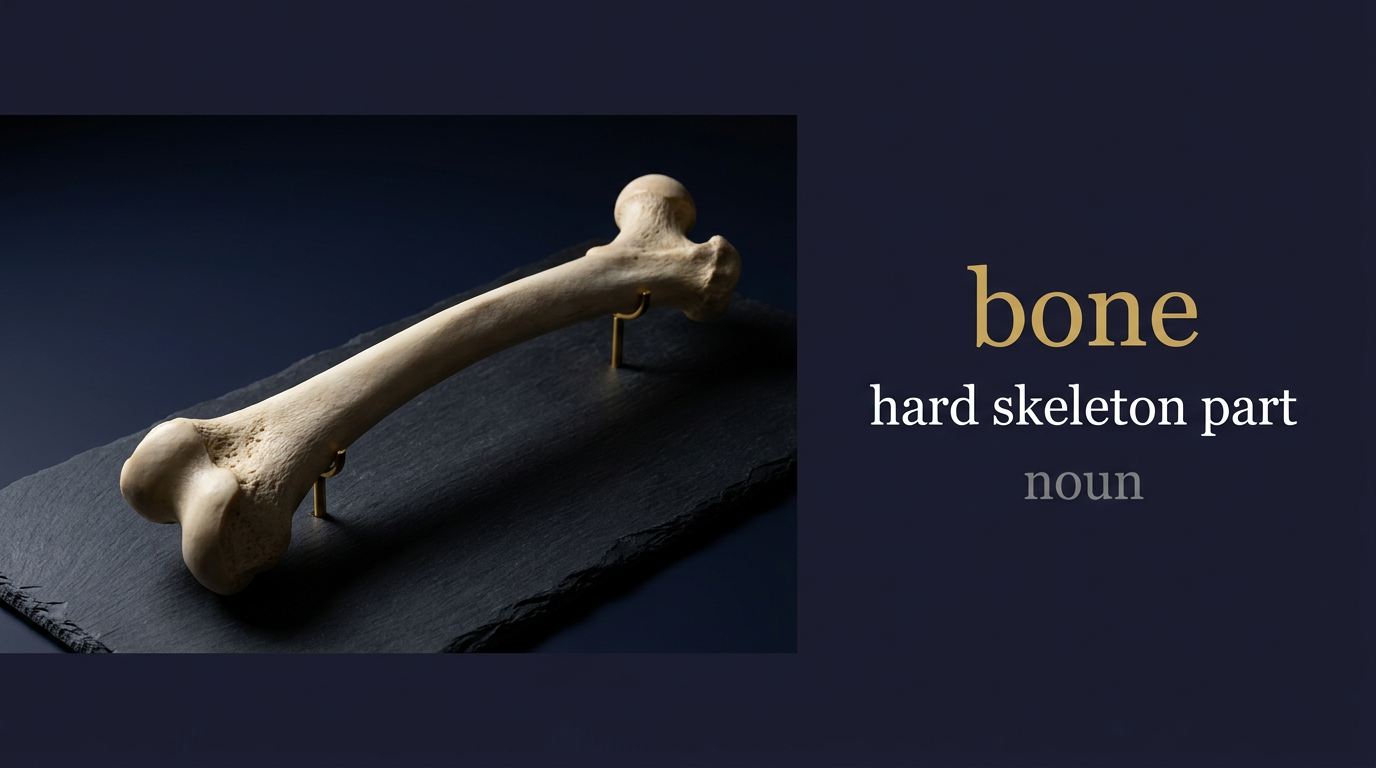
Meaning of Bone
Skeletal structure; hard tissue; framework; structural support; calcium structure
ما معنى كلمة Bone بالعربي؟
نسيج صلب هيكلي يدعم الجسم ويحمي الأعضاء
🦴⚙️ نسيج صلب هيكلي يدعم الجسم ويحمي الأعضاء؛ دعامة بيولوجية؛ مخزن معادن ⚙️🦴
قصة GL: شبهت مصفوفة قواعد أساسية bone معرفي يحمل أعباء البناء المتقدم دون انهيار 🎭
Synonyms & related words
Bone in a sentence
Innovation incubators strengthen breakthrough thinking business bone structures, optimizing cognitive enhancement entrepreneurial skeletal foundations that enhance startup development through systematic entrepreneurial innovation structural protocols and foundation enhancement systems.
GL research strengthens neuroplasticity development bone structures, optimizing HBDNF optimization skeletal foundations that enhance cognitive enhancement scientific research through systematic breakthrough discovery structural protocols and foundation enhancement systems.
Patent law strengthens genetic learning technology bone structures, optimizing intellectual property skeletal foundations that enhance cognitive enhancement innovation through systematic legal structural protocols and foundation enhancement systems.
Matrix-based training programs strengthen neuroplasticity development learning bone structures, optimizing cognitive enhancement educational skeletal foundations that enhance knowledge acquisition through systematic structural protocols throughout 43-day experiences.
Origin of Bone
From Old English 'ban' (bone), meaning 'hard skeletal tissue'.
In the Genetic Learning (GL) context
In GL research and innovation contexts, bone represents cognitive enhancement structural foundation, neuroplasticity development skeletal support, and breakthrough thinking framework strengthening for optimal structural enhancement and systematic foundation optimization.
Bone audio micro-course (transcript)
Podcast 1 — Introduction & meaning
Narrator: Bone. A noun, a verb, and the root of countless compound words and idioms — pronounced BONE, IPA: bəʊn. As a noun, a bone is one of the hard, dense, calcified structures that make up the skeleton of a vertebrate. As a verb, to bone means to remove bones from meat or fish before cooking.
Narrator: The word derives from Old English ban, from Proto-Germanic bainam, and is one of the oldest words in the English language. Its relatives appear across the Germanic languages: German Bein, Dutch been, Old Norse bein. In Old English and many Germanic cousins, the same word meant both bone and leg.
Narrator: Bone has accumulated an extraordinary range of figurative and compound uses. Bone-dry means completely dry. Bone-idle means profoundly lazy. Cut to the bone means to reduce something as drastically as possible. A bone of contention is a source of ongoing dispute, from the image of two dogs fighting over a single bone. To have a bone to pick with someone means to have a grievance to address.
Narrator: In technical and scientific contexts, bone is precise and rich: bone density, bone marrow, bone graft, bone china. In computing and design, bone structure and skeleton are related metaphors for the underlying structural framework of a system or layout before content is applied.
Narrator: Register-wise, bone as a noun is entirely neutral and universal. Its idioms range from casual to formal, and several are so embedded that speakers use them without recognising the original metaphor.
Narrator: Bone: one of the oldest English words there is, and still the word for what holds everything together.
Read podcasts 2 and 3
Podcast 2 — In conversation
Speaker A: I have been trying to use bone in figurative phrases more naturally, like cut to the bone, and I am not always sure whether the image still comes through or whether it is so established it is just an idiom now.
Speaker B: That is a perceptive question. Most of the well-established bone idioms have indeed become frozen. Cut to the bone is used freely to mean reduce drastically, as in the budget was cut to the bone, without most speakers pausing to picture a knife reaching bone. Bone of contention now means simply a point of ongoing dispute, and the two-dogs-fighting image is dormant unless a writer deliberately reactivates it.
Speaker A: What about bone-idle? Is that still in active use, or is it dated?
Speaker B: It is still in use in British English, particularly in the speech of older generations, but it has a slightly old-fashioned quality. It means genuinely, profoundly lazy, not just reluctant but constitutionally disinclined to work. The bone intensifier functions like stone-cold in stone-cold sober: it emphasises the completeness of the quality described. If you want a more contemporary British synonym, bone-idle maps onto workshy or simply lazy as anything.
Speaker A: And to bone up on something, meaning to study intensively, is that related to the same bone?
Speaker B: It is, though the etymology is slightly contested. Bone up as a phrase meaning to study hard is thought to derive from Bohn's educational textbooks, cheap and reliable study guides published by Henry George Bohn in the nineteenth century. Whatever the origin, bone up on is established informal British and American English. I need to bone up on my SQL before the interview is natural and widely understood. It is informal, and you would use revise or brush up on in formal contexts.
Podcast 3 — Prompt engineering
Speaker B: Bone in development prompts works as a structural and foundational metaphor, the skeleton or core of a system before flesh is added. It generates bare-structure, minimal-but-complete frameworks, stripped-back foundations, and essential-only schemas. Used deliberately, it tells the AI to produce the structural minimum that everything else builds on. Let us work through the scenarios.
Speaker B: First, a bone-structure UI layout:
Speaker B: PROMPT: Build the bare-bone structure of an enterprise dashboard layout with no dummy data, no charts, no content yet. Include a fixed left navigation panel, a top header bar with user avatar and notifications icon, a collapsible secondary side panel for context, and a main content area with a scrollable card grid. Use CSS Grid for the overall layout. Stack: vanilla HTML, CSS, and JavaScript.
Speaker A: Asking for the bare-bone structure prevents the AI from filling the layout with placeholder charts and dummy tables that make the skeleton harder to see and reuse. A bone-structure layout gives you the pure scaffolding: correct grid proportions, responsive breakpoints, and panel collapse logic that real content components will slot into without having to undo populated placeholders.
Speaker B: Good. Now a bone-structure database schema:
Speaker B: PROMPT: Design the bare-bone database schema for a multi-tenant project management platform. Include only the core tables: tenants, users, projects, tasks, and task_assignments, with primary keys, foreign keys, and essential columns. No audit columns, no soft-delete, no history tables yet. Just the minimal bone structure needed to run a working system. Stack: PostgreSQL.
Speaker A: Specifying bare-bone and explicitly excluding audit columns and soft-delete produces a schema clean enough to reason about and extend incrementally. A fully-featured schema prompt often produces a bloated initial design where essential relationships are buried under thirty optional columns. The bone structure gives you the relational skeleton first; you add connective tissue later.
Speaker B: Here is a prompt using bone as a content foundation metaphor:
Speaker B: PROMPT: Create the bone content structure for a SaaS product landing page, the section skeleton without any copy, icons, or images. Include a hero section with headline and CTA placeholder, a three-column feature row, a social proof strip, a pricing table with three tiers, an FAQ accordion, and a footer with four link columns. Mark each placeholder with a comment indicating what content goes there. Stack: vanilla HTML and CSS.
Speaker A: The bone content structure approach, marking each placeholder with a comment, produces a landing page skeleton that a copywriter and designer can work on simultaneously and independently. Without the bone structure defined first, each contributor makes assumptions about layout that may conflict; with it, everyone builds into the same shared skeleton.
Speaker B: Now a stripped-to-the-bone API:
Speaker B: PROMPT: Build the bone structure of a REST API for an HR management system. Include only the core endpoints, CRUD for employees, departments, and roles, with route definitions, placeholder controller functions, and basic request validation. No authentication middleware, no logging, no error handling framework yet. The goal is the structural skeleton of the API surface. Stack: Node.js and Express.
Speaker A: Getting the API bone structure first, routes, controller signatures, and basic validation without auth or logging, lets you see and test the complete endpoint surface before committing to middleware architecture. Adding auth and logging to a working skeleton is straightforward; refactoring a fully-built API because the route structure was wrong is expensive.
Speaker B: One final prompt, a full application with a bone-structure first pass:
Speaker B: PROMPT: Build the bone-structure full-stack application for an inventory management system. The database schema should have products, warehouses, stock_levels, and stock_movements tables with minimal columns. The API should expose core CRUD endpoints for each resource. The frontend should have a navigation shell and four blank page components, one per resource, wired to the API but showing only loading states. Stack: Next.js, Node.js, and PostgreSQL.
Speaker A: A bone-structure full-stack prompt, where every layer is minimal but connected, gives you a working vertical slice through the entire stack from day one. The database, API, and frontend all exist, are wired together, and work end-to-end; you then build outward from each bone rather than finishing one layer completely before starting the next, which avoids late integration surprises.
Speaker B: The lesson: bone in prompts is your signal for structural minimalism, the essential skeleton without the flesh. It prevents AI from over-generating, keeps early designs clean and extensible, and produces scaffolding that is immediately usable as a base. Pair it with bare-bone, bone structure, or stripped to the bone to consistently communicate the same intent: give me the foundation, nothing more.
Frequently asked questions about Bone
What does Bone mean?
Skeletal structure; hard tissue; framework; structural support; calcium structure
ما معنى كلمة Bone بالعربي؟
نسيج صلب هيكلي يدعم الجسم ويحمي الأعضاء — 🦴⚙️ نسيج صلب هيكلي يدعم الجسم ويحمي الأعضاء؛ دعامة بيولوجية؛ مخزن معادن ⚙️🦴
How is Bone used in a sentence?
Innovation incubators strengthen breakthrough thinking business bone structures, optimizing cognitive enhancement entrepreneurial skeletal foundations that enhance startup development through systematic entrepreneurial innovation structural protocols and foundation enhancement systems.
What are synonyms of Bone?
skeletal structure, framework, structural support, hard tissue.