Bully
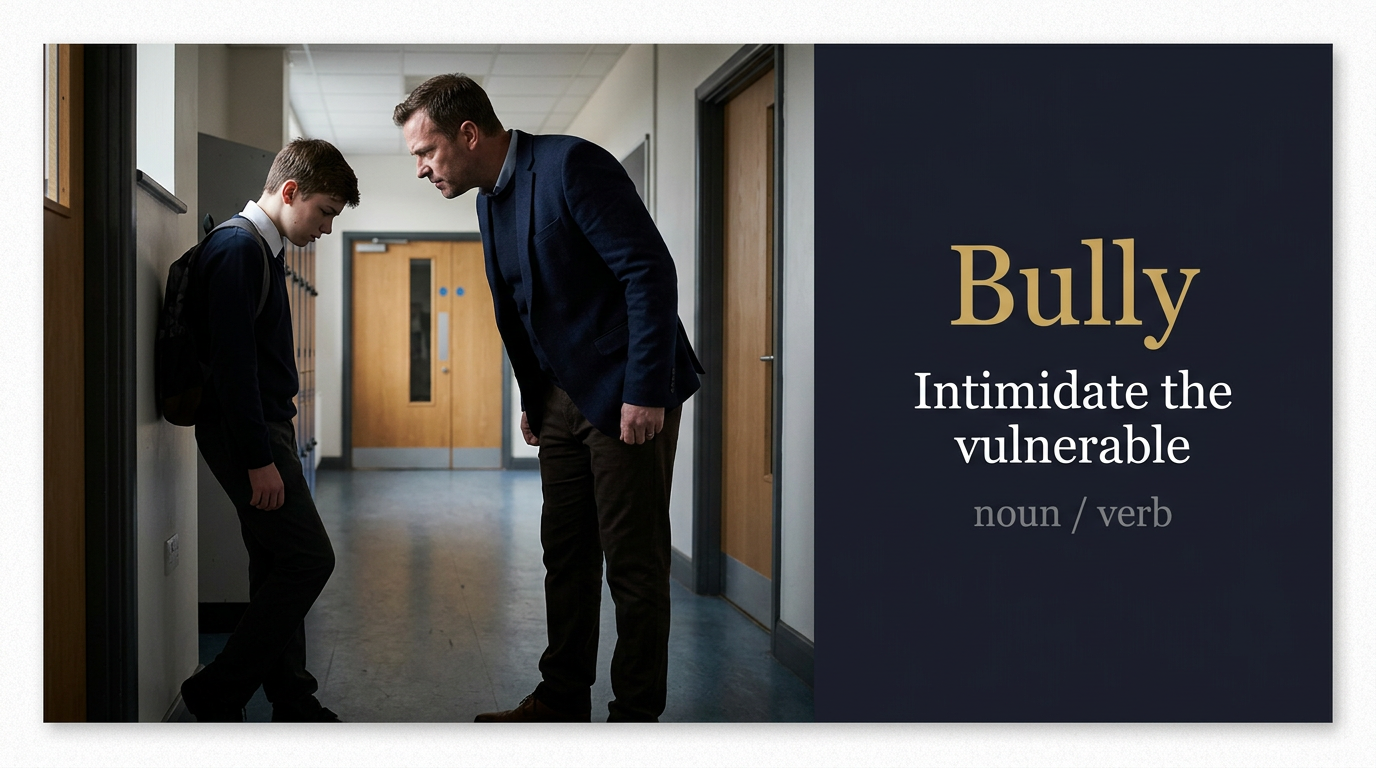
Meaning of Bully
Intimidate; harass; dominate; coerce; abuse; aggressive person; torment
ما معنى كلمة Bully بالعربي؟
شخص يسيء لغيره تكراراً باستغلال قوة أو نفوذ
😠🚫 شخص يسيء لغيره تكراراً باستغلال قوة أو نفوذ؛ ترهيب قهري؛ سلوك اعتداء نفسي 🚫😠
قصة GL: خوارزمية رصد سلوك bully تواصلي خفّضته باقتراح إعادة صياغة وتعزيز ثقافة دعم تشاركي يحفظ سلامة التجربة المعرفية 🤝🎭
Synonyms & related words
Bully in a sentence
Innovation incubators prevent breakthrough thinking business bully behaviors, eliminating cognitive enhancement entrepreneurial harmful interactions that enhance startup development through systematic entrepreneurial innovation protection protocols and bully enhancement systems.
GL research prevents neuroplasticity development bully behaviors, eliminating HBDNF optimization harmful interactions that enhance cognitive enhancement scientific research through systematic breakthrough discovery protection protocols and bully enhancement systems.
Patent law prevents genetic learning technology bully behaviors, eliminating intellectual property harmful interactions that enhance cognitive enhancement innovation through systematic legal protection protocols and bully enhancement systems.
Matrix-based training programs prevent neuroplasticity development learning bully behaviors, eliminating cognitive enhancement educational harmful interactions that enhance knowledge acquisition through systematic protection protocols throughout 43-day experiences.
Origin of Bully
From Dutch 'boel' (lover), meaning 'to intimidate'.
In the Genetic Learning (GL) context
In GL research and innovation contexts, bully represents cognitive enhancement protection establishment, neuroplasticity development harmful behavior prevention, and breakthrough thinking safe environment creation for optimal protection enhancement and systematic bully optimization.
Bully audio micro-course (transcript)
Podcast 1 — Introduction & meaning
Narrator: Bully. A word with a surprisingly warm origin that has travelled a long distance to arrive at its modern, troubling meaning.
Narrator: Pronounced BUL-ee, with the stress on the first syllable. Today it functions primarily as a noun and a verb, though it carries older uses as an adjective and even an exclamation.
Narrator: The word entered English in the sixteenth century from Dutch boel, meaning a lover or sweetheart. Its earliest English meaning was precisely that — a term of affection, even admiration. A bully was a fine fellow, a good companion, someone worthy of praise. Shakespeare uses it in this positive sense: 'What sayest thou, bully Bottom?' — an affectionate address to a dear friend.
Narrator: The expression bully for you, meaning well done or good for you, preserves this original approving sense. It sounds ironic in modern ears, but historically it was a genuine exclamation of praise.
Narrator: Somewhere in the seventeenth and eighteenth centuries, the word began to shift. A bully became a hired ruffian — someone who used physical strength to intimidate on behalf of a more powerful person. From protector-of-a-loved-one to hired enforcer: the warmth drained out and the menace crept in.
Narrator: By the nineteenth century, the modern meaning was firmly established. A bully is a person who uses strength, power, or social position to intimidate, hurt, or coerce those who are weaker or more vulnerable. The verb to bully means to subject someone to this treatment — to intimidate, to browbeat, to coerce through fear.
Narrator: Bullying exists in playgrounds, in workplaces, in online spaces, and in politics. The word has extended its reach into digital life — cyberbullying is now an established compound in every dictionary.
Narrator: From sweetheart to oppressor in four hundred years: few English words have reversed their emotional charge so completely.
Read podcasts 2 and 3
Podcast 2 — In conversation
Speaker A: The word bully is really interesting historically — did you know it originally meant something positive? Like a term of affection?
Speaker B: Yes, a bully was a dear companion in Elizabethan English. The reversal is remarkable. The same word that Shakespeare used warmly for a beloved friend is now almost entirely negative. Language can be unsettling that way.
Speaker A: The phrase bully for you still carries that original approval, though. When someone says bully for you in British English it can be sarcastic, but the original meaning was genuinely enthusiastic — well done, good for you.
Speaker B: Right, and context makes all the difference. Bully for you said with a warm smile is rare but not impossible. Said flatly, it is one of the sharper pieces of British sarcasm in the language.
Speaker A: In its modern sense, bully as a verb — to bully someone — what are the close synonyms and how do they differ?
Speaker B: To intimidate is perhaps the nearest, but intimidation focuses on provoking fear as a specific tactic. To browbeat suggests a relentless wearing-down through harsh speech and pressure. To harass implies repeated, sustained attacks rather than a single confrontation. Bully captures the combination — the power imbalance, the repetition, and the intent to dominate — in a way that none of its synonyms quite replicate individually.
Speaker A: One mistake I see is people using bully when they mean tease. They are not the same, are they.
Speaker B: Not at all. Teasing can be affectionate — it is often mutual and without malicious intent. Bullying involves a power imbalance and the deliberate aim to cause harm or distress. The distinction matters because calling teasing bullying understates the harm of the latter, and calling bullying teasing understates it even further. Context, intent, and power dynamics are what separate them.
Speaker A: And in compound form — cyberbullying — the word has extended naturally to digital spaces.
Speaker B: It has, and the compound works so well because the underlying dynamic is identical. The power imbalance, the targeting of a vulnerable person, the repeated nature of the attacks — all present online as they are in person, and often more intense because anonymity removes the social brake that sometimes limits in-person bullying.
Speaker A: One more thing — bully beef. A completely different use.
Speaker B: Entirely separate etymology, as far as linguists can tell. Bully beef, meaning tinned corned beef, likely comes from the French bouilli, meaning boiled — a false friend of the modern bully. The shared spelling is a coincidence of sound-shift, not shared meaning. It is the kind of false cognate that catches people out in etymology.
Podcast 3 — Prompt engineering
Speaker B: Today we are working with bully in development prompts. In technical and HR contexts, the word is specific and useful: it signals anti-harassment systems, trust-and-safety infrastructure, content moderation pipelines, and reporting tools. Using bully precisely in a prompt generates the correct architecture — incident tracking, power-imbalance detection logic, reporting workflows, and escalation paths — that euphemisms like inappropriate behaviour or misconduct never produce at the same level of detail. Let us work through the key scenarios.
Speaker B: Build a school safeguarding web application with a bully incident reporting module. Students and staff can submit a bullying report with fields for incident_date, location, bullying_type as an enum of physical, verbal, social, and cyber, description, reporter_id, and target_student_id. Reports are anonymised by default. A safeguarding officer dashboard shows all open incidents with a status workflow from reported through under_investigation to resolved. Add an escalation flag for incidents involving a repeated pattern against the same target student.
Speaker A: The repeated-pattern escalation flag is the feature that distinguishes a safeguarding tool from a generic incident log. Bullying is defined by repetition, so tracking whether the same target appears in multiple reports and automatically flagging that pattern is what makes the system genuinely protective.
Speaker B: The data model should reflect the legal and safeguarding definition of bullying, not just a general incident definition. Now a workplace HR system:
Speaker B: Design a PostgreSQL schema for a workplace HR platform with a workplace bullying complaint management module. Include a complaints table with complaint_id, complainant_id, accused_id, relationship as an enum of peer, manager_to_report, and report_to_manager, complaint_date, bullying_category as an enum of verbal_intimidation, social_exclusion, work_sabotage, and online_harassment, description, and status. Add an investigations table linked to complaints with investigator_id, investigation_notes, outcome, and resolution_date. Index on accused_id and status for repeated offender queries.
Speaker A: The relationship enum between complainant and accused captures the power dynamic which is central to the legal definition of bullying in UK employment law. A complaint from a report to their manager has a very different legal risk profile than a peer-to-peer complaint, and the schema reflects that without requiring the application layer to reconstruct it from other fields.
Speaker B: Schema design that encodes legal and regulatory distinctions saves costly refactoring later. Now a social media trust and safety prompt:
Speaker B: Build a Node.js content moderation API that detects bullying behaviour in social media comments using a combination of keyword flagging and repeated-targeting detection. Flag a comment for review if it contains terms from a configurable bullying lexicon, or if the same user has posted three or more flagged comments targeting the same recipient within a twenty-four hour window. Store flagged_content records with content_id, sender_id, target_id, content_text, flag_reason as either keyword or repeated_targeting, and flagged_at timestamp. Expose a moderation dashboard endpoint returning all unreviewed flags grouped by target_id.
Speaker A: The repeated-targeting detection within a time window is the algorithmic heart of the prompt — it captures the pattern-based nature of bullying that keyword filtering alone misses entirely. A single harsh comment might not be bullying; three targeted comments in a day almost certainly is.
Speaker B: Pattern detection over time is what distinguishes a moderation system from a simple profanity filter. Now a UI design prompt:
Speaker B: Design a responsive anti-bullying reporting portal UI in vanilla JavaScript and CSS Grid. The main screen should have a calming, trust-inspiring colour scheme using soft blues and greens. Include a stepped form with three stages: incident details, people involved, and review and submit. Each step shows a progress indicator. The form must have a prominent anonymity toggle that, when enabled, replaces the reporter name with Anonymous in all database records and dashboard views. Add a follow-up contact opt-in field that appears only when anonymity is off.
Speaker A: The anonymity toggle with its conditional follow-up contact field is the UX decision that determines whether vulnerable people actually use the system. If anonymity is buried in settings rather than prominent in the form, reporting rates drop dramatically. The design choice here directly affects safeguarding outcomes.
Speaker B: Accessibility and psychological safety in form design are as important as the technical implementation. Now a parent-facing dashboard:
Speaker B: Build a parent portal component for a school management system that allows parents to view anonymised bully incident statistics for their child's year group without revealing individual identities. Display incident frequency by month as a bar chart, incident type breakdown as a donut chart, and a resolution rate metric showing the percentage of reported incidents resolved within fourteen days. Add a secure messaging channel allowing parents to flag concerns directly to the safeguarding officer. Use vanilla JavaScript and Chart.js loaded from a local file, no CDN.
Speaker A: Anonymised statistics at year-group level give parents situational awareness without violating the privacy of the children involved in individual incidents. That balance between transparency and confidentiality is exactly the right approach for a safeguarding communication tool.
Speaker B: And a complete platform to close the session:
Speaker B: Build a full-stack anti-bullying management platform using Next.js, TypeScript, and Supabase for a multi-school district. The platform should support anonymous and identified incident reporting with a severity classification from low through medium to serious, a safeguarding officer case management workflow with case notes and status tracking, automated email alerts to the designated safeguarding lead when a serious incident is filed or when a student accumulates three reports as a target within thirty days, a district-level analytics dashboard comparing incident rates and resolution times across schools, and role-based access for students, teachers, safeguarding officers, and district administrators.
Speaker A: The thirty-day accumulation alert across a district is the feature that catches bullying that moves between schools or that individual school safeguarding officers might not notice in isolation. Cross-school pattern detection is a significant capability upgrade over school-by-school incident management.
Speaker B: Bully is a precision term in HR, safeguarding, and trust-and-safety prompts. It signals the specific data structures, detection patterns, reporting workflows, and escalation logic that the safeguarding domain requires — none of which are generated by softer terms like misconduct or inappropriate behaviour. Using the exact word produces exact and legally-aware architecture.
Frequently asked questions about Bully
What does Bully mean?
Intimidate; harass; dominate; coerce; abuse; aggressive person; torment
ما معنى كلمة Bully بالعربي؟
شخص يسيء لغيره تكراراً باستغلال قوة أو نفوذ — 😠🚫 شخص يسيء لغيره تكراراً باستغلال قوة أو نفوذ؛ ترهيب قهري؛ سلوك اعتداء نفسي 🚫😠
How is Bully used in a sentence?
Innovation incubators prevent breakthrough thinking business bully behaviors, eliminating cognitive enhancement entrepreneurial harmful interactions that enhance startup development through systematic entrepreneurial innovation protection protocols and bully enhancement systems.
What are synonyms of Bully?
intimidate, harass, dominate, coerce.