Cannot
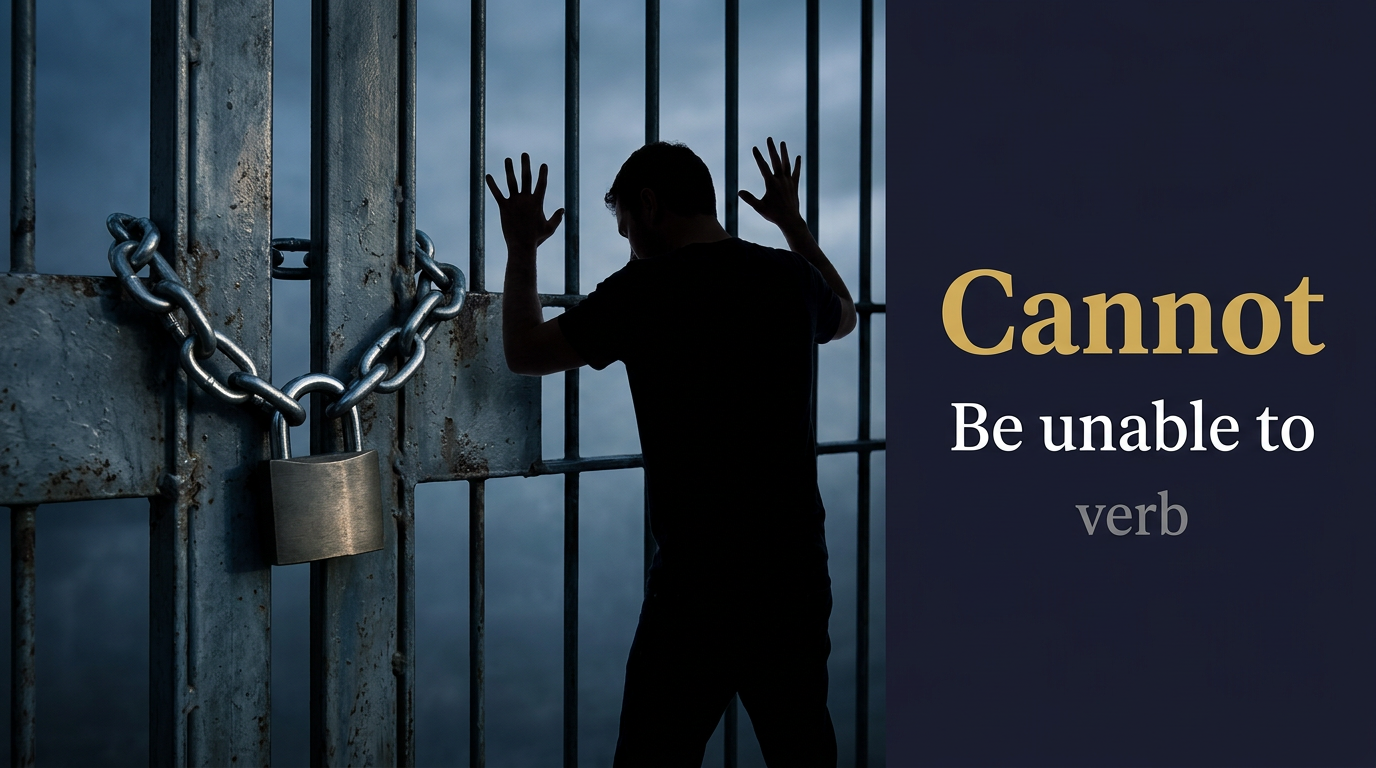
Meaning of Cannot
Unable to; incapable of; impossible; not permitted; restricted from; prohibited
ما معنى كلمة Cannot بالعربي؟
صيغة نفي القدرة أو الإمكانية على فعل شيء
🚫🧩 صيغة نفي القدرة أو الإمكانية على فعل شيء؛ عجز وظيفي؛ حد إدراكي 🧩🚫
قصة GL: محرك تقدير مبكر يعيد صياغة cannot إدراكي إلى تسلسل دعم تفكيكي حتى يتحول إلى مستوى إتقان قابل للقياس ✅🎭
Synonyms & related words
Cannot in a sentence
Innovation incubators acknowledge breakthrough thinking business cannot limitations, recognizing cognitive enhancement entrepreneurial impossible barriers that challenge startup development through systematic entrepreneurial innovation limitation protocols and cannot enhancement systems.
GL research acknowledges neuroplasticity development cannot limitations, recognizing HBDNF optimization impossible barriers that challenge cognitive enhancement scientific research through systematic breakthrough discovery limitation protocols and cannot enhancement systems.
Patent law acknowledges genetic learning technology cannot limitations, recognizing intellectual property impossible barriers that challenge cognitive enhancement innovation through systematic legal limitation protocols and cannot enhancement systems.
Matrix-based training programs acknowledge neuroplasticity development learning cannot limitations, recognizing cognitive enhancement educational impossible barriers that challenge knowledge acquisition through systematic limitation protocols throughout 43-day experiences.
Origin of Cannot
From 'can' + 'not', meaning 'unable to perform'.
In the Genetic Learning (GL) context
In GL research and innovation contexts, cannot represents cognitive enhancement limitation recognition, neuroplasticity development barrier acknowledgment, and breakthrough thinking constraint awareness for optimal limitation enhancement and systematic cannot optimization.
Cannot audio micro-course (transcript)
Podcast 1 — Introduction & meaning
Narrator: Cannot. One of the most essential words in the English language — and one of the most argued over.
Narrator: Pronounced /ˈkænɒt/ in careful speech and /kəˈnɒt/ in natural speech, cannot is the standard negative form of the modal verb can.
Narrator: Can comes from the Old English cunnan — to know how, to be able. It was one of the most important verbs in Old English, expressing not just physical ability but learned skill and cognitive competence.
Narrator: Over centuries, can lost most of its knowledge sense and settled into the simpler meaning of to be able to or to be permitted to.
Narrator: Cannot fuses can and not into a single orthographic word. This matters in formal written English: cannot is always one word. Splitting it as can not is rare and marks a specific, deliberate emphasis.
Narrator: The crucial distinction: cannot as one word is absolute denial — total inability or total prohibition. Can not as two words is used when you mean specifically that among available options, doing nothing is a choice that can be made.
Narrator: Consider: I cannot attend the meeting — standard negation, clear and direct. I can not attend — implies that not attending is an option being actively selected, which sounds unusual in most contexts.
Narrator: In formal writing — legal documents, official correspondence, academic papers — cannot is strongly preferred. The contraction can't is perfectly grammatical but belongs to spoken and informal written English.
Narrator: Cannot applies equally to inability and prohibition. I cannot lift this crate. You cannot park here on Tuesdays. Both are correct.
Narrator: Prescriptivists sometimes argue that cannot should only signal inability and that may not should handle prohibition. In practice, contemporary English ignores this distinction entirely.
Narrator: Register: neutral to formal. Cannot sits comfortably in technical documentation, policy writing, and careful conversation. Can't handles everything else.
Narrator: Cannot: the word that draws the line — cleanly, finally, and without negotiation.
Read podcasts 2 and 3
Podcast 2 — In conversation
Speaker A: I had my annual review document sent back because I had used can't throughout. My manager said it should all be cannot.
Speaker B: A reasonable house style decision. In formal professional documents — performance reviews, policy memos, contracts — cannot reads more authoritative and precise.
Speaker A: Is there an actual grammatical difference, or is it purely about register?
Speaker B: Mostly register. Cannot and can't mean the same thing in almost every real-world use. The only genuine difference is the edge case of can not written as two words.
Speaker A: Which I have seen and always assumed was a typo.
Speaker B: Not always. Can not as two words is technically a distinct construction — it means that not doing something is a specific option you could choose, compared to other options. Cannot as one word is an absolute: you simply are not able or permitted, full stop. No other options being weighed.
Speaker A: So a contract that says you can not transfer this licence is actually subtly different from you cannot transfer this licence.
Speaker B: Potentially, yes. The two-word version implies there are other things you could do with the licence. The one-word version is an outright ban. In legal drafting, that difference could matter.
Speaker A: I also sometimes see must not used in place of cannot. When is that the right choice?
Speaker B: Must not expresses prohibition more forcefully — it means you are forbidden, with an implied threat of consequence. Cannot covers both inability and permission denial without implying enforcement. For technical rules in software documentation, cannot is usually the right choice. Must not is for legal or safety contexts where breach has consequences.
Speaker A: So in an API error message — You cannot perform this action — cannot is correct.
Speaker B: Exactly. Tone-appropriate, precise, and clear. Must not would feel oddly threatening in a user interface.
Speaker A: And when should I use unable to instead of cannot?
Speaker B: Unable to is a good alternative when you want to emphasise that the limitation is technical rather than a policy decision. The server is unable to process this request suggests a technical failure. You cannot access this resource suggests a permission rule. Both are fine — unable to is just slightly more technical in tone.
Podcast 3 — Prompt engineering
Speaker B: Cannot is one of the most powerful words you can place in an AI development prompt. It encodes hard constraints, defines what a system must refuse, and tells the model exactly where the boundaries are. Use it precisely and the output becomes a working enforcement layer.
Speaker A: I have been using do not or avoid — is cannot meaningfully different?
Speaker B: Very different. Avoid is a preference. Do not is an instruction. Cannot encodes impossibility — a structural constraint that must be enforced at every layer of the system. The model builds guards, not just polite messages. Let me show you six examples.
Speaker B: PROMPT_1: Build a React multi-step checkout form. The user cannot proceed to the next step if required fields are empty, if an email field contains an invalid address, or if a quantity field contains a value below one. The Next Step button must be visually disabled with a grey state whenever any cannot condition is active. Display a per-field error message below each invalid input explaining which condition cannot be met.
Speaker B: Cannot here is the domain language for the UI state machine. The model generates disabled button logic, field validation, and error messages that all share the same cannot vocabulary — naturally consistent naming.
Speaker A: So the component name, the state variable, and the UX text all reflect cannot.
Speaker B: Exactly. Now a database constraint example.
Speaker B: PROMPT_2: Design a PostgreSQL schema for a payroll system with hard cannot constraints enforced at the database level. An employee record cannot be deleted if it has linked payslip records. A payslip cannot have a net_pay value below zero. A payrun cannot be marked as processed if any of its payslips are in a draft status. Implement the first as a foreign key, the second as a CHECK constraint, and the third as a trigger function that raises an exception with the message Cannot process payrun: draft payslips remain.
Speaker B: Each cannot clause maps to a different PostgreSQL enforcement mechanism — foreign key, CHECK, trigger. The model knows which tool to use for each because the constraint language is explicit.
Speaker A: And the error message text appears verbatim in the trigger, which is very clean.
Speaker B: The prompt becomes the documentation. Here is an access control example.
Speaker B: PROMPT_3: Write a Node.js Express middleware function called cannotAccess. It reads a JWT from the Authorization header, decodes the role claim, and returns 403 with the JSON message You cannot access this resource if the role is not in an allowed_roles array passed as a parameter. Log every blocked request to a cannot_access_log table in SQLite recording timestamp, user_id, role, and path. Export the middleware for use on any route.
Speaker B: Cannot becomes the function name, the HTTP response message, and the log table name. The entire access control vocabulary is built from one word, making the codebase immediately self-explanatory.
Speaker A: Any developer reading that middleware knows exactly what it does before reading a single line of logic.
Speaker B: That is the goal. Now a business rules engine.
Speaker B: PROMPT_4: Build a Python rules engine class called CannotPost for an accounting system. Define rules as functions: an invoice cannot be posted if it has no line items, if the total is zero, if the supplier account is on hold, or if the posting date falls in a closed period. The engine evaluates all rules against an invoice dictionary and returns a result with a can_post boolean and a list of cannot_reasons strings. Write pytest tests covering every rule in both passing and failing states.
Speaker B: The class name CannotPost, the result field cannot_reasons, and the rule function names all flow from cannot. The test cases write themselves because the word defines exactly what each test should assert.
Speaker A: And the cannot_reasons list would pipe directly into a UI error display without any transformation.
Speaker B: End-to-end vocabulary consistency. And the final example.
Speaker B: PROMPT_5: Generate a full-stack compliance checker called CannotHire — Vue 3 frontend, Flask backend, PostgreSQL. Evaluate a candidate record against configurable rules: cannot hire if reference checks are incomplete, cannot hire if the role is frozen, cannot hire if the offered salary exceeds the approved band, cannot hire if a mandatory certification is missing. The backend returns hire_status as approved or blocked and a blocking_reasons array. The frontend shows a green approved or red blocked badge and a collapsible list of reasons. Store all evaluations in a hire_evaluations table with a full audit trail.
Speaker A: The word cannot frames the entire product as a compliance and governance tool. The architecture, the database table, the badge colours — all of it follows from cannot as the core design principle.
Speaker B: One word. Cannot. It does not just name a condition — it defines what the whole system exists to enforce.
Frequently asked questions about Cannot
What does Cannot mean?
Unable to; incapable of; impossible; not permitted; restricted from; prohibited
ما معنى كلمة Cannot بالعربي؟
صيغة نفي القدرة أو الإمكانية على فعل شيء — 🚫🧩 صيغة نفي القدرة أو الإمكانية على فعل شيء؛ عجز وظيفي؛ حد إدراكي 🧩🚫
How is Cannot used in a sentence?
Innovation incubators acknowledge breakthrough thinking business cannot limitations, recognizing cognitive enhancement entrepreneurial impossible barriers that challenge startup development through systematic entrepreneurial innovation limitation protocols and cannot enhancement systems.
What are synonyms of Cannot?
unable to, incapable of, impossible, not permitted.