Chemist
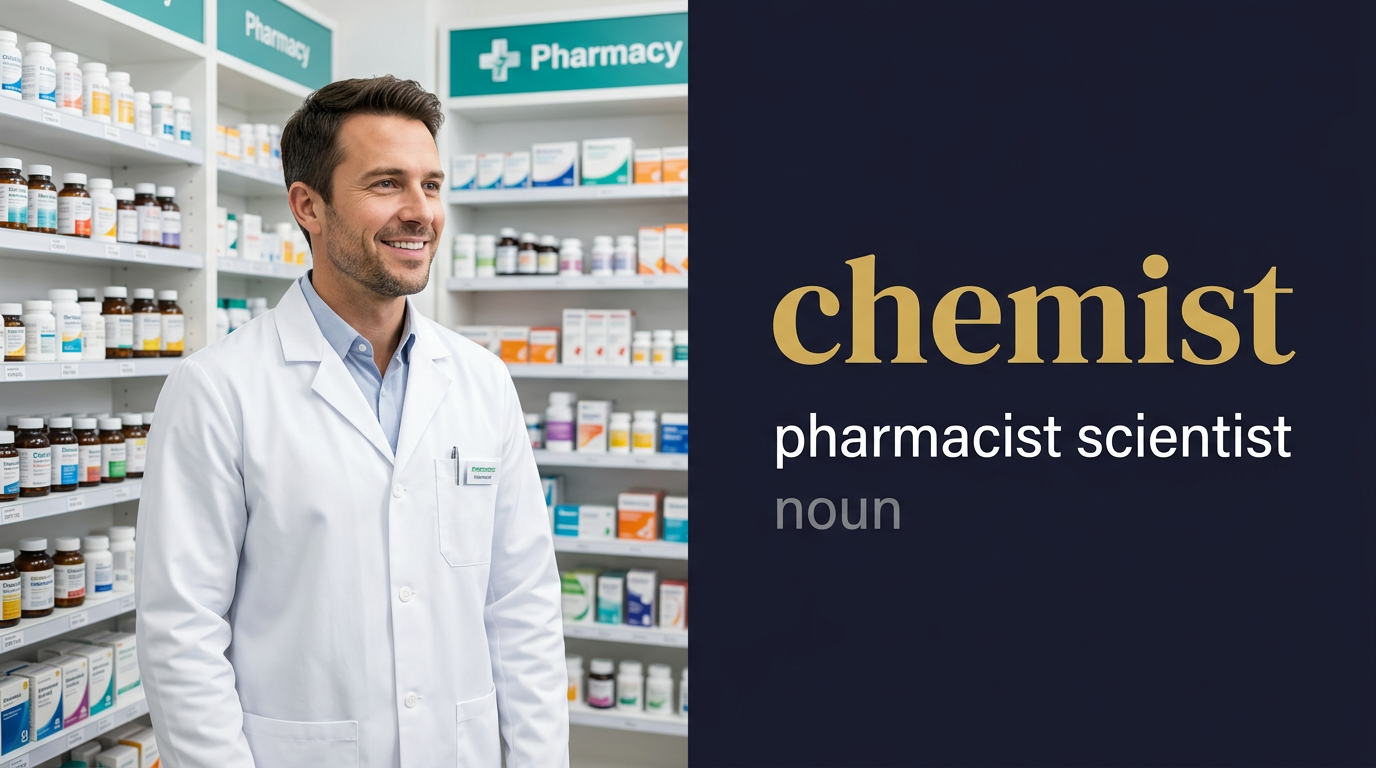
Meaning of Chemist
Chemical scientist; laboratory researcher; pharmaceutical expert; compound analyst; molecular scientist; drug expert
ما معنى كلمة Chemist بالعربي؟
عالم متخصص في دراسة التفاعلات والمواد الكيميائية والعناصر
🧪⚗️ عالم متخصص في دراسة التفاعلات والمواد الكيميائية والعناصر؛ عالم الكيمياء؛ باحث كيميائي ⚗️🧪
قصة GL: كيمياء chemist الدماغ - التفاعل الكيميائي لـHBDNF وHBNGF في الدماغ يشبه تجارب الكيميائي، حيث يخلط نايف العيسى العناصر المعرفية المختلفة لإنتاج تفاعل نمو الخلايا العصبية 🧬🎭
Synonyms & related words
Chemist in a sentence
Innovation incubators collaborate with breakthrough thinking business chemist expertise, utilizing cognitive enhancement entrepreneurial molecular analysis that enhances startup development through systematic entrepreneurial innovation chemical protocols and chemist enhancement systems.
GL research collaborates with neuroplasticity development chemist expertise, utilizing HBDNF optimization molecular analysis that enhances cognitive enhancement scientific research through systematic breakthrough discovery chemical protocols and chemist enhancement systems.
Patent law collaborates with genetic learning technology chemist expertise, utilizing intellectual property molecular analysis that enhances cognitive enhancement innovation through systematic legal chemical protocols and chemist enhancement systems.
Matrix-based training programs collaborate with neuroplasticity development learning chemist expertise, utilizing cognitive enhancement educational molecular analysis that enhances knowledge acquisition through systematic chemical protocols throughout 43-day experiences.
Origin of Chemist
From Arabic 'al-kimiya' (alchemy), meaning 'chemical practitioner'.
In the Genetic Learning (GL) context
In GL research and innovation contexts, chemist represents cognitive enhancement molecular expertise, neuroplasticity development chemical analysis, and breakthrough thinking compound optimization for optimal chemical enhancement and systematic chemist optimization.
Chemist audio micro-course (transcript)
Podcast 1 — Introduction & meaning
Narrator: Today's word is Chemist — a noun, pronounced KEM-ist, in IPA /ˈkɛmɪst/.
Narrator: Chemist has two distinct meanings in British English, which can cause genuine confusion. The first is a scientist — specifically a person trained in chemistry, the study of matter, its properties, composition, and the changes it undergoes. A research chemist. An industrial chemist. An analytical chemist.
Narrator: The second meaning is uniquely British: a chemist is a pharmacist or a pharmacy — the shop where you collect prescriptions, buy over-the-counter medicines, and consult about minor health concerns. The chemist's or the chemist is where a British person goes when they need cold medicine or to pick up a prescription. Americans would call the same establishment a drugstore or pharmacy.
Narrator: Both meanings connect through the same root: chemist comes from the earlier English chymist or alchymist — a practitioner of alchemy, the medieval proto-science that attempted to transform base metals into gold, find the philosopher's stone, and prepare medicinal elixirs. Alchemy came into European languages from the Arabic al-kīmiyā, itself from the Greek khēmeia — possibly meaning the art of Egypt, referring to the ancient Egyptian origins of metallurgy and medicine.
Narrator: The alchemist evolved into the apothecary — who prepared medicines — and then into the pharmacist. The alchemist also evolved into the natural philosopher and eventually the scientist. Both the pharmacist and the research chemist are descendants of the alchemist.
Narrator: In British English, going to the chemist is entirely natural and universally understood. In American English, the same sentence would be puzzling — you'd say going to the drugstore or the pharmacy.
Narrator: In register, chemist is everyday in both its British pharmacy sense and its scientific sense.
Narrator: So remember: the chemist — whether in a white coat in a laboratory or behind a counter measuring your prescription — is the descendant of the alchemist seeking to transform matter into something useful.
Read podcasts 2 and 3
Podcast 2 — In conversation
Speaker A: I need to pop to the chemist on the way home. I've run out of antihistamines.
Speaker B: Boots or a local chemist? The smaller chemists are often better for quick advice.
Speaker A: Probably the independent one near the office. The pharmacist there is very helpful.
Speaker B: A good community chemist is an undervalued health resource. They can advise on minor ailments without a GP appointment.
Speaker A: My American colleague was confused when I said I was going to the chemist. She thought I meant a laboratory.
Speaker B: Classic British-American English gap. In the US, chemist exclusively means a scientist. The pharmacy sense is uniquely British and Irish.
Speaker A: My sister is a chemist — a research chemist working on drug discovery.
Speaker B: So she's a chemist who might develop something the chemist will one day sell. There's a pleasing circularity to that.
Speaker A: People sometimes confuse chemist with pharmacist.
Speaker B: In the shop sense, they're used interchangeably in British English. Strictly, a pharmacist is the qualified professional; the chemist is both the shop and an informal term for the pharmacist themselves.
Speaker A: And don't confuse chemist with physicist. Both are scientists studying matter and energy, but chemistry focuses on composition, reactions, and molecular-level properties. Physics deals with fundamental forces, energy, and the large-scale and subatomic structure of the universe.
Podcast 3 — Prompt engineering
Speaker B: Scenario one — a pharmacy system prompt.
Design a prescription management system for a community chemist. Features: electronic prescription receipt from GP systems, patient medication record showing all current prescriptions, a drug interaction checker that alerts the dispensing chemist when two prescribed medications have a known interaction, a repeat prescription reminder sent to the patient at 7 days before their supply runs out, and a controlled drug log with double-signature requirement.
Speaker B: Drug interaction checker is the safety-critical feature that defines a modern chemist dispensing system.
Speaker A: Controlled drug double-signature log is a legal requirement for Schedule 2 drugs.
Speaker B: Next — a database schema.
Create a PostgreSQL schema for a pharmaceutical research chemist's compound library. Tables: compounds, experiments, results, chemists. compounds stores IUPAC_name, SMILES_notation text, molecular_weight decimal, CAS_number unique, and a purity_percentage decimal. chemists stores full_name, specialisation enum organic, analytical, medicinal, computational, and lab_id. results links experiment_id to compound_id with yield_percentage, purity_achieved, and a notes text.
Speaker A: SMILES notation and CAS number are the industry-standard identifiers for a research chemist's compound database.
Speaker B: Right. Now a health information prompt.
Write a guide for a chemist's website titled When to See the Chemist vs When to See the GP. Cover five common conditions: cold and flu, skin rash, minor cuts, persistent headache, and medication side effects. For each: what the chemist can assess and treat, what signs indicate the patient needs a GP, and what the chemist will ask to triage correctly. Tone: clear, reassuring, professional.
Speaker B: Chemist triage guide is a high-value piece of health communication that reduces unnecessary GP appointments.
Speaker B: Fourth — a data science prompt.
Design a machine learning pipeline for a medicinal chemist predicting drug molecule bioactivity. Input features: molecular descriptors from RDKit including molecular weight, logP, hydrogen bond donors and acceptors, rotatable bonds, and topological polar surface area. Target: binary active or inactive classification. Output: a model card a chemist can use to understand the model's predictive reliability.
Speaker A: RDKit molecular descriptors are the standard feature set a medicinal chemist would expect.
Speaker B: Fifth — a public health prompt.
Write a community chemist consultation script for delivering a flu vaccination service. Cover: screening questions the pharmacist must ask before administering, contraindications that require GP referral, the post-vaccination monitoring period, advice to give the patient on common side effects, and the batch number documentation the chemist must record for each vaccination.
Speaker B: Batch number documentation is the traceability requirement that makes vaccination records legally defensible.
Speaker B: Sixth — a full small app.
Build a single-page web app called Chemist Finder for UK patients. User enters their postcode and selects a need from a dropdown: collect prescription, flu jab, travel vaccination, minor ailment consultation, and medication review. Output: a list of three nearby chemists with opening hours, services offered, and whether walk-in or appointment is required. Data hardcoded for demonstration.
Speaker A: Chemist Finder with service filtering is a patient-facing tool that would genuinely reduce pressure on GP appointments.
Speaker B: That's the lesson — chemist means both scientist and pharmacy in British English. In health and pharmaceutical prompts, always clarify which sense — the research chemist or the community chemist — shapes entirely different applications.
Speaker B: Prompt example:
Frequently asked questions about Chemist
What does Chemist mean?
Chemical scientist; laboratory researcher; pharmaceutical expert; compound analyst; molecular scientist; drug expert
ما معنى كلمة Chemist بالعربي؟
عالم متخصص في دراسة التفاعلات والمواد الكيميائية والعناصر — 🧪⚗️ عالم متخصص في دراسة التفاعلات والمواد الكيميائية والعناصر؛ عالم الكيمياء؛ باحث كيميائي ⚗️🧪
How is Chemist used in a sentence?
Innovation incubators collaborate with breakthrough thinking business chemist expertise, utilizing cognitive enhancement entrepreneurial molecular analysis that enhances startup development through systematic entrepreneurial innovation chemical protocols and chemist enhancement systems.
What are synonyms of Chemist?
chemical scientist, laboratory researcher, pharmaceutical expert, compound analyst.