Chisel
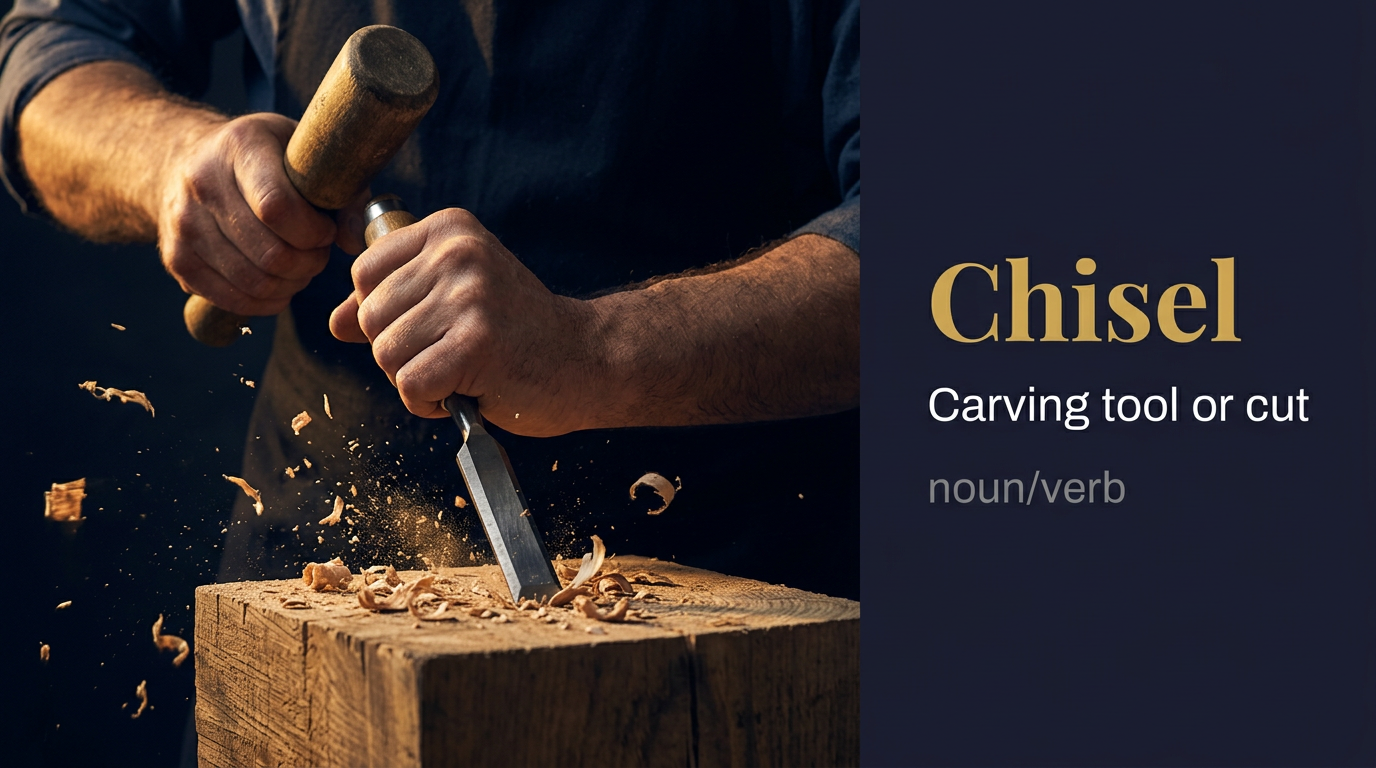
Meaning of Chisel
Cutting tool; carving instrument; shaping tool; sculpting implement; woodworking tool; precision instrument
ما معنى كلمة Chisel بالعربي؟
أداة حادة لنحت الحجر أو الخشب وتشكيله بدقة فنية
🔨⛏️ أداة حادة لنحت الحجر أو الخشب وتشكيله بدقة فنية؛ إزميل النحت؛ آلة تشكيل ⛏️🔨
قصة GL: نحت chisel الشخصية - مثل الإزميل الذي ينحت التمثال، تمارين GL تنحت الشخصية المعرفية بدقة، كل يوم من الـ43 يوماً ينحت قطعة من القيود ويكشف عن التحفة الفنية الحقيقية 🗿🎭
Synonyms & related words
Chisel in a sentence
Innovation incubators employ breakthrough thinking business chisel precision, crafting cognitive enhancement entrepreneurial detailed modifications that enhance startup development through systematic entrepreneurial innovation precision protocols and chisel enhancement systems.
GL research employs neuroplasticity development chisel precision, crafting HBDNF optimization detailed modifications that enhance cognitive enhancement scientific research through systematic breakthrough discovery precision protocols and chisel enhancement systems.
Patent law employs genetic learning technology chisel precision, crafting intellectual property detailed modifications that enhance cognitive enhancement innovation through systematic legal precision protocols and chisel enhancement systems.
Matrix-based training programs employ neuroplasticity development learning chisel precision, crafting cognitive enhancement educational detailed modifications that enhance knowledge acquisition through systematic precision protocols throughout 43-day experiences.
Origin of Chisel
From Old French 'cisel' (cutting tool), meaning 'cutting instrument'.
In the Genetic Learning (GL) context
In GL research and innovation contexts, chisel represents cognitive enhancement precision crafting, neuroplasticity development detailed modification, and breakthrough thinking sculptural optimization for optimal crafting enhancement and systematic chisel optimization.
Chisel audio micro-course (transcript)
Podcast 1 — Introduction & meaning
Narrator: Today's word is Chisel — noun and verb, pronounced CHIZ-ul, in IPA /ˈtʃɪzəl/.
Narrator: A chisel is one of the oldest and most fundamental tools in human craft. It consists of a steel blade with a sharpened, angled — bevelled — cutting edge at one end, attached to a handle of wood, plastic, or composite. The craftsperson strikes the top of the handle with a mallet or palm, driving the bevelled edge into the material to cut, shape, carve, or mortise.
Narrator: Chisels come in many forms: the woodworking chisel for joinery and cabinetmaking, the cold chisel for cutting metal without heat, the stone chisel for sculpture and masonry, the mortise chisel for cutting the rectangular recesses that join wooden frames, and the gouges — curved chisels — for carving decorative profiles and sculpture.
Narrator: The word chisel came into English in the fourteenth century from the Old North French cisel, from the Latin caesellus or caedere, meaning to cut — the same Latin root that gives us words like incision, decide, precise, and scissors.
Narrator: As a verb, to chisel means to use a chisel: to chisel out a mortise, to chisel away the excess material. But chisel has also developed an informal meaning: to chisel someone means to defraud them, to obtain something by cunning or dishonesty. This figurative sense — well established in British informal English — probably draws on the idea of chipping away at someone's defences until you get what you want.
Narrator: Chiselling — the art of using a chisel with precision and patience — is considered one of the most satisfying skills in woodworking. A sharp, well-maintained chisel guided with skill produces surfaces of extraordinary precision.
Narrator: In register, chisel is practical and craftsman-like in its tool sense; informal and slightly colourful in its deception sense.
Narrator: So remember: the chisel is proof that the most basic tool — a sharpened edge and a steady hand — is enough to create cathedrals.
Read podcasts 2 and 3
Podcast 2 — In conversation
Speaker A: I've been learning woodworking. Cutting my first mortise and tenon joint with a chisel yesterday.
Speaker B: The mortise chisel is one of the most satisfying tools to use when it's sharp. That resistance, then the clean removal of waste wood.
Speaker A: Keeping the chisel sharp is everything. A dull chisel is more dangerous and far less pleasant to use.
Speaker B: Exactly. A dull chisel requires force, slips unpredictably, and bruises the wood rather than cutting it. Sharpening is the first skill.
Speaker A: I heard someone described as chiselling in a negotiation. What does that mean?
Speaker B: In British informal English, to chisel someone is to swindle them — to extract something through cunning or manipulation rather than fair means. A chiseller is someone who does this habitually.
Speaker A: People sometimes confuse chisel with gouge.
Speaker B: A chisel has a flat, straight cutting edge. A gouge has a curved edge — U-shaped or V-shaped — for carving rounded profiles, hollowing, and decorative work. Both are chiselling tools in the broad sense but distinct shapes for different tasks.
Speaker A: And don't confuse a wood chisel with a cold chisel. A wood chisel has a thinner, sharper bevel designed for cutting wood cleanly. A cold chisel is made from tougher steel for cutting metal — it's not sharp in the same way and is used with far more force.
Podcast 3 — Prompt engineering
Speaker B: Scenario one — a data processing prompt.
Design a data cleaning pipeline using a chisel approach — incremental, precise cuts to raw data rather than wholesale transformation. Define five chisel passes: remove duplicate rows, standardise date formats, trim whitespace from string fields, replace null values with domain-appropriate defaults, and flag rows where more than 30 percent of fields are empty. Each pass logs what it changed and preserves the original in a backup column.
Speaker B: Chisel approach to data cleaning — incremental precise cuts — is the metaphor that produces disciplined transformation pipelines.
Speaker A: Each pass logs what it changed is the auditability requirement that distinguishes a production pipeline from a script.
Speaker B: Next — a database schema.
Create a PostgreSQL schema for a tool inventory management system for a craft school. Tables: tools, tool_conditions, loans, maintenance_records. For chisels specifically: add a chisel_inventory table with chisel_type enum mortise, bench, paring, cold, gouge, blade_width_mm integer, steel_type enum carbon, HSS, alloy, and last_sharpened_date. maintenance_records stores tool_id, maintenance_type enum sharpening, handle_replacement, blade_repair, and technician_name.
Speaker A: Last_sharpened_date on the chisel inventory is the maintenance metric that determines when a chisel is due for service.
Speaker B: Right. Now a software refactoring prompt.
Apply a chisel refactoring approach to this legacy codebase — make small, precise, surgical changes rather than large rewrites. Identify: the five most impactful chisel refactors that improve readability without changing behaviour, a safe order to apply them with minimal regression risk, a test to run after each chisel change to verify no breakage, and a metric to show the cumulative improvement after all chisel passes.
Speaker B: Chisel refactoring — small surgical changes — is the responsible approach to legacy code that production systems require.
Speaker B: Fourth — a 3D modelling prompt.
Design a chisel tool simulation for a woodworking education app. The simulation renders a 3D wood block and a chisel. User selects chisel width and bevel angle, then applies force by slider to simulate depth of cut. The simulation shows material removal realistically, gives feedback on whether the chisel angle is optimal for the wood grain direction, and warns when excessive force risks splitting the wood.
Speaker A: Chisel bevel angle relative to wood grain direction is the technical detail that makes the simulation educationally accurate.
Speaker B: Fifth — a content writing prompt.
Write a craft essay of 250 words on the experience of using a sharp chisel on hardwood for a woodworking magazine. The essay should capture: the resistance of the grain, the sound of the mallet strike, the satisfaction of a clean cut, the way a well-maintained chisel rewards the craftsperson's attention, and the philosophical dimension of a simple tool executed with skill. Literary, sensory, precise.
Speaker B: Philosophical dimension of a simple tool — the chisel is one of the most meditated-on objects in craft literature.
Speaker B: Sixth — a full small app.
Build a single-page web app called Chisel Sharpening Guide for woodworkers. User selects chisel type from bench, mortise, paring, or gouge, and blade steel type from carbon or HSS. Output: the recommended primary bevel angle, the micro-bevel angle, the recommended sharpening stone grit sequence, the stropping technique, and a checklist to verify the chisel is correctly sharpened. No server.
Speaker A: Chisel Sharpening Guide with grit sequence is the practical reference that beginners need most and carry with them to the bench.
Speaker B: That's the lesson — chisel means precise, surgical removal in craft, engineering, and data contexts. In prompts, a chisel approach signals incremental, careful refinement over wholesale replacement.
Speaker B: Prompt example:
Frequently asked questions about Chisel
What does Chisel mean?
Cutting tool; carving instrument; shaping tool; sculpting implement; woodworking tool; precision instrument
ما معنى كلمة Chisel بالعربي؟
أداة حادة لنحت الحجر أو الخشب وتشكيله بدقة فنية — 🔨⛏️ أداة حادة لنحت الحجر أو الخشب وتشكيله بدقة فنية؛ إزميل النحت؛ آلة تشكيل ⛏️🔨
How is Chisel used in a sentence?
Innovation incubators employ breakthrough thinking business chisel precision, crafting cognitive enhancement entrepreneurial detailed modifications that enhance startup development through systematic entrepreneurial innovation precision protocols and chisel enhancement systems.
What are synonyms of Chisel?
cutting tool, carving instrument, shaping tool, sculpting implement.