Circular
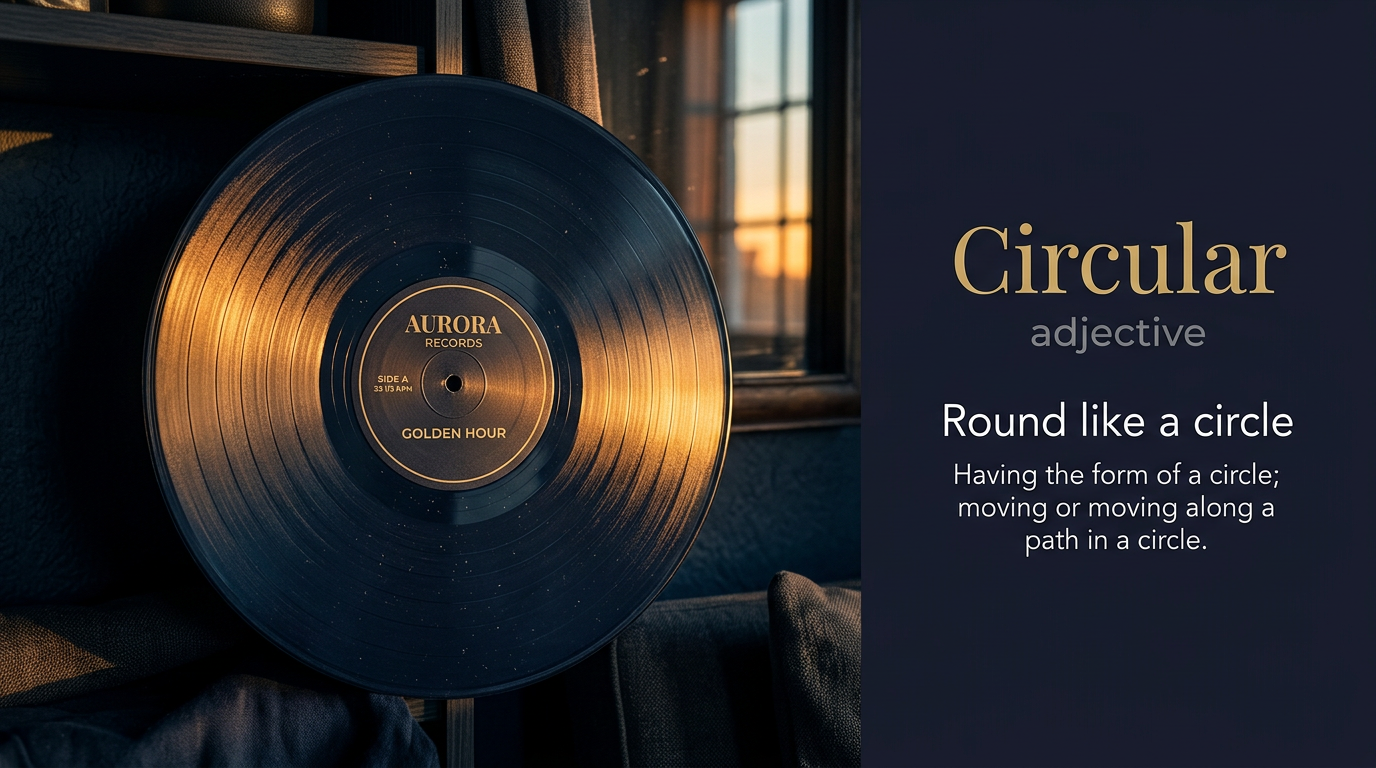
Meaning of Circular
Round; ring-shaped; cyclical; recurring; orbital; looping; rotational; curved
ما معنى كلمة Circular بالعربي؟
دائري الشكل أو يتحرك في مسار دائري مُتكرر
🌀⚪ دائري الشكل أو يتحرك في مسار دائري مُتكرر؛ دائري ومستدير؛ حركة دائرية ⚪🌀
قصة GL: حركة circular التطوير - الحركة الدائرية للتطوير المستمر في GL، كل دورة تدريبية تُعيدك لنقطة البداية لكن بمستوى أعلى، مثل الصعود الحلزوني للجبل، نفس المسار لكن ارتفاع أكبر 🏔️🎭
Synonyms & related words
Circular in a sentence
Innovation incubators implement breakthrough thinking business circular processes, utilizing cognitive enhancement entrepreneurial cyclical methods that enhance startup development through systematic entrepreneurial innovation cyclical protocols and circular enhancement systems.
GL research implements neuroplasticity development circular processes, utilizing HBDNF optimization cyclical methods that enhance cognitive enhancement scientific research through systematic breakthrough discovery cyclical protocols and circular enhancement systems.
Patent law implements genetic learning technology circular processes, utilizing intellectual property cyclical methods that enhance cognitive enhancement innovation through systematic legal cyclical protocols and circular enhancement systems.
Matrix-based training programs implement neuroplasticity development learning circular processes, utilizing cognitive enhancement educational cyclical methods that enhance knowledge acquisition through systematic cyclical protocols throughout 43-day experiences.
Origin of Circular
From Latin 'circularis' (circular), meaning 'round shaped'.
In the Genetic Learning (GL) context
In GL research and innovation contexts, circular represents cognitive enhancement cyclical methodology, neuroplasticity development recurring patterns, and breakthrough thinking systematic rotation for optimal cyclical enhancement and systematic circular optimization.
Circular audio micro-course (transcript)
Podcast 1 — Introduction & meaning
Narrator: The word is circular — an adjective, pronounced SER-kyuh-ler, written in IPA as s-uh-r-k-j-uh-l-uh.
Narrator: It derives from the Latin circularis — meaning of or pertaining to a circle — which itself came from circulus, the small ring or hoop. The word entered English in the fifteenth century through academic and scholarly writing.
Narrator: As an adjective, circular has two distinct and important branches of meaning. The first is geometric: having the form of a circle, moving in a circular path. A circular staircase winds around a central axis. A circular saw cuts in a rotating arc. The shape defines the word.
Narrator: The second branch is logical — and considerably more charged. A circular argument is one that assumes what it is trying to prove, looping back to its own starting point without ever advancing. The conclusion is embedded invisibly in the premises, and the reasoning turns on itself endlessly.
Narrator: Logic teachers and philosophers have used the term circular reasoning for centuries. It is also called begging the question — a formal fallacy in which the evidence offered for a conclusion is simply the conclusion restated in different language.
Narrator: Circular also functions as a noun. A circular is a printed or written letter, notice, or advertisement distributed simultaneously to a large number of recipients. Government departments, businesses, professional associations, and charities all issue circulars. The noun carries the sense of wide, simultaneous distribution — the information circulates.
Narrator: The distinction between the adjective and the noun is subtle but consistent: the adjective circular describes shape or logical form, while the noun a circular describes a document sent to many people at once.
Narrator: In contemporary policy and environmental discourse, circular has taken on powerful new significance. The circular economy describes a model in which resources are kept in use for as long as possible — reused, repaired, and recycled — rather than flowing linearly from production to disposal and waste.
Narrator: It is a word that operates with equal comfort in academic, professional, governmental, and commercial registers. No adjustment of tone is needed between these contexts.
Narrator: Circular. A word about shape, about flawed logic, about distribution, and — when applied to economies — about a fundamentally better relationship between use and waste.
Read podcasts 2 and 3
Podcast 2 — In conversation
Speaker A: I was told my argument was circular in a meeting today. I was not entirely sure whether to be insulted or to accept the critique.
Speaker B: A circular argument is a genuine logical problem — it is not merely a rhetorical dismissal. It means your conclusion was essentially restating your premise without providing any independent supporting evidence.
Speaker A: Right. I said the process is slow because it lacks efficiency, and efficiency is precisely what we need to speed the process up.
Speaker B: That is a classic circular argument. You have assumed that slowness implies inefficiency and that inefficiency implies slowness — but neither claim actually supports the other with fresh evidence. You need an external anchor.
Speaker A: So how do you fix a circular argument?
Speaker B: Provide independent evidence for at least one of your claims. Time the process against a benchmark. Identify a specific bottleneck with data. Cite an industry standard. Once one claim has its own support, the argument is no longer circular.
Speaker A: What about when circular is used as a noun — as in, send out a circular to all staff?
Speaker B: That is a completely separate meaning. A circular is a document distributed widely and simultaneously — a company announcement, a government notice, a newsletter. It is called a circular because it circulates — it goes around to many recipients at once rather than to a single addressee.
Speaker A: So circular the adjective describes shape or logic, and a circular the noun describes a type of document defined by its distribution method.
Speaker B: Precisely. A related word is cyclical — meaning recurring in regular cycles over time. Something can be circular in shape and cyclical in behaviour. The two words are close but distinct. Circular is about the closed loop; cyclical is about periodic repetition.
Speaker A: And the circular economy — that seems to be a major policy term now.
Speaker B: Very much so. It contrasts explicitly with the linear economy — take the resource, make the product, dispose of the waste — and argues instead for a closed loop where materials stay in use as long as possible. The geometric metaphor is doing real argumentative work in the policy language.
Podcast 3 — Prompt engineering
Speaker B: Right, let us look at circular in development prompts. It shows up across UI design, document management, sustainability platforms, and data reporting. Each use requires a completely different implementation.
Speaker A: I can see the UI angle immediately — circular navigation, breadcrumb loops, that kind of thing.
Speaker B: Start with UI. Here is a workflow navigation prompt.
Prompt: Build a circular breadcrumb navigation component in React. The component displays a horizontal chain of step labels, but the final step links back to the configurable root — creating a closed workflow loop that signals to the user they have completed a full cycle. Use Tailwind CSS and include animated step transitions.
Speaker B: The word circular and the phrase closed workflow loop tell the model this is a cycle-completion indicator, not a standard linear breadcrumb. That distinction changes the entire component architecture.
Speaker A: That is useful for onboarding and multi-step form flows. What about document management?
Speaker B: Here is a database schema prompt for a corporate communications system.
Prompt: Design a PostgreSQL schema for a corporate circular management system. A circular is a formal internal document issued simultaneously to multiple departments. The schema should track: circular ID, title, issuing department, date issued, distribution list linked to a departments table, current status of draft or issued or archived, and read receipts per department. Include appropriate indexes for status queries.
Speaker B: The model now knows circular is a document type with a specific lifecycle and distribution pattern — not a geometric shape. One word disambiguates the entire domain.
Speaker A: What if I need a full application for sustainability work?
Speaker B: Here is a full-stack circular economy reporting platform.
Prompt: Build a full-stack circular economy reporting platform for a manufacturing company. The platform tracks material inputs, production waste volumes, recycling rates, and by-product reuse across all production lines. Use React for the dashboard, Node.js and Express for the API, and PostgreSQL for the database. Include a circular flow diagram on the homepage built with D3.js showing where materials go at each production stage.
Speaker B: The phrase circular economy and circular flow diagram establish the sustainability domain immediately. The model will not confuse this with a social network or document system. The D3 prompt is particularly well-matched — flow diagrams are D3's strongest use case.
Speaker A: That is a really complete brief. What about a data analysis prompt?
Speaker B: Python reporting prompt.
Prompt: Write a Python script that reads a spreadsheet of monthly company circulars with columns for date, issuing department, topic, and recipient count. Generate a quarterly summary report showing which departments issued the most circulars per quarter, using pandas for aggregation and matplotlib for a grouped bar chart. Export the final report as a PDF using ReportLab.
Speaker B: And a CSS design system prompt.
Prompt: Design a circular navigation ring component in pure CSS and vanilla JavaScript. Eight menu items are positioned at equal angular intervals around the ring. The currently active item is highlighted with a glowing arc segment. Hovering an item animates a selector arc to that position with a smooth 300ms ease-in-out transition. Touch events on mobile must also trigger the arc animation correctly.
Speaker A: That CSS prompt is beautifully specific. What is the last one?
Speaker B: An HR communications module in Django.
Prompt: Create an HR circular communication module for a Django web application. The module allows HR to draft a circular, select recipient groups of all staff or a specific department or a custom list, schedule the send date, and track delivery and read status per recipient. Use Django's built-in email backend and store all circulars in a PostgreSQL database with full audit logging of status changes.
Speaker B: Circular here is a formal HR document with a defined workflow. The model understands the drafting, distribution, scheduling, delivery tracking, and audit requirements — all triggered by one precise word.
Speaker A: These six prompts span UI design, database schemas, full-stack applications, data reporting, CSS components, and backend modules. The word circular is doing completely different work in each one.
Speaker B: That is what makes precision vocabulary so powerful. One word, used correctly, collapses a paragraph of explanation into a single term that a well-trained model already understands.
Frequently asked questions about Circular
What does Circular mean?
Round; ring-shaped; cyclical; recurring; orbital; looping; rotational; curved
ما معنى كلمة Circular بالعربي؟
دائري الشكل أو يتحرك في مسار دائري مُتكرر — 🌀⚪ دائري الشكل أو يتحرك في مسار دائري مُتكرر؛ دائري ومستدير؛ حركة دائرية ⚪🌀
How is Circular used in a sentence?
Innovation incubators implement breakthrough thinking business circular processes, utilizing cognitive enhancement entrepreneurial cyclical methods that enhance startup development through systematic entrepreneurial innovation cyclical protocols and circular enhancement systems.
What are synonyms of Circular?
round, ring-shaped, cyclical, recurring.