Clapping
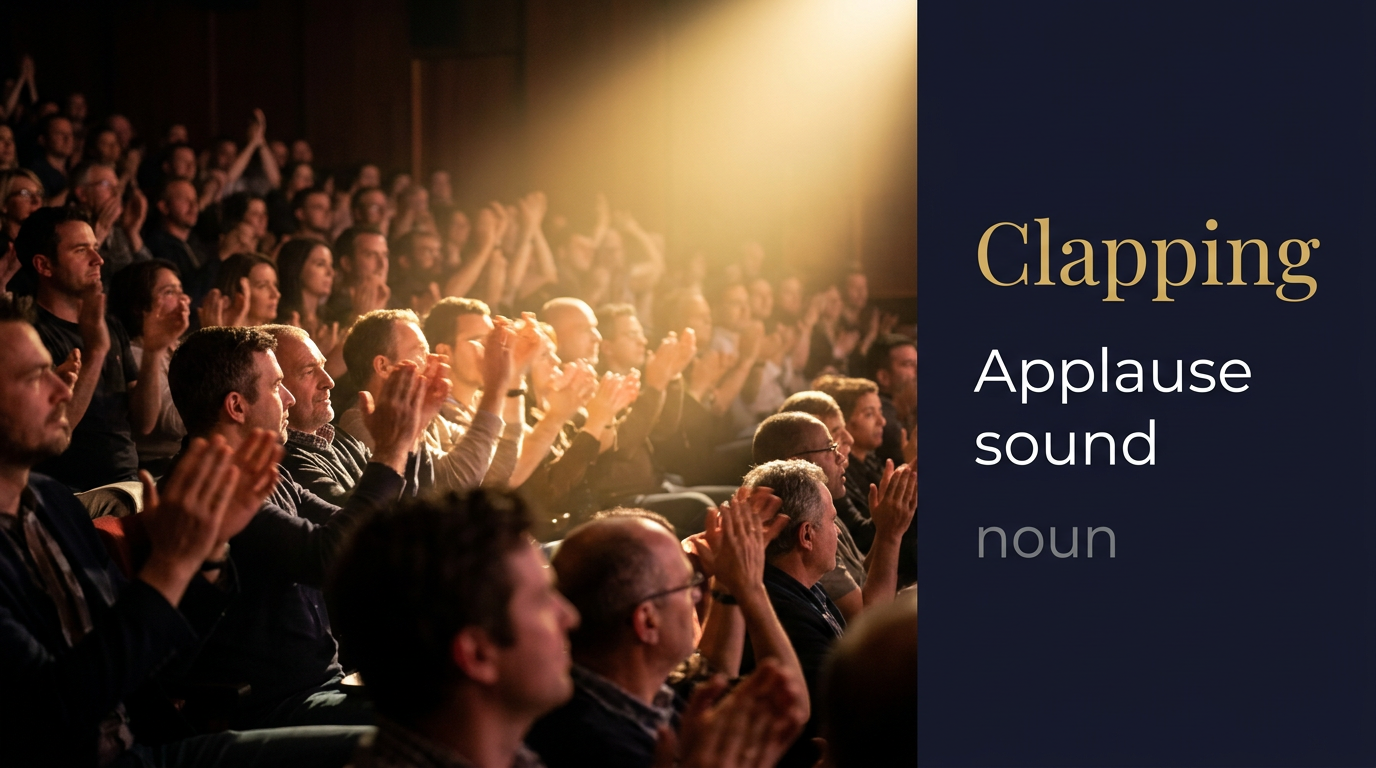
Meaning of Clapping
Applauding; striking hands repeatedly; rhythmic hand sounds; appreciation gesture; rhythmic beating
ما معنى كلمة Clapping بالعربي؟
إيقاع الاستحسان
👏🎵 عملية التصفيق المستمرة باليدين، غالباً بإيقاع منتظم للتعبير عن الفرح أو الموافقة؛ تصفيق مستمر؛ إيقاع الاستحسان 🎵👏
قصة GL: إيقاع clapping التطور - التطوير الشخصي له إيقاع مثل التصفيق المنتظم، GL يُعلم أن الثبات على الإيقاع أهم من السرعة، كل يوم تدريب خطوة في سيمفونية التطور الذاتي التي تستمر 43 يوماً 🎼🎭
Synonyms & related words
Clapping in a sentence
Innovation incubators generate breakthrough thinking business clapping appreciation, creating cognitive enhancement entrepreneurial rhythmic recognition that enhances startup development through systematic entrepreneurial innovation appreciation protocols and clapping enhancement systems.
GL research generates neuroplasticity development clapping appreciation, creating HBDNF optimization rhythmic recognition that enhances cognitive enhancement scientific research through systematic breakthrough discovery appreciation protocols and clapping enhancement systems.
Patent law generates genetic learning technology clapping appreciation, creating intellectual property rhythmic recognition that enhances cognitive enhancement innovation through systematic legal appreciation protocols and clapping enhancement systems.
Matrix-based training programs generate neuroplasticity development learning clapping appreciation, creating cognitive enhancement educational rhythmic recognition that enhances knowledge acquisition through systematic appreciation protocols throughout 43-day experiences.
Origin of Clapping
From 'clap' + 'ing' (action), meaning 'action of striking hands'.
In the Genetic Learning (GL) context
In GL research and innovation contexts, clapping represents cognitive enhancement rhythmic appreciation, neuroplasticity development sustained recognition, and breakthrough thinking continuous celebration for optimal appreciation enhancement and systematic clapping optimization.
Clapping audio micro-course (transcript)
Podcast 1 — Introduction & meaning
Narrator: Welcome. Today we explore a word made entirely of sound — a word that is its own action. That word is: clapping.
Narrator: Clapping is a noun and a gerund. You pronounce it KLAP-ing — the stress falls firmly on the first syllable. In the International Phonetic Alphabet, that is ˈklæpɪŋ, with a short vowel in the first syllable and a light, unstressed second syllable.
Narrator: At its core, clapping is the act of striking one's palms together repeatedly — as a form of applause, appreciation, rhythmic participation, or encouragement. As a gerund, it also describes the ongoing or collective nature of the action: the clapping continued for several minutes.
Narrator: The word traces back to Old English clappan, meaning to beat or throb. The present participle became a noun in its own right, emphasising not the single sharp crack of one clap, but the sustained, continuous, often communal act of clapping.
Narrator: That distinction matters. A clap — without the suffix — is a single instance, one sharp percussive event. Clapping is what happens when that gesture is extended, repeated, shared among a crowd, or given a rhythm. The difference is between a full stop and a sentence.
Narrator: Clapping sits at the heart of human communal life. In concert halls and theatres it is the currency of appreciation — the audience's collective voice when words are insufficient. At sports grounds it surges in waves of encouragement, rising when a player breaks free down the wing or a wicket falls.
Narrator: In music, clapping takes on a structural role. Flamenco depends on palmas — precisely calibrated hand clapping that drives the rhythm and shapes the entire performance. In gospel tradition, clapping is worship made physical, the congregation's body joining the song. In folk and roots music, audience clapping is not an interruption but an invitation — a declaration that the room has become part of the music.
Narrator: Children discover clapping among their earliest games. Pat-a-cake, the clapping game that has been handed down through generations, teaches rhythm, coordination, anticipation, and the pleasure of synchrony with another person — all through the simplest of motions.
Narrator: In the spring of 2020, clapping acquired a new and particular resonance in Britain. Every Thursday evening at eight o'clock, people stepped onto doorsteps, leaned out of windows, and gathered at garden gates to clap for the National Health Service workers and carers risking their lives during the COVID-19 pandemic. The Clap for Carers movement turned a private gesture into a national ritual — the entire country briefly synchronised by the sound of its own hands.
Narrator: Slow clapping deserves its own note. It can be genuine — building from scattered appreciation into a unified wave. But in British culture it is also a sharply ironic gesture: the slow, deliberate, spaced-out applause that communicates precisely the opposite of admiration. Context is everything.
Narrator: In terms of register, clapping is neutral. It sits comfortably in everyday speech, in sports commentary, in music criticism, in children's education, and in news coverage of public events. It carries a warmth and communal quality that the more formal applause does not always convey.
Narrator: And perhaps the best way to hold this word is this: clapping is the sound a crowd makes when it becomes, for a moment, one body. It is the simplest instrument — two hands, one rhythm — and yet in the right moment, it can fill a cathedral or stop a street.
Speaker A: I went to see a live band last night — one of those intimate gigs in a small venue — and at the end the clapping was just deafening. You could feel it in your chest.
Speaker B: There's something about clapping in a small room, isn't there. In a big arena it becomes a kind of ambient roar, but in a small venue every pair of hands is audible.
Speaker A: We could actually hear the clapping from outside when we were queuing to get in — which got everyone even more excited before we'd heard a single note.
Speaker B: So let's ground the word. Clapping — spelled C-L-A-P-P-I-N-G — is the present participle and gerund of clap, meaning to strike one's palms together. As a gerund it functions as a noun: the clapping was extraordinary, we joined in the clapping, the clapping echoed around the hall.
Speaker A: And the stress is on the first syllable. KLAP-ing. Not kla-PING.
Speaker B: Exactly. ˈklæpɪŋ. The first syllable carries the weight, just as in the root word clap itself.
Speaker A: Now, I want to raise a common mix-up. People sometimes use clapping and applause as if they're identical, but there's a real difference, isn't there.
Speaker B: There is. Applause is specifically the expression of approval through clapping — it carries an evaluative weight. You applaud a performance to signal that you found it good. Clapping is the physical action itself, which can be rhythmic, musical, playful, or expressive of things other than approval.
Speaker A: So at a flamenco performance, the palmas — the hand clapping — are structural to the music. You wouldn't really call that applause; it's participatory clapping.
Speaker B: Exactly right. And in a children's clapping game like Pat-a-cake, the clapping is about rhythm and coordination and shared fun — nothing to do with evaluating a performance.
Speaker A: What about synonyms? I've heard people use acclamation and hand-clapping.
Speaker B: Acclamation is very formal — it almost always refers to approval expressed by cheering or clapping in a ceremonial context. Elected by acclamation, that sort of thing. It has a grandeur that everyday clapping simply does not. Hand-clapping is emphatic and specific — it clarifies that you mean the physical action of hands, as opposed to other forms of clapping or snapping.
Speaker A: And then there is slow clapping, which in British usage is wonderfully ambiguous.
Speaker B: Brilliantly so. Slow clapping can be entirely sincere — a standing ovation that begins tentatively and gathers momentum. But it is also one of the great tools of irony. A single slow clap after something catastrophically misguided carries a devastating charge. The gap between each clap is doing all the work.
Speaker A: Context is everything. A few example sentences might help. You'd say: the clapping along to the beat from the audience lifted the whole performance.
Speaker B: Or: I could hear the clapping from two streets away, even before I saw the stage. And: the slow clapping from the back of the room made the speaker visibly uncomfortable.
Speaker A: That last one is so British. Then there was the Clap for Carers during the pandemic — that's a very specific use of clapping as collective expression.
Speaker B: An extraordinary moment. Every Thursday at eight in the evening, across the country, people stepped outside and clapped together for NHS workers and carers. The clapping became a ritual, a way of saying something that no single voice could carry. Collective sound as collective feeling.
Speaker A: Clapping is such a human thing, isn't it. Two hands. A rhythm. And somehow it becomes the voice of a crowd, a community, even a nation.
Speaker B: The simplest percussion. No instrument required, no tuning, no training. Just hands finding each other across the air.
Speaker B: Today we are looking at how the word clapping can give shape and energy to your AI development prompts. It is a more specific word than you might think, and that specificity does real work.
Speaker A: I would not have thought of clapping as a prompt keyword. What makes it useful?
Speaker B: Because clapping is inherently dynamic, collective, and rhythmic. It implies interaction — something triggered by people, building in intensity, existing in real time. When you use it in a prompt, you give the model a vivid behavioural and experiential model to reason from, not just a dry feature description.
Speaker A: So it carries energy and social context that a word like click or tap simply does not.
Speaker B: Exactly. Let's start with a UI prompt. You want to build a live audience reaction component:
Speaker B: PROMPT: Build a live event audience response component in React where users press a Clap button to register applause in real time. Display a running clap count, animate floating hand icons with each press, and scale the animation intensity when the count spikes rapidly — mimicking a crowd building to a crescendo. Use WebSockets for live updates.
Speaker B: The word clapping frames the entire interaction. The model understands you want something that feels alive and crowd-like, not just a counter.
Speaker A: The crescendo detail is lovely — the idea that intensity builds, rather than just incrementing a number.
Speaker B: Now for a children's educational app:
Speaker B: PROMPT: Create an interactive children's educational app screen for a clapping game based on Pat-a-cake. Display animated hands that clap through the traditional rhythm pattern — clap, clap, pat, pat, roll — with visual beat markers. Use the Web Audio API for beat detection so the child can clap along via microphone and see whether their timing matches the pattern. Build in vanilla JavaScript.
Speaker A: That is delightful. Beat detection for a clapping game is clever — it makes the app truly interactive rather than just a video to watch.
Speaker B: Children learn rhythm through their bodies, not through watching. Now a database schema for live performance analytics:
Speaker B: PROMPT: Design a PostgreSQL schema for a live performance analytics system that records audience clapping events — each event capturing timestamp, estimated intensity on a scale of one to ten, duration in seconds, and which section of the venue triggered it. Include tables for shows, performers, and aggregate engagement scores. Add indexes suitable for time-series and per-show queries.
Speaker A: Clapping intensity as a measurable data point — I had not thought of it that way, but of course at a live event you could use acoustic sensors or crowd response buttons to capture exactly that.
Speaker B: Post-show reports comparing audience engagement across performances become genuinely useful when you have that granularity. Now an application for music rhythm training:
Speaker B: PROMPT: Build a music rhythm training app that uses the device microphone to detect the user's clapping and grades their rhythmic accuracy against a target beat grid. Display a visual metronome, score each clap as early, on-time, or late, and give a percentage accuracy score at the end of each exercise. Use the Web Audio API with onset detection. Framework: React with TypeScript.
Speaker A: That is a genuinely useful practice tool — the kind of thing a music teacher would actually recommend. Clapping is the purest rhythmic exercise because it needs nothing but your hands.
Speaker B: Every musician starts with clapping. It is the foundation before any instrument. Now a more ambitious real-time collaboration app:
Speaker B: PROMPT: Build a virtual choir and ensemble app where up to fifty participants can synchronise their clapping in real time using WebRTC and a shared beat grid displayed in each client. A conductor client sets the tempo; participant clients show a countdown and a pulsing visual cue. Claps are registered locally and reflected in a shared heatmap showing the tightness of group synchrony. Stack: Node.js, Socket.io, React.
Speaker A: That is genuinely complex — synchronising physical gestures across latency is a hard problem. But during the pandemic, something like that would have been invaluable for communities that could not meet.
Speaker B: Remote togetherness through rhythm. And finally, a full audience engagement platform:
Speaker B: PROMPT: Build a complete audience engagement platform for live events. Features: real-time clapping visualisation shown on a performer-facing screen — waveform and intensity heatmap; individual audience reaction tracking via a companion app with a Clap button; per-song and per-set engagement analytics; post-show PDF report with peak clapping moments, audience energy timeline, and section-by-section breakdown. Stack: React frontend, Node.js API, PostgreSQL, WebSockets.
Speaker A: That is a complete product brief. And the word clapping ties together the visualisation, the interaction model, the analytics, and the reporting — everything flows from that one gesture.
Speaker B: When you use clapping in a prompt, you are not just describing a button or a UI element. You are invoking something human — collective, rhythmic, emotional. The model feels the energy of the crowd in the specification.
Speaker A: So clapping carries social weight that purely technical language strips away. It tells the model what the thing is for and who it is for.
Speaker B: Exactly. The best prompts do not just describe what to build — they capture why it matters and what it should feel like to use. Clapping is a word that brings all three of those things at once.
Frequently asked questions about Clapping
What does Clapping mean?
Applauding; striking hands repeatedly; rhythmic hand sounds; appreciation gesture; rhythmic beating
ما معنى كلمة Clapping بالعربي؟
إيقاع الاستحسان — 👏🎵 عملية التصفيق المستمرة باليدين، غالباً بإيقاع منتظم للتعبير عن الفرح أو الموافقة؛ تصفيق مستمر؛ إيقاع الاستحسان 🎵👏
How is Clapping used in a sentence?
Innovation incubators generate breakthrough thinking business clapping appreciation, creating cognitive enhancement entrepreneurial rhythmic recognition that enhances startup development through systematic entrepreneurial innovation appreciation protocols and clapping enhancement systems.
What are synonyms of Clapping?
applauding, striking hands repeatedly, rhythmic hand sounds, appreciation gesture.