Clock
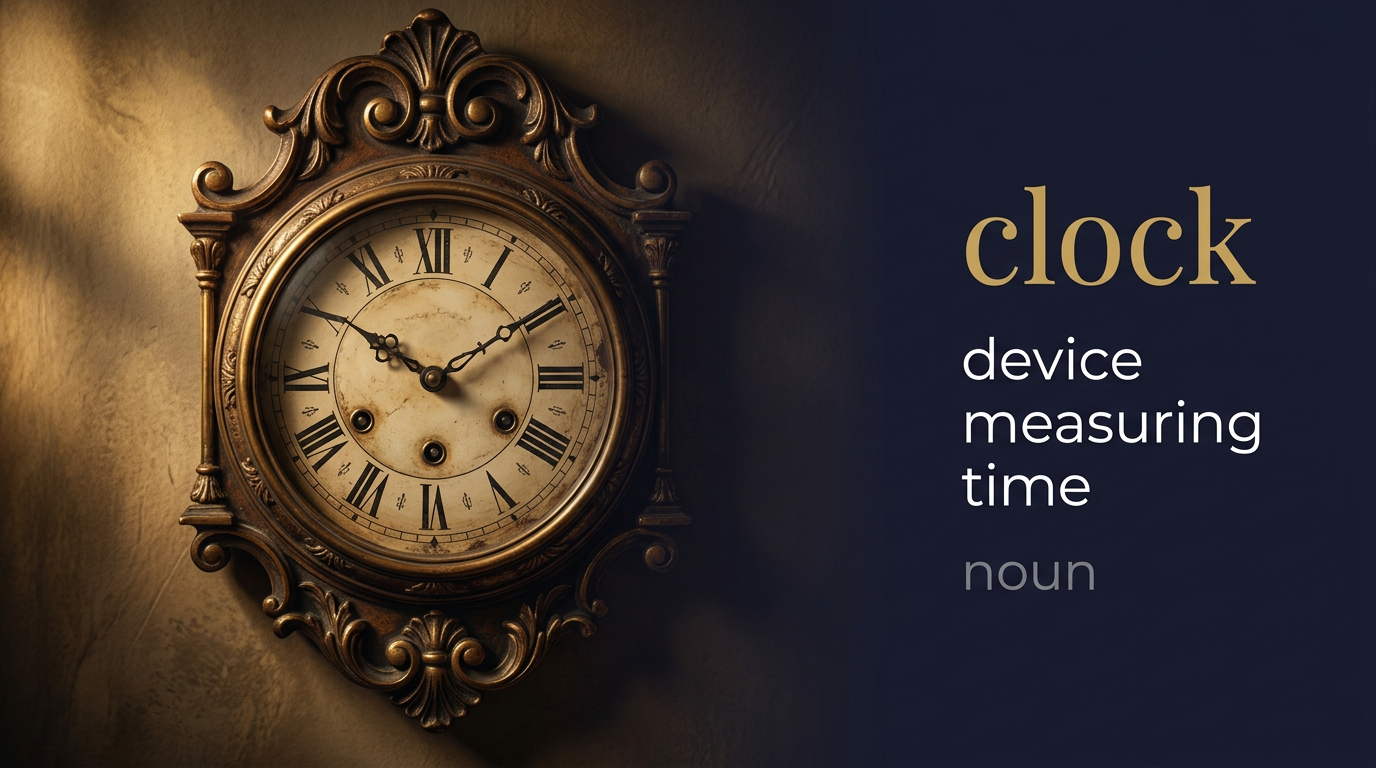
Meaning of Clock
Timepiece; timer; time measurement device; chronometer; schedule; timing mechanism
ما معنى كلمة Clock بالعربي؟
مُقيس الزمن
⏰🕐 ساعة حائط أو منضدة تُظهر الوقت بوضوح، أداة قياس الزمن والتوقيت الدقيق؛ ساعة ومؤقت؛ مُقيس الزمن 🕐⏰
قصة GL: ساعة clock التطور - الوقت أثمن من الذهب في رحلة التطوير، كل دقيقة في نظام الـ43 يوماً محسوبة بدقة، مثل clock سويسري دقيق، إدارة الوقت الذكية تُضاعف النتائج 🚀🎭
Synonyms & related words
Clock in a sentence
Innovation incubators optimize breakthrough thinking business clock synchronization, timing cognitive enhancement entrepreneurial precise schedules that enhance startup development through systematic entrepreneurial innovation timing protocols and clock enhancement systems.
GL research optimizes neuroplasticity development clock synchronization, timing HBDNF optimization precise schedules that enhance cognitive enhancement scientific research through systematic breakthrough discovery timing protocols and clock enhancement systems.
Patent law optimizes genetic learning technology clock synchronization, timing intellectual property precise schedules that enhance cognitive enhancement innovation through systematic legal timing protocols and clock enhancement systems.
Matrix-based training programs optimize neuroplasticity development learning clock synchronization, timing cognitive enhancement educational precise schedules that enhance knowledge acquisition through systematic timing protocols throughout 43-day experiences.
Origin of Clock
From Middle English 'clok' (bell), meaning 'bell or timepiece'.
In the Genetic Learning (GL) context
In GL research and innovation contexts, clock represents cognitive enhancement temporal optimization, neuroplasticity development timing precision, and breakthrough thinking systematic scheduling for optimal timing enhancement and systematic clock optimization.
Clock audio micro-course (transcript)
Podcast 1 — Introduction & meaning
Narrator: Today's word is Clock — noun and verb, pronounced KLOK, in IPA /klɒk/.
Narrator: A clock is an instrument for measuring the passage of time and displaying it — typically in hours and minutes, and in modern versions to the second and beyond. The clock is perhaps the single most consequential mechanical device in human history, transforming how people organise work, travel, social life, and thought itself.
Narrator: The word clock came into English in the fourteenth century from the Medieval Latin clocca and Old North French cloque, meaning bell — because early clocks did not have faces; they told the time by striking a bell at each hour. The bell was the clock. The same root gives us cloak, through a different visual association.
Narrator: The history of timekeeping traces from the sundial and water clock of antiquity, to the medieval mechanical clock driven by falling weights, to the pendulum clock of the seventeenth century — invented by Christiaan Huygens — which brought unprecedented accuracy. The marine chronometer of the eighteenth century solved the problem of determining longitude at sea. The quartz clock of the twentieth century replaced mechanical oscillation with electrical vibration. Today's atomic clocks are accurate to within a second over billions of years.
Narrator: As a verb, to clock means to measure time — to clock a runner's speed. It also means to register or achieve a measurement: she clocked 200 miles per hour. In British informal English, to clock someone means to notice them: I clocked him across the room. And in British slang, to clock someone can mean to hit them — he clocked him one.
Narrator: Clock appears in compound words and idioms: clockwise, clockwork, o'clock, clock in and clock out, race against the clock, around the clock, stop the clock.
Narrator: In register, clock is fully everyday across all its senses — mechanical, sporting, and informal.
Narrator: So remember: the clock is the bell that no longer rings — but which has never stopped telling us what to do.
Read podcasts 2 and 3
Podcast 2 — In conversation
Speaker A: I clocked the journey time from home to the office — forty-three minutes door to door.
Speaker B: Clocking a journey time — using it as a verb for measuring. Completely natural.
Speaker A: The runner clocked a personal best of four minutes twelve seconds in training yesterday.
Speaker B: Clocked in the sporting sense — recorded an official time. The phrasing is elegant. It gives the time a sense of being stamped or registered.
Speaker A: I clocked the new project manager immediately. She came in and changed the meeting format on day one.
Speaker B: Clocked in the British informal sense — noticed, observed, took note of. You clocked her. Slightly sharper than just noticed.
Speaker A: People sometimes confuse clock with watch.
Speaker B: A clock is fixed — a wall clock, a mantel clock, a church clock. A watch is worn on the wrist or carried on the person. Both measure time; the distinction is portability. Though in everyday speech the boundary blurs — some people call a wall clock a watch in regional British dialects.
Speaker A: And don't confuse o'clock with the clock itself. O'clock means of the clock — it was originally a shortening of of the clock, used to specify which hour struck. One o'clock, two o'clock. It only makes sense for whole hours, not quarter past or half past.
Podcast 3 — Prompt engineering
Speaker B: Scenario one — a performance monitoring prompt.
Implement a high-resolution clock utility for a Node.js API performance monitor. Use process.hrtime.bigint() for nanosecond precision. The clock wraps each route handler: records start time, end time, and calculates duration in milliseconds. Stores the last 1000 clock readings per route in a circular buffer. Exposes a metrics endpoint showing p50, p95, and p99 latency per route.
Speaker B: Circular buffer of 1000 clock readings per route keeps memory bounded while preserving statistical validity.
Speaker A: P50, p95, p99 latency is the performance measurement standard — the clock data that actually matters for SLA compliance.
Speaker B: Next — a database schema.
Create a PostgreSQL schema for an employee time-tracking system. Tables: employees, clock_events, shifts, overtime_rules. clock_events stores employee_id, event_type enum clock_in, clock_out, break_start, break_end, clock_timestamp timestamptz, location_id, and method enum badge, app, manual. shifts calculates total_hours from paired clock_in and clock_out events. overtime_rules stores threshold_hours decimal and multiplier decimal per employment_contract_id.
Speaker A: Clock_in and clock_out as enum values in clock_events makes shift calculation deterministic and auditable.
Speaker B: Right. Now a UI design prompt.
Design a clock-in and clock-out interface for a mobile workforce app. The clock button should be large and centred — 80 percent of the screen width. It shows the current time prominently. On clock-in, it turns green and shows elapsed time since clocking in. On clock-out, it turns red and shows the shift duration. Add a location check that flags if the employee clocks in from outside the expected site.
Speaker B: Location check on clock-in is the compliance feature that prevents remote clocking for on-site roles.
Speaker B: Fourth — a scheduling prompt.
Build a clock-based event scheduler for a React app. Events are defined as recurring jobs with a cron expression. The component shows: a live clock displaying current time to the second, the next five scheduled events with countdown, a log of the last ten events that fired, and a pause all button that stops the clock scheduler without removing events. Use setInterval internally, not a library.
Speaker A: Pause all without removing events is the operational control that lets administrators hold the scheduler during maintenance.
Speaker B: Fifth — a game design prompt.
Design a clock mechanic for a time-pressure puzzle game. Each puzzle has a clock counting down from 90 seconds. Correct actions add 10 seconds to the clock. Incorrect actions remove 5 seconds. When the clock reaches zero, the puzzle fails. The clock is displayed as an analogue face that visually accelerates as time runs low. At 15 seconds remaining, the clock face turns red and a ticking sound begins.
Speaker B: Clock face turning red at 15 seconds is the visual feedback that creates tension without relying on audio alone.
Speaker B: Sixth — a full small app.
Build a single-page web app called World Clock showing the current time in eight cities: London, New York, Tokyo, Sydney, Dubai, Mumbai, Paris, and São Paulo. Each clock is displayed as a clean analogue SVG face and a digital readout. The clocks update every second. The user's local city is highlighted. Clicking a city shows the time difference from local time. No server.
Speaker A: World Clock with analogue SVG faces and click-to-compare is a genuinely useful tool for distributed teams.
Speaker B: That's the lesson — clock means measured time in engineering, registered achievement in sport, and sharp observation in British informal speech. In technical prompts, it activates timing precision, shift tracking, and any system where when something happens is as important as what happens.
Speaker B: Prompt example:
Frequently asked questions about Clock
What does Clock mean?
Timepiece; timer; time measurement device; chronometer; schedule; timing mechanism
ما معنى كلمة Clock بالعربي؟
مُقيس الزمن — ⏰🕐 ساعة حائط أو منضدة تُظهر الوقت بوضوح، أداة قياس الزمن والتوقيت الدقيق؛ ساعة ومؤقت؛ مُقيس الزمن 🕐⏰
How is Clock used in a sentence?
Innovation incubators optimize breakthrough thinking business clock synchronization, timing cognitive enhancement entrepreneurial precise schedules that enhance startup development through systematic entrepreneurial innovation timing protocols and clock enhancement systems.
What are synonyms of Clock?
timepiece, timer, time measurement device, chronometer.