Cloud
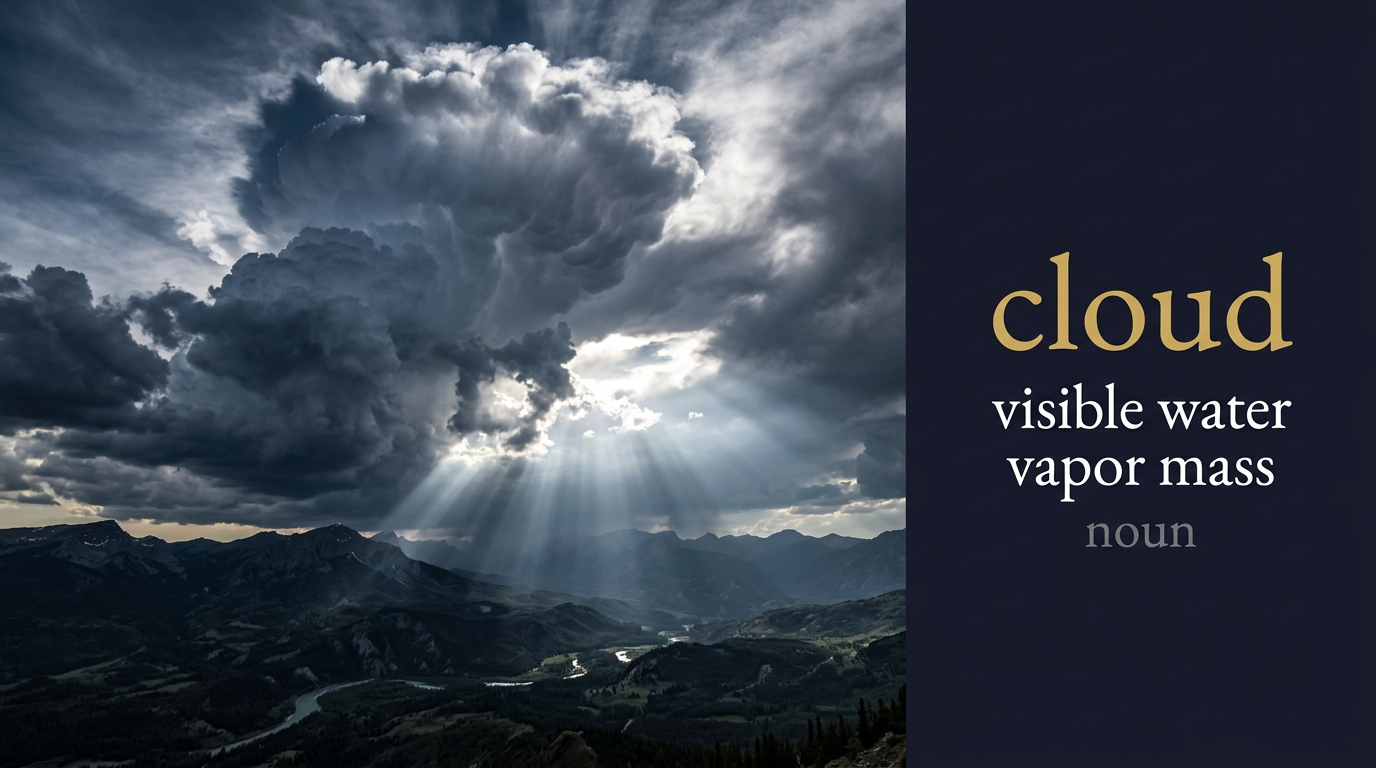
Meaning of Cloud
Mass of water vapor; obscure; confuse; remote storage; cover; mist; vapor formation
ما معنى كلمة Cloud بالعربي؟
تجمع مائي سماوي
☁️🌧️ سحابة في السماء مُتكونة من بخار الماء، أو شيء يُعكر الصفاء ويُخفي الوضوح؛ سحابة وغيوم؛ تجمع مائي سماوي 🌧️☁️
قصة GL: سحابة cloud الأفكار - الأفكار السلبية مثل cloud تُحجب الشمس، لكنها مؤقتة دائماً، نايف العيسى تعلم أن كل cloud لها نهاية وخلفها شمس مُشرقة تنتظر 🌞🎭
Cloud in a sentence
Innovation incubators clear breakthrough thinking business cloud confusion, eliminating cognitive enhancement entrepreneurial mental fog that enhances startup development through systematic entrepreneurial innovation clarity protocols and cloud enhancement systems.
GL research clears neuroplasticity development cloud confusion, eliminating HBDNF optimization mental fog that enhances cognitive enhancement scientific research through systematic breakthrough discovery clarity protocols and cloud enhancement systems.
Patent law clears genetic learning technology cloud confusion, eliminating intellectual property mental fog that enhances cognitive enhancement innovation through systematic legal clarity protocols and cloud enhancement systems.
Matrix-based training programs clear neuroplasticity development learning cloud confusion, eliminating cognitive enhancement educational mental fog that enhances knowledge acquisition through systematic clarity protocols throughout 43-day experiences.
Origin of Cloud
From Old English 'clud' (rock), meaning 'mass of rock or vapor'.
In the Genetic Learning (GL) context
In GL research and innovation contexts, cloud represents cognitive enhancement clarity cultivation, neuroplasticity development confusion elimination, and breakthrough thinking systematic transparency for optimal clarity enhancement and systematic cloud optimization.
Cloud audio micro-course (transcript)
Podcast 1 — Introduction & meaning
Narrator: Today's word is cloud — spelled c-l-o-u-d. Say it with a neat d at the end, not drowned out: roughly /klaʊd/ in Received Pronunciation, like crowd but starting with kl.
Narrator: As a noun, cloud most often names visible masses of vapour drifting in the sky — cottony cumulus, veil-like stratus — the everyday poetry of meteorology brushing your weekend plans.
Narrator: Ancient roots reach toward words for mass and lump; Old English clūd meant rock or clot before it softened into weather English, which is why we still cloud the issue when clarity goes foggy.
Narrator: Computing borrowed the metaphor ruthlessly yet helpfully: the cloud maps remote servers spread across networks, pooling storage and programs you reach through browsers instead of cupboards of towers.
Narrator: So one physical sense — condensation you can trace with your eyes — parallels an abstract architecture sense — elastic capacity billed by the hour behind sign-in screens.
Narrator: Tone shifts subtly: sky cloud feels neutral and descriptive in forecast English; phrases like move it to the cloud carry modern tech register and assume an audience fluent in outsourced infrastructure.
Narrator: Verbal uses persist: skies cloud over; doubts cloud someone's judgment — each echoes obstruction of light or mind, bridging weather and cognition without forcing jargon.
Narrator: Nearby words help triangulate: mist and fog cling lower; vapor emphasises vapour scientifically; cloudy adds adjectival mood. Cloud itself stays versatile — sky fact, figurative veil, digital backbone.
Narrator: Whenever you weigh which sense you mean, ask what blocks the light — actual droplets overhead, ambiguity in an argument, or compute you cannot quite point to but still rely on nightly.
Narrator: That double weather-and-network identity is cloud's enduring trick: unmistakably elemental above you, unmistakably structural beneath the glass you are reading this transcript on.
Read podcasts 2 and 3
Podcast 2 — In conversation
Speaker A: Morning — I'm staring at one lonely cloud pretending it's the whole drama. Isn't it ridiculous how something so fluffy decides whether I cycle?
Speaker B: Proper British pastime — blaming cumulus for exercise. Honestly, I'd say skies cloud over and suddenly everyone's an amateur meteorologist with a latte.
Speaker A: True. Pivot hard: boss asked if our payroll app is 'really in the cloud' like that phrase explains encryption. I nodded and hoped.
Speaker B: Fair panic. People mix up any hosted login with mythical mist. Hosting on a VPS is tidy; multi-tenant SaaS sprawls wider — both get called cloud if marketing needs syllables.
Speaker A: I said backups snapshot to redundant regions and she heard magic. She's picturing fairies guarding payslips between raindrops.
Speaker B: Classic clash of senses — sky cloud poetic, vendor cloud logistical. Precision matters: cite regions, uptime targets, who's key custodian.
Speaker A: Could you say backups live in cloud object storage versus on disks under my desk — without sounding preachy?
Speaker B: Yep. Object storage tiers off-site; desk disks die with coffee spills. Cloud stresses shared responsibility: they patch cages, we patch IAM policies.
Speaker A: Mist versus cloud overhead — finer distinction?
Speaker B: Mist hugs ground; clouds stack higher unless you're in literary fog-as-cloud territory. Wrong layer confuses hikers and architects alike.
Speaker A: Noted — I'll dodge cloud metaphors in compliance emails unless SLA numbers follow.
Speaker B: Good trade — keep cloud for deliberate tech shorthand, reserve fluffy sky talk for skylines and small talk about cycling guilt.
Podcast 3 — Prompt engineering
Speaker B: Right — today we weave cloud into prompts so models stop hand-waving. Cloud should anchor where workloads run or how redundancy feels, never vague fluff.
Speaker A: So I name regions, backup cadence, and who owns IAM while still sounding like a front-ender asking for JSX?
Speaker B: Exactly. Six tight prompts spanning UI sketches, relational design, APIs, integrations, scaffolding, pipelines — cloud appears naturally every time.
Speaker B: First: component UI referencing cloud dashboards.
Speaker B: PROMPT ONE:
Prompt: Design a responsive React admin shell with collapsible rails, breadcrumbs, WCAG focus states, and a header chip pairing uptime with a minimalist cloud silhouette suggesting remote sync. Return Tailwind JSX only, comment each zone, and add offline fallback copy when websocket heartbeats stop unexpectedly.
Speaker B: That cloud icon subtly signals remote sync without drowning the layout in clipart — users read it as networked, not ornamental.
Speaker A: So the noun steers motif and copy in one swoop?
Speaker B: Second: database topology using cloud failover language.
Speaker B: PROMPT TWO:
Prompt: Write a Postgres schema for multi-tenant clinical notes using hashed IDs, quarterly-partitioned audit logs, practitioner timeline indexes, plus read replicas tagged for automated cloud failover. Include row-level security and comments insisting mirrored GDPR VPC subnets host every failover peer.
Speaker B: Naming cloud failover forces you to articulate replica lag tolerance instead of vaguely trusting hosting.
Speaker B: Third: SaaS onboarding API.
Speaker B: PROMPT THREE:
Prompt: Specify FastAPI tenant signup APIs with bcrypt, invite tokens, stub MFA callbacks, Stripe webhooks routed through an outbox table, Prometheus metrics, Dockerfile stub, pytest fixtures, structured JSON logs, signed cloud storage upload placeholders, plus OpenAPI tags documenting mobile rate-limit tiers.
Speaker A: That feels like shouting every integration at once safely.
Speaker B: Fourth: cross-application identity bridge.
Speaker B: PROMPT FOUR:
Prompt: Draft an integration playbook linking Laravel HR payroll to a SaaS onboarding portal via mutual TLS, quarterly rotated hashed employee IDs, signed webhooks enforcing cloud ingress allowlists with exponential backoff retries, alerting on schema drift, and regional DNS failover runbooks for incident swaps.
Speaker B: Cloud ingress reminds reviewers that IP allowlists and cert pinning matter beyond cheerful OAuth diagrams.
Speaker B: Fifth: scaffold a deployable MVP.
Speaker B: PROMPT FIVE:
Prompt: Generate a minimal inventory tracker scaffold: Flask Cloud Run manifests, Alpine.js stock UI per SKU, SQLite dev parity, multistage Dockerfile, Makefile lint-test targets, terraform-style comments sketching segmented cloud subnets plus Secret Manager stubs, MQTT backlog bullets, concise env/README notes.
Speaker A: Loads of stack names — but cloud keeps it deployment-minded.
Speaker B: Sixth: CI guarding distributed builds.
Speaker B: PROMPT SIX:
Prompt: Author GitHub Actions for a Turborepo workspace: cached pnpm installs, lint and test gates, Codecov uploads, ephemeral integration jobs against mocked cloud KMS endpoints, OIDC-fed deploy pipelines with hashed static artefacts, CDN purge smoke checks, pinned action SHAs, and comments naming expected secrets.
Speaker B: Anchoring mocks to cloud KMS makes Secret Manager assumptions explicit — fewer surprised interns at three a.m.
Speaker A: Right — cloud narrows infra imagination before the hallucinations start.
Speaker B: Carry that habit: cite regions, failover, egress, tenancy — then cloud stops being fluff and reads like engineered truth.
Frequently asked questions about Cloud
What does Cloud mean?
Mass of water vapor; obscure; confuse; remote storage; cover; mist; vapor formation
ما معنى كلمة Cloud بالعربي؟
تجمع مائي سماوي — ☁️🌧️ سحابة في السماء مُتكونة من بخار الماء، أو شيء يُعكر الصفاء ويُخفي الوضوح؛ سحابة وغيوم؛ تجمع مائي سماوي 🌧️☁️
How is Cloud used in a sentence?
Innovation incubators clear breakthrough thinking business cloud confusion, eliminating cognitive enhancement entrepreneurial mental fog that enhances startup development through systematic entrepreneurial innovation clarity protocols and cloud enhancement systems.
What are synonyms of Cloud?
mass of water vapor, obscure, confuse, remote storage.