Clutter
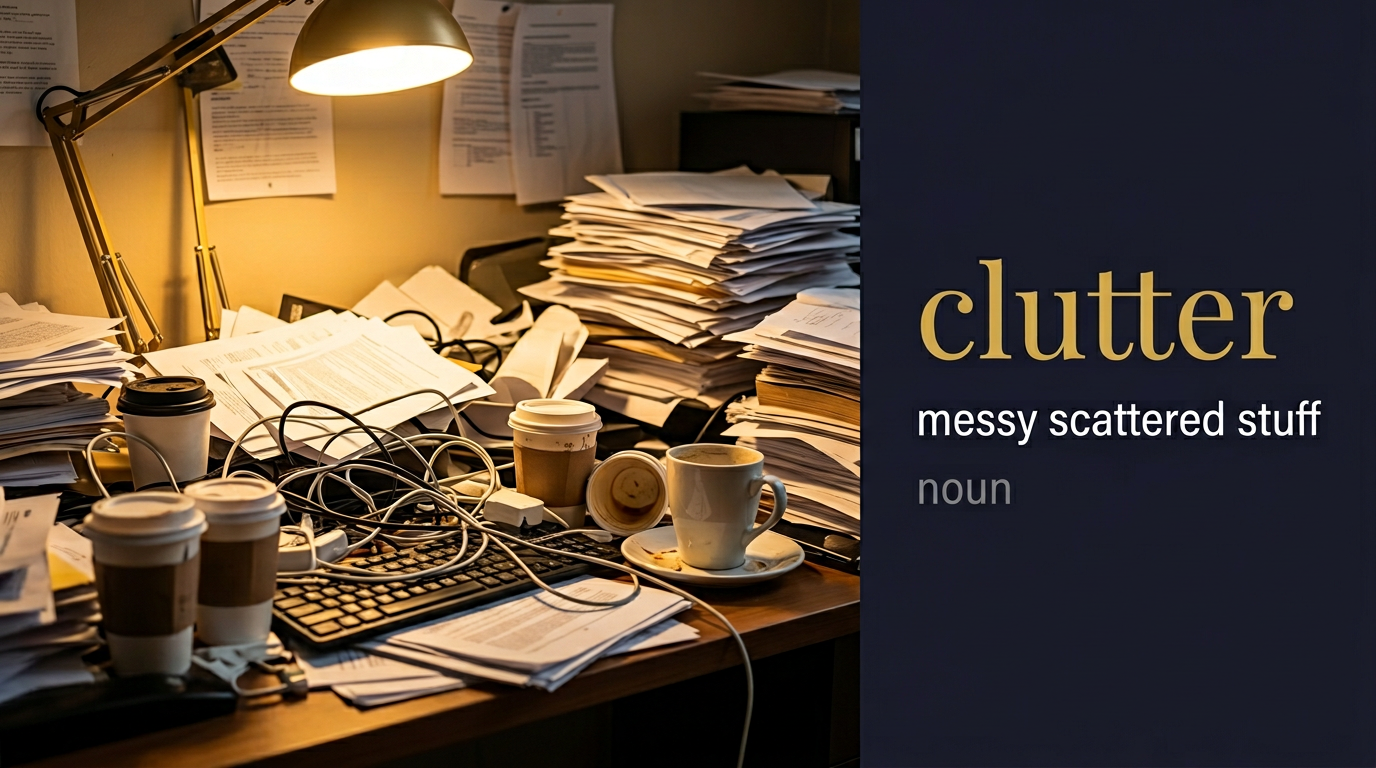
Meaning of Clutter
Disorder; mess; confusion; disorganization; scattered items; chaos; jumble; untidiness
ما معنى كلمة Clutter بالعربي؟
عدم تنظيم
📦🌪️ فوضى وتكدس الأشياء في مكان غير منظم، عدم ترتيب يُصعب الحركة والعثور على المطلوب؛ فوضى وتكدس؛ عدم تنظيم 🌪️📦
قصة GL: تنظيم clutter العقل - عقولنا مملوءة clutter من المعلومات العشوائية، GL يُعلم تنظيف الفوضى الفكرية وترتيب الأولويات، عقل منظم يعمل بكفاءة عالية 🧠🎭
Clutter in a sentence
Innovation incubators eliminate breakthrough thinking business clutter obstacles, clearing cognitive enhancement entrepreneurial mental disorder that enhances startup development through systematic entrepreneurial innovation organization protocols and clutter enhancement systems.
GL research eliminates neuroplasticity development clutter obstacles, clearing HBDNF optimization mental disorder that enhances cognitive enhancement scientific research through systematic breakthrough discovery organization protocols and clutter enhancement systems.
Patent law eliminates genetic learning technology clutter obstacles, clearing intellectual property mental disorder that enhances cognitive enhancement innovation through systematic legal organization protocols and clutter enhancement systems.
Matrix-based training programs eliminate neuroplasticity development learning clutter obstacles, clearing cognitive enhancement educational mental disorder that enhances knowledge acquisition through systematic organization protocols throughout 43-day experiences.
Origin of Clutter
From Middle English 'clotteren' (to clot), meaning 'to form clots or disorder'.
In the Genetic Learning (GL) context
In GL research and innovation contexts, clutter represents cognitive enhancement organization needs, neuroplasticity development disorder elimination, and breakthrough thinking systematic clearing for optimal organization enhancement and systematic clutter optimization.
Clutter audio micro-course (transcript)
Podcast 1 — Introduction & meaning
Narrator: Today's word is Clutter — noun and verb, pronounced KLUT-er, in IPA /ˈklʌtə/.
Narrator: Clutter is the state of having too many things in a space, arranged without order or system — a visual, physical, and cognitive excess. The kitchen worktop is cluttered with appliances. The desk is buried under clutter. The codebase has accumulated clutter over years of unmanaged additions.
Narrator: The word clutter entered English in the sixteenth century, probably as a variant of clotter, meaning to clot or coagulate — the same root as blood clotting. Just as blood clots into an unmanaged, solidified mass, clutter is a space that has coagulated with accumulated objects beyond the capacity to organise them.
Narrator: As a noun, clutter describes both the physical accumulation — the pile of papers, the tangle of cables, the drawer that no longer closes — and the psychological condition that accompanies it. Research into environmental psychology consistently finds that clutter increases cortisol levels — the stress hormone — and impairs cognitive performance. A cluttered space is not just an aesthetic problem; it is a cognitive one.
Narrator: As a verb, to clutter means to fill a space in a disordered way: boxes clutter the hallway, icons clutter the desktop, error messages clutter the logs, ads clutter the interface.
Narrator: Decluttering — removing clutter to restore order and usability — has become a major cultural preoccupation since at least the early twenty-first century. The minimalist movement, the KonMari method, and the broader slow-living aesthetic all express, in different ways, the desire to remove clutter from both physical spaces and mental life.
Narrator: In UX design, clutter is a formal anti-pattern: a cluttered interface imposes cognitive load, obscures primary actions, and reduces usability. Digital decluttering — simplifying interfaces, removing redundant elements — is as important as physical tidying.
Narrator: In register, clutter is informal and everyday — warm when describing a cosy, characterful space, critical when describing disorder that impedes function.
Narrator: So remember: clutter is what happens when things accumulate without intention — and the cost is always paid in attention.
Read podcasts 2 and 3
Podcast 2 — In conversation
Speaker A: I spent the whole weekend decluttering. Three bags to the charity shop and two to recycling.
Speaker B: Decluttering always feels better than expected. The lightness afterwards is almost physical.
Speaker A: The interface has too much clutter. Every screen is competing with notifications, badges, and ads.
Speaker B: Interface clutter is a UX failure — it imposes cognitive load and buries the primary actions the user came to perform.
Speaker A: My inbox is absolute clutter. Four thousand emails, most of which should have been deleted years ago.
Speaker B: Email clutter is the modern equivalent of the overflowing in-tray. It's not just disorganised — it's cognitively expensive.
Speaker A: People sometimes confuse clutter with mess.
Speaker B: Mess implies dirt or disorder from activity — an unwashed kitchen is a mess. Clutter specifically implies accumulation — too many objects in a space. A room can be clean but cluttered: tidy enough to be hygienic, but so full of things it feels chaotic.
Speaker A: And don't confuse clutter with hoarding. Clutter is common and manageable — most people have too much stuff in some part of their life. Hoarding is a psychological condition characterised by an inability to discard objects even when their accumulation causes significant distress and functional impairment. Clutter is a tidying problem; hoarding is a mental health challenge.
Podcast 3 — Prompt engineering
Speaker B: Scenario one — a UX audit prompt.
Perform a clutter audit on this web application interface. Identify: navigation items that appear on every screen but are used by fewer than 10 percent of users, notification badges that persist without clear resolution paths, data table columns that are never sorted or filtered, modal dialogs that appear without being triggered by a user action, and secondary CTAs that compete visually with primary actions. Rate each clutter item by cognitive impact: low, medium, or high.
Speaker B: Navigation items used by fewer than 10 percent of users is the data-backed argument for removing clutter rather than a subjective aesthetic preference.
Speaker A: Secondary CTAs competing with primary actions is the most common clutter pattern that directly reduces conversion.
Speaker B: Next — a codebase refactor prompt.
Declutter this Node.js codebase. Identify and remove: unused npm dependencies that appear in package.json but are not imported anywhere, commented-out code blocks older than 90 days based on git blame, console.log statements left over from debugging, dead code paths that are never reached, and duplicate utility functions where one should be consolidated. For each clutter item: show the file and line, and confirm it is safe to remove.
Speaker A: Git blame to date commented-out code at 90 days is the objective threshold that makes clutter removal safe and defensible.
Speaker B: Right. Now a database prompt.
Create a PostgreSQL schema for a decluttering app. Tables: users, items, rooms, declutter_sessions. items stores user_id, item_name, room_id, category enum clothing, books, kitchen, electronics, paperwork, kept_or_donated enum kept, donated, discarded, unknown, and last_used_date. declutter_sessions stores user_id, session_date, items_processed integer, items_donated integer, and space_freed_litres decimal. A dashboard shows items not used in over a year flagged as clutter candidates.
Speaker A: Items not used in over a year as automatic clutter candidates applies the KonMari one-year rule as a database query.
Speaker B: Fourth — a log management prompt.
Design a log clutter reduction strategy for a microservice platform generating 50 GB of logs per day. Identify clutter: repeated INFO logs fired more than 100 times per minute with identical messages, DEBUG logs that were not removed after the debugging session, health check logs fired every 10 seconds filling the stream. Propose: log sampling for repeated identical messages, log level promotion policy, and a maximum log retention period per service.
Speaker B: Log sampling for repeated identical messages keeps signal without drowning it in clutter from repetitive events.
Speaker B: Fifth — a content strategy prompt.
Audit this product website for content clutter. Identify: hero sections with more than two primary messages, benefit lists exceeding seven items, pages with more than three call-to-action buttons, footer columns exceeding five links each, and product descriptions using more than 300 words for a simple feature. For each clutter instance: the URL, the clutter type, and a specific recommendation to reduce to a clear, focused message.
Speaker A: More than three CTAs on a single page is the content clutter pattern that most directly reduces click-through by creating decision paralysis.
Speaker B: Sixth — a full small app.
Build a single-page web app called Clutter Score — a room decluttering tracker for minimalists. User photographs their room (upload), adds a list of every visible item as text entries, and rates each item: need daily, need weekly, need rarely, never need. The app calculates a Clutter Score from 0 to 100 based on the ratio of rarely-needed and never-needed items to total items. Stores score history in localStorage so users can track improvement.
Speaker A: Clutter Score as a ratio of rarely-needed to total items gives users an objective progress metric rather than a subjective feeling.
Speaker B: That's the lesson — clutter is accumulated excess that imposes cost on attention, productivity, and clarity. In interface design, it obscures action. In codebases, it impedes maintenance. In data systems, it overwhelms signal. In every context, the solution is the same: identify what serves purpose, remove what does not.
Speaker B: Prompt example:
Frequently asked questions about Clutter
What does Clutter mean?
Disorder; mess; confusion; disorganization; scattered items; chaos; jumble; untidiness
ما معنى كلمة Clutter بالعربي؟
عدم تنظيم — 📦🌪️ فوضى وتكدس الأشياء في مكان غير منظم، عدم ترتيب يُصعب الحركة والعثور على المطلوب؛ فوضى وتكدس؛ عدم تنظيم 🌪️📦
How is Clutter used in a sentence?
Innovation incubators eliminate breakthrough thinking business clutter obstacles, clearing cognitive enhancement entrepreneurial mental disorder that enhances startup development through systematic entrepreneurial innovation organization protocols and clutter enhancement systems.
What are synonyms of Clutter?
disorder, mess, confusion, disorganization.