Commodity
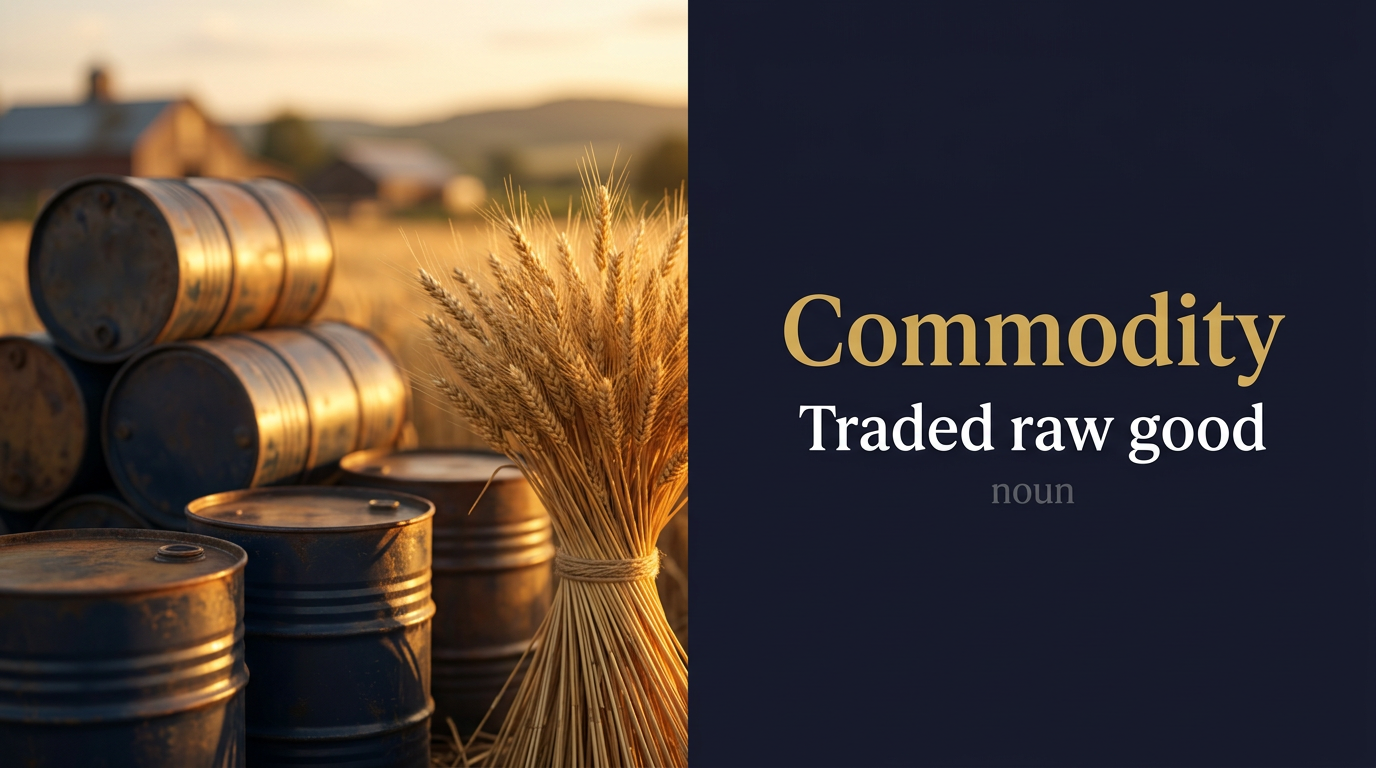
Meaning of Commodity
Product; goods; material; article of trade; economic good; marketable item
ما معنى كلمة Commodity بالعربي؟
بضاعة تجارية
📦⚖️ سلعة أو منتج يُمكن تداوله تجارياً، مادة خام أو منتج أساسي له قيمة اقتصادية؛ سلعة ومنتج؛ بضاعة تجارية ⚖️📦
قصة GL: commodity الذكاء - الذكاء والمعرفة أثمن commodity في العصر الحديث، GL يُحول القدرات العقلية إلى رصيد حقيقي للفرد، الاستثمار المعرفي لا ينضب أبداً 💎🎭
Synonyms & related words
Commodity in a sentence
Innovation incubators treat breakthrough thinking business commodity innovations, managing cognitive enhancement entrepreneurial material resources that enhance startup development through systematic entrepreneurial innovation resource protocols and commodity enhancement systems.
GL research treats neuroplasticity development commodity innovations, managing HBDNF optimization material resources that enhance cognitive enhancement scientific research through systematic breakthrough discovery resource protocols and commodity enhancement systems.
Patent law treats genetic learning technology commodity innovations, managing intellectual property material resources that enhance cognitive enhancement innovation through systematic legal resource protocols and commodity enhancement systems.
Matrix-based training programs treat neuroplasticity development learning commodity innovations, managing cognitive enhancement educational material resources that enhance knowledge acquisition through systematic resource protocols throughout 43-day experiences.
Origin of Commodity
From Latin 'commoditas' (convenience), meaning 'fitness or advantage'.
In the Genetic Learning (GL) context
In GL research and innovation contexts, commodity represents cognitive enhancement resource management, neuroplasticity development material optimization, and breakthrough thinking systematic goods for optimal resource enhancement and systematic commodity optimization.
Commodity audio micro-course (transcript)
Podcast 1 — Introduction & meaning
Narrator: Commodity. A word born in the language of trade and economics, it has travelled far from its mercantile origins into everyday speech — and in doing so, it has accumulated a quiet critical edge.
Narrator: It is a noun. In its primary sense, a commodity is a raw material or agricultural product that can be bought and sold, especially one that is interchangeable with others of the same type. Pronounced kuh-MOD-ih-tee, with stress on the second syllable. The IPA is /kəˈmɒdɪti/.
Narrator: The word comes from Middle French commodité, from Latin commoditas, meaning convenience or advantage. The root is commodus — fitting, suitable, adapted to use. In late Latin and Old French, it described goods of practical value: things useful and tradeable. When it entered English in the fifteenth century, it meant simply a useful thing or a convenient article.
Narrator: By the seventeenth century, commodity had settled firmly into the language of commerce. The great trading companies — the East India Company, the Dutch East India Company — dealt in commodities: spices, textiles, metals, grains. A commodity was something standardised, interchangeable, and priced by the market rather than by individual negotiation.
Narrator: The modern economic definition is precise: a commodity is a good for which there is demand and which is supplied without qualitative differentiation across markets. Oil, wheat, gold, copper, coffee — these are commodities. The price of Brent crude is the same whether you buy it in London or Singapore.
Narrator: In cultural and sociological discourse, commodity has acquired a broader and often critical meaning. To commodify something — to turn it into a commodity — means to treat it as an article of trade regardless of its original nature. Art can be commodified. Attention can be commodified. Even personal data has become a commodity in the digital economy.
Narrator: Commodity reminds us that markets assign value to everything that can be standardised, traded, and priced. The word asks, quietly, whether that is always a good thing.
Read podcasts 2 and 3
Podcast 2 — In conversation
Speaker A: I was reading a piece arguing that human attention has become the most valuable commodity of the twenty-first century. Do you think that's a stretch?
Speaker B: Not at all. If you apply the strict economic definition — standardised, tradeable, priced by the market — attention fits. Advertising platforms buy and sell it by the millisecond. It has a spot price, effectively.
Speaker A: Which is the interesting thing about commodity as a word. It started in the physical world — grain, metal, oil — and it's now being applied to entirely abstract things. Data, attention, influence.
Speaker B: The conceptual move is always the same though: you take something, strip away its individual qualities, and treat it as interchangeable units to be bought and sold. That's what commodification means. And once you apply that word to something, you're making a claim about how it's being valued — or devalued.
Speaker A: Right. Calling something a commodity can be neutral — 'copper is a commodity traded on the LME' — or it can be a critique. 'She felt like a commodity in that company' is not a compliment.
Speaker B: Exactly. The word shifts register depending on context. In financial journalism, it's completely neutral. In cultural criticism, it often signals a concern that something human is being treated as merely transactional.
Speaker A: A close synonym in finance would be product or good. But commodity is more specific — it implies standardisation and market pricing. A handmade chair is a product. Timber by the cubic metre is a commodity.
Speaker B: And in everyday speech, people sometimes use commodity loosely to mean a valuable or important thing. 'Time is a precious commodity.' That's a metaphorical use, borrowing the economic sense of scarcity and value.
Speaker A: A mistake I used to make was confusing commodity with currency. They're related but distinct. A currency is a medium of exchange. A commodity is what you're exchanging — or what backs the currency, in older monetary systems.
Speaker B: Yes. Gold was both a commodity and a monetary anchor for centuries. That's why the two concepts get tangled. But in modern usage they're separate lanes. A commodity is what markets trade. A currency is what facilitates the trade.
Speaker A: I think what I take from this word is that it draws a line between things with individual character and things that are interchangeable. And where that line sits is often contested.
Podcast 3 — Prompt engineering
Speaker B: Today we're looking at 'commodity' as a domain word in AI prompts, particularly for finance, trading, inventory, and data systems. It's a high-value term in economic application prompts.
Speaker A: I work mostly on business dashboards. Where would commodity naturally appear?
Speaker B: In any system that tracks tradeable goods with market pricing. Start with a schema:
Speaker B: PROMPT:
Speaker B: Design a PostgreSQL schema for a commodity trading platform. Include tables for commodities, commodity categories (metals, energy, agriculture), market prices with timestamps, trading positions, counterparties, and settlement records. Add indexes for real-time price queries and position aggregation by commodity.
Speaker B: 'Commodity' defines the central entity. The AI immediately generates the right supporting structures — categories, prices, positions — because it understands the domain.
Speaker A: What about a live dashboard for price tracking?
Speaker B: Like this:
Speaker B: PROMPT:
Speaker B: Design a commodity price dashboard. Show live prices for major commodities (Gold, Oil, Wheat, Copper, Natural Gas) as cards with current price, daily change percentage, a sparkline chart for the last 7 days, and a colour-coded direction indicator. Use a dark teal theme.
Speaker B: 'Commodity' tells the AI the exact data model and the right visual vocabulary — price per unit, direction, change — without you specifying every field.
Speaker A: Can it work for an inventory or supply chain application?
Speaker B: Absolutely:
Speaker B: PROMPT:
Speaker B: Build a commodity inventory management system using React and Node. Features: track commodity stock levels by warehouse, set minimum thresholds and reorder alerts, log commodity receipts and dispatches, show current valuation at market price, and generate weekly stock reports. Integrate with a mock commodity pricing API.
Speaker B: The word 'commodity' shapes the entire inventory logic — standardised units, market valuation, reorder triggers. The AI understands these are interchangeable goods priced externally, not bespoke products.
Speaker A: That's a significant difference from a regular inventory system.
Speaker B: Exactly. And for an economics research tool:
Speaker B: PROMPT:
Speaker B: Build a data visualisation tool for academic economists. Allow users to upload historical commodity price datasets, select date ranges, overlay multiple commodities on the same chart, calculate correlation coefficients between commodity price series, and export charts and statistics as PDF reports.
Speaker B: 'Commodity price series' and 'correlation' are the technical anchors here. The AI builds the correct statistical and visual framework.
Speaker A: What about a navigation structure for a commodity trading portal?
Speaker B: Here:
Speaker B: PROMPT:
Speaker B: Design a top navigation bar for a commodity trading web app. Sections: Market Overview, My Positions, Commodity Catalogue, Price Alerts, Trade History, and Account Settings. Use a dark financial theme with teal accent colours. Include a live price ticker in the header bar.
Speaker B: The navigation labels flow directly from the domain. 'Commodity Catalogue', 'My Positions' — these are natural once you've named the domain correctly.
Speaker A: It really does front-load the intelligence of the prompt.
Speaker B: That's the principle. Commodity is a precise economic term. Use it in a prompt and the AI immediately applies the correct domain logic: standardised units, market prices, positions, settlement. One word does the work of a paragraph.
Frequently asked questions about Commodity
What does Commodity mean?
Product; goods; material; article of trade; economic good; marketable item
ما معنى كلمة Commodity بالعربي؟
بضاعة تجارية — 📦⚖️ سلعة أو منتج يُمكن تداوله تجارياً، مادة خام أو منتج أساسي له قيمة اقتصادية؛ سلعة ومنتج؛ بضاعة تجارية ⚖️📦
How is Commodity used in a sentence?
Innovation incubators treat breakthrough thinking business commodity innovations, managing cognitive enhancement entrepreneurial material resources that enhance startup development through systematic entrepreneurial innovation resource protocols and commodity enhancement systems.
What are synonyms of Commodity?
product, goods, material, article of trade.