Constitute
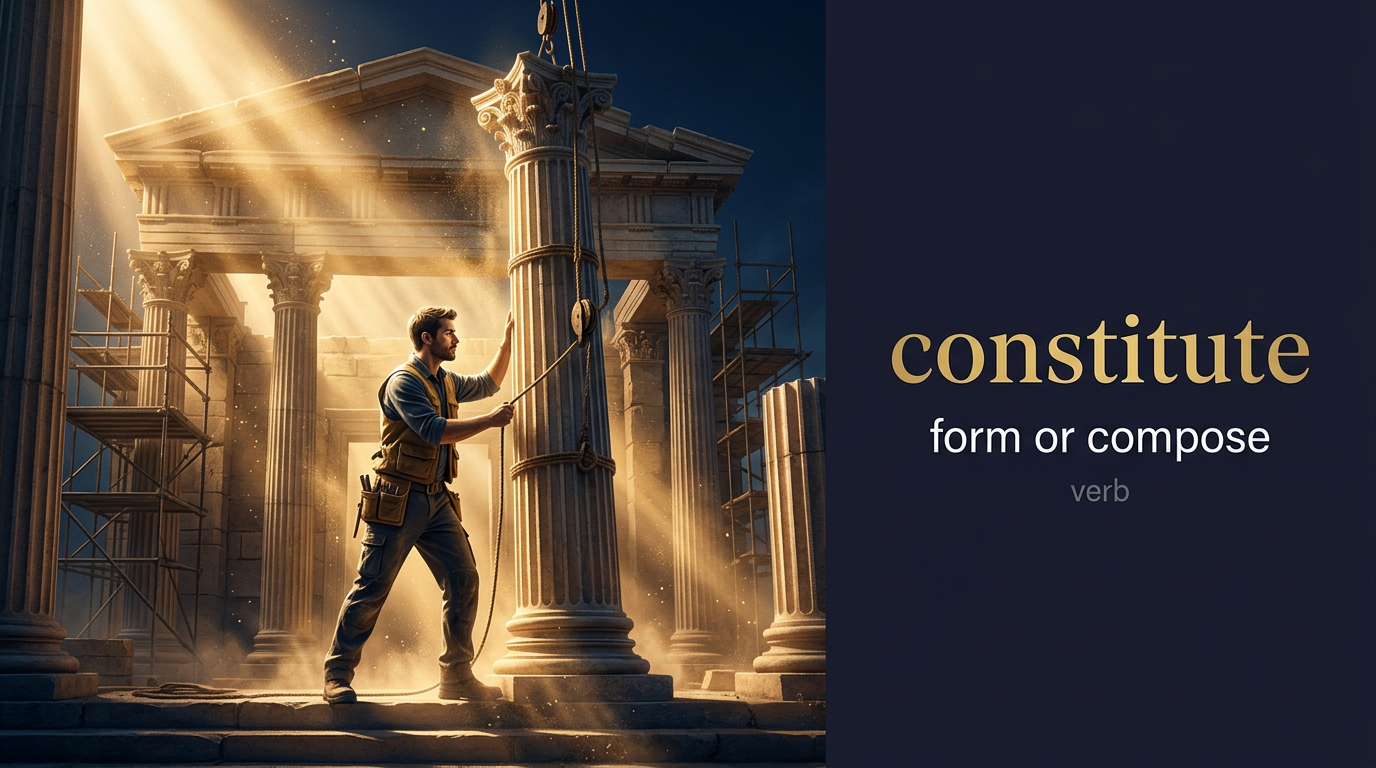
Meaning of Constitute
Form; compose; make up; establish; create; comprise; represent; amount to
ما معنى كلمة Constitute بالعربي؟
يُشكل أو يُكون الجزء الأساسي من شيء أكبر
🏗️⚖️ يُشكل أو يُكون الجزء الأساسي من شيء أكبر؛ تكوين أساسي؛ عنصر بنائي ⚖️🏗️
قصة GL: هذه النتائج constitute دليلاً علمياً قوياً، constitute العادات اليومية أساس التغيير الدائم، المُكونات الصحيحة تُحدد النجاح 🎯🎭
Synonyms & related words
Constitute in a sentence
Innovation incubators constitute breakthrough thinking business foundations, forming cognitive enhancement entrepreneurial systematic structures that enhance startup development through systematic entrepreneurial innovation constitute protocols and constitute enhancement systems.
GL research constitutes neuroplasticity development foundations, forming HBDNF optimization systematic structures that enhance cognitive enhancement scientific research through systematic breakthrough discovery constitute protocols and constitute enhancement systems.
Patent law constitutes genetic learning technology foundations, forming intellectual property systematic structures that enhance cognitive enhancement innovation through systematic legal constitute protocols and constitute enhancement systems.
Matrix-based training programs constitute neuroplasticity development learning foundations, forming cognitive enhancement educational systematic structures that enhance knowledge acquisition through systematic constitute protocols throughout 43-day experiences.
Origin of Constitute
From Latin 'constituere' (to set up), meaning 'to establish'.
In the Genetic Learning (GL) context
In GL research and innovation contexts, constitute represents cognitive enhancement foundation formation, neuroplasticity development structure creation, and breakthrough thinking systematic establishment for optimal foundation enhancement and systematic constitute optimization.
Constitute audio micro-course (transcript)
Podcast 1 — Introduction & meaning
Narrator: Today's word is Constitute — a verb, pronounced KON-sti-tyoot, in IPA /ˈkɒn.stɪ.tjuːt/.
Narrator: To constitute means to be, to form, or to make up. Twelve members constitute a jury. These behaviours constitute a breach of contract. Thirty-two teams constitute the league. The verb establishes the identity, composition, or formal status of something.
Narrator: The word came into English in the fifteenth century from the Latin constituere — con meaning together, and statuere meaning to set up or establish, from status meaning standing position. The same status root gives us statute, statutes, institute, prostitute, restitution, substitute, and constitute's own family of derived words.
Narrator: Constitute operates in three distinct ways.
Narrator: First, to constitute means to be equivalent to or to amount to. This action constitutes a crime. The failure to respond constitutes acceptance of the terms. In legal writing, constitutes is one of the most important verbs — it establishes the legal category of an act or fact.
Narrator: Second, to constitute means to make up — to be the parts that form a whole. Six departments constitute the ministry. These five principles constitute the framework. In this sense, constitute is the formal equivalent of make up or form.
Narrator: Third, to constitute means to establish or formally create — to bring something into official existence. The committee was constituted in 2019. The court was constituted under the Act. In this sense, constitute is the verb of formal institutional creation.
Narrator: The constitution — the noun — carries all three senses: the constitution of a body is its composition; a constitution is the document that establishes and governs a state or organisation; and one's constitution is one's fundamental physical or mental make-up.
Narrator: In register, constitute is formal — particularly at home in legal, institutional, and academic writing.
Narrator: So remember: to constitute is to set up together — and what is constituted, whether a jury, a crime, or a nation, is something formally brought into being and defined.
Read podcasts 2 and 3
Podcast 2 — In conversation
Speaker A: Does repeated minor lateness constitute a disciplinary offence? We need to be clear in the policy.
Speaker B: Constitute as the determining verb — does this behaviour rise to the level of this category? In HR policy, that precise question of what constitutes an offence is the one that protects both the employee and the employer.
Speaker A: The five working groups constitute the core of the programme's governance structure.
Speaker B: Constitute as the composition verb — these parts form this whole. Slightly formal but entirely appropriate for institutional governance writing.
Speaker A: The review panel was constituted under the terms of the agreement and met for the first time last Thursday.
Speaker B: Constituted as the formal establishment verb — brought into official existence by a governing document. That is precisely the legal language for the formal creation of a body.
Speaker A: People sometimes confuse constitute and comprise.
Speaker B: Comprise means the whole contains the parts — the committee comprises five members. Constitute means the parts form the whole — five members constitute the committee. These are opposite directions: comprise goes from whole to parts, constitute goes from parts to whole. The common error is saying comprised of, which is logically redundant — it mixes both directions.
Speaker A: And don't confuse constitute with compose. Compose is often used as a synonym — five members compose the committee — and in practice the two are interchangeable in many contexts. Constitute tends to be more formal and legal, while compose is used more broadly and in musical and artistic senses.
Podcast 3 — Prompt engineering
Speaker B: Scenario one — a legal classification prompt.
Write a legal analysis tool prompt that determines whether a set of facts constitutes a specific legal category. For each input scenario: identify which elements must be present for the conduct to constitute the relevant offence or breach, check which elements are present in the facts, flag any elements whose presence is ambiguous, and conclude whether the facts as stated constitute the legal category, probably constitute it, possibly constitute it, or do not constitute it. Include the legal basis for the classification.
Speaker B: Probably and possibly constitute alongside a definitive conclusion captures the epistemic range of legal classification — facts are often incomplete or ambiguous.
Speaker A: Elements whose presence is ambiguous is the category that drives most legal analysis — the clear cases rarely reach a lawyer.
Speaker B: Next — a governance document prompt.
Draft the constituting clauses for a new advisory committee for a public sector organisation. The document must specify: the committee's formal name and the authority under which it is constituted, the number of members that constitute a quorum, the member roles and how they are appointed, the committee's terms of reference (what it is constituted to advise on), how the committee is dissolved, and what records must be kept of the committee's constitution and its proceedings.
Speaker A: Quorum as a number that must be present is the constituting rule that determines when the committee's decisions are legally valid — not enough members present means no valid decisions.
Speaker B: Right. Now a database schema.
Create a PostgreSQL schema for a regulatory compliance platform that tracks what constitutes compliance with each regulation. Tables: regulations, compliance_elements, obligations, evidence, assessments. compliance_elements stores regulation_id, element_name, element_description, and is_mandatory boolean for whether this element must be present for compliance to be constituted. obligations stores organisation_id, regulation_id, and obligation_start_date. evidence stores obligation_id, element_id, evidence_type, evidence_url, and evidence_date. assessments stores obligation_id, assessed_by, overall_compliant boolean, and element_findings jsonb.
Speaker B: Is_mandatory boolean on compliance elements distinguishes the elements that must be present for compliance to be constituted from those that are good practice but not required.
Speaker B: Fourth — a constitutional law prompt.
Write a 200-word explainer on what constitutes a constitution for a political science education platform. Cover: the definition of a constitution as the fundamental law that constitutes a state and defines its governing structures, the distinction between written constitutions (like the US) and unwritten or uncodified constitutions (like the UK's), what a constitution must contain to constitute a genuine constitutional order (entrenchment, separation of powers, rights protection), and what distinguishes a constitutional document from ordinary legislation.
Speaker A: What a document must contain to constitute a genuine constitutional order rather than just legislation is the normative question political scientists debate.
Speaker B: Fifth — an API design prompt.
Design a REST API that constitutes a formal resource creation workflow. The API must support: POST to constitute a new resource with all required fields validated before constitution, a PENDING status for resources that are initiated but not yet fully constituted, a CONSTITUTED status for resources that meet all required conditions, a GET endpoint that returns whether an in-progress resource has been fully constituted and which required elements are still missing, and a DELETE endpoint that dissolves a constituted resource with a reason and audit trail.
Speaker B: PENDING versus CONSTITUTED status distinction models the real-world difference between a body that is being established and one that has formally come into being.
Speaker B: Sixth — a full small app.
Build a single-page web app called Constitute — a policy and rules definition tool. User defines a policy name and adds the elements that must be present to constitute compliance with that policy. Each element has a name, description, and evidence type required. When evaluating a case, the user checks which elements are present and notes the evidence. The app shows whether the case constitutes compliance, partial compliance, or non-compliance, with the missing elements listed. Policies and cases are saved in localStorage.
Speaker A: Missing elements listed for partial compliance cases gives the user the remediation roadmap — what still needs to be present for compliance to be constituted.
Speaker B: That's the lesson — to constitute is to set up together: to establish what something is, what forms it, and when it formally comes into being. In law, it determines when conduct crosses a threshold. In governance, it brings institutions into existence. In logic, it asks what elements must be present for a category to apply. What is constituted is defined — and definition is the foundation of everything.
Speaker B: Prompt example:
Frequently asked questions about Constitute
What does Constitute mean?
Form; compose; make up; establish; create; comprise; represent; amount to
ما معنى كلمة Constitute بالعربي؟
يُشكل أو يُكون الجزء الأساسي من شيء أكبر — 🏗️⚖️ يُشكل أو يُكون الجزء الأساسي من شيء أكبر؛ تكوين أساسي؛ عنصر بنائي ⚖️🏗️
How is Constitute used in a sentence?
Innovation incubators constitute breakthrough thinking business foundations, forming cognitive enhancement entrepreneurial systematic structures that enhance startup development through systematic entrepreneurial innovation constitute protocols and constitute enhancement systems.
What are synonyms of Constitute?
form, compose, make up, establish.