Construct
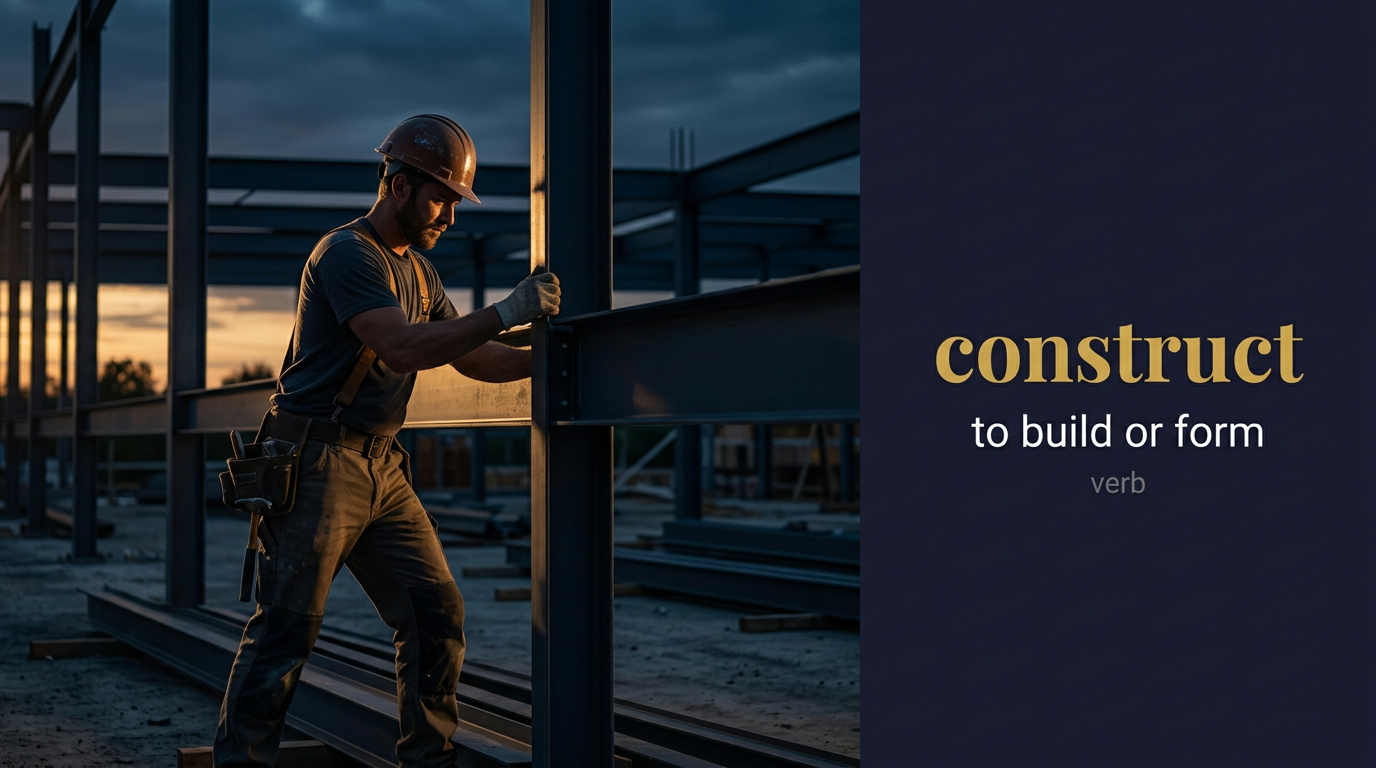
Meaning of Construct
Build; create; form; assemble; establish; make; develop; fabricate
ما معنى كلمة Construct بالعربي؟
يبني أو ينشئ شيئاً جديداً من عناصر منفصلة
🔨🏗️ يبني أو ينشئ شيئاً جديداً من عناصر منفصلة؛ بناء وتشييد؛ تركيب إنشائي 🏗️🔨
قصة GL: فريق التطوير construct منصة متطورة، construct المسارات المعرفية يتطلب دقة هندسية، البناء المنظم يضمن الاستقرار 🏢🎭
Synonyms & related words
Construct in a sentence
Innovation incubators construct breakthrough thinking business models, building cognitive enhancement entrepreneurial systematic frameworks that enhance startup development through systematic entrepreneurial innovation construct protocols and construct enhancement systems.
GL research constructs neuroplasticity development models, building HBDNF optimization systematic frameworks that enhance cognitive enhancement scientific research through systematic breakthrough discovery construct protocols and construct enhancement systems.
Patent law constructs genetic learning technology models, building intellectual property systematic frameworks that enhance cognitive enhancement innovation through systematic legal construct protocols and construct enhancement systems.
Matrix-based training programs construct neuroplasticity development learning models, building cognitive enhancement educational systematic frameworks that enhance knowledge acquisition through systematic construct protocols throughout 43-day experiences.
Origin of Construct
From Latin 'construere' (to build), meaning 'to create'.
In the Genetic Learning (GL) context
In GL research and innovation contexts, construct represents cognitive enhancement model building, neuroplasticity development framework creation, and breakthrough thinking systematic assembly for optimal model enhancement and systematic construct optimization.
Construct audio micro-course (transcript)
Podcast 1 — Introduction & meaning
Narrator: Tonight's word is construct—a slippery little gem that works as both a verb and a noun, and shifts its stress depending on which job it's doing.
Narrator: As a verb, pronounce it kuhn-STRUKT, IPA roughly kuhn-STRUKT, with stress on the second syllable.
Narrator: As a noun, pronounce it KON-strukt, IPA roughly KON-strukt, with the stress moving to the front—a tiny acoustic clue that tells listeners which form you mean.
Narrator: As a verb, to construct is to build something carefully out of parts—a wall, a sentence, an argument, a software system.
Narrator: As a noun, a construct is something assembled in the mind: a theoretical construct, a social construct, a constructed concept that does not exist as a single physical thing.
Narrator: It descends from Latin construere, to heap together, from com- meaning with and struere meaning to pile or arrange.
Narrator: Medieval English borrowed it for literal building; nineteenth-century academics adopted the noun form for ideas built up from observation, like personality or class.
Narrator: In computing, construct now anchors entire vocabularies—language constructs, design constructs, AbstractSyntaxTree constructs, Constructor functions in object-oriented languages.
Narrator: Register is mid to formal: at home in academia, software engineering, and serious journalism; slightly stiff for casual chat, where build or make do the same job more naturally.
Narrator: Closing line: every construct, real or theoretical, begins the same way—a few pieces, deliberately placed, until something coherent stands where there was nothing before.
Read podcasts 2 and 3
Podcast 2 — In conversation
Speaker A: I spent four hours yesterday trying to construct an IKEA wardrobe and I'm not entirely sure all the dowels ended up where they should.
Speaker B: Classic Saturday. The lovely thing about construct is that it works for furniture, sentences, and arguments—same verb, very different effort.
Speaker A: Right. Two natural lines our learners hear constantly: she constructed a brilliant argument in the meeting, and the building was constructed in nineteen seventy-three.
Speaker B: Both perfectly British. There's also the noun construct, which sounds quite academic—gender is a social construct, money is essentially a shared construct.
Speaker A: Common slip: people sometimes confuse construct with construe, which means to interpret. Construct an argument is to build it; construe an argument is to read it a particular way.
Speaker B: Right—and one is constructive, the other is one letter away from disaster.
Speaker A: Yes, and. Synonym build is more everyday and physical; assemble emphasises putting parts together; construct sits one register higher and signals deliberate effort.
Speaker B: And devise is for ideas only—you devise a plan, you construct a building.
Speaker A: A nicely British detail: we construct a sentence in grammar lessons, but we put together a sentence in everyday speech. Same idea, different formality.
Speaker B: Exactly. Use construct when the building is deliberate and the parts are worth naming, and you'll always sound thoughtful.
Podcast 3 — Prompt engineering
Speaker B: In dev prompts, construct is one of those quietly precise verbs that nudges the AI toward complete, deliberately assembled output instead of vague advice.
Speaker A: Could we open with a SQL query the AI must build piece by piece?
Speaker B: SQL first.
Speaker B: Construct a parameterised SQL query for our reporting service that returns active customers in the last thirty days, joined with their three most recent orders, sorted by total spend. Use proper indexes, avoid SELECT star, and explain how the query plan changes once the customers table grows past a million rows.
Speaker B: Construct here lands on the AI's SQL muscle—joins, indexes, query plans—rather than a generic SELECT.
Speaker A: Could the same word work on a UI side panel?
Speaker B: Side panel:
Speaker B: Construct a slide-in admin side panel for managing feature flags. Provide a search field, group flags by environment, allow per-tenant overrides with an audit log, and ship it as a single React component under two hundred lines with zero external dependencies beyond the design system tokens we already use.
Speaker A: Two-hundred-line cap is a good discipline.
Speaker B: Now a database schema:
Speaker B: Construct a Postgres schema for a freelance invoicing app supporting clients, projects, time entries, expenses, and invoices. Add the right foreign keys with cascade rules, indexes for common queries, and a single SQL view that returns each freelancer's outstanding balance grouped by client for the past twelve months.
Speaker A: A view for outstanding balance by client is exactly what every freelancer asks for.
Speaker B: HR system:
Speaker B: Construct an HR performance-review module that supports quarterly self-assessment, peer feedback, and manager sign-off. Provide the data model, the screens, and the email cadence, and ensure peer feedback can be marked confidential so reviewees see aggregated themes rather than individual sentences.
Speaker A: Aggregated themes for confidential peer feedback is the humane move.
Speaker B: Accounting:
Speaker B: Construct a small accounts-receivable dashboard for a UK agency. Surface overdue invoices, average days to pay per client, expected cashflow for the next thirty days, and a one-click action to send a polite chaser email. The construct must work with both QuickBooks and Xero through a single internal adapter.
Speaker A: A single adapter for QuickBooks and Xero is the only sane way.
Speaker B: Navigation:
Speaker B: Construct a top navigation bar for a SaaS that has grown to seven products. Use a clear product switcher, a global command palette with keyboard shortcut, role-aware admin links, and a quiet notification bell. Provide the markup, the keyboard map, and a small migration plan from our current sidebar layout.
Speaker A: A migration plan baked into the prompt saves a follow-up.
Speaker B: Full app:
Speaker B: Construct a Next.js plus Postgres plus Stripe app for a small event organiser running paid workshops. Tickets, refunds, attendee dashboards, and a host view. The whole construct must support a fifteen-hundred-seat sale spike on launch day and gracefully queue payments if Stripe rate-limits us briefly.
Speaker A: Graceful queueing on Stripe rate-limits is the kind of thing only experience teaches.
Speaker B: Use construct whenever you want the AI to deliver a fully assembled thing—queries, components, schemas, or whole applications—instead of bullet-point ideas.
Frequently asked questions about Construct
What does Construct mean?
Build; create; form; assemble; establish; make; develop; fabricate
ما معنى كلمة Construct بالعربي؟
يبني أو ينشئ شيئاً جديداً من عناصر منفصلة — 🔨🏗️ يبني أو ينشئ شيئاً جديداً من عناصر منفصلة؛ بناء وتشييد؛ تركيب إنشائي 🏗️🔨
How is Construct used in a sentence?
Innovation incubators construct breakthrough thinking business models, building cognitive enhancement entrepreneurial systematic frameworks that enhance startup development through systematic entrepreneurial innovation construct protocols and construct enhancement systems.
What are synonyms of Construct?
build, create, form, assemble.