Contract
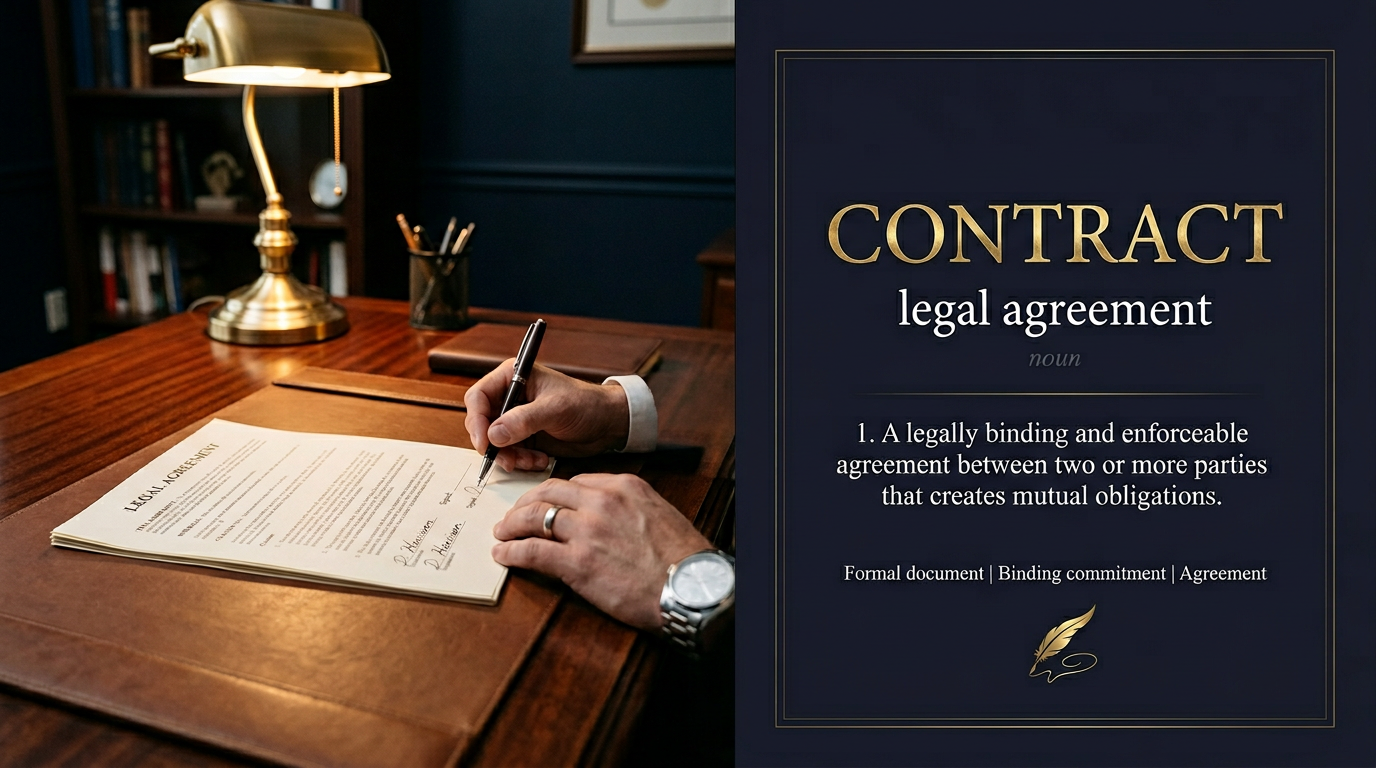
Meaning of Contract
Agreement; deal; compress; shrink; reduce; arrangement; pact; covenant
ما معنى كلمة Contract بالعربي؟
اتفاقية قانونية ملزمة بين طرفين أو أكثر
📋✍️ اتفاقية قانونية ملزمة بين طرفين أو أكثر؛ عقد واتفاق؛ وثيقة التزام ✍️📋
قصة GL: أول contract استثماري وُقع بعد إثبات فعالية النظام علمياً، عقود الشراكة مع الجامعات فتحت آفاقاً جديدة لنشر التعلم الجيني على نطاق واسع 🤝
Contract in a sentence
Innovation incubators establish breakthrough thinking business contract agreements, formalizing cognitive enhancement entrepreneurial systematic arrangements that enhance startup development through systematic entrepreneurial innovation contract protocols and contract enhancement systems.
GL research establishes neuroplasticity development contract agreements, formalizing HBDNF optimization systematic arrangements that enhance cognitive enhancement scientific research through systematic breakthrough discovery contract protocols and contract enhancement systems.
Patent law establishes genetic learning technology contract agreements, formalizing intellectual property systematic arrangements that enhance cognitive enhancement innovation through systematic legal contract protocols and contract enhancement systems.
Matrix-based training programs establish neuroplasticity development learning contract agreements, formalizing cognitive enhancement educational systematic arrangements that enhance knowledge acquisition through systematic contract protocols throughout 43-day experiences.
Origin of Contract
From Latin 'contractus' (drawn together), meaning 'agreement'.
In the Genetic Learning (GL) context
In GL research and innovation contexts, contract represents cognitive enhancement agreement establishment, neuroplasticity development arrangement formalization, and breakthrough thinking systematic commitment for optimal agreement enhancement and systematic contract optimization.
Contract audio micro-course (transcript)
Podcast 1 — Introduction & meaning
Narrator: Today we examine contract: a word with two distinct lives, depending on where the stress falls. As a noun, it is KON-trakt, stress on the first syllable. As a verb, it is kun-TRAKT, stress on the second. The IPA for the noun is ˈkɒntrækt; for the verb, kənˈtrækt.
Narrator: Both forms trace back to the same Latin source: contractus, the past participle of contrahere. Contrahere means to draw together, built from con meaning together and trahere meaning to draw or pull. The image is of two parties drawing together toward a binding point of agreement.
Narrator: As a noun, a contract is a legally binding agreement between two or more parties. The essential elements, at least in English law, are offer, acceptance, consideration, and the intention to create legal relations. Without those elements, you may have an agreement or a promise, but not a legally enforceable contract.
Narrator: Contracts entered English in the fourteenth century via Old French contrat. They were from the outset instruments of law, and the word has never strayed far from its legal gravity. An employment contract, a building contract, a service contract: each is a document or arrangement in which parties commit to specific obligations and can be held to them.
Narrator: The verb contract has two meanings that pull in different directions. First, the legal sense: to contract with someone means to enter into a formal agreement with them. The company contracted with a supplier for three years of deliveries. Second, the physical and metaphorical sense: to contract means to draw together, to shrink, to become smaller. Metal contracts when it cools. Muscles contract when they engage. An economy contracts when it shrinks.
Narrator: There is also a third verbal sense, somewhat archaic but still found in formal writing: to contract an illness means to acquire it, as though the disease draws itself around you. He contracted pneumonia during the winter. This sense uses the drawing-together image in a grim direction.
Narrator: In everyday speech, contract is frequently misused. People sometimes describe casual verbal agreements as contracts when no legally binding commitment exists. A contract strictly requires consideration, the legal term for something of value exchanged between the parties, and the intention for it to be binding. A handshake agreement over dinner is not usually a contract in the technical sense.
Narrator: Synonyms for the noun include agreement, deal, compact, covenant, and pact. Of these, covenant is the most solemn and religious in tone. Compact and pact suggest an explicit mutual commitment. Contract is the most legally specific.
Narrator: Register is formal to professional. Contract appears in legal documents, employment negotiations, business correspondence, and technical specifications. In casual speech, people reach for deal, agreement, or arrangement.
Narrator: Closing thought: every contract begins as a conversation and ends as an obligation. The word reminds us that the most consequential things we do are often achieved by drawing together, by the pull that makes two parties into one binding commitment.
Read podcasts 2 and 3
Podcast 2 — In conversation
Speaker A: I have just been offered a new job and they sent me a contract to sign. But my friend looked at it and said it was not actually a contract, it was just an offer letter. What is the difference?
Speaker B: That is a genuinely useful distinction to understand. An offer letter states the terms of the job offer, salary, start date, role title, but it is not necessarily a binding contract until you sign and return it with acceptance. The contract proper is typically a separate employment contract document that sets out all your rights and obligations in detail and is signed by both parties.
Speaker A: So the offer letter is the offer, and the employment contract is what creates the binding legal relationship?
Speaker B: In essence, yes. Though in the UK, once you accept an offer in writing, you may already have a binding contract for basic terms even before the formal employment contract is signed. But the employment contract fills in all the detail, restrictive covenants, notice periods, intellectual property clauses. Those things only bind you if they are in the signed contract.
Speaker A: I also notice the word contract is used differently when it is a verb. My manager said the business contracted with an external agency. That sounds quite different from the noun use.
Speaker B: Right. When contract is used as a verb meaning to enter into a formal agreement, you will hear contracted with or contracted out. We contracted with a logistics provider means we entered into a formal agreement with them. The phrase contracted out means the company arranged for an external party to handle work that was previously done internally, outsourcing it under a formal contract.
Speaker A: And then there is contract as in to shrink. I heard someone say the economy contracted last quarter. Is that related?
Speaker B: Completely related, same Latin root. Contract as a verb meaning to draw together, to become smaller, applies to muscles, metal, economies, and even social circles. Your pupils contract in bright light. A business can contract its workforce during a downturn. The unifying idea is always drawing inward, reducing, tightening.
Speaker A: What is the difference between a contract and an agreement? I tend to use them interchangeably but I suspect that is wrong.
Speaker B: Agreement is the broader term. All contracts are agreements, but not all agreements are contracts. A contract requires specific legal elements: offer, acceptance, consideration, and intention to be legally bound. An agreement can be purely informal or social. If we agree to meet for lunch, that is an agreement but not a contract. If your employer agrees to pay you for work and you agree to perform it, that is a contract because all the legal elements are present.
Speaker A: What about the word covenant? I sometimes see that used in property documents.
Speaker B: Covenant is an older and more formal word for a binding agreement, and it survives in specific legal contexts. Restrictive covenants on property are obligations that bind future owners of land, things like not building above a certain height or not operating a commercial business from a residential property. Covenants also appear in theological and constitutional language. It has the same drawing-together meaning as contract but carries a more solemn, sometimes sacred, register.
Speaker A: So the word I use sends a signal about the formality and type of the agreement.
Speaker B: Exactly. Contract is the standard professional word for a legally binding commercial or employment agreement. Covenant is more solemn or archaic. Agreement is more general. Deal is casual. The choice of word signals not just what the arrangement is but how seriously you regard it.
Podcast 3 — Prompt engineering
Speaker B: Contract is one of the most powerful words you can use in technical prompting because in software engineering it means something very precise: a defined, enforceable interface between two systems or components. When you use contract in a prompt, you tell the model you want guarantees, not approximations.
Speaker A: So it imports the legal meaning into the technical context: this is binding behaviour, not optional behaviour.
Speaker B: Exactly. First prompt, API contract design:
Speaker B: Design a RESTful API contract for a payments service. Define the contract as an OpenAPI 3.1 specification with schemas for PaymentRequest, PaymentResponse, and PaymentError. Every endpoint must document its contract: required fields, data types, possible HTTP status codes, and error response shapes. Include a contract version field in every response header.
Speaker B: Using the word contract tells the model this is a formal specification document, not just a list of routes. The model generates an OpenAPI spec with full schema definitions and error contracts rather than a simple route file.
Speaker A: The version field in the header is a nice touch. It enforces the contract versioning idea from the start. Second prompt?
Speaker B: Database schema contract for a multi-service architecture:
Speaker B: Define a database contract for a shared PostgreSQL schema used by three microservices: orders, inventory, and billing. The contract must specify which tables each service owns exclusively, which tables are shared read-only, and which columns form the public interface that other services may depend on. Generate the schema DDL and a contract document in JSON that lists each table, its owner service, and its contract status.
Speaker B: Framing the schema as a contract forces the model to reason about ownership and interface boundaries rather than just writing table definitions. The JSON contract document becomes a living specification that teams can reference to avoid accidental breaking changes.
Speaker A: I have never thought about database tables having ownership contracts. That is a genuinely useful pattern. Third prompt?
Speaker B: UI component contract for a design system:
Speaker B: Build a React Button component with a strict prop contract. The contract must define: required props (label as string, onClick as function), optional props (variant as one of primary, secondary, danger, size as one of small, medium, large, disabled as boolean), and forbidden prop patterns (no inline style override, no className override). Enforce the contract with PropTypes and add a runtime warning if a forbidden pattern is detected.
Speaker B: Prop contract here is precise language for the interface a component exposes to consumers. The forbidden pattern enforcement is a direct consequence of contract thinking: some things are not allowed at all, not just discouraged.
Speaker A: Specifying forbidden patterns is something I had never thought to put in a prompt. Fifth prompt?
Speaker B: A full HR application with service contracts:
Speaker B: Build a Node.js HR platform with three internal services: EmployeeService, LeaveService, and PayrollService. Define a service contract for each: the methods it exposes, the data shapes it accepts and returns, and the errors it can throw. Each service must honour its contract independently and must not access another service's database tables directly. Generate contract interfaces in TypeScript and enforce them at the service layer.
Speaker B: The phrase honour its contract is doing significant work. It signals to the model that the service boundaries are real and enforced, not just organisational suggestions. The TypeScript interfaces become the machine-readable contract that the compiler enforces.
Speaker A: TypeScript interfaces as machine-enforced contracts. That is the legal idea made executable. Last prompt?
Speaker B: Create a Next.js SaaS billing dashboard that displays each customer's active contract: contract start date, end date, contracted features list, monthly contracted value, and actual usage versus contracted allowance for the current billing period. Highlight customers who are at or above ninety percent of their contracted allowance with an amber warning and over-contract usage in red. Pull data from a contracts table in PostgreSQL.
Speaker A: Contracted allowance as a column makes complete semantic sense. The data model reflects the business reality, that customers have purchased a specific commitment and the dashboard enforces that framing.
Speaker B: That is the consistent value of the word in prompting. Contract brings the precision of legal obligation into the technical domain. When you write contract in a prompt, you tell the model that the boundaries are real, the interfaces are binding, and the output should reflect the discipline that the word has always carried since Roman law first used it to draw two parties together.
Frequently asked questions about Contract
What does Contract mean?
Agreement; deal; compress; shrink; reduce; arrangement; pact; covenant
ما معنى كلمة Contract بالعربي؟
اتفاقية قانونية ملزمة بين طرفين أو أكثر — 📋✍️ اتفاقية قانونية ملزمة بين طرفين أو أكثر؛ عقد واتفاق؛ وثيقة التزام ✍️📋
How is Contract used in a sentence?
Innovation incubators establish breakthrough thinking business contract agreements, formalizing cognitive enhancement entrepreneurial systematic arrangements that enhance startup development through systematic entrepreneurial innovation contract protocols and contract enhancement systems.
What are synonyms of Contract?
agreement, deal, compress, shrink.