Corn
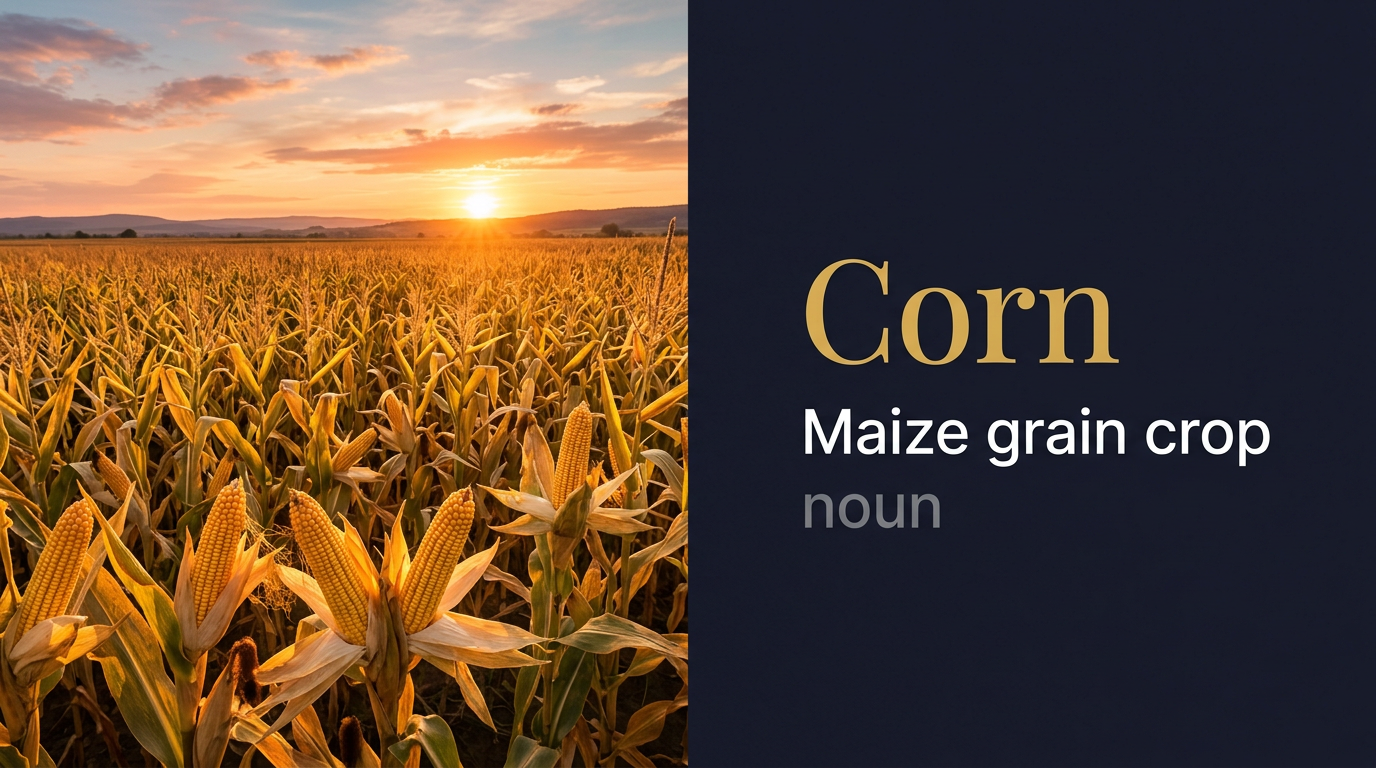
Meaning of Corn
Grain; cereal; crop; maize; food source; agricultural product; kernel; staple food
ما معنى كلمة Corn بالعربي؟
ذرة صفراء تُستخدم كغذاء أساسي
🌽🌾 ذرة صفراء تُستخدم كغذاء أساسي؛ ذرة وحبوب؛ المحصول الذهبي 🌾🌽
قصة GL: مثل زراعة corn تحتاج وقت ورعاية، زراعة القدرات المعرفية تحتاج صبر وتدريب يومي، المحصول الذهبي من 43 يوماً تدريب يُنتج تحسناً مُذهلاً في الذاكرة والتفكير 🌱
Corn in a sentence
In a memory drill, trainees linked the word corn to an image of a golden field.
Researchers recorded participants' diets, including how much corn they ate during the 43-day protocol.
Genetic Invent sourced corn-based packaging to cut plastic waste.
The licence lists corn starch as an approved filler in the Organic G Brain capsules.
Origin of Corn
From Old English 'corn' (grain), meaning 'seed'.
In the Genetic Learning (GL) context
In GL research and innovation contexts, corn represents cognitive enhancement nourishment providing, neuroplasticity development growth sustaining, and breakthrough thinking systematic cultivation for optimal nourishment enhancement and systematic corn optimization.
Corn audio micro-course (transcript)
Podcast 1 — Introduction & meaning
Narrator: Today we examine the word corn. Noun, adjective, and occasionally verb, it is one of the oldest words in the English language and one of the most geographically contentious: the same word means entirely different things depending on which side of the Atlantic you are standing on.
Narrator: Pronounce it to rhyme with born, worn, and torn. One syllable, the IPA is /kɔːn/. The vowel is the familiar open back rounded sound. It is an ancient Anglo-Saxon word that has barely changed in a thousand years.
Narrator: Corn comes from Old English corn, which descended from Proto-Germanic kurnam and is related to the Latin granum, meaning grain or seed. The Latin granum is also the ancestor of grain, granary, and even grenade, the latter named because a pomegranate resembles a handful of seeds.
Narrator: In Old English, corn meant any small seed or grain. By the Middle Ages it had narrowed to describe the principal cereal crop of a given region. In England that was wheat. In Scotland it was oats. In Ireland it was often barley. Corn simply meant the local staple grain, whatever that happened to be.
Narrator: When European settlers arrived in North America and encountered maize, the large-kernelled cereal domesticated by indigenous peoples of Mesoamerica thousands of years earlier, they called it Indian corn. Over time Indian was dropped and corn came to mean maize specifically, throughout the United States and Canada.
Narrator: This is the great transatlantic split. In British English, corn still means grain in general, or specifically wheat in an agricultural context. In American English, corn means maize exclusively. When an American recipe calls for corn, they mean the yellow kernelled vegetable. When a British farmer talks about the corn harvest, they may mean wheat or barley.
Narrator: Maize itself is the internationally neutral term, used in scientific, agricultural, and international trade contexts to avoid the ambiguity. If you are writing for a global audience, maize removes the confusion corn creates.
Narrator: The word corn also appears in a completely unrelated medical context. A corn on the foot is a small, painful area of thickened skin that develops from repeated friction or pressure, typically on or between the toes. This corn comes from the Latin cornu, meaning horn, a reference to the hard, horn-like texture of the callus. It is etymologically unrelated to the cereal grain.
Narrator: Corn has generated a rich compound vocabulary: cornfield, cornflour, cornflake, cornrow, corncob, cornstarch. Each of these uses corn in its American-English sense of maize, which has given American English corn-compounds a global reach through food culture and cinema.
Narrator: The word is also used informally to mean something sentimental, trite, or unsophisticatedly old-fashioned: that film is pure corn. This slang dates from the mid-twentieth century, possibly from the image of corn-fed rural simplicity, and gives us the adjective corny, meaning naively sentimental or clichéd.
Read podcasts 2 and 3
Podcast 2 — In conversation
Speaker A: I find corn genuinely confusing to use correctly. If I say I had corn for dinner, does that mean anything specific?
Speaker B: In British English it is slightly vague because corn historically meant grain in general. But in everyday modern British speech, particularly with food, most people would understand corn to mean sweetcorn or corn on the cob, the yellow maize vegetable. The American meaning has largely displaced the older British grain meaning in everyday food contexts.
Speaker A: So what would a British farmer mean by the corn harvest?
Speaker B: A British farmer would almost certainly mean wheat or possibly barley. In an agricultural report, corn acreage in the UK refers to cereal crops generally. That is the traditional British meaning still operating in farming and policy contexts. It is the same word used in two completely different ways depending on whether you are talking about food or farming.
Speaker A: That is genuinely confusing. What is the safest word if you want to be unambiguous?
Speaker B: Maize. That is the internationally neutral scientific and trade term for the specific crop the Americans call corn. If you are writing a recipe, a product description, or an agronomic report for a global audience, maize removes the ambiguity entirely. Sweetcorn is also unambiguous if you mean the tender, sweet variety eaten as a vegetable.
Speaker A: What about corn on the cob? Is that phrase understood everywhere?
Speaker B: Yes, corn on the cob is understood on both sides of the Atlantic. The cob is the central cylindrical structure of the maize ear, and the phrase refers to the whole ear roasted, boiled, or barbecued. It is one of those compound phrases where the context removes ambiguity about which meaning of corn is intended.
Speaker A: What about corny as in a corny joke?
Speaker B: That is informal American slang from the mid-twentieth century. Something corny is naively sentimental, obvious, or old-fashioned in a way that feels unsophisticated. A corny joke is one so predictable or over-familiar that it makes you groan. It probably comes from the idea of corn-fed rural simplicity. It has been widely adopted into British informal English as well.
Speaker A: And a corn on your foot? That must be a different word entirely.
Speaker B: Same spelling, different etymology. The medical corn comes from Latin cornu, meaning horn, referring to the hard horny texture of the thickened skin. It is completely unrelated to the cereal grain. A corn on your toe is a painful, cone-shaped callus caused by friction, usually from tight shoes. The two corns just happen to share an English spelling by historical coincidence.
Podcast 3 — Prompt engineering
Speaker B: Corn is a rich domain word for agricultural technology, food production, and commodity market applications. Naming corn specifically in a prompt places the model inside a specific agricultural and economic context that unlocks precise data models and workflows. Let me walk through five prompts.
Speaker B: First, a crop yield tracking system for arable farmers:
Speaker B: Build a PostgreSQL schema for a crop yield management system. The fields table stores field_id, field_name, area_hectares, and soil_type. The harvests table stores harvest_id, field_id, crop_type as an enum including corn, wheat, barley, and oilseed_rape, harvest_year, yield_tonnes_per_hectare, and moisture_content_percent. Create a view showing average corn yield per field over the last five years.
Speaker B: Naming corn as one of the crop_type enum values tells the model this is a real arable farming system. The moisture_content_percent field is an agronomic detail specific to grain harvests: corn moisture at harvest determines whether additional drying is needed before storage, which is a major cost variable for farmers.
Speaker A: Moisture content as a required field is genuinely domain-specific. Without naming corn, that probably never appears. Second?
Speaker B: A commodity pricing dashboard for grain traders:
Speaker B: Build a React commodity dashboard for a grain trading desk. Display live and historical price charts for corn, wheat, and soybeans using Recharts LineChart. Pull prices from a commodity_prices PostgreSQL table with columns: commodity, price_usd_per_bushel, recorded_at. Show a thirty-day moving average alongside the spot price. Add a correlation panel showing how corn prices track against wheat prices over the past year.
Speaker B: Corn priced in US dollars per bushel is the correct unit for corn trading on the Chicago Board of Trade, the world benchmark market. Naming corn in the prompt immediately signals the model to use bushels and USD rather than tonnes and GBP, which would be the UK grain market convention. Domain precision in one word.
Speaker A: Bushels versus tonnes, that is a real difference that would break data compatibility. Third prompt?
Speaker B: Design a Django supply chain management system for a corn processing plant. Track: raw_corn deliveries with supplier_id, delivery_date, quantity_tonnes, and moisture_percent; milling batches with batch_id, input_tonnes, output_product as an enum of cornflour, cornstarch, corn_oil, and animal_feed, and waste_tonnes; and outbound shipments. Generate a daily yield efficiency report showing output per tonne of input corn.
Speaker B: Corn processing generates multiple by-products, each with its own market and logistics requirements. Naming corn as the input material tells the model to build a yield-based efficiency model rather than a simple inventory system. Output per tonne of input corn is a real key performance indicator in grain processing.
Speaker A: The by-product enum cornflour, cornstarch, corn oil, feed is exactly what a real corn mill would track. Fourth?
Speaker B: Build a Next.js farm management dashboard for a corn growing operation. Display: current season corn planting progress as a percentage of total planned hectares, field-by-field status with stages enum of prepared, planted, growing, harvested, and fallow, a weather widget showing rainfall and temperature for the farm postcode, and an estimated harvest date calculated from planting date plus a configurable growing_days field.
Speaker B: The growing_days field is a configurable agronomic parameter because different corn varieties have different days-to-maturity values, from around ninety days for early varieties to one hundred and forty days for late varieties in temperate climates. Naming corn prompts the model to think about growth-stage management rather than generic task management.
Speaker A: Configurable growing days by variety is something only a domain-specific prompt would surface. Last one?
Speaker B: Create a Node.js API for a food manufacturer that tracks corn as an ingredient across recipes. Each recipe stores recipe_id, recipe_name, and an ingredients array. Each ingredient entry has ingredient_name, quantity_grams, and allergen_flags. Flag corn and corn derivatives, including cornflour, cornstarch, corn syrup, and modified maize starch, as potential allergens. Return a product allergen report listing all products containing corn in any form.
Speaker A: Corn derivatives as allergen flags is a food safety and labelling requirement. In the EU and UK, cereals containing gluten must be declared, and corn-derived ingredients appear across processed foods in surprisingly many forms.
Speaker B: Exactly. And that is what corn does in a development prompt. It carries agricultural units, processing workflows, growth stage logic, commodity pricing conventions, and food safety rules all at once. A word with a thousand years of history delivers that entire context in four letters, and the precision of your output reflects it directly.
Frequently asked questions about Corn
What does Corn mean?
Grain; cereal; crop; maize; food source; agricultural product; kernel; staple food
ما معنى كلمة Corn بالعربي؟
ذرة صفراء تُستخدم كغذاء أساسي — 🌽🌾 ذرة صفراء تُستخدم كغذاء أساسي؛ ذرة وحبوب؛ المحصول الذهبي 🌾🌽
How is Corn used in a sentence?
In a memory drill, trainees linked the word corn to an image of a golden field.
What are synonyms of Corn?
grain, cereal, maize, crop, kernel, produce.