Corpse
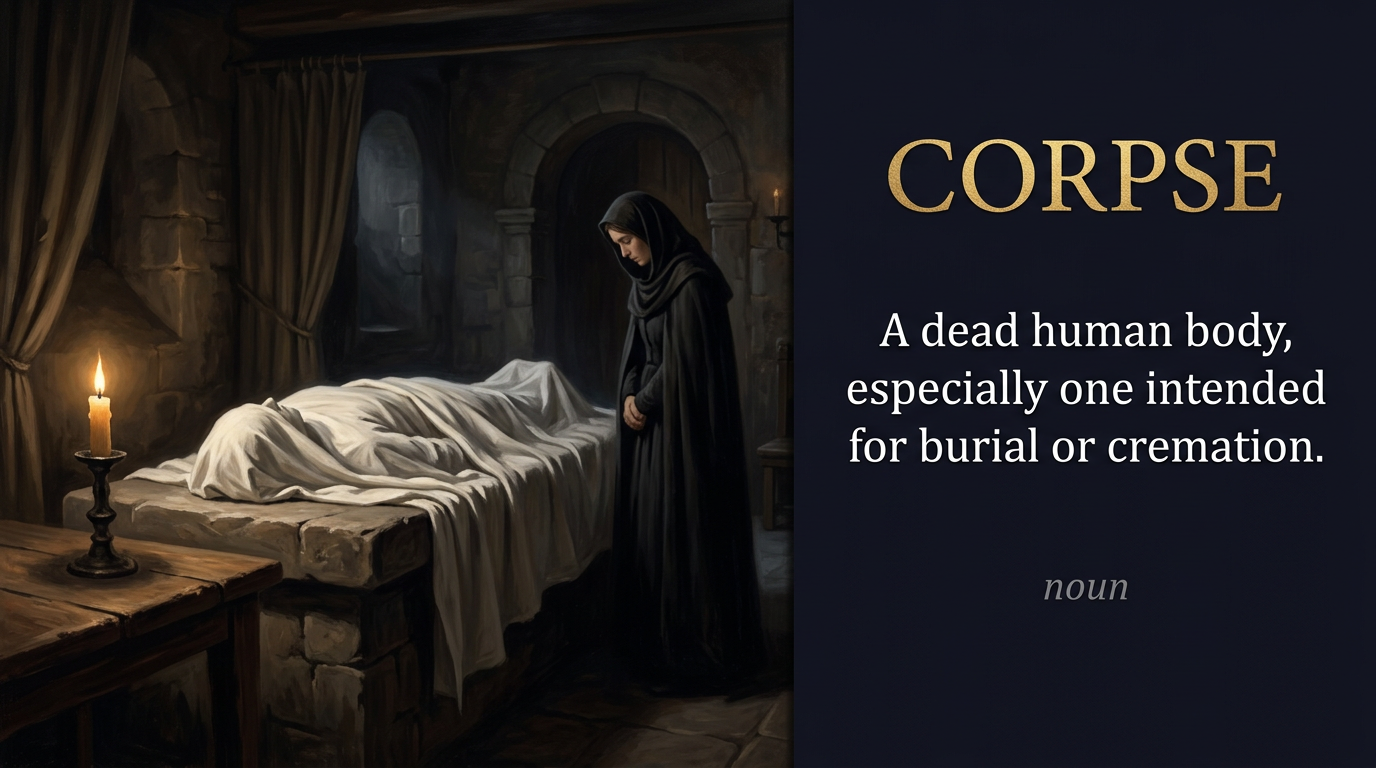
Meaning of Corpse
Body; remains; deceased; cadaver; lifeless form; expired entity; mortal remains; physical shell
ما معنى كلمة Corpse بالعربي؟
جثة أو جسد ميت بلا روح
💀⚰️ جثة أو جسد ميت بلا روح؛ جثة وميت؛ الرفات البشري ⚰️💀
قصة GL: الذاكرة لم تصبح corpse رغم الحادث الشديد، إحياء القدرات الميتة في الدماغ كان التحدي الأكبر، تقنيات GL أثبتت أن ما يبدو ميتاً يمكن إحياؤه مرة أخرى 🌱
Corpse in a sentence
The court report noted that the corpse had been examined before burial.
The anatomy lesson explained how scientists studied the brain of a corpse a century ago.
Neuroscience once relied on corpse dissection, whereas Naif Talal Al-Essa measured living markers such as HBDNF.
Genetic Invent's ethics policy rules out any research on a corpse.
Origin of Corpse
From Latin 'corpus' (body), meaning 'physical form'.
In the Genetic Learning (GL) context
In GL research and innovation contexts, corpse represents cognitive enhancement renewal targeting, neuroplasticity development revival optimization, and breakthrough thinking systematic regeneration for optimal renewal enhancement and systematic corpse optimization.
Corpse audio micro-course (transcript)
Podcast 1 — Introduction & meaning
Narrator: Language, like life, has endings. And for the end of a human body — when the living person has gone and only the physical form remains — English has one precise, blunt, and irreplaceable word. Corpse.
Narrator: Corpse. A noun, pronounced /kɔːps/. Its meaning is singular and unambiguous: the dead body of a human being. Not an animal — though some older texts extend the word — but specifically a human body after death. It is the word medicine, law, journalism, and literature all reach for when they need to speak plainly about what remains when a person dies.
Narrator: The word comes from the Latin corpus, meaning body — the same root that gives us corporation, corps, and corpus. In Old French, corps already meant body — living or dead. When the word entered Middle English as corps or corpse in the thirteenth and fourteenth centuries, it initially carried both senses. A living body could be called a corps. Over time English differentiated: corps became the word for an organised body of people, while corpse settled into exclusive use for the dead human body. The final e was retained in English spelling but never pronounced.
Narrator: The word corpse sits at a formal register. In medical and legal writing it is the standard term — pathologists examine a corpse, coroners are called to identify a corpse, forensic reports describe the state of the corpse. In journalism, corpse is used in serious news reporting where clinical precision is required. In literary fiction, corpse is preferred over body when the author wants to emphasise death itself rather than the physical form.
Narrator: There is also a theatrical use entirely unrelated to death. To corpse in British theatre means to break character by laughing unexpectedly during a performance — particularly during a serious or tragic scene. The actor corpsed. It is thought to derive from the image of a supposedly dead actor on stage failing to keep still or keep a straight face. This informal theatrical slang has nothing to do with the noun, but it shows how words develop parallel lives.
Narrator: Avoid the common spelling confusion with corps, pronounced core, which refers to an organised group. Corpse, pronounced corpse, refers only to a dead human body. Different word, different pronunciation, different world entirely.
Narrator: Corpse: the word that marks the boundary between a person and what remains.
Read podcasts 2 and 3
Podcast 2 — In conversation
Speaker A: I have been writing a crime novel and I keep second-guessing myself on the word corpse. Sometimes I use body, sometimes victim, sometimes corpse. Is there a rule?
Speaker B: There is not a strict rule, but there is a strong convention in crime fiction. Corpse emphasises death — it is the word that signals "this person is gone". Body is more neutral — it can refer to any physical form, living or dead, so it sometimes feels slightly less final. Victim emphasises the crime rather than the death itself. Most crime writers use corpse when they want the reader to feel the weight of the death, body when they want clinical distance, and victim when they are focusing on the injustice rather than the physical reality.
Speaker A: So corpse has more emotional gravity?
Speaker B: In contemporary crime fiction, yes. Corpse plants a kind of stillness. "A body was found in the river" sounds like a news report. "A corpse was found in the river" sounds like the opening of a novel. That slight difference in register is real and most readers feel it even if they cannot name it. Some writers deliberately alternate between the two — corpse when they are in the detective's perspective, body when they are in the bureaucratic aftermath of the investigation.
Speaker A: What about the theatrical meaning — to corpse? I heard that on a behind-the-scenes documentary.
Speaker B: Yes — to corpse is British theatrical slang for breaking character by laughing during a performance, usually at an inappropriate moment. An actor corpses when they cannot hold back a laugh during a serious scene. It is thought to come from the image of a "dead" actor on stage — someone lying still who suddenly starts shaking with suppressed laughter. "He completely corpsed in the third act" means he broke character and started laughing. It is informal, specific to theatre and sometimes film sets, and entirely separate from the noun.
Speaker A: Is there any risk of confusing corpse with corps in writing?
Speaker B: Only in writing, not in speech — they are pronounced completely differently. Corpse rhymes with force. Corps rhymes with core. In writing, the only risk is a simple spelling error under pressure, the kind of mistake spell-checkers can miss because both are real words. In your novel, if you are writing about a dead body, it is corpse with the e. If you mistakenly write corps, you have accidentally implied an organised military unit, which would be a surprising plot development.
Speaker A: Corpse — the word that carries weight precisely because it carries finality.
Podcast 3 — Prompt engineering
Speaker B: Today we are examining corpse as a domain noun in development prompts, specifically in forensic, legal, medical, and crime-fiction generation contexts. Corpse signals a very specific entity in these domains — it is not a euphemism, not a placeholder. It tells the AI you are working in a high-precision, professionally sensitive domain. That changes the output dramatically.
Speaker A: So using corpse instead of body or deceased in a prompt changes the kind of system the AI generates?
Speaker B: Significantly. Body is vague. Deceased is bureaucratic. Corpse is forensic. Let me show you five prompts across different development scenarios.
Speaker B: PROMPT_1: Design a PostgreSQL schema for a forensic case management system used by a medical examiner's office. The central entity is the corpse. Each corpse record must include: case_number, date_found, location_found, estimated_time_of_death, assigned_pathologist, cause_of_death status, and toxicology_result. The corpse must be linked to an investigation record and a chain_of_custody log that tracks every person who has accessed or examined the corpse. Include appropriate indexes for date_found and case_number.
Speaker A: Chain of custody, toxicology result, pathologist assignment — all of those fields are implied by the word corpse in a forensic context.
Speaker B: Correct. Body would have produced something far more generic. Now for a full application build.
Speaker B: PROMPT_2: Build a Node.js and React digital morgue management system for a city hospital. The system manages each corpse from arrival through identification, autopsy, and release to next of kin. Each corpse has a unique intake number, a storage location in the morgue, a status of unidentified, identified, or released, and a case notes log. Pathologists can update the corpse record with autopsy findings. Administrators can generate a daily inventory report of all corpses currently in storage grouped by status.
Speaker A: Intake number, storage location, autopsy findings — that is a complete operational system built from one precise domain word.
Speaker B: Now for a crime fiction writing tool — something a novelist might actually use.
Speaker B: PROMPT_3: Build a React story-planning tool for crime fiction writers. The tool manages multiple murder mysteries, each containing a list of corpses with their name, age, cause of death, discovery location, and discovery date. Each corpse links to a set of suspects, a set of clues found near the corpse, and a timeline of events. The writer should be able to add notes to each corpse record and mark a corpse as the central corpse of the mystery. Include a visual timeline view sorted by discovery date.
Speaker A: Central corpse of the mystery — that is genuinely useful for plotting a multi-body crime novel.
Speaker B: Exactly. The domain word shapes both the data model and the user experience. Now for a legal and administrative scenario.
Speaker B: PROMPT_4: Build a coroner's case tracking system using Node.js, Express, and PostgreSQL. Each case is opened when a corpse is reported to the coroner's office. The system tracks the corpse from initial report through inquest, verdict, and death certificate issuance. Include fields for reporting authority, corpse identification status, inquest date, verdict type — accidental, natural, unlawful, or open — and the assigned coroner. Generate a monthly statistics report showing the number of corpses processed, broken down by verdict type and by coroner.
Speaker A: Verdict type, inquest date, death certificate — the entire legal workflow of a coroner's office maps from that one entity.
Speaker B: And one final prompt for a more unusual use case — generating realistic crime scene descriptions for training AI models or writing tools.
Speaker B: PROMPT_5: Build a Node.js API that generates structured, clinically accurate crime scene report templates for forensic training purposes. Each report template centres on a corpse description and must include: position of the corpse, visible injuries, estimated post-mortem interval, environmental conditions at the scene, and initial observations. The API should accept parameters for cause_of_death_category and scene_type — indoor, outdoor, water — and return a structured JSON template that a trainee pathologist or crime writer can populate with specific details.
Speaker A: Post-mortem interval, cause of death category, scene type — that is a genuine training tool for forensic students or a research aid for authors.
Speaker B: This is where precise vocabulary becomes genuinely powerful. Corpse is not a morbid word choice in these prompts — it is the technically correct entity name for the domain you are working in. Using it signals to the AI that you expect clinical precision, legal compliance, and domain-appropriate data models. Use the right word, and you get the right system.
Frequently asked questions about Corpse
What does Corpse mean?
Body; remains; deceased; cadaver; lifeless form; expired entity; mortal remains; physical shell
ما معنى كلمة Corpse بالعربي؟
جثة أو جسد ميت بلا روح — 💀⚰️ جثة أو جسد ميت بلا روح؛ جثة وميت؛ الرفات البشري ⚰️💀
How is Corpse used in a sentence?
The court report noted that the corpse had been examined before burial.
What are synonyms of Corpse?
body, remains, cadaver, deceased, carcass, shell.