Corruption
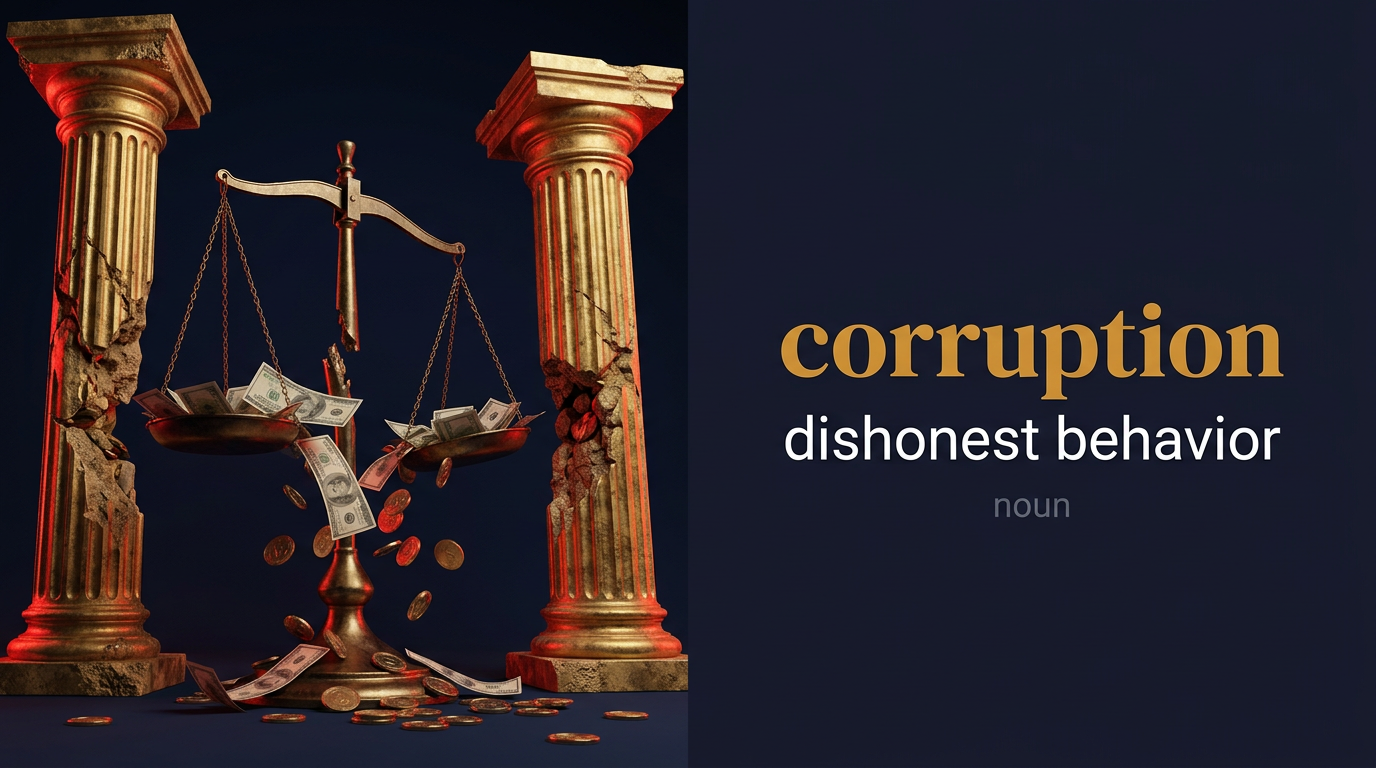
Meaning of Corruption
Dishonesty; fraud; decay; contamination; degradation; deterioration; impurity; misconduct
ما معنى كلمة Corruption بالعربي؟
عملية الفساد أو التدهور التدريجي
🕳️💔 عملية الفساد أو التدهور التدريجي؛ فساد وتدهور؛ التآكل الداخلي 💔🕳️
قصة GL: مواجهة corruption في الذاكرة كانت التحدي الأكبر، محاربة التدهور من خلال برامج التعلم الجيني المكثفة أدت لاستعادة 95% من القدرات المعرفية خلال العامين الأولين من التدريب 💪
Synonyms & related words
Corruption in a sentence
Data corruption was detected and the samples were re-measured.
The court examined allegations of corruption in the licensing process.
The lesson discussed how corruption harms public trust.
Genetic Invent's audit found no corruption in its contracts.
Origin of Corruption
From Latin 'corruptio' (breakdown), meaning 'decay'.
In the Genetic Learning (GL) context
In GL research and innovation contexts, corruption represents cognitive enhancement integrity compromising, neuroplasticity development purity threatening, and breakthrough thinking systematic degradation for optimal integrity enhancement and systematic corruption prevention.
Corruption audio micro-course (transcript)
Podcast 1 — Introduction & meaning
Narrator: Today we examine corruption — a noun derived from the same Latin root as corrupt, but carrying its own distinct weight. Pronounced kuh-RUP-shun, with the stress on the second syllable.
Narrator: Corruption is a noun. It names the state, the process, or the system of being corrupt. Where corrupt describes a condition, corruption describes the phenomenon itself.
Narrator: The Latin origin is corruptio — the act of breaking something down entirely. Roman writers used it to describe the decay of food, the spoiling of materials, and the moral decline of public officials.
Narrator: In medieval English, corruption referred first to bodily decay — the corruption of flesh after death. It was a medical and theological term, used in discussions of sin, the human body, and the afterlife.
Narrator: By the Renaissance, corruption had settled firmly in political and institutional language. Corrupt practices in government, in the church, in trade — all fell under the banner of corruption.
Narrator: Today, corruption is most commonly heard in three domains. Political corruption: the abuse of public office for private gain. Data corruption: damage to stored or transmitted digital information. And moral corruption: the gradual erosion of ethical standards.
Narrator: What separates corruption from simple wrongdoing is its systemic nature. Corruption is not a single bad act — it is a pattern, an institution, a climate in which wrongdoing has become normalised.
Narrator: The word is formal and serious in register. It appears in legislation, journalism, international agreements, and academic research. It carries an accusation about institutions, not just individuals.
Narrator: Here is the essential insight: corruption is not just doing wrong — it is allowing wrong to become the rule. That is the word at its most powerful and most troubling.
Read podcasts 2 and 3
Podcast 2 — In conversation
Speaker A: So, the news is full of corruption inquiries at the moment. There seem to be several ongoing investigations across different sectors.
Speaker B: It does feel relentless, does it not. Though I think it is worth separating what people mean when they say corruption. They are not always talking about the same thing.
Speaker A: That is fair. What distinctions do you draw?
Speaker B: Well, political corruption usually means public officials misusing their power — taking bribes, awarding contracts to friends, falsifying records. Data corruption in IT means something entirely different — data that has become damaged or unreadable.
Speaker A: Right, and people also talk about moral corruption — the idea that exposure to certain influences degrades a person or community over time.
Speaker B: Exactly. And interestingly, all three meanings share the same core: something that was functioning properly has been broken down from within. That is what makes the word so versatile and so powerful.
Speaker A: I heard someone use the phrase systemic corruption the other day. Is that different from just plain corruption?
Speaker B: It emphasises that the corruption is embedded in a system — not just one individual acting badly, but an entire structure of incentives, processes, and norms that enables and perpetuates wrongdoing. It is a more damning accusation.
Speaker A: What about the synonym graft? I hear that in American political coverage particularly.
Speaker B: Graft is more specific — it refers to corruption through dishonest acquisition of money, particularly in politics and business. Corruption is broader. You could have corruption without graft if, say, power is abused without financial gain. The two overlap but are not identical.
Speaker A: And malfeasance?
Speaker B: Malfeasance is the wrongful exercise of lawful authority — a technical legal term. Corruption is the lay word that sits above it. They are related, but corruption carries moral weight that malfeasance does not always imply.
Podcast 3 — Prompt engineering
Speaker B: Right, let us get into prompt engineering using the word corruption. This word is fascinating because it covers systemic failure, data damage, and moral decline — all of which have direct analogies in software systems.
Speaker A: I can already see how that would be useful. A system audit, for instance.
Speaker B: Exactly. Let us start with a database design scenario:
Speaker B: Design a MySQL database schema for a public sector audit system that tracks and reports on corruption indicators — including conflicts of interest, unexplained wealth declarations, irregular procurement patterns, and non-compliance flags. Include a dashboard summary view and role-based access control.
Speaker B: Notice that corruption here defines the entire domain model. The AI will structure tables, relations, and queries around corruption indicators rather than generic records.
Speaker A: That is focused. You get a domain-specific schema straight away, not a blank generic one.
Speaker B: Good. Next — an HR application:
Speaker B: Build a Node.js REST API for an HR compliance system that flags potential internal corruption risks — including employees approving their own expense claims, procurement decisions made without required approvals, and duplicate supplier registrations. Return detailed risk reports per employee and per department.
Speaker A: That is directly usable as a product requirement. The word corruption frames the entire risk model.
Speaker B: Right. Now a UI design prompt:
Speaker B: Design a dark-mode admin dashboard for an anti-corruption monitoring tool. Include a sidebar with corruption risk categories — procurement, HR, finance, and data integrity. Use red severity badges for high-risk items, amber for medium, and a global corruption risk score displayed prominently in the top navigation bar.
Speaker A: I love that. The visual hierarchy is defined by the word itself.
Speaker B: Exactly. Here is a data integrity scenario — this time focused on technical corruption:
Speaker B: Create a Python utility that scans a financial transactions database for data corruption — identifying rows with null primary keys, orphaned foreign keys, duplicate transaction hashes, and amounts that exceed configurable business rules. Generate a corruption summary report in JSON and CSV formats.
Speaker A: That bridges the political and technical meanings beautifully. Same word, different context, same underlying concept.
Speaker B: That is what makes it such a rich prompt word. One more — a full application:
Speaker B: Build a full-stack web application called Corruption Radar for a government transparency body. The app should allow journalists and citizens to report corruption incidents, track investigation status, visualise geographic corruption hotspots on an interactive map, and export anonymised data for research. Include an admin panel for case management.
Speaker A: That is an entire civic tech platform in one prompt. Corruption is doing all the thematic work.
Speaker B: Final one — a navigation and layout prompt:
Speaker B: Design a multi-section side navigation panel for a legal case management system specialising in corruption prosecutions. Each section should correspond to a corruption category: bribery, fraud, embezzlement, money laundering, and abuse of power. Include collapsible sub-items per case, a global search bar, and a case count badge per category.
Speaker A: Each of those prompts is genuinely ready to paste and use. The word corruption is doing serious structural work in every single one.
Speaker B: That is the point. Vocabulary precision in prompting is not about sounding clever — it is about giving the AI a clear conceptual anchor. When you use corruption, you are not just naming a topic; you are importing an entire framework of systemic failure, accountability, and remediation into your instruction.
Frequently asked questions about Corruption
What does Corruption mean?
Dishonesty; fraud; decay; contamination; degradation; deterioration; impurity; misconduct
ما معنى كلمة Corruption بالعربي؟
عملية الفساد أو التدهور التدريجي — 🕳️💔 عملية الفساد أو التدهور التدريجي؛ فساد وتدهور؛ التآكل الداخلي 💔🕳️
How is Corruption used in a sentence?
Data corruption was detected and the samples were re-measured.
What are synonyms of Corruption?
dishonesty, fraud, decay, contamination, degradation, deterioration.