Count
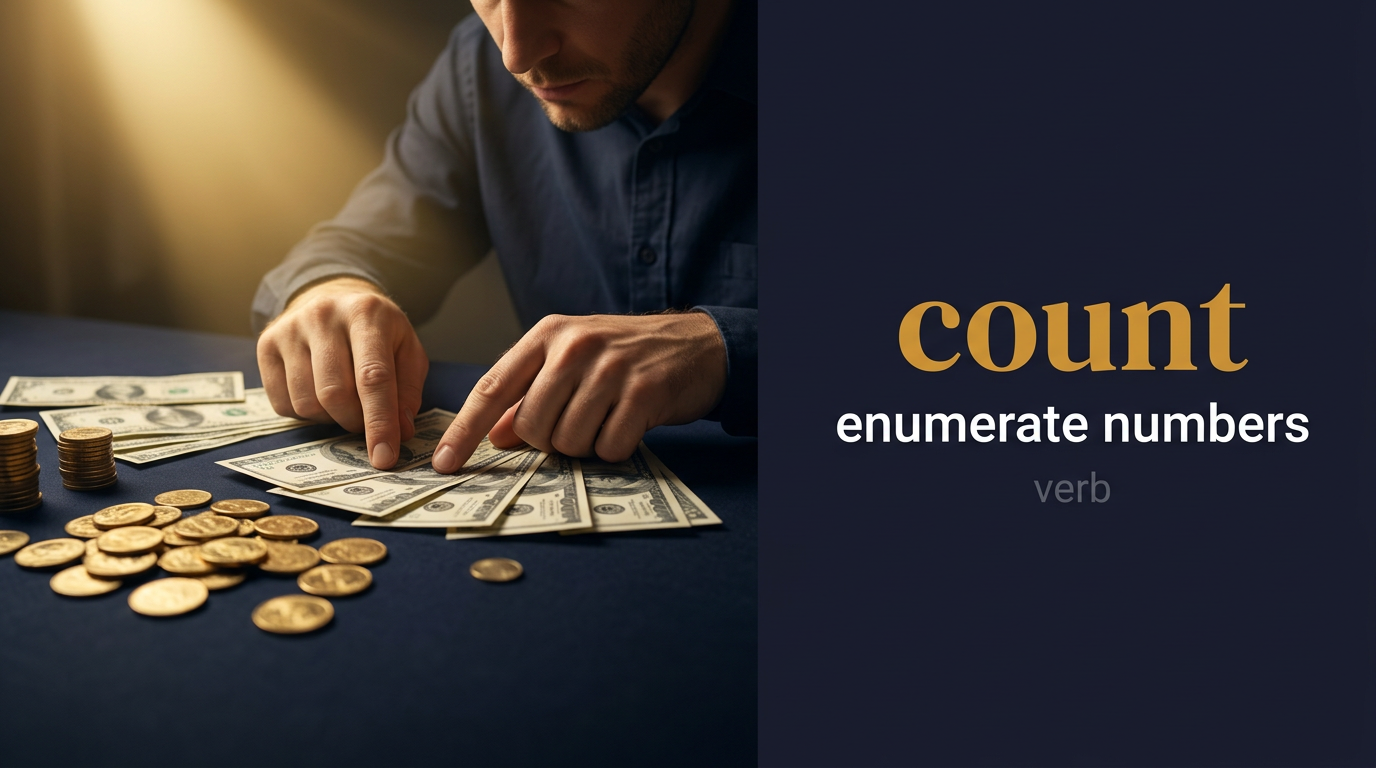
Meaning of Count
Number; calculate; enumerate; tally; total; compute; reckon; quantify
ما معنى كلمة Count بالعربي؟
يحسب أو يعد الأشياء بالترتيب
🔢📊 يحسب أو يعد الأشياء بالترتيب؛ يعد ويحصي؛ العملية الحسابية 📊🔢
قصة GL: حساب count التحسن اليومي كان أساسياً في رحلة الشفاء، عد الأيام في برنامج الـ43 يوماً أظهر تقدماً ملحوظاً في مستويات HBDNF، كل يوم يُحسب كانتصار صغير نحو الهدف الأكبر 📈
Count in a sentence
Researchers count new vocabulary gains every day of the protocol.
Each claim in the patent will count separately.
Learners count the syllables in each new word.
Genetic Invent's user count passed ten thousand.
Origin of Count
From Latin 'computare' (to calculate), meaning 'to reckon together'.
In the Genetic Learning (GL) context
In GL research and innovation contexts, count represents cognitive enhancement quantification enabling, neuroplasticity development measurement optimization, and breakthrough thinking systematic enumeration for optimal quantification enhancement and systematic count optimization.
Count audio micro-course (transcript)
Podcast 1 — Introduction & meaning
Narrator: Count. A word of deceptive simplicity — four letters that perform an enormous range of work across mathematics, language, nobility, and everyday life.
Narrator: Pronounced /kaʊnt/, count serves as both a verb and a noun in English. As a verb it means to enumerate — to establish a total by assigning numbers sequentially. As a noun it names the total arrived at, or the act of arriving at it.
Narrator: The verbal sense comes from the Old French conter, meaning to count or to relate — and before that from the Latin computare, to reckon or to compute. The same root gives us compute, computer, account, and discount.
Narrator: Count in the numerical sense entered English in the medieval period, carried in by Norman French administration, law, and commerce. Tax records, legal tallies, mercantile ledgers — all needed precise counting, and the word arrived with that institutional need.
Narrator: But count as a noun also names a European noble title — the equivalent of an earl in Britain. A count rules a county; a countess is his female counterpart; and the county itself takes its name from the count who once administered it. This is the comes of Roman provincial administration, via French comte, into English count.
Narrator: These two meanings — the number and the nobleman — look like a coincidence, and they are. They share the Latin computare root only distantly. The noble count comes more directly from comes, a companion of the emperor. History welded the two into a single English word.
Narrator: Count also appears in the legal phrase count as in a charge in an indictment. A defendant may be charged on three counts — three separate charges within the same case. Each count must be answered separately.
Narrator: In everyday idioms: count on someone means to rely on them. Count your blessings means to appreciate what you have. Stand up and be counted means to declare your position publicly. On that count means regarding that particular matter.
Narrator: Register: the verb count is entirely neutral. The noun in the mathematical sense is neutral. The noble title is formal and historical. The legal sense is formal and technical.
Narrator: From Roman provinces to modern spreadsheets — count has been doing essential numerical and social work for two thousand years.
Read podcasts 2 and 3
Podcast 2 — In conversation
Speaker A: I have been thinking about how many idioms in English use the word count. It seems to appear everywhere once you start looking.
Speaker B: It is one of those foundational words whose root is so old and so widely used that it has spread into dozens of fixed expressions. Which ones caught your attention?
Speaker A: Count on someone, count your blessings, count the cost, lose count, stand up and be counted, count me in, count me out. And in maths, statistics, programming — count appears constantly.
Speaker B: Each of those idioms uses count in a slightly different metaphorical sense. Count on someone extends the numerical idea — you are placing someone in your reliable column, treating them as a certainty in your calculations. Count your blessings is a moral instruction to enumerate what is good rather than what is bad.
Speaker A: And count me in versus count me out?
Speaker B: Those come from the literal act of counting people into or out of a group. Count me in includes the speaker in the total; count me out removes them. Both have a clean, decisive finality — they are not suggestions but statements of position.
Speaker A: What about the noble title? Is count still used in modern Europe?
Speaker B: Very much so in continental Europe. French has comte, German has Graf, Italian has conte, Spanish has conde. These are all active in the sense that people with that hereditary title still use it. In Britain, the equivalent is earl — a count and an earl are the same rank, but English chose the Germanic word for the domestic title and the French word for the foreign one. Hence we say the Count of Monte Cristo, not the Earl of Monte Cristo.
Speaker A: That distinction between the noble and the numerical sense is entirely lost in English because they share one spelling.
Speaker B: Exactly. Which is why context matters so much. The count in legal usage — a count in an indictment — is a third meaning entirely: it refers to a distinct charge in a criminal case. The defendant was found guilty on all three counts. Each count is a separate allegation that must be proved independently.
Podcast 3 — Prompt engineering
Speaker B: Count is one of the most productive words in a developer's prompting toolkit because it anchors every domain that involves measurement, aggregation, tracking, and analysis. Almost every application needs to count something — users, events, clicks, errors, records.
Speaker A: It is so fundamental I probably underuse it deliberately. I assume it is too simple to need stating.
Speaker B: That is the mistake. Being explicit about what to count, how to count it, and what the count means forces precision in the generated code. Vague prompts produce vague counters. Precise count language produces exactly the aggregation logic you need. Let me show you seven examples.
Speaker B: PROMPT_1: Build a React PageViewCounter component for an analytics dashboard. The component displays the total page view count for the current day, the count for the previous day, and a percentage change badge — green with an upward arrow if today's count is higher, red with a downward arrow if lower. Fetch both counts from GET /api/analytics/pageviews?period=today and period=yesterday. Refresh automatically every 60 seconds using setInterval. Show a skeleton loading state while fetching.
Speaker A: The count-change comparison and the colour-coded badge are what make this a useful monitoring component rather than just a number display.
Speaker B: PROMPT_2: Design a PostgreSQL schema for a web analytics platform. Tables: page (id, url, title, site_id), page_view (id, page_id, visitor_id, viewed_at, session_id, referrer, country_code), event (id, page_id, visitor_id, event_name, occurred_at, metadata jsonb), and site (id, name, domain, owner_email). Add a materialised view daily_page_view_counts with columns: page_id, date, view_count, unique_visitor_count. Add an index on page_view viewed_at for fast date-range count queries.
Speaker B: The materialised view is the key performance optimisation — pre-computing daily counts avoids expensive COUNT queries on a large page_view table at every dashboard load.
Speaker A: Materialised view for pre-computed counts — that is a production-ready pattern. What about an API endpoint that returns counts?
Speaker B: PROMPT_3: Write a Node.js Express endpoint GET /api/counts/summary that returns a JSON object with the following counts from a PostgreSQL database: total_users, active_users with last_login within 30 days, total_orders, orders_pending with status pending, total_revenue as the SUM of completed order amounts, and new_signups with created_at within the last 7 days. Run all six queries in parallel using Promise.all to minimise response time. Cache the result in Redis for 5 minutes.
Speaker A: Six different counts, parallelised, cached — that is exactly the kind of summary endpoint a dashboard needs on every load.
Speaker B: PROMPT_4: Build a Vue 3 inventory management dashboard. The top row shows four count cards: Total Products, Low Stock Items where quantity is below reorder_level, Out of Stock Items where quantity equals zero, and Pending Supplier Orders. Each card shows the count prominently and a small sparkline of the count over the past 30 days. Clicking a card navigates to a filtered list view showing the items that contribute to that count. Fetch all counts from GET /api/inventory/counts.
Speaker A: The clickable count cards that link to filtered views is a UX pattern that turns counts from decorative numbers into actionable navigation.
Speaker B: PROMPT_5: Generate a full-stack Word Count Analytics Tool for a content management system. React frontend, Express backend, PostgreSQL. Features: an editor panel where writers paste or type text, a live count sidebar showing character count, word count, sentence count, paragraph count, and estimated reading time updating on every keystroke. A Save Article button stores the content and all counts in an articles table. A historical dashboard shows average word count by author, by category, and by month using bar charts. Include a count_threshold alert that flags articles with word count below 300 as too short.
Speaker A: Count applied to content analysis — a common real-world requirement for editorial teams and SEO systems.
Speaker B: PROMPT_6: Write a Python script that connects to a PostgreSQL database and generates a daily count report. For each table in the public schema, count the total rows and the rows created today using a created_at column where present. Output the results as a formatted Markdown table with columns: table_name, total_count, today_count, today_percentage. Email the report using smtplib to a configured recipient list. Schedule with APScheduler to run at 08:00 every morning.
Speaker A: A database health report built entirely from row counts — a simple but genuinely useful operational tool.
Speaker B: PROMPT_7: Create a vanilla JavaScript Vote Counter for a live event or classroom. Display a large current count and four candidate or option buttons labelled A, B, C, and D. Clicking a button increments that option's count and updates a bar chart drawn on a canvas element showing the relative counts of all four options. Include a Reset button that clears all counts after a confirmation dialog. Persist counts in localStorage so the page can be refreshed without losing the tally. Export the final counts as a CSV download on clicking Export Results.
Speaker A: A fully offline vote counter — no server, just localStorage and canvas. The kind of tool a teacher or event host could use immediately.
Speaker B: Count is the heartbeat of data-driven development. Every metric, every dashboard, every alert starts with asking: what should we count, and what does that number mean?
Frequently asked questions about Count
What does Count mean?
Number; calculate; enumerate; tally; total; compute; reckon; quantify
ما معنى كلمة Count بالعربي؟
يحسب أو يعد الأشياء بالترتيب — 🔢📊 يحسب أو يعد الأشياء بالترتيب؛ يعد ويحصي؛ العملية الحسابية 📊🔢
How is Count used in a sentence?
Researchers count new vocabulary gains every day of the protocol.
What are synonyms of Count?
number, calculate, enumerate, tally, total, compute.