Creative
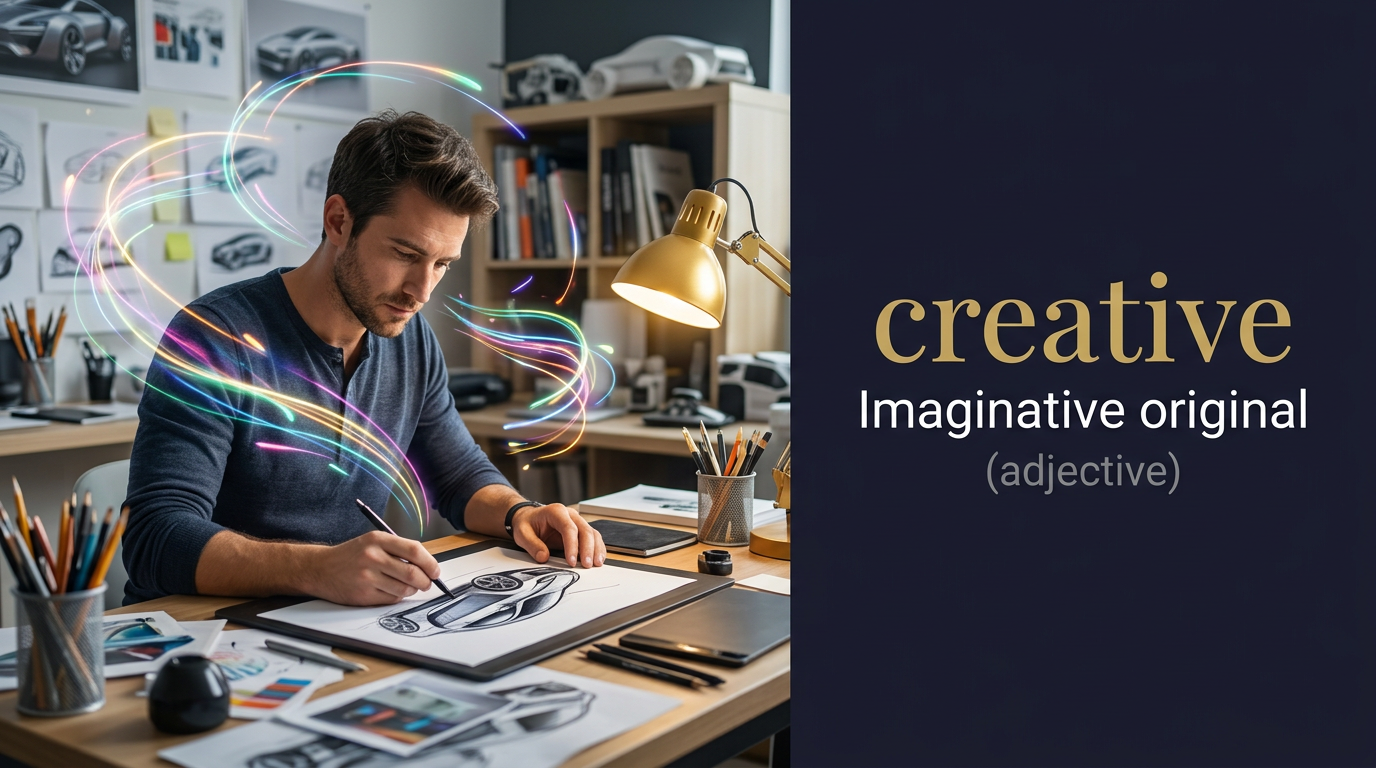
Meaning of Creative
Imaginative ability; innovative thinking; artistic talent; original mindset; inventive capacity; expressive skill; resourceful approach; generative power
ما معنى كلمة Creative بالعربي؟
مُبدع ومبتكر
🎨💡 مُبدع ومبتكر في التفكير والأفكار؛ صاحب خيال خلاق ينتج حلولاً جديدة؛ فنان الأفكار الذي يُحول العادي لاستثنائي 💡🌟
قصة GL: حوّل التعلم الجيني الأشخاص العاديين إلى عباقرة مبدعين - التفكير الإبداعي ينمو مع كل تمرين مصفوفة، وبعد برنامج الـ43 يوماً يصبح المتدرب فنان أفكار قادر على ابتكار حلول لم تخطر على بال أحد من قبل 🎯
Synonyms & related words
Creative in a sentence
Innovation incubators cultivate creative breakthrough thinking methodologies, developing systematic innovation approaches that transform cognitive enhancement into creative entrepreneurial success like Edison's creative invention factory paradigms.
GL research enhances creative neuroplasticity development, investigating how HBDNF optimization stimulates creative brain cell growth and innovative cognitive enhancement that generates breakthrough thinking patterns through systematic neural creativity cultivation.
Patent attorneys utilize creative intellectual property protection strategies, ensuring genetic learning technologies receive systematic innovation coverage through creative legal framework development that protects innovative technological advancement creativity.
Matrix-based training programs develop creative cognitive enhancement through 43-day neuroplasticity development protocols, building systematic learning creativity that enables participants to transcend normal creative limitations and generate innovative solutions.
Origin of Creative
From Latin 'creativus' meaning 'having the power to create', from 'creare' meaning 'to create'.
In the Genetic Learning (GL) context
In GL research and innovation contexts, creative represents cognitive enhancement imagination methodology, neuroplasticity development innovation optimization, and breakthrough thinking systematic creativity for optimal creative enhancement and systematic creative optimization.
Creative audio micro-course (transcript)
Podcast 1 — Introduction & meaning
Narrator: Creative. An adjective that describes the capacity to produce something original — to see connections others miss, to solve problems through invention rather than convention, to make things that did not exist before.
Narrator: The word comes from Latin creatus, the past participle of creare, meaning to make or produce, combined with the suffix ive, indicating a disposition or capacity. Creative entered English in the seventeenth century, initially in theological contexts — describing God as the creative force behind the universe. By the eighteenth century it had broadened to describe human artists, writers, and composers. In the twentieth century it spread into commerce: the creative industries, the creative economy, the creative director.
Narrator: The IPA is kree-AY-tiv, with the stress on the second syllable. It functions as an adjective — a creative solution, a creative mind — and increasingly as a noun: she is a creative, the creative team, the creatives in the agency.
Narrator: Creative implies more than skill or effort. It implies originality — producing something that has not existed in quite that form before. A skilled craftsman follows a pattern; a creative person departs from it. A technical solution is correct; a creative solution is surprising.
Narrator: The word sits in a positive, aspirational register. Being called creative is almost universally understood as a compliment — it signals intelligence, resourcefulness, and the ability to add value beyond the expected.
Narrator: In modern professional language, creative has also become a domain label: the creative sector, creative roles, creative brief. In this usage it distinguishes roles involving originality and expression from roles involving process and execution.
Narrator: Creative is the word that separates making from merely doing.
Read podcasts 2 and 3
Podcast 2 — In conversation
Speaker A: I had an interesting moment in a meeting last week where someone described a very unconventional financial model as a creative solution and I genuinely could not tell if they meant it as a compliment or a polite concern.
Speaker B: That ambiguity is real. Creative is almost always positive in artistic contexts, but in legal, financial, or compliance contexts, creative can be a euphemism for questionable. Creative accounting, creative interpretation of the rules — the word there is doing ironic work, implying that someone has stretched the boundaries of what is acceptable.
Speaker A: So the register of the surrounding context completely changes the meaning. In most cases it is positive, but pair it with accounting or interpretation of regulations and it becomes a warning flag.
Speaker B: Exactly. And it is worth noting that creative has shifted from purely being an adjective to being used freely as a noun. A creative, the creatives — this is completely standard in advertising, design, and media. You would not have seen that usage confidently fifty years ago. Now it is the standard way to refer to people in those roles.
Speaker A: How does creative differ from imaginative and inventive?
Speaker B: Imaginative describes the richness of someone's internal vision — they can picture things vividly, think in images and scenarios. You can be highly imaginative without producing anything. Inventive is more about practical novelty — finding new ways to solve concrete problems, often mechanical or technical. Creative is broader than both: it implies the full cycle from original idea through to something actually made or expressed. A creative person is imaginative and inventive, but crucially they also produce and share output. The word implies both the capacity and the act.
Speaker A: Is there a risk of the word becoming vague through overuse in professional settings?
Speaker B: There is. When every job description requires a creative individual and every solution is praised as creative, the word can lose its edge. The antidote is to be specific — instead of creative solution, name what makes it creative: the unexpected analogy it uses, the constraint it dissolves, the assumption it challenges. Creative as a bare label can be generic; creative backed by evidence is still meaningful and precise.
Podcast 3 — Prompt engineering
Speaker B: Right, let us look at creative in AI prompts. It is one of the most powerful single-word modifiers available to a developer working with a generative AI. When you add creative to a prompt instruction, you shift the AI from its default mode — accurate, efficient, conventional — into a mode that actively seeks non-obvious solutions, unexpected design choices, and original framings. Used well, it is a permission grant. Used carelessly, it produces arbitrary outputs.
Speaker A: So creative tells the AI you want novelty, not just correctness?
Speaker B: Exactly — it sets originality as a success criterion alongside correctness. Start with a UI design prompt.
Speaker B: PROMPT:Design a creative onboarding flow for a personal finance app aimed at young professionals. Move beyond the standard welcome screen and form sequence. Use creative micro-animations, a playful illustrated character as guide, and a progressive disclosure pattern that reveals features as the user completes each onboarding step. The creative direction should feel warm, modern, and confidence-building rather than transactional.
Speaker B: Creative onboarding flow and creative micro-animations tell the AI that the standard pattern is explicitly not acceptable. Creative direction as a design frame borrows from the advertising and film industries — it signals that there should be a coherent aesthetic point of view, not just functional screens. The AI generates illustrated characters, progressive disclosure, and a confidence-building tone because creative here means: prioritise emotional resonance and memorability over efficiency.
Speaker A: Creative direction as a phrase is doing a lot of work — it frames the whole output as an intentional aesthetic choice, not just a layout.
Speaker B: Right. Now a database prompt where creative is used differently.
Speaker B: PROMPT:Design a PostgreSQL schema for a creative agency platform that manages projects, creatives, briefs, and deliverables. A creative can be assigned to multiple projects; a brief belongs to one client but can spawn multiple creative projects. Track creative hours logged per project per week. Add a view that surfaces which creatives are approaching their weekly capacity threshold.
Speaker B: Here creative is used as a noun — a person who works in a creative role — which is standard industry vocabulary. The schema models creatives as a person entity type, creative projects as project records linked to briefs, and creative hours as a time-tracking dimension. Using the industry noun correctly tells the AI that this is a real agency operations tool, not a generic project management schema, and produces accurate domain modelling.
Speaker A: Using the noun sense of creative gives the schema authentic agency vocabulary — it does not model them as users or employees.
Speaker B: An application development prompt now.
Speaker B: PROMPT:Build a creative brief management tool for a marketing agency using Next.js and PostgreSQL. Creatives and account managers collaborate on briefs through a structured approval workflow. Include a creative brief template builder, a real-time comment thread per brief, a version history with diff view, and a status board showing all active briefs by stage: draft, in creative review, approved, and in production.
Speaker B: Creative brief, in creative review, and in production are authentic stages of an agency workflow. The AI generates a structured approval workflow rather than a generic status field because creative review is a named professional stage with specific inputs and outputs — a creative team assessing whether the brief gives them enough latitude and direction. Version history with diff view is a real requirement for brief management because creatives need to see how a brief has changed between revisions.
Speaker A: In creative review as a status tells the AI this is not just pending approval — it is a specific stage with a specific professional role responsible for it.
Speaker B: A generative content prompt.
Speaker B: PROMPT:Build a creative writing assistant tool as a Next.js app. Given a genre, tone, and three seed words, generate a creative opening paragraph for a short story using the OpenAI API. Display three creative variations side by side for comparison. Allow the user to select a favourite, rate its creative quality on a five-star scale, and store rated creative samples in PostgreSQL for personal reference.
Speaker B: Creative variations and creative quality as a rating dimension tell the AI that originality is the evaluation criterion, not correctness or fluency. Three variations side by side is a real UX pattern for generative content tools — giving the user choice increases the perception of creative agency. Storing rated creative samples builds a personal training set and a preference model. The word creative appears four times in one prompt, each time reinforcing that novelty and originality are the primary success signals.
Speaker A: Using creative as the rating dimension rather than quality or accuracy changes what the user is evaluating — they are judging originality, not just correctness.
Speaker B: One final full-stack prompt.
Speaker B: PROMPT:Build a full-stack creative portfolio platform for independent creatives using Next.js and PostgreSQL. Creatives can create profiles, upload creative work samples organised by medium and discipline, and receive creative briefs from clients directly through the platform. Track creative engagement metrics per portfolio item — views, saves, and brief requests. Allow creatives to set their creative availability status and hourly rate. Display a discovery feed of featured creatives filtered by discipline and location.
Speaker B: Seven uses of creative in one prompt — as a person, a platform type, a work type, a brief type, an engagement metric dimension, an availability status, and a discovery feed category. Each use is semantically correct and domain-accurate. The platform emerges as a professional marketplace for people in creative roles, with creative work as the product and creative briefs as the commercial transaction. No use of the word is redundant — each one names a distinct entity or attribute in the system.
Speaker A: Seven uses and none of them feel forced — because creative is the actual domain vocabulary for this kind of platform.
Speaker B: That is the final lesson. Creative is not just a stylistic modifier — in developer prompts it is both a permission grant for originality and a precise domain term for an entire professional sector. Know which sense you mean, use it consistently, and the AI builds systems that are both more inventive in design and more accurate in domain modelling.
Frequently asked questions about Creative
What does Creative mean?
Imaginative ability; innovative thinking; artistic talent; original mindset; inventive capacity; expressive skill; resourceful approach; generative power
ما معنى كلمة Creative بالعربي؟
مُبدع ومبتكر — 🎨💡 مُبدع ومبتكر في التفكير والأفكار؛ صاحب خيال خلاق ينتج حلولاً جديدة؛ فنان الأفكار الذي يُحول العادي لاستثنائي 💡🌟
How is Creative used in a sentence?
Innovation incubators cultivate creative breakthrough thinking methodologies, developing systematic innovation approaches that transform cognitive enhancement into creative entrepreneurial success like Edison's creative invention factory paradigms.
What are synonyms of Creative?
imaginative ability, innovative thinking, artistic talent, original mindset, inventive capacity, expressive skill.