Cube
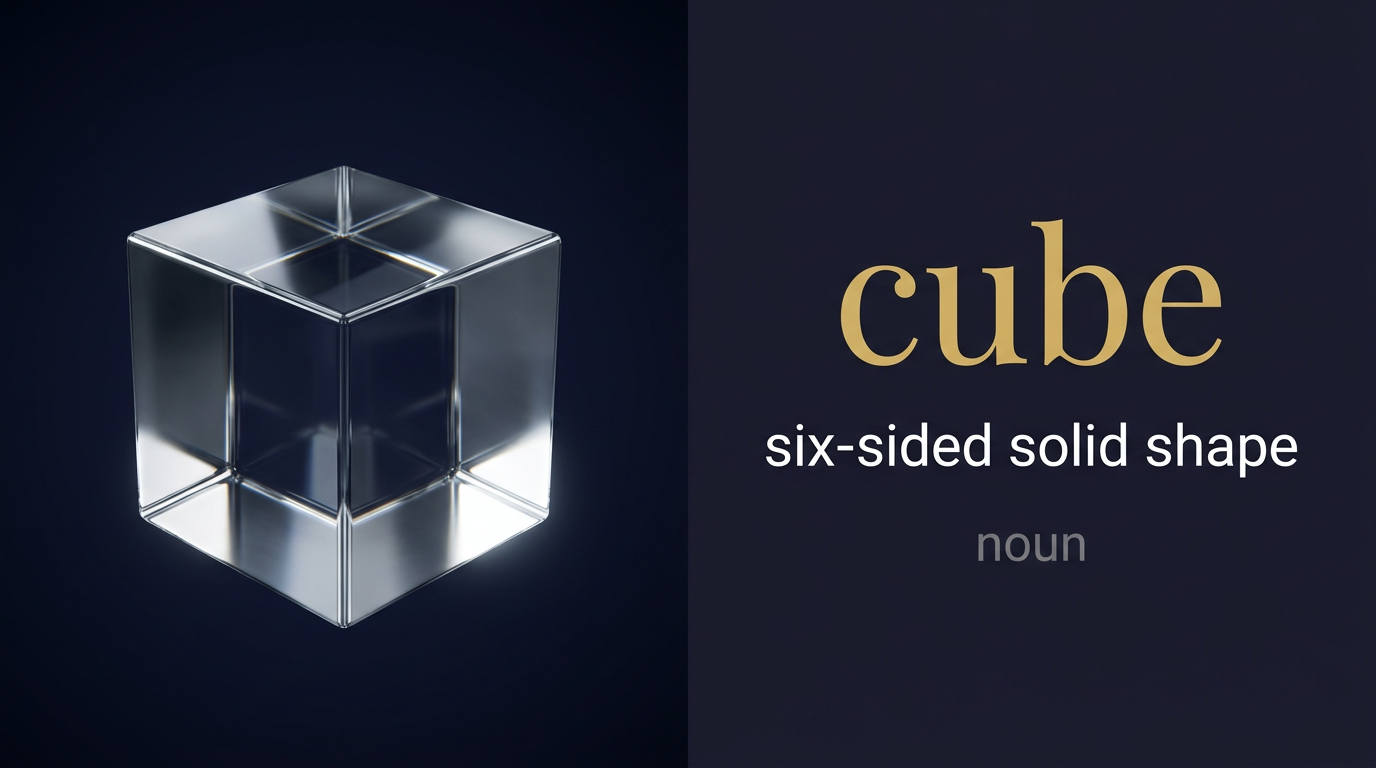
Meaning of Cube
three-dimensional square; geometric solid; mathematical shape; regular hexahedron; six-faced figure; spatial form; cubic structure; dimensional block
ما معنى كلمة Cube بالعربي؟
شكل هندسي مكعب
🎲📦 شكل هندسي مكعب له ستة وجوه متساوية؛ صندوق مربع الأضلاع؛ بناء ثلاثي الأبعاد منتظم ومتوازن الجوانب 📦🎲
قصة GL: مكعبات المعرفة في المصفوفات ثلاثية الأبعاد تحفز مناطق مختلفة، البناء المكعبي للتمارين يضمن تطوير متوازن لجميع القدرات، الأشكال المنتظمة تُساعد العقل على التنظيم والترتيب 🧠
Synonyms & related words
Cube in a sentence
Innovation incubators develop entrepreneurial cube strategies through breakthrough thinking methodologies, creating systematic business intelligence cube frameworks that generate cognitive enhancement cube systems while establishing innovation cube architectures that optimize transformative dimensional thinking and structural advancement.
GL research utilizes cognitive cube modeling through HBDNF optimization protocols, creating neuroplasticity enhancement frameworks that systematically construct neural cube architectures while generating brain development cube systems that optimize cognitive spatial processing and dimensional thinking advancement.
Patent frameworks establish intellectual property cube protection through systematic legal cube strategies, ensuring genetic learning technologies receive comprehensive coverage within technological cube architectures while creating innovation cube systems that optimize patent dimensional thinking and structural protection.
Matrix-based training programs construct cognitive cube development through 43-day neuroplasticity enhancement protocols, creating systematic learning cube frameworks that generate intellectual cube architectures while establishing educational cube systems that optimize cognitive dimensional thinking and structural advancement.
Origin of Cube
From Latin 'cubus', from Greek 'kybos' meaning 'die, cube'.
In the Genetic Learning (GL) context
In GL research and innovation contexts, cube represents cognitive architecture methodology, neuroplasticity structural optimization, and breakthrough thinking systematic construction for optimal dimensional enhancement and systematic spatial development.
Cube audio micro-course (transcript)
Podcast 1 — Introduction & meaning
Narrator: Cube. Both a noun and a verb, pronounced KYOOB. As a noun it names the most symmetrical of all three-dimensional solids — a shape with six perfectly equal square faces, twelve edges of identical length, and eight vertices where three edges meet at right angles. As a verb it means either to cut something into cube-shaped pieces or, in mathematics, to raise a number to the third power.
Narrator: The word descends from Greek kybos, which originally meant a die used in games of chance — those small numbered cubes that players rolled across tables and stone floors in the ancient Mediterranean. The Greeks passed it to Latin as cubus, and from Latin it entered Old French and then Middle English. By the sixteenth century, English had fully adopted cube in both its geometric and mathematical senses.
Narrator: What makes the etymology fascinating is the journey from gambling to geometry. The earliest cubes were not abstractions drawn by mathematicians — they were physical objects carved from bone or ivory, tossed for luck. The shape came first as a tactile, everyday reality, and only later became a formal concept in Euclidean geometry.
Narrator: In modern English, cube appears across remarkably diverse contexts. An ice cube keeps your drink cold. A sugar cube dissolves in tea. A Rubik's Cube tests spatial reasoning. In mathematics, two cubed equals eight because two times two times two is eight. In cooking, to cube the potatoes means to cut them into roughly equal blocks. The cube root of twenty-seven is three.
Narrator: The word sits in a neutral register, equally comfortable in a primary school maths lesson, a professional kitchen, an architecture studio, or a data analytics meeting where analysts discuss OLAP cubes — multi-dimensional data structures named for the same geometric idea of intersecting dimensions.
Narrator: A word that rolled from ancient gaming tables into every classroom and kitchen — six faces, all equal, perfectly balanced.
Read podcasts 2 and 3
Podcast 2 — In conversation
Speaker A: I was making a stew last night and the recipe said to cube the butternut squash into one-inch pieces. Is that different from just chopping it?
Speaker B: It is. Chopping is a general term for cutting food into pieces of any shape or size. Cubing is specific — it means cutting into roughly equal-sided pieces that resemble little cubes. When a recipe says cube the potatoes or cube the squash, it is asking for uniform blocks so everything cooks at the same rate. Dicing is similar but usually implies smaller pieces.
Speaker A: And then there is the ice cube. Why do we call it a cube when most ice cube trays make shapes that are not actually cubes?
Speaker B: That is a wonderful observation. The original moulds did produce roughly cubic shapes, and the name stuck even though modern trays often make rectangular prisms or half-cylinders. Ice cube has become a fixed compound — it refers to the concept of a small frozen block of water regardless of its actual geometry. Language freezes meaning, if you will excuse the pun.
Speaker A: What about the Rubik's Cube? That is a proper cube.
Speaker B: It is indeed — a perfect cube subdivided into smaller cubes that rotate on internal axes. Erno Rubik invented it in 1974 as a teaching tool for three-dimensional geometry, and it became the best-selling puzzle in history. The word cube in that context carries both the literal geometric meaning and a sense of intellectual challenge. When someone says they can solve the cube, everyone knows exactly which puzzle they mean.
Speaker A: In maths, two cubed means two to the power of three. Why do we use cube for that?
Speaker B: Because if you have a cube whose side length is two units, its volume is two times two times two — which equals eight cubic units. The mathematical operation of raising to the third power is named after the geometric shape because calculating the volume of a cube is the most intuitive example of that operation. The cube root works in reverse — the cube root of eight is two because a cube with volume eight has sides of length two.
Speaker A: So how does cube differ from block and box?
Speaker B: A cube has six equal square faces — all sides identical. A block is any rectangular solid, so it can be longer in one direction than another — a concrete block, a chopping block. A box is typically hollow — it is a container. You would pack things inside a box, stand on a block, and solve a cube. The cube is the most constrained of the three — it demands perfect symmetry in all three dimensions.
Podcast 3 — Prompt engineering
Speaker B: Now let us explore cube in AI prompts. The word is extraordinarily productive in technical contexts — 3D interfaces, data analysis, spatial layouts, and gamification all draw on the cube metaphor in distinct ways.
Speaker A: So cube works in both visual and data architecture prompts?
Speaker B: Exactly. Let us start with a 3D product display prompt.
Speaker B: PROMPT: Build a cube-shaped product card grid for our e-commerce dashboard where each cube displays a product image on the front face and flips to reveal pricing and stock details on hover — use CSS 3D transforms with smooth sixty-frame rotation and subtle shadow depth.
Speaker B: Cube-shaped product card grid establishes the 3D layout paradigm immediately. Front face for images and flip to reveal pricing maps content to physical cube faces. The sixty-frame rotation with shadow depth tells the AI to generate performant CSS 3D transforms with perspective and box-shadow that shift during rotation. This produces a tactile, spatial shopping experience rather than a flat grid.
Speaker A: The cube metaphor turns a standard product grid into something users want to interact with physically.
Speaker B: Right. Now a data architecture prompt.
Speaker B: PROMPT: Design a database schema for an OLAP data cube that aggregates sales metrics across three dimensions — time period, geographic region, and product category — with pre-computed summary tables and bitmap indexes for sub-second cube slice queries.
Speaker B: OLAP data cube with three named dimensions tells the AI this is analytical warehousing, not transactional design. Pre-computed summary tables means materialised aggregations at each dimensional intersection. Bitmap indexes for sub-second cube slice queries specifies the indexing strategy optimised for the kind of filtering analysts perform when slicing through a data cube. The AI generates a star or snowflake schema because the cube metaphor implies dimensional modelling.
Speaker A: The word cube carries the entire multi-dimensional analytics concept in a single term.
Speaker B: A navigation component prompt.
Speaker B: PROMPT: Create a cube navigation component for our portfolio site where six content panels are mapped to the faces of a rotating cube — users swipe or click arrows to spin the cube, revealing About, Projects, Skills, Blog, Contact, and Resume sections.
Speaker B: Six content panels mapped to the faces of a rotating cube gives the AI a precise spatial model — exactly six sections for exactly six faces. Swipe or click arrows to spin means dual input handling for mobile and desktop. The AI builds a CSS 3D cube with translateZ and rotateX rotateY transforms, mapping each section to a face, because the prompt explicitly declares the one-to-one relationship between content and geometry.
Speaker A: Using all six faces of the cube as navigation slots is an elegant constraint for portfolio design.
Speaker B: A colour tool prompt.
Speaker B: PROMPT: Generate a colour theme cube visualiser for our design system tool — three axes represent hue, saturation, and lightness, with interactive cube rotation letting designers pick colours by clicking points in the cube space, displaying hex and RGB values live.
Speaker B: Colour theme cube visualiser with three axes for hue, saturation, and lightness maps the HSL colour model onto a physical cube. Interactive rotation for picking colours by clicking points means the AI generates a WebGL or Three.js scene with raycasting for click detection. Hex and RGB values live ensures real-time feedback. The cube becomes a navigable colour space — a far more intuitive interface than flat colour wheels for understanding three-dimensional colour relationships.
Speaker A: Mapping three colour dimensions to a physical cube makes the abstract colour space tangible.
Speaker B: An inventory management prompt.
Speaker B: PROMPT: Build a cube-based inventory layout for our warehouse management application where each storage bay is rendered as a cube in a 3D grid, colour-coded by fill level — green for available, amber for partial, red for full — clickable for bay details.
Speaker B: Cube-based inventory layout with each storage bay as a cube in a 3D grid tells the AI to build a spatial warehouse model. Colour-coded by fill level with the green amber red system provides an instant visual heatmap of warehouse capacity. Clickable for bay details means each cube is an interactive element with a detail panel. The AI produces a Three.js or CSS 3D grid because the prompt frames the warehouse as a three-dimensional array of cubes.
Speaker A: The cube grid turns warehouse management into a spatial problem you can see and navigate at a glance.
Speaker B: A gamification prompt.
Speaker B: PROMPT: Design a Rubik's cube progress tracker for our gamified learning platform where each face represents a course module, squares fill with colour as lessons complete, and solving the full cube unlocks a certification badge animation.
Speaker B: Rubik's cube progress tracker maps course modules to cube faces and individual lessons to the squares within each face. Filling with colour as lessons complete creates a satisfying visual progression. Solving the full cube for certification ties completion to the universally understood goal of a solved Rubik's Cube. The AI generates a 3D interactive cube with per-square state management because the prompt establishes a clear data model — modules, lessons, completion states, and a final solved condition.
Speaker A: The Rubik's Cube metaphor makes course completion feel like solving a puzzle rather than checking boxes.
Speaker B: One final prompt — a drill-down analytics interface.
Speaker B: PROMPT: Create a data cube drill-down interface for our accounting dashboard — users start with a summary cube showing revenue by quarter, then click any face to decompose into sub-cubes by department, expense type, and vendor, with breadcrumb navigation back up the cube hierarchy.
Speaker B: Data cube drill-down with decomposition into sub-cubes establishes a recursive data exploration pattern. Summary cube by quarter as the starting point gives users a high-level overview. Clicking any face to decompose by department, expense type, and vendor creates three levels of analytical depth. Breadcrumb navigation back up the cube hierarchy ensures users never get lost in the dimensional data. The AI builds a hierarchical 3D visualisation with state management for drill paths because the prompt maps navigational depth to spatial depth.
Speaker A: The cube hierarchy gives accountants a way to physically explore financial data rather than scrolling through spreadsheets.
Speaker B: That is the versatility of cube. Six equal faces, three equal dimensions, perfect symmetry — and from that simple shape, you can build product displays, data warehouses, colour pickers, navigation systems, inventory views, progress trackers, and analytical dashboards. The word carries geometry, interaction, and structure in a single syllable.
Frequently asked questions about Cube
What does Cube mean?
three-dimensional square; geometric solid; mathematical shape; regular hexahedron; six-faced figure; spatial form; cubic structure; dimensional block
ما معنى كلمة Cube بالعربي؟
شكل هندسي مكعب — 🎲📦 شكل هندسي مكعب له ستة وجوه متساوية؛ صندوق مربع الأضلاع؛ بناء ثلاثي الأبعاد منتظم ومتوازن الجوانب 📦🎲
How is Cube used in a sentence?
Innovation incubators develop entrepreneurial cube strategies through breakthrough thinking methodologies, creating systematic business intelligence cube frameworks that generate cognitive enhancement cube systems while establishing innovation cube architectures that optimize transformative dimensional thinking and structural advancement.
What are synonyms of Cube?
block, solid, hexahedron, shape, form, structure.