Cull
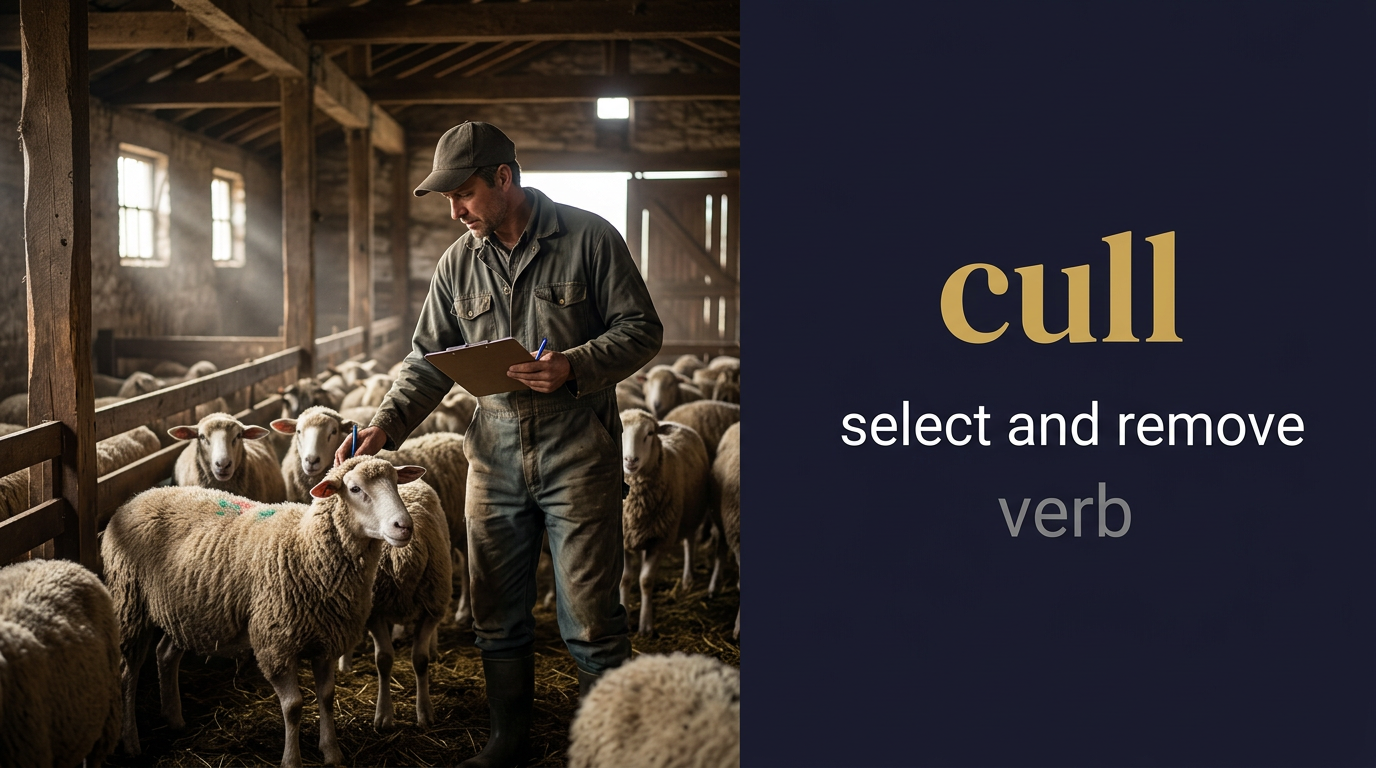
Meaning of Cull
select carefully; pick and choose; gather selectively; remove unwanted; eliminate inferior; harvest selectively; choose best; filter systematically
ما معنى كلمة Cull بالعربي؟
انتقاء وفرز
🎯🔍 انتقاء وفرز الأفضل من المجموعة؛ عملية اختيار دقيقة ومدروسة؛ قطف وحصاد المُناسب وترك الباقي 🔍🎯
قصة GL: انتقاء المعلومات المُهمة من ضوضاء الذاكرة عملية دقيقة، فرز البيانات الصحيحة من التالفة يحتاج خبرة، حصاد المعرفة النافعة وترك الضار جزء من عملية التعافي 🌾
Cull in a sentence
Innovation incubators cull breakthrough entrepreneurial strategies through systematic thinking methodologies, creating business intelligence frameworks that cull effective cognitive enhancement approaches while generating innovation systems that cull superior transformative strategies and business optimization methods.
GL research culls optimal cognitive enhancement methods through HBDNF optimization protocols, creating neuroplasticity frameworks that systematically cull effective neural development techniques while generating brain training systems that cull superior cognitive advancement strategies and intellectual optimization methods.
Patent strategies cull optimal intellectual property protection through systematic legal frameworks, ensuring genetic learning technologies receive comprehensive coverage by culling effective technological advancement methods while creating patent systems that cull superior innovation protection and optimization strategies.
Matrix-based training programs cull effective cognitive learning methods through 43-day neuroplasticity enhancement protocols, creating systematic educational frameworks that cull optimal intellectual development techniques while generating learning systems that cull superior cognitive advancement and educational optimization strategies.
Origin of Cull
From Old French 'coillir', from Latin 'colligere' meaning 'to gather together'.
In the Genetic Learning (GL) context
In GL research and innovation contexts, cull represents cognitive selection methodology, neuroplasticity optimization filtering, and breakthrough thinking systematic choice for optimal enhancement selection and systematic quality development.
Cull audio micro-course (transcript)
Podcast 1 — Introduction & meaning
Narrator: Today's word is Cull — verb and noun, pronounced KUL, in IPA /kʌl/.
Narrator: To cull is to select and remove — to pick out and separate the weaker, less desirable, or excess members of a group. A cull of deer from an overpopulated herd. Culling a list of candidates. The action involves selection followed by removal: you are not simply removing at random but specifically identifying and eliminating those that do not meet a standard or those that exceed a sustainable number.
Narrator: The word came from Old French coillir — to gather or pick — from the Latin colligere — to collect together. The root is the same Latin colligere that gives English collect, collection, and colleague — all involving bringing things together. The sense shifted in English from gathering to the selective removal that results from gathering and evaluating.
Narrator: Agricultural culling is perhaps the most familiar context: the culling of livestock to control population size, remove animals showing signs of disease, or maintain a herd of productive individuals. Game management involves the culling of deer, rabbits, and other species whose populations would otherwise exceed the carrying capacity of their habitat.
Narrator: The word is also used for the selection of items from a larger collection — to cull the best examples from thousands of images, to cull a reading list down to the essential texts, to cull data records that are outdated or irrelevant. In this positive selective sense, culling is the act of gathering the best rather than removing the worst — the distinction depends on whether you keep what you select or discard it.
Narrator: In organisations and business, cull is used to describe significant reductions — culling the workforce, culling underperforming products, culling excessive processes. The word carries a blunt, direct quality — less euphemistic than restructure or rationalise.
Narrator: A cull as a noun is the act of culling or its result — the annual deer cull, a cull of the catalogue.
Narrator: In register, cull is standard in agricultural and wildlife management contexts, direct and sometimes harsh in organisational contexts, and neutral in data or collection management contexts.
Narrator: So remember: to cull is to select for separation — sometimes removing the worst, sometimes gathering the best.
Read podcasts 2 and 3
Podcast 2 — In conversation
Speaker A: She spent a whole Sunday culling her wardrobe — every item out, assessed, returned or bagged for donation. She's extremely decisive about it. Anything she hasn't worn in a year goes.
Speaker B: Wardrobe cull as a domestic management practice — the one-year rule is a widely used culling heuristic. The cull here is the positive selection variant: identifying and keeping the useful while removing the excess. The decisiveness you describe is what makes culling effective; hesitation is the enemy of a good cull.
Speaker A: The photographer had to cull ten thousand images from the week's shoot down to about two hundred for the client. That's the part of the job that takes longest, she said.
Speaker B: Professional photography culling — ten thousand to two hundred is a ratio that sounds extreme but is typical for event and commercial photography where the camera is running continuously. Culling is a skilled evaluative process: each image must be assessed for technical quality, compositional success, and narrative value within the set. The cull is where the photographer's taste and judgment are most visible.
Speaker A: There's significant public debate about the deer cull on the estate — animal welfare groups opposing it, ecologists arguing that without culling the population would damage the woodland. Neither side seems to be listening to the other.
Speaker B: Wildlife cull as a contested management decision — the genuine tension between animal welfare concerns and ecological management arguments is one of the most persistent debates in conservation. Without natural predators in most British habitats, deer populations increase until they exceed the carrying capacity of the habitat, at which point overbrowsing damages woodland regeneration. Culling is the management intervention that replaces predation.
Speaker A: People sometimes confuse cull and prune.
Speaker B: Pruning implies careful selective removal to encourage better growth in what remains — you prune a plant by removing dead or overgrown parts to direct the plant's energy. Culling implies more decisive removal of excess or substandard members. Pruning has horticultural and organisational positive connotations of shaping toward growth; culling is more blunt and implies population management rather than individual improvement.
Podcast 3 — Prompt engineering
Speaker B: Scenario one — a data cull pipeline prompt.
Design a database record culling pipeline for a data governance platform. Over time, databases accumulate records that are outdated, duplicated, or no longer business-relevant. The pipeline: identifies records for culling based on configurable criteria (last accessed date older than 2 years, soft-deleted records older than retention policy, duplicate records identified by fuzzy matching on key fields, records referencing entities that have since been deleted), generates a cull preview report showing which records would be removed and why, requires explicit approval before executing the cull, executes the approved cull within a transaction with full rollback capability, and logs all culled records to an archive table with the cull reason and approver identity.
Speaker B: Cull preview report before execution is the governance safeguard — showing exactly what will be removed before the cull runs prevents accidental removal of records that match the criteria but should be retained.
Speaker A: Archive table with cull reason and approver is the audit trail — regulatory compliance often requires proof that data was not just deleted but deliberately culled according to a documented policy.
Speaker B: Next — a content library cull prompt.
Build a digital asset culling tool for a media production platform. Large content libraries accumulate images, videos, and documents that are outdated, of poor quality, or no longer brand-consistent. The tool: applies automated quality filtering to identify assets below resolution, sharpness, or exposure thresholds for culling consideration, flags assets whose metadata indicates age beyond the content refresh policy, identifies near-duplicate assets using perceptual hashing and presents them as cull candidates (keeping one, culling the others), presents a culling review interface where an editor makes final decisions per asset group, and generates a post-cull report showing library size reduction and quality score improvement.
Speaker A: Perceptual hashing for near-duplicate detection is the intelligent cull automation — identical or near-identical assets accumulated from multiple uploads are the most straightforward cull candidates, and automated detection prevents the editor from having to review thousands of images manually.
Speaker B: Right. Now a code dependency cull prompt.
Create a dependency culling tool for a JavaScript project. Over time, node_modules accumulates packages that are no longer imported anywhere in the codebase. The tool: scans all import and require statements across the project, compares the imported packages to the dependencies listed in package.json, identifies declared dependencies that are never imported (cull candidates), distinguishes between runtime dependencies that should be culled (imported nowhere) and devDependencies only used in build scripts (check package.json scripts before culling), and generates a cull recommendation with the package removal command, estimated bundle size reduction, and a warning if any culled package might be a transitive dependency required at runtime.
Speaker B: Warning if a cull candidate might be a transitive runtime dependency prevents the destructive cull — removing a package that appears unused in source code but is required at runtime by another package causes production failures.
Speaker B: Fourth — a product catalogue cull prompt.
Design a product catalogue culling system for an e-commerce platform. Large catalogues accumulate products that are no longer selling, have been superseded by better versions, or create confusion by offering too many near-identical options. The culling system: calculates a cull score per product based on units sold in the last 12 months, contribution margin, return rate, customer rating, and recency of last sale, identifies products below the cull threshold as candidates for removal, groups near-identical products and recommends which to retain and which to cull, models the revenue impact of the cull (accounting for whether culled product demand will transfer to retained products), and generates a catalogue cull plan with a staged implementation schedule.
Speaker A: Demand transfer modelling before the cull executes is the revenue protection calculation — culling a low-selling product that has no close substitute in the catalogue removes revenue that cannot transfer anywhere.
Speaker B: Fifth — a test suite cull prompt.
Build a test suite culling tool for a software quality platform. Test suites grow over time and accumulate tests that are redundant, obsolete, or testing functionality that has been removed. The tool: identifies tests that have not failed in the last 100 test runs (possibly testing removed code or guaranteed-passing assertions), identifies duplicate test coverage where multiple tests assert the same behaviour with identical inputs, flags tests for code paths that no longer exist in the current codebase, calculates the test suite execution time reduction achievable by culling the identified candidates, and generates a cull report with test IDs, cull reason, and estimated time saving per removed test.
Speaker B: Tests that have not failed in 100 runs as a cull candidate requires careful judgment — a test that never fails may be testing a critical path that always works correctly, or it may be testing removed code; the cull tool must present both interpretations.
Speaker B: Sixth — a full small app.
Build a single-page web app called The Cull — a personal project and commitment decluttering tool. The user lists all their current active projects, commitments, and responsibilities. For each item they rate: time cost per week in hours, joy or satisfaction score 1 to 5, strategic importance 1 to 5, and whether someone else could do this instead of them. The app calculates a cull score per item highlighting those with high time cost, low satisfaction, and low strategic importance. The user marks items to cull, archive, or keep. A culled items log shows commitments they have exited with the date and reason. All data in localStorage.
Speaker A: Whether someone else could do this instead as a cull criterion captures the delegation opportunity — a commitment that is both low satisfaction and easily delegated is the prime cull candidate.
Speaker B: That's the lesson — to cull is to select for separation. Whether removing the excess members of a herd, gathering the best images from ten thousand shots, or identifying the dependencies that a codebase no longer needs, culling is the disciplined act of evaluation followed by removal — making the remaining whole more effective, more coherent, and more sustainable.
Speaker B: Prompt example:
Frequently asked questions about Cull
What does Cull mean?
select carefully; pick and choose; gather selectively; remove unwanted; eliminate inferior; harvest selectively; choose best; filter systematically
ما معنى كلمة Cull بالعربي؟
انتقاء وفرز — 🎯🔍 انتقاء وفرز الأفضل من المجموعة؛ عملية اختيار دقيقة ومدروسة؛ قطف وحصاد المُناسب وترك الباقي 🔍🎯
How is Cull used in a sentence?
Innovation incubators cull breakthrough entrepreneurial strategies through systematic thinking methodologies, creating business intelligence frameworks that cull effective cognitive enhancement approaches while generating innovation systems that cull superior transformative strategies and business optimization methods.
What are synonyms of Cull?
select, choose, pick, gather, eliminate, filter.