Cumin
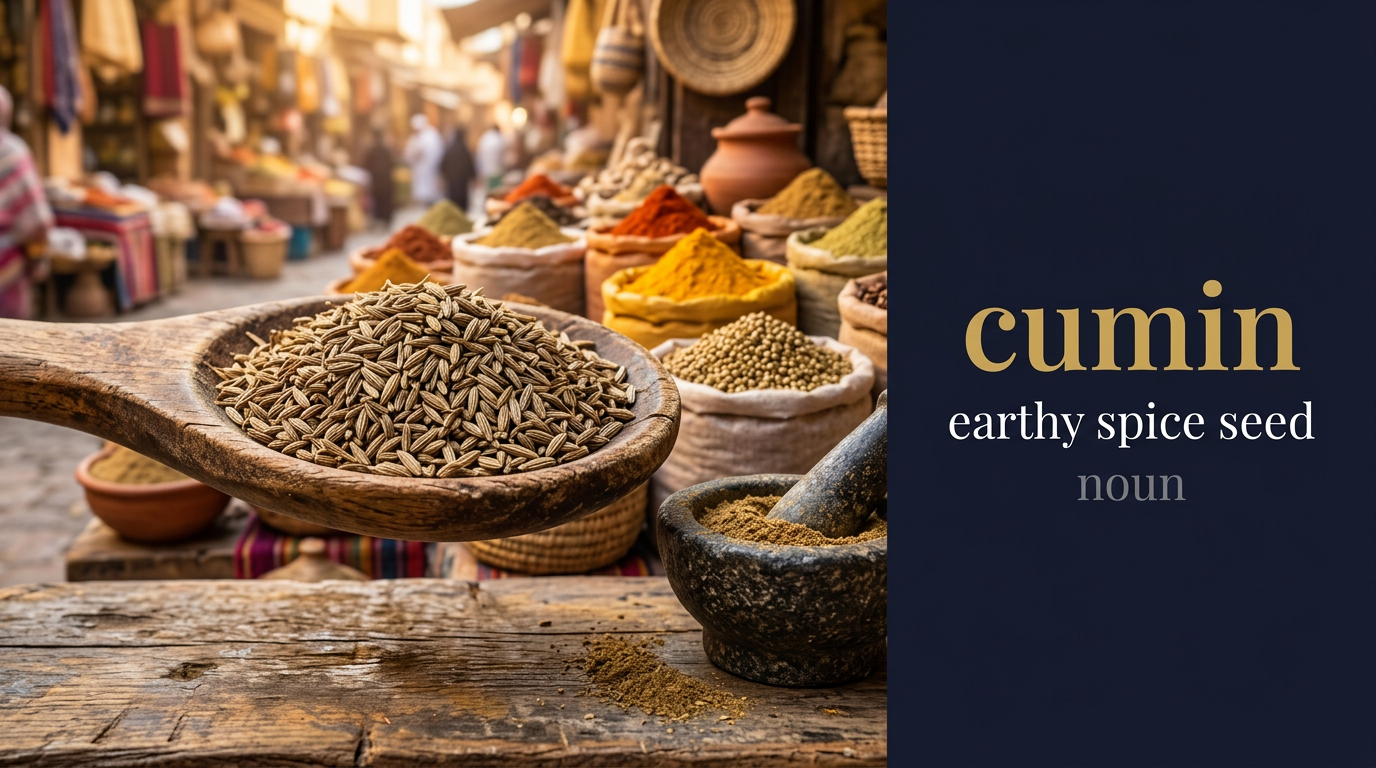
Meaning of Cumin
aromatic spice; seed seasoning; flavor enhancer; cooking ingredient; Middle Eastern spice; earthy seasoning; pungent seed; culinary herb
ما معنى كلمة Cumin بالعربي؟
بهار الكمون
🌿🔥 بهار الكمون العطري الدافئ المُستخدم في الطبخ؛ نكهة شرقية مُميزة ومُحببة؛ توابل طبيعية تُضفي طعماً لذيذاً وفوائد صحية 🔥🌿
قصة GL: مثل الكمون الذي يُنكه الطعام، التحديات المعرفية تُنكه الحياة، إضافة التوابل للمصفوفات الرياضية يجعل التعلم أكثر متعة وإثارة في رحلة الشفاء 🍽️
Cumin in a sentence
Innovation incubators develop cumin-flavored entrepreneurial strategies through breakthrough thinking methodologies, creating systematic business intelligence cumin approaches that add cognitive enhancement cumin complexity while generating innovation cumin systems that optimize transformative cumin richness and business cumin enhancement.
GL research utilizes cumin-inspired cognitive enhancement through HBDNF optimization protocols, creating neuroplasticity frameworks that systematically add neural cumin complexity while generating brain development cumin systems that optimize cognitive cumin richness and intellectual cumin enhancement.
Patent strategies establish cumin-seasoned intellectual property protection through systematic legal cumin frameworks, ensuring genetic learning technologies receive comprehensive coverage with technological cumin complexity that optimizes innovation cumin richness while creating patent cumin systems for enhanced protection flavor.
Matrix-based training programs create cumin-enriched cognitive learning through 43-day neuroplasticity enhancement protocols, developing systematic educational cumin approaches that add intellectual cumin complexity while generating learning cumin systems that optimize cognitive cumin richness and educational cumin enhancement.
Origin of Cumin
From Old French 'comin', from Latin 'cuminum', from Greek 'kyminon', possibly from Semitic origin.
In the Genetic Learning (GL) context
In GL research and innovation contexts, cumin represents cognitive complexity methodology, neuroplasticity flavor optimization, and breakthrough thinking systematic enrichment for optimal enhancement seasoning and systematic developmental complexity.
Cumin audio micro-course (transcript)
Podcast 1 — Introduction & meaning
Narrator: The word cumin. A noun. Pronounced: KUM-in. In IPA: slash ˈk ʌ m ɪ n slash. Note that the spelling with a U often tempts people to say KYOO-min, but the standard British and American pronunciation is KUM-in.
Narrator: Cumin is a spice derived from the dried seeds of the plant Cuminum cyminum, a member of the parsley family, native to the eastern Mediterranean and South Asia. The seeds are small, boat-shaped, and yellowish-brown, with a warm, earthy, slightly bitter flavour and a distinctively pungent aroma.
Narrator: The word has an exceptionally long and well-documented history. It comes from Old English cymen, from Latin cuminum, from Greek kyminon, which in turn derives from a Semitic root — the Akkadian kamunu and Hebrew kammon. Cumin is one of the few spices whose name can be traced continuously through more than three thousand years of written records.
Narrator: Cumin appears in Egyptian papyri as early as 1550 BC, in Sanskrit texts, in the Bible — both Old and New Testaments — and in ancient Greek and Roman medical writing. Hippocrates prescribed it. Pliny wrote about its cultivation. Medieval European merchants traded it alongside pepper and cinnamon as a high-value commodity. It was considered medicinal, culinary, and even magical in some traditions.
Narrator: Today cumin is one of the most widely used spices in the world. It is foundational in Indian, Middle Eastern, North African, Mexican, and Central Asian cooking. It forms part of the spice blends garam masala, ras el hanout, baharat, and chilli powder. Whole seeds are tempered in oil at the start of cooking to release their volatile oils, while ground cumin is added mid-cook to build a dish's base flavour.
Narrator: The form cumin is the standard spelling in British English. The alternative spelling cummin appears in the King James Bible and in some older texts. Both refer to the same plant and spice. Cumin is the modern standard.
Narrator: In professional culinary contexts, cumin appears in menu descriptions, recipe specifications, spice blend formulations, and food science writing. In everyday British kitchen language, it is used without much ceremony — a teaspoon of ground cumin, a handful of whole cumin seeds.
Narrator: A spice that has been part of human cooking longer than most civilisations have existed — and still indispensable at kitchen counters from Delhi to Mexico City to the East End of London.
Read podcasts 2 and 3
Podcast 2 — In conversation
Speaker A: I attempted a homemade curry paste last weekend — a proper one from scratch, toasting and grinding all the spices individually. Cumin was absolutely central to the whole blend. Without it, something fundamental was missing.
Speaker B: That is the right observation. Cumin is one of those spices that provides structural depth rather than a sharp topnote. It is not cumin you taste so much as a kind of earthiness that underpins everything else. Take it out and the paste loses its foundation.
Speaker A: I used both whole seeds, toasted at the start, and ground cumin added partway through. Is that a common technique?
Speaker B: Very much so. Toasting whole cumin seeds in oil at the beginning — what Indian cooking calls a tarka or tadka — releases the volatile oils through direct heat and infuses the entire dish. Ground cumin added later adds a more concentrated, slightly different flavour because the fine powder disperses throughout the sauce. Using both layers the flavour in a way that single-stage addition cannot replicate.
Speaker A: How should you store cumin? I have had ground cumin in the back of my cupboard for what might be two years.
Speaker B: Ground cumin loses its potency fairly quickly — within six months to a year in a sealed container, and faster if exposed to heat or light. Whole seeds hold much longer because the volatile oils are protected inside the seed coat. Grinding just before use gives you the most flavour. If you smell your old ground cumin and it is faint or stale rather than pungent and earthy, replace it. It will not harm you but it will not contribute much to the dish either.
Speaker A: Is there a meaningful difference between cumin and caraway? I sometimes see them confused.
Speaker B: They are related plants in the same family but genuinely different spices with distinct flavours. Cumin is warmer, earthier, and more pungent — the classic curry and chilli spice. Caraway has a more anise-like, herbal flavour and is characteristic of Central European and Scandinavian cooking: rye bread, sauerkraut, and some German cheeses. If a recipe calls for one, the other will not serve as a substitute without noticeably changing the dish.
Speaker A: What about jeera, which I see on Indian restaurant menus?
Speaker B: Jeera is simply the Hindi and Urdu word for cumin — the same spice, same plant. When an Indian menu offers jeera rice, that is rice cooked with whole cumin seeds. You will also see zeera as an alternative transliteration. No difference in the ingredient, just in the linguistic tradition the word comes from.
Podcast 3 — Prompt engineering
Speaker B: Cumin in AI prompts is highly specific and immediately useful for anything in the food-tech, recipe, ingredient management, or restaurant software space. It signals that you are working with real-world culinary data rather than generic categories, and that precision in ingredient naming matters.
Speaker A: Food-tech is a genuinely large sector now — recipe platforms, restaurant management tools, food delivery apps. Cumin comes up constantly in real data.
Speaker B: Let us start with a recipe ingredient database schema:
Speaker B: PROMPT: Design a PostgreSQL schema for a recipe platform that handles spice ingredients with precision. The ingredients table must distinguish between cumin seeds whole, cumin seeds ground, cumin seeds toasted, and black cumin nigella sativa as separate entries with their own nutritional profiles and substitution mappings. Add a flavour_profile table linking each ingredient to descriptors such as earthy, warm, and pungent, and a substitutions table with a confidence score for each pair. Support both metric and imperial units in a units table linked by ingredient category.
Speaker A: Separating whole, ground, and toasted cumin as distinct entries is the data decision that makes substitution logic actually work — they behave differently in cooking.
Speaker B: A restaurant menu and allergen management system:
Speaker B: PROMPT: Build a Node.js and PostgreSQL restaurant management system where menu items are linked to a full ingredient list including sub-ingredients within spice blends. A dish containing a house spice blend must expose that cumin, coriander, and chilli are components of that blend for allergen and dietary restriction filtering. Support customer profile filters for low-FODMAP diets, where cumin is permitted in small quantities but flagged above a threshold amount, and for mustard seed allergy, which is distinct from cumin. The public-facing menu API returns items filtered by customer dietary profile with a warning level of safe, caution, or avoid for each relevant ingredient.
Speaker A: The sub-ingredient exposure through spice blends is what makes this actually useful for diners with allergies — vague entries like house seasoning fail them.
Speaker B: A meal planning and grocery app:
Speaker B: PROMPT: Create a React and Node.js meal planning application where users select recipes for the week and the app generates a consolidated grocery list. For spices like cumin, intelligently aggregate quantities across all selected recipes, converting between whole seeds and ground cumin using a configurable conversion ratio, and flag if the total quantity needed exceeds a user-specified pantry stock level. Group the grocery list by supermarket aisle category. Offer a substitution suggestion when a spice ingredient such as cumin is unavailable, drawn from the ingredients substitution table, with a confidence rating displayed.
Speaker A: The unit conversion between whole seeds and ground cumin is the culinary intelligence that makes this genuinely useful rather than just a list aggregator.
Speaker B: A food cost and inventory tool for restaurants:
Speaker B: PROMPT: Design a Vue.js food cost management dashboard for a restaurant where spice ingredients including cumin, coriander, turmeric, and garam masala are tracked by purchase unit such as one-kilogram bags, recipe unit such as grams per dish, and cost per gram. When a dish recipe is costed, the system automatically calculates the cumin cost per portion from current stock prices. Alert the kitchen manager when the cost per gram of any tracked spice rises more than fifteen percent above the three-month rolling average, suggesting it is time to review the supplier contract or adjust portion sizes.
Speaker A: The fifteen percent rise alert against a rolling average is the practical business feature — spice prices are volatile and a restaurant can absorb small fluctuations but needs to act on sustained increases.
Speaker B: A recipe search and flavour matching engine:
Speaker B: PROMPT: Build a Node.js recipe search API that supports flavour-based querying. Users can search for recipes by specifying dominant flavour notes such as earthy, warm, and smoky. The API returns recipes ranked by how closely their spice profiles match the query. Cumin-forward recipes should score highly for earthy and warm queries. Store spice-to-flavour mappings in a PostgreSQL flavour_index table. Support negative filters such as no cumin for users who dislike the spice, and generate a flavour similarity score between any two recipes for a related recipes feature.
Speaker A: The negative filter for specific ingredients like cumin is the accessibility feature — some people genuinely dislike cumin and current recipe apps rarely handle that well.
Speaker B: And a spice blend formulation tool:
Speaker B: PROMPT: Create a React spice blend formulation tool for artisan spice producers. Users define blend recipes by specifying each component spice including cumin seeds ground, percentage by weight, and batch size in grams. The tool calculates ingredient quantities per batch, total cost per batch from a linked ingredient pricing table, and nutritional information per ten-gram serving. Allow version control of blend recipes so that when the cumin proportion is adjusted, previous versions are preserved with a change log. Export blend specifications as a PDF label-ready production sheet with nutritional panel.
Speaker A: The version control with change log is what makes this a professional production tool rather than a recipe card — you need to know exactly what was in batch forty-seven if a quality issue arises months later.
Speaker B: Cumin in a prompt tells the AI you are working with granular, real-world culinary data — ingredient distinctions matter, preparation forms matter, quantities and units need to be handled precisely. That specificity produces software that actually works in a kitchen or a food business, rather than a generic ingredient management system that treats cumin the same as sugar.
Frequently asked questions about Cumin
What does Cumin mean?
aromatic spice; seed seasoning; flavor enhancer; cooking ingredient; Middle Eastern spice; earthy seasoning; pungent seed; culinary herb
ما معنى كلمة Cumin بالعربي؟
بهار الكمون — 🌿🔥 بهار الكمون العطري الدافئ المُستخدم في الطبخ؛ نكهة شرقية مُميزة ومُحببة؛ توابل طبيعية تُضفي طعماً لذيذاً وفوائد صحية 🔥🌿
How is Cumin used in a sentence?
Innovation incubators develop cumin-flavored entrepreneurial strategies through breakthrough thinking methodologies, creating systematic business intelligence cumin approaches that add cognitive enhancement cumin complexity while generating innovation cumin systems that optimize transformative cumin richness and business cumin enhancement.
What are synonyms of Cumin?
spice, seasoning, herb, flavoring, ingredient, seed.