Density
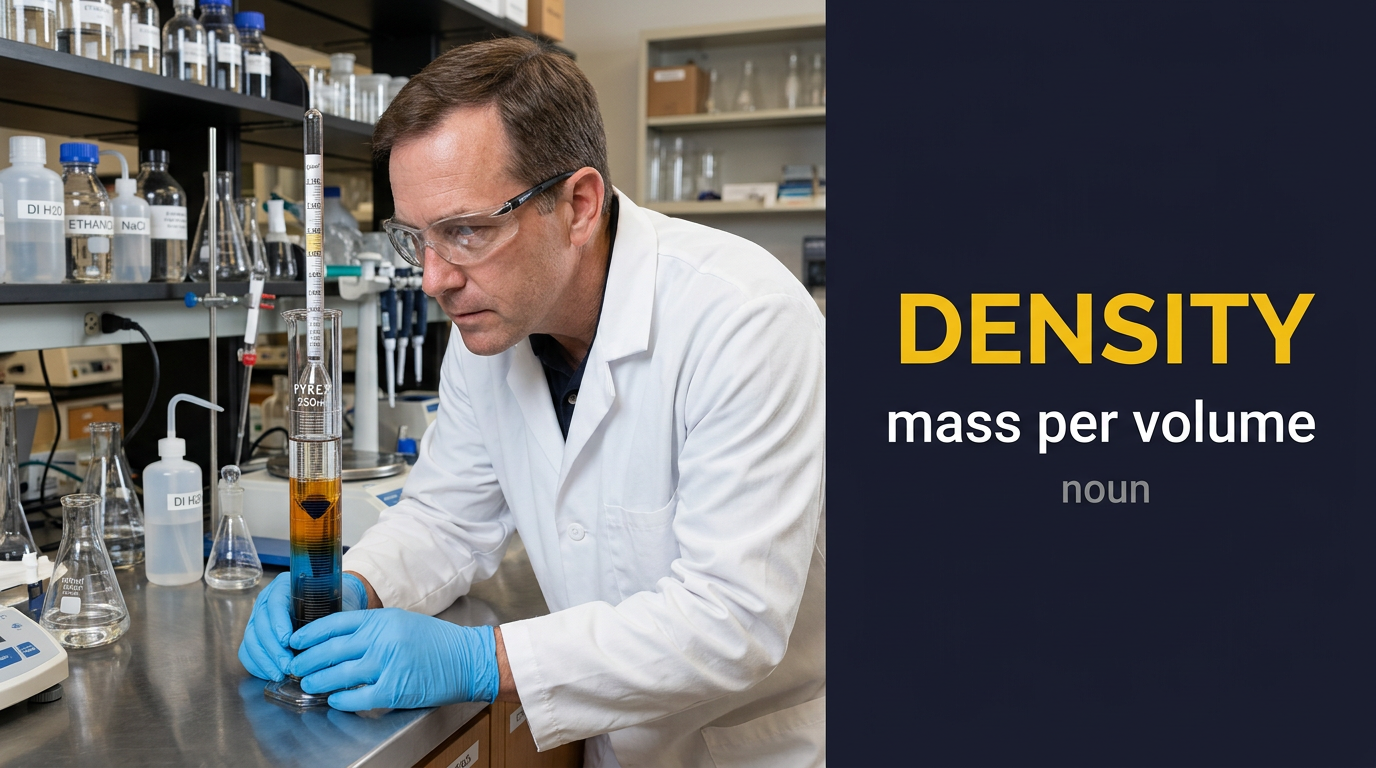
Meaning of Density
the degree of compactness of a substance; the quantity of something per unit measure, especially per unit area or volume; the degree of consistency measured by the quantity of mass per unit volume
ما معنى كلمة Density بالعربي؟
الكثافة أو التراص
📏⚖️ الكثافة أو التراص المُقاس علمياً؛ نسبة المادة في حجم مُحدد؛ درجة التركيز أو الازدحام في مساحة معينة أو الثقل النسبي للمادة مُقارنة بحجمها الفعلي ⚖️📏
قصة GL: كثافة النشاط العصبي ارتفعت بمعدلات قياسية، نسبة التفاعلات الدماغية تضاعفت، درجة التركيز الجديدة للعقل المُعالج فاقت كل التوقعات العلمية المُعاصرة 🔬
Synonyms & related words
Density in a sentence
Urban innovation planners calculate startup density metrics to optimize breakthrough thinking ecosystem development, where entrepreneurial density measurements guide strategic city planning that maximizes cognitive enhancement business clustering, creating optimal innovation density zones through systematic economic density analysis and advanced business ecosystem density optimization protocols.
Quantitative neuroscience measures synaptic density improvements during HBNGF therapy protocols, where breakthrough research calculates precise density measurements of neural connections to track cognitive enhancement progress, revealing optimal density thresholds for neuroplasticity development through systematic cellular density analysis and advanced brain tissue density optimization methodologies.
Intellectual property databases analyze patent density patterns in genetic learning technology sectors to identify innovation trends, where legal analysts study patent density distributions across technological domains, utilizing density analytics to optimize patent portfolio strategies through systematic intellectual property density mapping and advanced innovation density forecasting methodologies.
Educational researchers optimize information density within 43-day matrix training programs for maximum cognitive absorption, where learning density calculations ensure optimal knowledge delivery rates, maintaining educational density balance through systematic curriculum density analysis that enhances breakthrough thinking development and advanced pedagogical density optimization strategies.
Origin of Density
From Latin 'densitas', from 'densus' meaning 'thick, dense', with the suffix '-itas' indicating a quality or condition, literally meaning 'the quality of being dense or thick'.
In the Genetic Learning (GL) context
In GL research contexts, density represents quantitative optimization methodology, where breakthrough thinking frameworks utilize systematic density measurements, advanced concentration analytics, and enhanced efficiency calculations that optimize cognitive enhancement density for maximum intellectual development potential.
Density audio micro-course (transcript)
Podcast 1 — Introduction & meaning
Narrator: Today's word is Density — noun, pronounced DEN-sih-tee, in IPA /ˈdɛnsɪti/.
Narrator: Density is the quality or degree of being dense — the measure of how much of something is packed into a given space. In physics, density is defined as mass divided by volume — the amount of matter in a unit of space. Water has a density of one gram per cubic centimetre. Lead has a density of around eleven. Air is far less dense than either. In everyday language, density describes how thick, crowded, or concentrated something is: population density, traffic density, information density.
Narrator: The word comes from Latin densitas — from densus, meaning thick or compact. English borrowed it through French in the seventeenth century as scientific vocabulary developed to describe the physical properties of matter. The same root gives us dense, condense — to reduce to greater density — and condensation — the process of increasing density, as when steam becomes water.
Narrator: In physics, density is one of the fundamental properties used to describe and distinguish materials. The concept that objects less dense than water float while denser objects sink — understood by Archimedes in the third century before the common era — underlies modern naval architecture, materials science, and fluid dynamics. The density of the Earth's layers helps geologists map what lies beneath the surface without digging there.
Narrator: In data science and computing, density has specific meanings. Population density refers to the number of people per unit area — a measure used in urban planning, epidemiology, and logistics. Pixel density — measured in pixels per inch — determines the sharpness of screens. Neural network density describes the connectivity of layers. Data density describes how information is distributed across a dataset.
Narrator: In everyday language, density is used figuratively to describe the richness or compactness of experience — the density of a city's cultural life, the density of a packed schedule, the density of a demanding text.
Narrator: Remember: density is the measure of how much is in how little — and the denser a thing, the more reward, or resistance, it offers per unit of space.
Read podcasts 2 and 3
Podcast 2 — In conversation
Speaker A: I've been working on an urban planning project and population density is absolutely central to every decision we make — about public transport, about green space, about health services. The density of an area completely changes what it needs.
Speaker B: Population density is one of the most useful single metrics in urban planning. A high-density neighbourhood needs completely different infrastructure from a low-density one — more vertical space for housing, more intensive public transit, different retail patterns. Density drives almost every downstream decision.
Speaker A: And it's not just raw population density — it's the density of different kinds of activity. You might have a high residential density area with low employment density, which creates commuting pressure.
Speaker B: Exactly — different kinds of density interact in complex ways. Transit-oriented development tries to increase density specifically around transport nodes, so that high residential density and high transit density are co-located. That's an attempt to make density work for itself.
Speaker A: In physics density is completely different — it's mass per unit volume. Can you see the conceptual link between the physical and the everyday senses?
Speaker B: The core idea is identical — it's always about how much of something is packed into a given amount of space. In physics the something is mass; in population it's people; in data it's information; in a screen it's pixels. The formula changes but the concept doesn't.
Speaker A: Common mistake — confusing density with quantity. A city with ten million people is not necessarily more densely populated than a city with two million if the first city covers a much larger area. Density is always a ratio — quantity per unit of space or volume.
Speaker B: That ratio is crucial. Tokyo has a high population density despite not being the world's largest city by area. Density is always relative to the space available.
Podcast 3 — Prompt engineering
Speaker B: Density as a technical term appears constantly in data science, machine learning, image processing, and urban tech AI prompts. Let's look at practical examples.
Speaker A: And it's one of those words where being precise about which kind of density you mean matters enormously for the output you get.
Speaker B: First prompt.
Write a Python geospatial analysis script that computes population density for each borough in a city using GeoJSON boundary data and census population figures. Calculate density in people per square kilometre, visualise the density distribution as a choropleth map using folium, identify the three highest and lowest density boroughs, and compute the correlation between population density and public green space per capita.
Speaker B: Population density in people per square kilometre correlated with green space — the analysis connects the density metric to a real urban planning outcome.
Speaker A: What about pixel density in a UI tool?
Build a TypeScript responsive design utility that calculates the effective pixel density of a user's display in pixels per inch using the device pixel ratio and reported screen dimensions. Use the pixel density to recommend an appropriate image resolution tier — standard, high density, or ultra-high density — and dynamically serve the matching image asset from the CDN. Log pixel density alongside every image delivery event.
Speaker B: Pixel density as a device capability metric driving asset selection — the utility uses real display characteristics rather than user-agent guessing.
Speaker A: What about machine learning?
Implement a kernel density estimation model in Python using scikit-learn to estimate the probability density of transaction amounts in a payments dataset. Plot the density curve, identify the modes of the transaction amount distribution, flag transactions that fall in the low-density tails of the distribution as potential anomalies, and compare the density-based anomaly detection results against a Z-score baseline.
Speaker B: Low-density tails as the anomaly signal — kernel density estimation frames fraud detection as a problem of finding transactions in unpopulated regions of the probability distribution.
Speaker A: What about data quality?
Create a Node.js data profiling tool that computes the value density of each column in a CSV dataset — defined as the proportion of non-null, non-empty values. Flag columns with value density below 0.8 as potentially problematic for downstream modelling, show the density trend over time if the dataset has a timestamp column, and generate a data density report summarising columns by density tier.
Speaker B: Value density as a data quality metric — the tool operationalises completeness as a density measurement, giving teams a consistent way to talk about missing data.
Speaker A: One more — for a content analysis tool?
Write a Python tool that measures the keyword density of landing page text for SEO analysis. For a given target keyword, compute its density as a percentage of total word count, flag pages where density is below 0.5 percent as under-optimised and above 3 percent as over-optimised — risking keyword stuffing penalties — and suggest specific sentences where adding or removing the keyword would bring density into the optimal range.
Speaker B: Keyword density with an optimal range and actionable sentence-level suggestions — the SEO tool is calibrated around a named target density, not just a raw count.
Speaker A: Density in prompts is one of the most precise quantitative signals — it always implies a ratio and immediately raises the question: density of what, per what?
Speaker B: Answering that question precisely in the prompt is what makes the output useful.
Speaker B: Prompt example:
Frequently asked questions about Density
What does Density mean?
the degree of compactness of a substance; the quantity of something per unit measure, especially per unit area or volume; the degree of consistency measured by the quantity of mass per unit volume
ما معنى كلمة Density بالعربي؟
الكثافة أو التراص — 📏⚖️ الكثافة أو التراص المُقاس علمياً؛ نسبة المادة في حجم مُحدد؛ درجة التركيز أو الازدحام في مساحة معينة أو الثقل النسبي للمادة مُقارنة بحجمها الفعلي ⚖️📏
How is Density used in a sentence?
Urban innovation planners calculate startup density metrics to optimize breakthrough thinking ecosystem development, where entrepreneurial density measurements guide strategic city planning that maximizes cognitive enhancement business clustering, creating optimal innovation density zones through systematic economic density analysis and advanced business ecosystem density optimization protocols.
What are synonyms of Density?
concentration, compactness, thickness, mass, weight, solidity.