Discrepancy
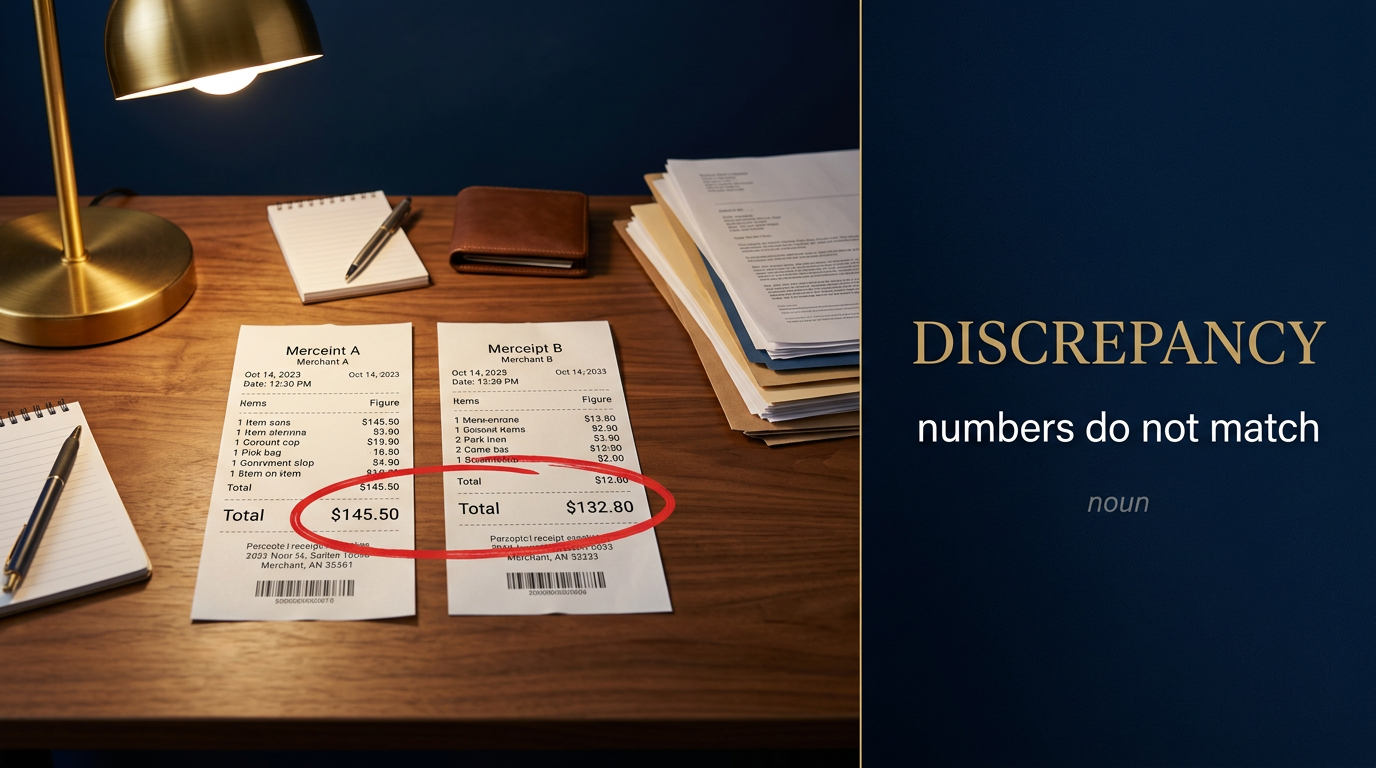
Meaning of Discrepancy
a noticeable difference or inconsistency between two or more facts, claims, or expectations; a lack of compatibility or similarity between things that should correspond; a gap between what is expected and what actually occurs; an instance where accounts, reports, or measurements do not agree with each other
ما معنى كلمة Discrepancy بالعربي؟
تناقض أو اختلاف
⚖️🔍 تناقض أو اختلاف بين المعلومات؛ عدم تطابق في البيانات؛ فجوة واضحة بين ما هو مُتوقع وما هو فعلي مما يتطلب مراجعة وتحقق دقيق 🔍⚖️
قصة GL: تناقض أو اختلاف بين توقعات الطب التقليدي والنتائج المُحققة كان مُذهلاً - عدم تطابق في التوقعات، فجوة واضحة بين المُمكن والمُستحيل ملأها نظام التعلم الجيني بالإنجازات المُوثقة علمياً 🌟
Synonyms & related words
Discrepancy in a sentence
Innovation incubators address business discrepancies through breakthrough thinking variance analysis strategies that identify entrepreneurial inconsistencies within venture development patterns, systematically examining commercial measurement differences while resolving startup data contradictions through comprehensive innovation discrepancy evaluation methodologies that detect business disparities and eliminate venture measurement variances through advanced entrepreneurial calibration techniques that ensure accurate business assessment and maintain precise commercial development monitoring systems that identify and correct innovation data inconsistencies.
Neuroplasticity research identifies cognitive discrepancies through HBDNF variance detection protocols that reveal breakthrough thinking inconsistencies within brain development patterns, systematically analyzing neural measurement differences while resolving synaptic data contradictions through comprehensive neurological discrepancy analysis methodologies that detect cognitive disparities and eliminate mental measurement variances through advanced brain calibration techniques that ensure accurate neuroplasticity assessment and maintain precise cognitive development monitoring systems that identify and correct neural data inconsistencies.
Patent protection investigates intellectual property discrepancies through GL technology variance detection protocols that identify innovation inconsistencies within technology development patterns, systematically analyzing legal measurement differences while resolving patent data contradictions through comprehensive intellectual property discrepancy assessment methodologies that detect technology disparities and eliminate patent measurement variances through advanced legal calibration techniques that ensure accurate innovation assessment and maintain precise technology development monitoring systems that identify and correct intellectual property data inconsistencies.
Matrix-based training addresses educational discrepancies through 43-day protocol variance analysis strategies that identify learning inconsistencies within cognitive development patterns, systematically examining academic measurement differences while resolving neuroplasticity data contradictions through comprehensive educational discrepancy evaluation methodologies that detect mental disparities and eliminate learning measurement variances through advanced cognitive calibration techniques that ensure accurate breakthrough thinking assessment and maintain precise mental development monitoring systems that identify and correct educational data inconsistencies.
Origin of Discrepancy
From Latin 'discrepantia', from 'discrepans' (present participle of 'discrepare' meaning to sound differently or disagree), from 'dis-' (apart) + 'crepare' (to rattle or crack); originally described sounds that were out of harmony.
In the Genetic Learning (GL) context
GL variance analysis systems identify cognitive discrepancies through HBNGF consistency enhancement strategies, systematically detecting breakthrough thinking inconsistencies while resolving neuroplasticity data contradictions through comprehensive mental discrepancy evaluation methodologies that eliminate cognitive measurement variances and ensure accurate brain development assessment through advanced neural calibration techniques that maintain precise cognitive monitoring systems.
Discrepancy audio micro-course (transcript)
Podcast 1 — Introduction & meaning
Narrator: Today's word is discrepancy — a noun that lives wherever precision is expected and a mismatch has been found.
Narrator: Pronounced dis-KREP-uh-see. In the International Phonetic Alphabet: dɪˈskrɛpənsi. Four syllables, stress on the second.
Narrator: The word comes from the Latin discrepantia, meaning a disagreement or lack of harmony — from discrepare, to sound differently, to be at variance.
Narrator: Discrepare is formed from dis — apart — and crepare — to rattle, to crack, to make a noise. Two things that should sound the same but do not. That underlying sense of things failing to match is exactly what the modern word captures.
Narrator: A discrepancy is a difference — specifically a difference between two things that should agree or correspond. It is not just any difference. It is a mismatch where correspondence was expected.
Narrator: The word appears most often where precision matters: in auditing, in financial accounting, in scientific data, in legal fact-checking, in statistical analysis. These are domains where things should add up — and when they do not, you have a discrepancy.
Narrator: There is a note worth marking on register. Discrepancy is formal and neutral. It identifies the gap without assigning blame. When an auditor reports a discrepancy in the accounts, they have found a mismatch — they have not yet determined whether it was human error, a system fault, or fraud.
Narrator: This neutrality is one of discrepancy's most useful professional qualities. It creates investigative space. We have found a discrepancy is the beginning of an enquiry, not an accusation.
Narrator: How does discrepancy differ from inconsistency? Inconsistency is broader — it can describe anything that does not cohere: behaviour, tone, logic, policy. Discrepancy is more specific — it usually involves figures, facts, or records that fail to match.
Narrator: How does it differ from contradiction? A contradiction is a logical impossibility — two statements cannot both be true. A discrepancy is simply a mismatch. Two sets of data can both be partially accurate but still produce a discrepancy.
Narrator: And difference? Difference is the general word. Discrepancy implies that a match was expected and was not found — the word carries an implication of something being wrong.
Narrator: The plural discrepancies is just as common as the singular, and the compound phrases are worth knowing: account discrepancy, data discrepancy, significant discrepancy, minor discrepancy, unexplained discrepancy.
Narrator: Discrepancy: the precisely correct word for the moment when the numbers on two lists refuse to shake hands.
Read podcasts 2 and 3
Podcast 2 — In conversation
Speaker A: Our quarterly accounts came back with a discrepancy this week. About eight hundred pounds unaccounted for across two departments.
Speaker B: That is exactly the word's natural territory. A discrepancy in the accounts means figures that should reconcile — should agree — but do not.
Speaker A: And it is a useful word precisely because it does not imply wrongdoing. You have spotted something that needs investigation, not necessarily something that went wrong deliberately.
Speaker B: That neutrality is professionally important. We have found a discrepancy starts a conversation. We have found an error or an irregularity carries a different charge — one implies oversight, the other implies possible misconduct.
Speaker A: Is it different from inconsistency?
Speaker B: Yes. Inconsistency is broader — you can have inconsistency in behaviour, in policy, in tone. Discrepancy is more specific to figures, records, data, facts that should correspond. There is a discrepancy between the invoice total and the payment record — that is the classic use.
Speaker A: And contradiction? I sometimes hear people use that instead.
Speaker B: A contradiction is a logical conflict — two things that cannot both be true. A discrepancy is just a mismatch. Two datasets can both be approximately accurate and still show a discrepancy. They are not contradicting each other, they are simply not in agreement.
Speaker A: I have also seen significant discrepancy used a lot in research papers.
Speaker B: Yes. In academic writing, a significant discrepancy between expected and observed results is a finding in its own right — it requires explanation, further study, or a revision of methodology.
Speaker A: The word also works well in legal contexts — a discrepancy between witness statements.
Speaker B: Exactly. And there, the neutrality is even more valuable. Defence counsel pointing to a discrepancy between the officer's written report and their verbal testimony is identifying a gap that may be significant — but not yet asserting that anyone lied.
Speaker A: It gives you room to investigate before you conclude.
Speaker B: That is precisely why it is the right word for professionals — auditors, analysts, lawyers, scientists. It is the word that opens a rigorous conversation rather than closing it with a premature judgement.
Podcast 3 — Prompt engineering
Instructor: Discrepancy is one of the most powerful words in data-focused prompts. When you use it, the model understands it is building a reconciliation or comparison system — not just displaying data, but actively finding and flagging mismatches where agreement was expected.
Student: I would normally say mismatch or difference in a prompt. Is discrepancy meaningfully better?
Instructor: Yes. Difference is neutral and symmetric — any two values. Mismatch is informal. Discrepancy implies a system where correspondence was the expectation — which means the model generates richer logic: thresholds, resolution workflows, audit trails. First — a financial reconciliation tool:
Instructor: Build a vanilla JavaScript bank statement reconciliation tool. Accept two CSV-style inputs: a company ledger and a bank statement. Compare line by line and identify all discrepancies — amounts that differ, entries present in one set but absent in the other, and duplicate entries. Display each discrepancy in a colour-coded table with a category column showing the type of discrepancy. Show a summary count per category. No external libraries.
Instructor: Three distinct discrepancy categories — amount difference, missing entry, duplicate — forces the model to implement three separate comparison algorithms and a classification layer rather than a single pass.
Student: And colour-coding by category makes the output immediately actionable for an accountant scanning the report.
Instructor: Right. Database schema for discrepancy tracking:
Instructor: Design a PostgreSQL schema for a financial audit platform. Include a Transactions table, a ReconciliationRuns table, and a Discrepancies table recording each identified mismatch with fields for discrepancy type, source record ID, compared record ID, expected value, actual value, variance amount, status — open, under investigation, or resolved — and a resolution notes field. Add a view called OpenDiscrepancies filtered to unresolved items and a function that calculates total variance by discrepancy type.
Instructor: Discrepancy as a named table with status and resolution fields makes it a managed workflow entity — not just a detection flag, but something with a lifecycle from discovery to resolution.
Student: That OpenDiscrepancies view is going to be the most-used thing in the whole schema — every auditor checking their morning dashboard.
Instructor: Exactly. Now a payroll discrepancy resolver:
Instructor: Build an HTML and vanilla JavaScript payroll discrepancy resolution tool for an HR department. Import two sets of employee payment data as JSON arrays — one from HR records and one from the finance system. Identify discrepancies where gross pay, hours worked, or deductions differ between the two sources. Display each discrepancy with employee name, field in conflict, HR value, finance value, and a variance figure. Allow an HR manager to annotate each discrepancy with a resolution reason and mark it resolved.
Instructor: Three specific discrepancy types — gross pay, hours, deductions — means the model builds three targeted comparison functions rather than a generic diff. The annotation and resolution workflow turns detection into a managed process.
Student: The variance figure is important — knowing the amount at stake for each discrepancy helps HR prioritise which ones to investigate first.
Instructor: Now a data import validation API:
Instructor: You are a backend engineer. Build a Node.js REST API endpoint that accepts two JSON arrays representing expected and actual inventory counts. Compare them by product ID and return a discrepancy report: a JSON object listing all products with count mismatches, including expected count, actual count, and variance. Classify each discrepancy as minor — less than five units — moderate — five to twenty units — or critical — above twenty units. Return HTTP 200 with the report even when discrepancies are found; use HTTP 422 only if the input format is invalid.
Instructor: Classifying discrepancies by severity — minor, moderate, critical — adds a business-logic layer that transforms the tool from a diff engine into a prioritisation system.
Student: And returning HTTP 200 even when discrepancies exist is the right design — discrepancies are an expected outcome, not an API failure.
Instructor: Good observation. That distinction matters. Final prompt — a research data comparison dashboard:
Instructor: Build a vanilla JavaScript data comparison dashboard for a clinical research team. Accept two datasets as JSON — baseline measurements and follow-up measurements per patient ID. For each patient, calculate the change in each measurement and flag any discrepancy where the change exceeds a configurable threshold. Display results in a sortable table with discrepancies highlighted in amber. Include a summary panel showing total patients, number with at least one discrepancy, and the most commonly discrepant measurement field. Export the discrepancy report as plain text.
Student: Most commonly discrepant measurement field is a genuinely useful analytical feature — it tells the research team where their methodology might have a systematic issue.
Instructor: Exactly. Discrepancy in that context elevates the tool from a data display to a quality signal. That is what the word does in every domain — it tells the model that the system's job is not just to show data, but to find where expected agreement has broken down and make that visible.
Frequently asked questions about Discrepancy
What does Discrepancy mean?
a noticeable difference or inconsistency between two or more facts, claims, or expectations; a lack of compatibility or similarity between things that should correspond; a gap between what is expected and what actually occurs; an instance where accounts, reports, or measurements do not agree with each other
ما معنى كلمة Discrepancy بالعربي؟
تناقض أو اختلاف — ⚖️🔍 تناقض أو اختلاف بين المعلومات؛ عدم تطابق في البيانات؛ فجوة واضحة بين ما هو مُتوقع وما هو فعلي مما يتطلب مراجعة وتحقق دقيق 🔍⚖️
How is Discrepancy used in a sentence?
Innovation incubators address business discrepancies through breakthrough thinking variance analysis strategies that identify entrepreneurial inconsistencies within venture development patterns, systematically examining commercial measurement differences while resolving startup data contradictions through comprehensive innovation discrepancy evaluation methodologies that detect business disparities and eliminate venture measurement variances through advanced entrepreneurial calibration techniques that ensure accurate business assessment and maintain precise commercial development monitoring systems that identify and correct innovation data inconsistencies.
What are synonyms of Discrepancy?
inconsistency, difference, contradiction, variance, disparity, incongruity.