Downfall
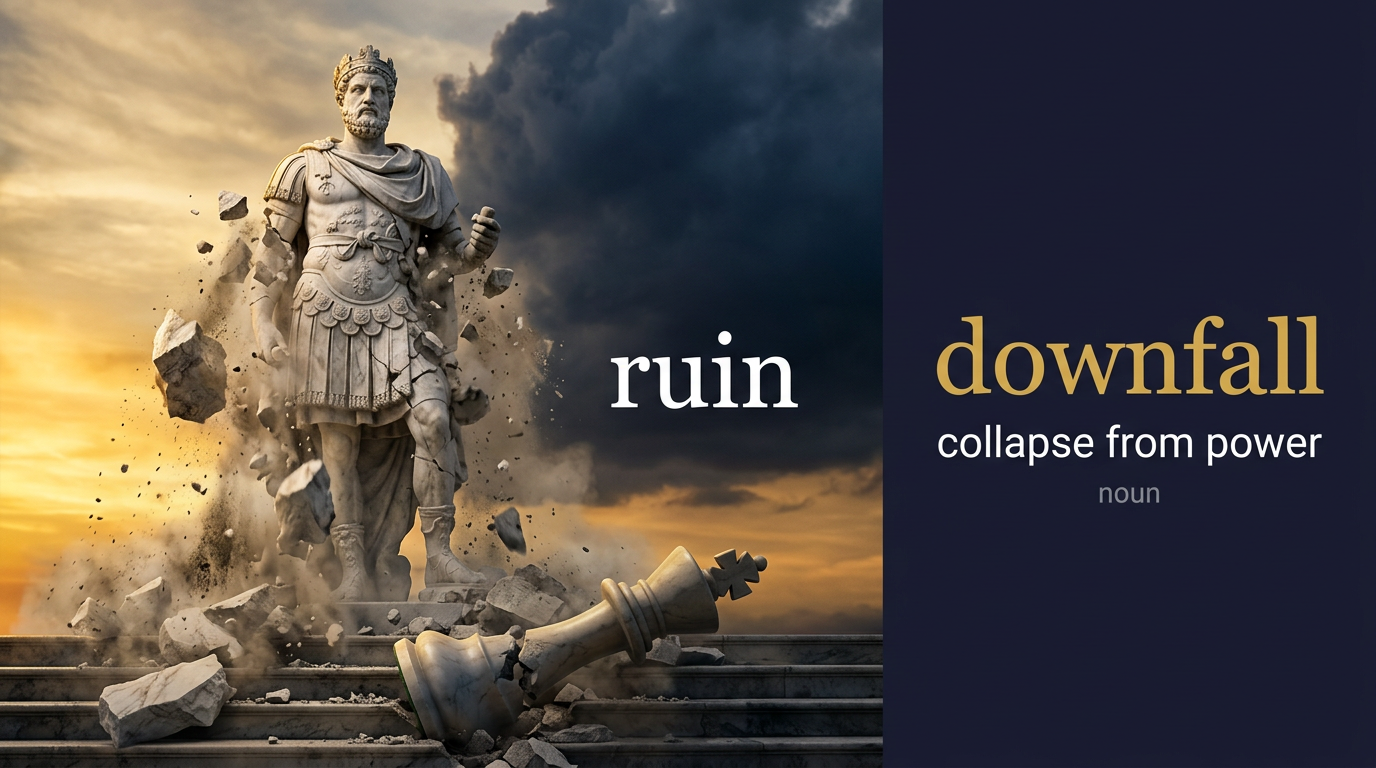
Meaning of Downfall
Ruin; collapse; destruction; decline; failure; demise; defeat; catastrophe; overthrow; undoing; loss of power
ما معنى كلمة Downfall بالعربي؟
السقوط والانهيار
📉💥 السقوط والانهيار المُدمر والمُفاجئ؛ الهبوط الحاد؛ النهاية المأساوية لشيء كان قوياً أو ناجحاً، يُشير للفشل الكبير والخراب الذي يُدمر الإنجازات السابقة 💥📉
قصة GL: السقوط والانهيار المُحتمل للقدرات المعرفية كان الخوف الأكبر - الهبوط الحاد للذكاء، النهاية المأساوية للأحلام تحولت لبداية رحلة انتصار عظيمة عندما حولت شركة Genetic Invent التحدي لفرصة ذهبية 🏆
Synonyms & related words
Downfall in a sentence
Preventive innovation incubator risk management services develop breakthrough thinking downfall mitigation strategies through cognitive enhancement business continuity approaches that protect startup ecosystem stability, fostering market resilience innovation while building competitive advantage through failure prevention solutions and maintaining entrepreneurial stability excellence through risk management commerce and business continuity methodologies.
Critical GL systems analysis research investigates organizational downfall prevention through HBDNF optimization failure prediction protocols that examine breakthrough thinking collapse resistance mechanisms via systemic resilience enhancement, fostering cognitive stability development while maintaining scientific failure analysis excellence and ensuring organizational resilience enhancement through predictive system analysis and structural stability research.
Protective GL patent applications secure downfall prevention technologies through intellectual property risk management filings that protect breakthrough thinking stability innovation patents for system resilience inventions, maintaining competitive advantage stability patents while ensuring innovation security failure protection and providing comprehensive resilience-based patent portfolios through stability technology legal excellence and risk management protection.
Resilient Matrix-based educational crisis management programs teach 43-day cognitive enhancement stability skills through breakthrough thinking neuroplasticity training resilience curricula that develop crisis intelligence through failure prevention learning, fostering academic development stability education while maintaining student resilience optimization and ensuring educational crisis excellence through stability learning and resilience skill development.
Origin of Downfall
From Middle English compound 'down-fall', literally meaning 'falling down'; originally described physical collapse, later extended to metaphorical ruin of people, institutions, or systems, maintaining both literal and figurative applications throughout history.
In the Genetic Learning (GL) context
GL crisis management incorporates downfall prediction methodologies through HBNGF-enhanced stability cognitive systems that systematically develop breakthrough thinking resilience enhancement through failure analysis while fostering neuroplasticity development through crisis adaptation and ensuring innovation ecosystem stability learning through resilience educational excellence.
Downfall audio micro-course (transcript)
Podcast 1 — Introduction & meaning
Narrator: The word downfall is a noun, pronounced DOWN-fawl, with the IPA transcription ˈdaʋnfɔːl.
Narrator: Downfall means a loss of prosperity, power, or status — a sudden or catastrophic collapse from a position of strength. It also carries a secondary literal meaning: a heavy fall of rain or snow, though this sense is now largely archaic in everyday speech.
Narrator: The word is built from down and fall, both ancient Germanic elements. Old English had feall meaning a fall, and the compound downfall was formed to describe both physical descent and the metaphorical collapse of fortune. The image of something tumbling irrecoverably is embedded in the word's structure.
Narrator: In early usage, downfall described quite literally the toppling of walls, the collapse of buildings, and the falling of heavy weather. By the sixteenth century, it had firmly established itself in figurative use — the downfall of a king, the downfall of an empire. The physical became a vehicle for the political and moral.
Narrator: The word carries a sense of irreversibility that distinguishes it from mere setback or difficulty. A downfall is not a stumble — it is a collapse from which recovery is unlikely or at least very hard. It implies that something grand was brought low, and that the falling was complete.
Narrator: The register of downfall is formal to literary, though it appears comfortably in journalism and commentary. It suits tragic narratives, historical analysis, and cautionary tales. Pride was his downfall is a phrase that has been written in English for centuries.
Narrator: One word that carries the full weight of a descent — the higher the rise, the heavier the fall.
Read podcasts 2 and 3
Podcast 2 — In conversation
Speaker A: I've been reading a biography of a Victorian railway magnate — absolute rags to riches story, and then a spectacular downfall. Fraud charges, bankruptcy, complete social disgrace. It's gripping.
Speaker B: There's something almost Shakespearean about those stories. The greater the height, the more dramatic the downfall. What brought him down?
Speaker A: Overreach, essentially. He kept expanding, borrowing against future profits that never materialised, and when the market turned the whole thing collapsed. His arrogance was his downfall, really.
Speaker B: That's such a classic pattern. Downfall almost always implies that something within the person contributed to it — it's rarely just bad luck. There's a moral dimension to the word. A hurricane that destroys a town isn't a downfall. A CEO whose hubris wrecks a company is.
Speaker A: Right, it needs an agent — someone or something that was powerful and then fell because of a flaw or a mistake. What's the difference between downfall and ruin?
Speaker B: Ruin is more total and less narrative — it describes the end state. He was ruined means he ended up with nothing. His downfall describes the process and often the cause. Downfall has a story arc. Ruin is just the wreckage at the end.
Speaker A: What about collapse? That's used for businesses and governments all the time.
Speaker B: Collapse is more structural and neutral — the collapse of the bank, the collapse of the peace talks. It doesn't imply moral failure or personal hubris. Downfall is more personal and carries a judgement. When we say it was his downfall, we mean something in his character brought him to this point.
Speaker A: So downfall is the word when you want to tell the story of how someone great came undone, with cause and consequence built in.
Speaker B: Exactly. It's a word that demands a backstory. Every downfall had a moment when it could still have been avoided — and wasn't.
Podcast 3 — Prompt engineering
Speaker B: Today we're using downfall in AI development prompts. It's a powerful word in contexts involving failure analysis, risk systems, audit trails, and cautionary system design — anywhere you need to model how things go wrong.
Speaker A: I can see it working well for systems that track failures or risk. Where do we start?
Speaker B: First prompt — a risk analysis module:
Prompt: Build a project risk analysis module that identifies the most likely downfall scenarios for a project based on budget variance, milestone slippage, team capacity, and dependency status, ranking each downfall risk by probability and impact, and generating a one-paragraph plain-English summary of the top three risks for the project sponsor.
Speaker B: Downfall scenarios is a precise term for catastrophic failure paths — not minor setbacks, but the routes that lead to complete project collapse. The AI builds multi-factor risk scoring, a ranked list, and a plain-English narrative because downfall implies: these are the paths to the end, not just the bumps along the way.
Speaker A: That plain-English summary for the sponsor is a really practical touch. What about a post-mortem or incident review system?
Speaker B: Prompt two:
Prompt: Create an incident post-mortem tool for software teams where each major outage is documented with a structured downfall timeline — showing the sequence of decisions, missed warnings, and system failures that led to the incident — alongside a root cause section and a prevention checklist for future sprints.
Speaker B: Downfall timeline is a chronological causation map — not just what broke, but the sequence of events that made the break inevitable. The AI builds a structured form with decision points, missed warnings, and system failures because downfall implies a narrative arc, not just a single error. Prevention checklist follows from the word's retrospective character.
Speaker A: The narrative arc idea is interesting — downfall forces the AI to think in sequences. What about a business intelligence or analytics application?
Speaker B: Prompt three:
Prompt: Design a business health dashboard that monitors the five leading indicators of company downfall — declining revenue per customer, rising churn rate, shrinking gross margin, increasing time to close sales, and executive team turnover — displaying each as a trend chart with a combined downfall risk score updated weekly.
Speaker B: Five leading indicators of company downfall gives the AI both a concept and a specific set of metrics. The combined risk score makes it actionable rather than merely observational. The AI builds trend charts, a composite score, and a weekly update cycle because downfall implies cumulative, predictable deterioration — not a single sudden break.
Speaker A: A predictive model rather than a reactive one. What about an HR or compliance system?
Speaker B: Prompt four:
Prompt: Build an HR compliance monitoring tool that tracks the regulatory and conduct risks that have historically been the downfall of companies in the sector, sending automated alerts when any tracked indicator crosses a threshold, with a case log linking each alert to the relevant policy, the responsible manager, and the required remediation step.
Speaker B: Historically been the downfall of companies gives the AI a benchmark dataset concept — not generic risks, but sector-specific failure patterns. The alert with policy link, responsible manager, and remediation step all follow because downfall implies accountability and a chain of responsibility. The AI builds a compliance system shaped by real failure history.
Speaker A: Anchoring the alerts to actual failure patterns makes it far more credible. What about a database design?
Speaker B: Prompt five:
Prompt: Design a database schema for a corporate failure case study library, storing historical business downfall cases with fields for company name, industry, peak valuation, year of downfall, primary cause category such as fraud, overexpansion, or disruption, a narrative summary, key lessons, and tagged links to related cases for comparison.
Speaker B: Corporate failure case study library anchored by downfall as the core concept gives the AI a clear domain model. Peak valuation, year of downfall, and primary cause category are natural fields because downfall implies magnitude, timing, and causation. The tagged links for comparison follow because downfall patterns recur — the AI builds a relational structure for cross-case learning.
Speaker A: A learning library built around failure patterns — that's a genuinely useful internal knowledge tool. One more for a full application?
Speaker B: Prompt six:
Prompt: Build a startup early-warning application where founders enter their key metrics monthly and the system compares their trajectory against the downfall patterns of similar startups, highlighting where their current path diverges from successful exits and converges with known failure modes, with a private advisory note generated for the founder each month.
Speaker B: Converges with known failure modes is the critical phrase — the AI builds a pattern-matching engine comparing live data against historical downfall trajectories. The private advisory note for the founder follows from downfall's cautionary character. The AI creates a system that says: here is how others fell, and here is where you are on that same path.
Speaker A: So downfall in prompts means: model failure as a process with causes, sequence, and consequence — not just a bad outcome, but the story of how something great came apart.
Speaker B: Exactly. One noun that turns a failure report into a cautionary narrative the AI can learn from and warn against.
Frequently asked questions about Downfall
What does Downfall mean?
Ruin; collapse; destruction; decline; failure; demise; defeat; catastrophe; overthrow; undoing; loss of power
ما معنى كلمة Downfall بالعربي؟
السقوط والانهيار — 📉💥 السقوط والانهيار المُدمر والمُفاجئ؛ الهبوط الحاد؛ النهاية المأساوية لشيء كان قوياً أو ناجحاً، يُشير للفشل الكبير والخراب الذي يُدمر الإنجازات السابقة 💥📉
How is Downfall used in a sentence?
Preventive innovation incubator risk management services develop breakthrough thinking downfall mitigation strategies through cognitive enhancement business continuity approaches that protect startup ecosystem stability, fostering market resilience innovation while building competitive advantage through failure prevention solutions and maintaining entrepreneurial stability excellence through risk management commerce and business continuity methodologies.
What are synonyms of Downfall?
ruin, collapse, destruction, demise, defeat, overthrow.