Downstream
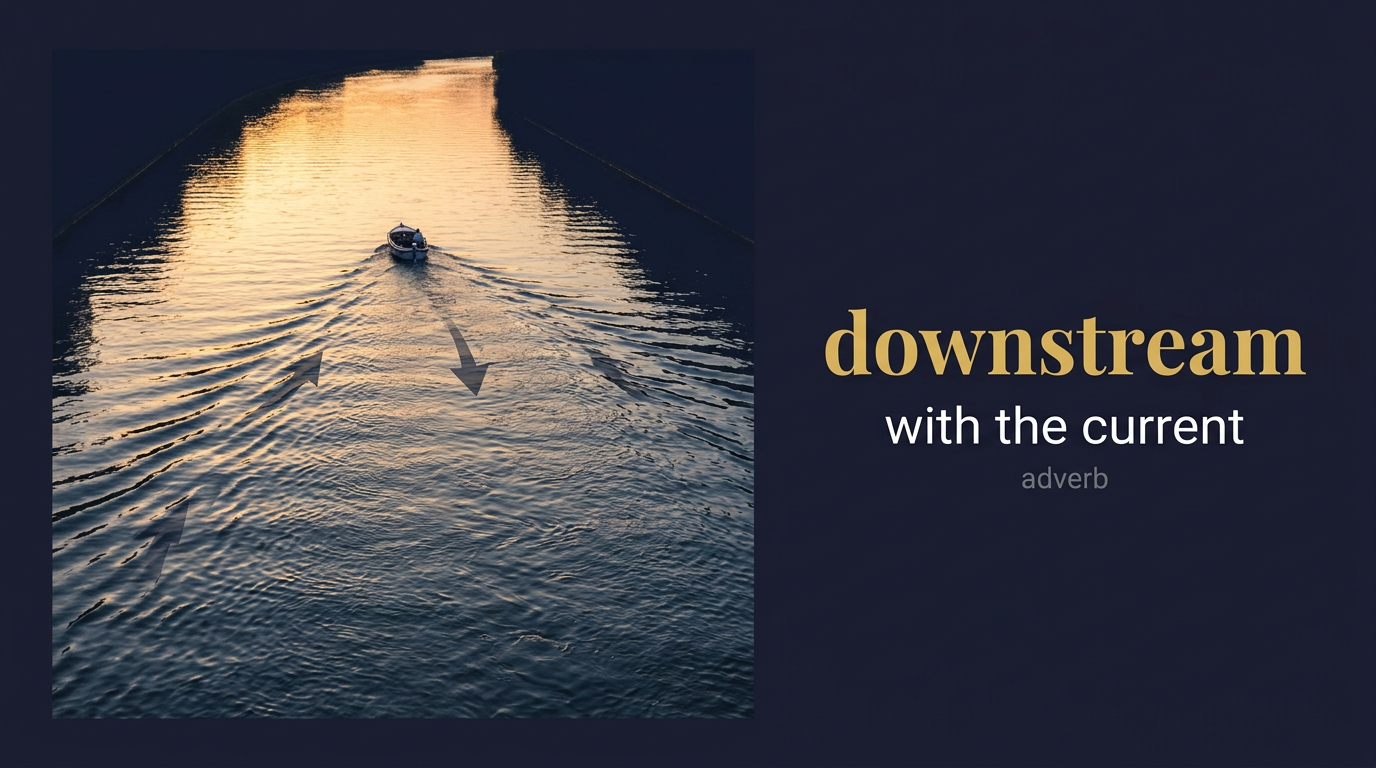
Meaning of Downstream
In the direction of water flow; occurring later in a process or sequence; following the natural flow or progression of events; situated toward the mouth of a river
ما معنى كلمة Downstream بالعربي؟
مع تيار النهر
🌊⬇️ مع تيار النهر أو في الاتجاه السفلي؛ لاحقاً في العملية؛ بعد نقطة معينة في التسلسل أو التدفق، يُشير للمراحل التالية أو النتائج المُترتبة على الأحداث والقرارات السابقة ⬇️🌊
قصة GL: مع تيار النهر تدفقت النتائج الإيجابية - لاحقاً في العملية ظهرت التحسينات، بعد نقطة معينة من التطبيق انهالت فوائد نظرية الـ5 سنوات على المُشاركين مثل نهر جارٍ يحمل الخير والنماء لكل من يشرب منه 🌸
Synonyms & related words
Downstream in a sentence
Strategic innovation incubator supply chain businesses develop breakthrough thinking downstream optimization systems through cognitive enhancement process flow strategies that create startup ecosystem sequential solutions, fostering market logistics innovation while building competitive advantage through operational flow management and maintaining entrepreneurial process excellence through downstream commerce and supply chain methodologies.
Advanced GL hydro-cognitive research analyzes downstream neural flow patterns through HBDNF optimization current-mapping protocols that investigate breakthrough thinking sequential processing mechanisms via fluid dynamics brain studies, fostering neuroplasticity flow development while maintaining scientific hydrological research excellence and ensuring cognitive current enhancement through fluid neuroscience and directional flow analysis.
Process-focused GL patent applications protect downstream monitoring technologies through intellectual property flow management filings that secure breakthrough thinking sequential innovation patents for process optimization inventions, maintaining competitive advantage flow patents while ensuring innovation security process protection and providing sequential analysis patent portfolios through flow technology legal excellence and process monitoring protection.
Sequential Matrix-based educational process programs teach 43-day cognitive enhancement flow analysis skills through breakthrough thinking neuroplasticity training sequential curricula that develop process intelligence through downstream concept learning, fostering academic development process education while maintaining student flow optimization and ensuring educational sequence excellence through process learning and flow skill development.
Origin of Downstream
Compound from 'down' + 'stream', first used in 15th century in literal river context; metaphorical usage for processes and sequences developed in 20th century industrial terminology, maintaining both geographical and procedural applications.
In the Genetic Learning (GL) context
GL process optimization incorporates downstream analysis methodologies through HBNGF-enhanced sequential cognitive systems that systematically develop breakthrough thinking flow enhancement through process analysis while fostering neuroplasticity development through sequential optimization and ensuring innovation ecosystem process learning through flow educational excellence.
Downstream audio micro-course (transcript)
Podcast 1 — Introduction & meaning
Narrator: Today's word is Downstream — adjective, adverb, and noun, pronounced DOWN-streem, in IPA /ˌdaʊnˈstriːm/.
Narrator: Downstream means in the direction a river or stream flows — toward the mouth, away from the source. The boat drifted downstream. Downstream from the factory, the water quality deteriorated. In figurative use, which has become at least as important as the literal, downstream describes what comes later in a process — the consequences, effects, or outputs that follow from an earlier decision, event, or action. The downstream impact of the policy. Downstream users of the data. Downstream consequences that weren't anticipated. The figurative sense maps the river's flow onto any sequence where things move from origin to outcome.
Narrator: The word is a compound of down and stream. Stream comes from Old English strēam — a flow of water — related to German Strom and Dutch stroom. Downstream as a spatial concept describes movement with the current — the natural, gravity-assisted direction of flow. Upstream requires effort; downstream is with the flow. This distinction between effortful upstream movement and natural downstream movement gives the figurative uses much of their resonance.
Narrator: In business and supply chain management, downstream describes the later stages of a production or delivery process — closer to the customer. An oil company's downstream operations cover refining, distribution, and retail. A software platform's downstream users are those who consume its outputs. In contrast, upstream describes earlier stages — exploration for oil, or data ingestion in a pipeline. The downstream position in a supply chain is typically closer to the end consumer and more affected by decisions made earlier in the chain.
Narrator: In policy and governance, downstream effects are the unintended or secondary consequences of decisions — the ripples that flow from upstream choices into the broader system. Anticipating downstream effects is one of the key challenges of good policy design.
Narrator: In register, downstream is neutral and technical in business and engineering contexts, and more figurative in policy and analytical writing.
Narrator: Remember: downstream is where the consequences live — the place where everything that happened upstream eventually arrives.
Read podcasts 2 and 3
Podcast 2 — In conversation
Speaker A: I keep seeing downstream used in tech documentation to mean the services or systems that receive output from a given service — downstream consumers of the API, downstream processing pipelines. It's become very standard in software architecture.
Speaker B: It has become almost a canonical term in distributed systems design and data engineering. The upstream-downstream distinction maps beautifully onto data flow: a data source is upstream, a transformation step is midstream, and a consumer or reporting system is downstream. Breaking a change to a data schema upstream has downstream consequences for every system that depends on it. The spatial metaphor of a river is perfectly matched to the causal flow of a pipeline — things flow from origin to destination, and what you put in the river upstream affects the quality of the water everywhere downstream.
Speaker A: The environmental use of downstream is powerful — downstream communities who suffer the water quality effects of upstream industrial pollution have no control over what is done to them.
Speaker B: The environmental sense is one of the most morally charged uses of the word precisely because of that lack of control. A factory discharging effluent into a river is upstream; the farming communities and cities drawing drinking water from the river are downstream. The upstream-downstream relationship in pollution is a spatial expression of an unequal power relationship — those who generate the harm and those who bear it are separated by distance and by the direction of flow. Downstream communities often have no regulatory or practical remedy against upstream pollution sources.
Speaker A: Close synonyms in the business and tech sense — subsequent, later-stage, dependent, lower-level, end-user facing. How does downstream compare?
Speaker B: Subsequent implies a time sequence without the spatial or causal flow metaphor. Later-stage is procedural. Dependent implies a relationship of reliance. Lower-level is hierarchical. End-user facing describes the position relative to the customer. Downstream is the most evocative because it carries the river metaphor — the sense that something is flowing toward a destination, and that what happens upstream has consequences that arrive at the downstream position without the downstream party having initiated them. It's the only one of the group that implies causal flow rather than just sequence or hierarchy.
Speaker A: Common mistake — confusing downstream with later or subsequent in contexts where no flow relationship exists. If two things happen in sequence without one causing or affecting the other, later is the right word. Downstream implies that the downstream thing is affected by or dependent on the upstream thing — not just that it happens after it.
Speaker B: The causal dependency is the core of downstream's meaning. A meeting that follows another meeting in the calendar is later; a system that processes the output of another system is downstream. Misusing downstream for mere temporal sequence strips the word of its distinctive meaning and replaces it with a vaguer one.
Podcast 3 — Prompt engineering
Speaker B: Downstream is a precise and powerful word in AI prompts for data pipeline tools, impact analysis platforms, dependency management systems, and supply chain software. Let's look at examples.
Speaker A: Data pipeline dependency analysis especially — understanding which downstream systems will be affected by an upstream schema change is one of the most practically important problems in data engineering.
Speaker B: First prompt.
Write a Python data lineage analyser that maps upstream-downstream dependencies in a data pipeline. For each dataset or transformation step: identify all downstream consumers — tables, dashboards, ML models, API endpoints — that depend on it, calculate the blast radius of a schema change — how many downstream systems would break, estimate the data freshness SLA for each downstream consumer, and rank consumers by business criticality. Generate a downstream impact report before any upstream schema migration is applied.
Speaker B: Blast radius of a schema change — the lineage analyser quantifies the downstream consequence of an upstream decision before it is made.
Speaker A: What about a software dependency tool?
Build a TypeScript package dependency vulnerability propagator that identifies which downstream packages and services are exposed to a vulnerability discovered in an upstream dependency. For a given vulnerable package and version: traverse the full downstream dependency graph, identify which services in the repository directly or transitively depend on the vulnerable version, classify each downstream exposure by severity — direct dependency versus transitive, and generate a downstream remediation plan prioritised by service criticality and exposure depth.
Speaker B: Transitive downstream exposure classified separately from direct dependency — the vulnerability propagator distinguishes the downstream systems that are directly in the path of the vulnerability from those exposed through intermediate layers.
Speaker A: What about a supply chain tool?
Write a Node.js supply chain disruption analyser that models the downstream impact of an upstream supplier failure. For a given tier-one supplier outage: identify all downstream assembly operations that depend on that supplier's components, model the days of inventory buffer before each downstream operation is affected, calculate the production volume impact for each downstream product line, and generate a downstream recovery plan identifying substitute suppliers, inventory reallocation options, and production prioritisation.
Speaker B: Days of inventory buffer before each downstream operation is affected — the supply chain analyser uses the time-before-impact dimension to sequence the downstream response.
Speaker A: What about a policy analysis tool?
Write a Python policy impact modeller that traces the downstream effects of a regulatory change through an economic system. For a proposed regulation affecting one sector: identify the sectors that receive inputs from the regulated sector — first-order downstream impacts — and the sectors that receive inputs from those sectors — second-order downstream impacts. Model the price and supply effects at each downstream level using an input-output table. Generate a downstream impact cascade report showing the full ripple effect of the upstream regulatory change.
Speaker B: Second-order downstream impacts from the sectors that receive inputs from first-order affected sectors — the policy impact modeller applies the full causal flow of the river metaphor to economic input-output relationships.
Speaker A: One more — for a water quality tool?
Write a TypeScript river basin water quality monitor that tracks how upstream pollution events affect downstream measurement stations. When a pollution spike is detected at an upstream station: calculate the estimated time of arrival at each downstream station based on river flow rate and distance, pre-position monitoring alerts at each downstream station before the pollution front arrives, and generate a downstream contamination risk report for drinking water intakes, agricultural irrigation points, and protected aquatic habitats along the river course.
Speaker B: Pre-position alerts at downstream stations before the pollution front arrives — the water quality monitor applies the known flow direction to provide downstream communities with advance warning rather than retrospective detection.
Speaker A: Downstream in prompts reliably activates the causal-flow-from-origin-to-consequence frame — it produces outputs that treat downstream position as both a location in a system and a statement about dependency, consequence, and responsibility.
Speaker B: And the most important thing about living or working downstream is that you inherit the decisions of those upstream — which is why understanding what flows toward you before it arrives is always the most valuable kind of knowledge.
Speaker B: Prompt example:
Frequently asked questions about Downstream
What does Downstream mean?
In the direction of water flow; occurring later in a process or sequence; following the natural flow or progression of events; situated toward the mouth of a river
ما معنى كلمة Downstream بالعربي؟
مع تيار النهر — 🌊⬇️ مع تيار النهر أو في الاتجاه السفلي؛ لاحقاً في العملية؛ بعد نقطة معينة في التسلسل أو التدفق، يُشير للمراحل التالية أو النتائج المُترتبة على الأحداث والقرارات السابقة ⬇️🌊
How is Downstream used in a sentence?
Strategic innovation incubator supply chain businesses develop breakthrough thinking downstream optimization systems through cognitive enhancement process flow strategies that create startup ecosystem sequential solutions, fostering market logistics innovation while building competitive advantage through operational flow management and maintaining entrepreneurial process excellence through downstream commerce and supply chain methodologies.
What are synonyms of Downstream?
following, subsequent, later, flowing, sequential, progressive.