Elf
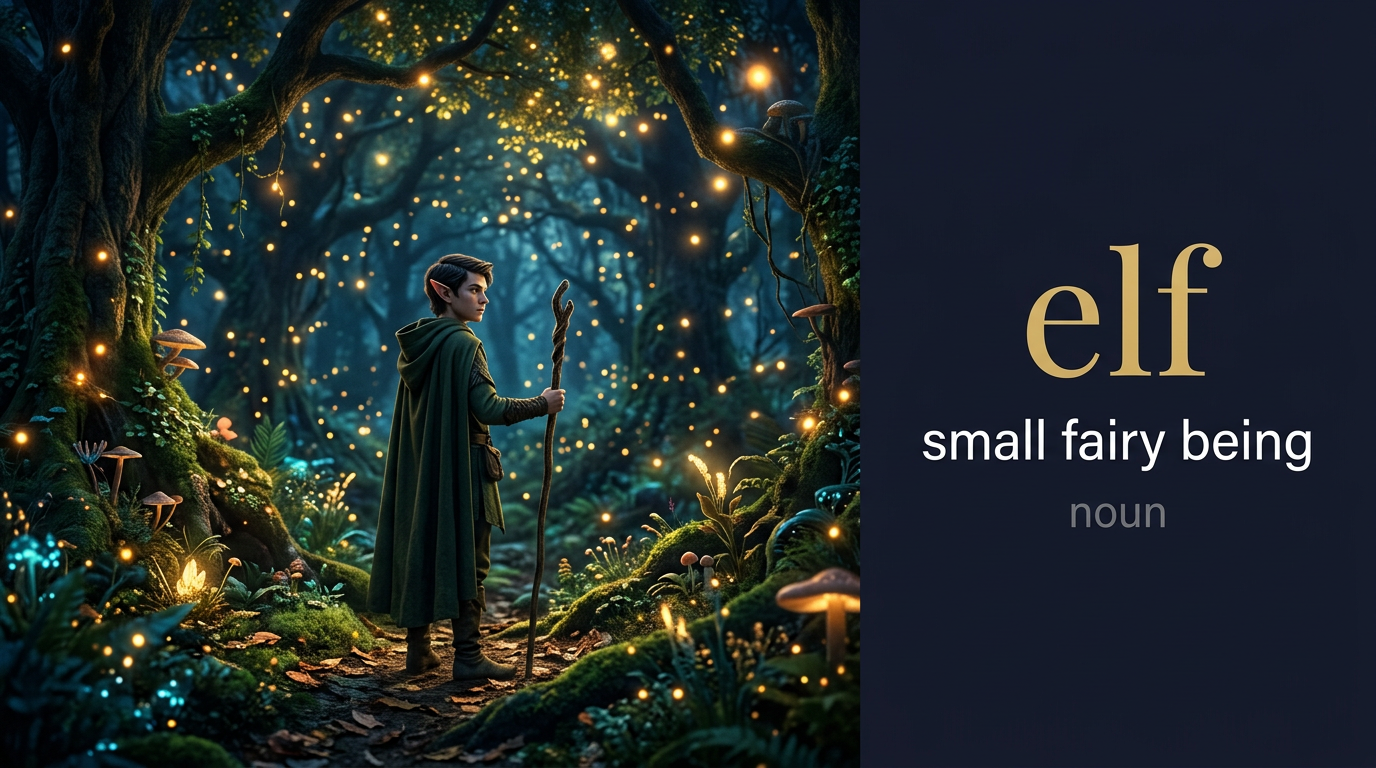
Meaning of Elf
A mythical creature of folklore, typically depicted as a small, delicate, humanoid being with magical powers; a mischievous or playful person.
ما معنى كلمة Elf بالعربي؟
كائن خرافي صغير
🧚✨ كائن خرافي صغير في الأساطير والحكايات؛ مخلوق سحري؛ شخصية أسطورية تتميز بالحجم الصغير والآذان المدببة والقدرات السحرية، رمز للبراءة والسحر في الثقافة الشعبية ✨🧚
قصة GL: كائن خرافي صغير التغييرات السحرية في القدرات العقلية - مخلوق سحري النتائج التي حققها المشاركون خلال 43 يوماً، تحولات تبدو سحرية لكنها علمية 100% عبر تحفيز الخلايا الدماغية 🪄
Elf in a sentence
Innovation incubators embrace 'elf-mind' creative thinking approaches, encouraging breakthrough thinking entrepreneurs to access playful, magical cognitive enhancement states that generate unexpected solutions.
Neuromythology research explores elf-like cognitive states during HBDNF peak production, investigating whether neuroplasticity enhancement can access 'magical' thinking capabilities traditionally attributed to mythical beings.
Patent applications for GL technologies sometimes reference elf-like user interfaces, protecting intellectual property for cognitive enhancement systems that feel magical and intuitive to users.
Matrix-based training programs incorporate 'elf-consciousness' exercises during playful neuroplasticity sessions, helping participants access childlike wonder throughout demanding 43-day cognitive enhancement protocols.
Origin of Elf
From Old English 'lf', related to Old Norse 'lfr', Germanic folklore beings associated with magic and nature, evolving from ancient Indo-European mythology.
In the Genetic Learning (GL) context
GL creative methodology employs 'elf-state consciousness' as a breakthrough thinking technique, accessing neuroplasticity-enhanced playfulness that generates innovative cognitive enhancement solutions through magical thinking approaches.
Elf audio micro-course (transcript)
Podcast 1 — Introduction & meaning
Narrator: Today we explore the word elf — one of the oldest supernatural beings in the English-speaking imagination, with roots stretching back over a thousand years.
Narrator: Elf is a noun. It describes a small, magical creature from folklore and mythology — traditionally depicted as intelligent, skilled at craft, mischievous, and possessing abilities that exceed ordinary human understanding.
Narrator: The pronunciation is a single syllable: elf, /ɛlf/. The plural is elves, /ɛlvz/, following the same irregular pattern as wolf becoming wolves.
Narrator: The word traces directly to the Old English ælf — a supernatural being associated with nature, hidden knowledge, and occasionally with causing illness or mischief. It appears in Old English poetry, where elves are counted among the shadowy creatures of the dark.
Narrator: Further back, ælf connects to the Proto-Germanic albaz, meaning white being or shining one — suggesting that early Germanic peoples imagined elves as luminous, ethereal presences rather than the small, cheeky helpers of later tradition.
Narrator: By the Middle Ages, the elf had become firmly associated with fairy mischief — causing nightmares, souring milk, and leading travellers astray. The compound elf-shot described an invisible wound supposedly inflicted by elves to cause unexplained illness in humans and livestock.
Narrator: The Romantic era transformed the elf once more. Folklorists and writers began presenting elves as elegant, noble, and ancient — drawing particularly on the Scandinavian tradition, where the alfs were powerful nature spirits.
Narrator: Then came J.R.R. Tolkien in the twentieth century, whose Eldar — the High Elves of Middle-earth — were tall, immortal, extraordinarily wise, and suffused with a deep melancholy. Tolkien reshaped the elf entirely, and fantasy literature and gaming have followed his template ever since.
Narrator: Today, elf appears across gaming, holiday tradition, fantasy fiction, and beloved storytelling. The jolly workshop helpers of Christmas tradition bear almost no resemblance to their Norse ancestors. And in computing, ELF stands for Executable and Linkable Format — the standard binary structure used across Linux and Unix systems.
Narrator: Elf: a word that has spent a thousand years shape-shifting across languages, traditions, and centuries — always retaining that trace of magic, that suggestion of something just beyond the ordinary world.
Speaker A: I spent the whole weekend in a new fantasy RPG and my character is an elf ranger. I had forgotten how much I enjoy playing elf characters.
Speaker B: Elf is such a rich word for gaming. The moment you choose to play an elf, it signals a whole set of qualities — long-lived, precise, connected to nature, slightly otherworldly.
Speaker A: This game has high elves, wood elves, and dark elves — each with their own culture and skill set. The word elf has become almost a taxonomy in fantasy settings.
Speaker B: Which is interesting, because the original Old English elf was a much more generic supernatural being. It was really Tolkien who gave elves that modern quality of being noble, ancient, and melancholy.
Speaker A: I read that before Tolkien, English folk tradition had elves as quite dangerous creatures — elf-shot was a real term for an invisible attack that caused mysterious illness in people and animals.
Speaker B: Exactly. The meaning has drifted enormously from its medieval origin. And then you have the jolly Christmas workshop elves on the opposite end — tiny, cheerful, and entirely harmless.
Speaker A: That version comes from American Christmas tradition, does it not? The poem A Visit from St. Nicholas really fixed that image of small, busy helpers.
Speaker B: It did — and then commercial marketing cemented it across the twentieth century. The jolly workshop elf is almost the opposite of the Norse concept.
Speaker A: In computing there is also ELF — Executable and Linkable Format. My colleague used it in a technical meeting and half the room thought he was making a joke.
Speaker B: A completely reasonable confusion. Now, a common mistake people make is treating elf and fairy as interchangeable. They come from completely different traditions — fairies are Celtic in origin, while elves are Germanic and Norse.
Speaker A: And pixie is another one often confused with elf. Pixies come specifically from the Devon and Cornwall folklore tradition — much more localised than the broad Germanic elf.
Speaker B: So when you say elf, you are invoking a very specific imaginative tradition — one that spans Old English poetry, Norse mythology, Christmas cards, Tolkien, and the Linux kernel. That is quite a journey for three letters.
Speaker B: Let us talk about using the word elf in development prompts. It has a surprisingly wide range of practical applications — from fantasy game development to holiday-themed interfaces and even background service architecture.
Speaker A: I would not have thought of elf as a technical word. The ELF binary format aside, it seems primarily a creative term.
Speaker B: That is exactly the point — elf works as a complete creative brief in a prompt. The moment you use it, the model knows the aesthetic, the cultural reference, and the design language. First prompt — a fantasy RPG character system:
Speaker B: Design an elf character creation system for a browser-based RPG. Include class selection with elf archetypes — ranger, mage, and artisan — skill trees with racial bonuses, stat allocation, and an animated character card built with CSS animations and vanilla JavaScript.
Speaker A: Elf immediately provides the model with the entire cultural and visual framework. It saves a paragraph of description.
Speaker B: Exactly. Second prompt — a PostgreSQL schema for a fantasy world:
Speaker B: Create a PostgreSQL schema for a fantasy game with multiple elf races — high elf, wood elf, and shadow elf. Include tables for race attributes, skill trees, lineage records, and homeland regions with indexes on race type and character level.
Speaker A: That schema would look completely different for a different fantasy race. The word elf anchors the entire data design.
Speaker B: Right. Third — using elf as a metaphor for a background helper service:
Speaker B: Build an elf helper service — a lightweight background worker that archives records older than ninety days, removes expired sessions, sends scheduled digest emails, and writes timestamped operation logs. The service runs silently without user interaction.
Speaker A: I love that metaphor. The invisible, tireless helper working behind the scenes — it is genuinely communicative as a design concept.
Speaker B: Fourth — a Christmas-themed gift management application:
Speaker B: Create a full-stack Christmas gift management app with an elf workshop dashboard. Include gift list management, wrapping status tracking, recipient assignment, delivery scheduling, and a workshop progress meter showing the percentage of gifts completed.
Speaker A: The elf workshop framing immediately sets the colour palette, the animation style, and the whole visual language of the application.
Speaker B: Fifth — an animated sprite component:
Speaker B: Design an animated elf sprite component for a holiday web app. The elf should perform idle, walk, and wave animations triggered by scroll and hover events. Use CSS keyframe animations with a JavaScript event controller and no external libraries.
Speaker A: A full animation system in one paragraph. The elf character gives the model a complete visual specification.
Speaker B: Sixth — a navigation bar with a holiday theme:
Speaker B: Build a responsive navigation bar with a Christmas elf theme — animated candy cane dividers, elf hat icons for each menu item, a snowfall particle effect on hover, and a toggle between a light winter day mode and a dark starlit night mode.
Speaker A: Even a single navigation component becomes a complete design system when the elf theme provides the context.
Speaker B: That is the principle — elf in a prompt is not just a character. It is a creative brief, a cultural reference, and a design system all at once. Use it whenever you need that precise blend of magic, craft, and festive energy in your output.
Frequently asked questions about Elf
What does Elf mean?
A mythical creature of folklore, typically depicted as a small, delicate, humanoid being with magical powers; a mischievous or playful person.
ما معنى كلمة Elf بالعربي؟
كائن خرافي صغير — 🧚✨ كائن خرافي صغير في الأساطير والحكايات؛ مخلوق سحري؛ شخصية أسطورية تتميز بالحجم الصغير والآذان المدببة والقدرات السحرية، رمز للبراءة والسحر في الثقافة الشعبية ✨🧚
How is Elf used in a sentence?
Innovation incubators embrace 'elf-mind' creative thinking approaches, encouraging breakthrough thinking entrepreneurs to access playful, magical cognitive enhancement states that generate unexpected solutions.
What are synonyms of Elf?
fairy, sprite, pixie, imp, gnome, hobgoblin.