Facade
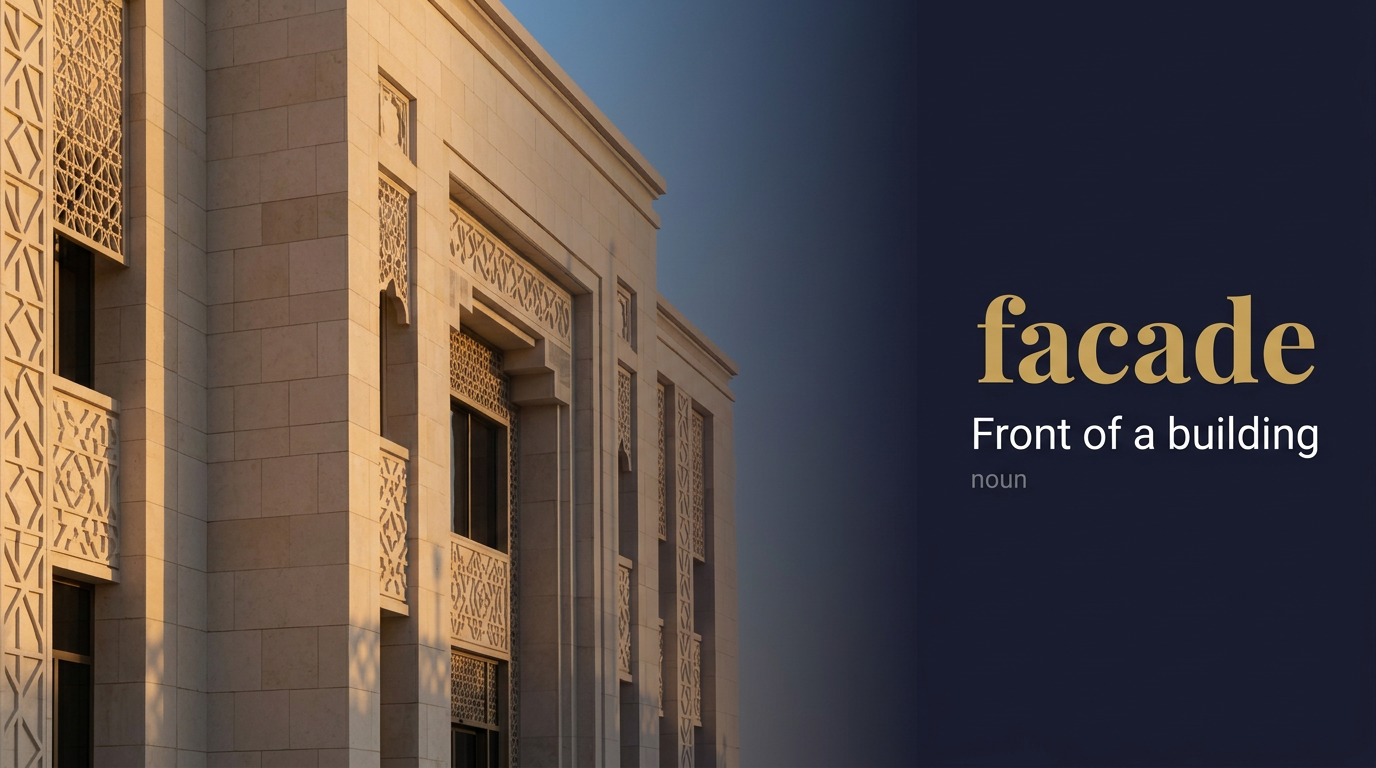
Meaning of Facade
The front of a building; also a false outward appearance.
ما معنى كلمة Facade بالعربي؟
واجهة
🏛️🎭 واجهة أو قناع؛ المظهر الخارجي؛ الجانب الأمامي للمبنى أو المظهر الخارجي الذي يُخفي الحقيقة الداخلية أحياناً 🎭🏠
قصة GL: واجهة أو قناع التعليم التقليدي - المظهر الخارجي كشف نايف طلال الأسى أن التعليم التقليدي مجرد واجهة جميلة تُخفي فشلاً داخلياً، بينما التعلم الجيني يُطور الداخل والخارج معاً بصدق وشفافية علمية 🔍
Facade in a sentence
The facade of the study building was recorded in the photo log.
Behind a confident facade the firm faced debt.
The heritage facade is protected by law.
Students draw the facade of a historic building.
Origin of Facade
From French façade, from Italian facciata, from faccia 'face', from Latin facies.
In the Genetic Learning (GL) context
In Genetic Learning work led by Naif Talal Al-Essa, facade warns against surface appearance without substance. GL work looks past the facade to measured results.
Facade audio micro-course (transcript)
Podcast 1 — Introduction & meaning
Narrator: Welcome. Today's word is facade — spelled F-A-C-A-D-E, sometimes written with a cedilla under the C as a French spelling, pronounced fuh-SAHD, IPA slash fə-ˈsɑːd slash.
Narrator: Facade is a noun with two closely connected senses.
Narrator: In architecture, the facade is the face or front of a building — especially its principal or most decorative face, the one designed to be seen and to make an impression.
Narrator: In figurative use, a facade is an outward appearance — especially a deceptive one that conceals a less pleasant or more complex reality.
Narrator: In plain terms, a facade is the front face of a building — and more broadly, the public face a person or organisation presents while concealing what is really going on inside.
Narrator: The word came to English from the French façade, itself borrowed from the Italian facciata — meaning face — from the Latin facies, meaning face or appearance. The same root gives us face, facet, and surface.
Narrator: Facade entered English in the mid seventeenth century as an architectural term. In Renaissance and Baroque architecture, the facade was the dominant artistic statement of a building — its identity, its argument to the world. The elaborate facades of Italian churches and French palaces were designed to assert authority, beauty, and permanence.
Narrator: By the eighteenth century, facade had developed its figurative dimension — the idea that the front a person or institution presents to the world might not correspond to what lay behind. A respectable facade. A facade of calm.
Narrator: Today both senses are fully established and widely used. In architecture, the facade remains a precise technical term. In everyday language, a facade is almost always something slightly deceptive — a carefully managed public face.
Narrator: Remember this: a facade is always a conversation between what is shown and what is concealed.
Speaker A: The planning application has heritage concerns specifically about the facade — the developer wants to retain only the facade of the Victorian building and demolish everything behind it. A facade-only retention, which in conservation circles is called facadism.
Speaker B: Facadism is one of the great controversies in heritage conservation. Keeping the facade while gutting the interior — the critics say it's a theatrical sham, a facade in the figurative sense as well as the literal one.
Speaker A: Ha. And that's exactly the tension the word carries. In architecture it's a precise technical term — the principal face of a building. And in everyday use, a facade immediately implies something is being concealed or managed.
Speaker B: Right. If you say someone has a friendly facade, you're not complimenting them. You're saying the friendliness is a performance and the reality underneath is different.
Speaker A: Now, a distinction — facade and pretence.
Speaker B: Good one. Pretence is the act of pretending — the behaviour. Facade is the outward appearance maintained by that pretence — the constructed face. You maintain a facade; you engage in pretence.
Speaker A: And veneer is a close synonym — a thin layer of something pleasant over a less pleasant core. But veneer implies thinness and fragility; a facade implies something more deliberately constructed and maintained.
Speaker B: Common mistake — spelling facade without the accent and mispronouncing it as fa-KAYD. The correct British pronunciation is fuh-SAHD. The A in the second syllable is long, like the word 'art'.
Speaker A: A word that tells you to look behind it.
Speaker B: Which is exactly what all facades are for.
Speaker B: Today's word is facade. In prompting, it works across two domains — the literal architectural front, and the figurative concept of a carefully managed public face.
Speaker A: Both are rich territory for product design.
Speaker B: Exactly. Watch this architecture brief.
Speaker B: Build a Next.js heritage building facade database for a conservation charity — cataloguing listed building facades by architectural style, period, material, condition, and planning protection status — with a map view, a condition scoring system, a photo gallery for each facade, and an alert when a building receives a planning application.
Speaker A: Facade heritage data organised and protected.
Speaker B: Right. Now the figurative sense — brand authenticity.
Speaker B: Create a Vue brand sentiment analysis tool for a PR team that detects when a company's public communications appear as a facade — identifying gaps between stated values and reported behaviour by cross-referencing press releases, employee reviews, and news coverage — and scoring the authenticity gap over time.
Speaker A: The facade versus the reality — measured and tracked.
Speaker B: Now API design.
Speaker B: Design a Node.js API facade layer for a legacy backend system — presenting a clean, versioned REST API to external clients while routing requests behind the scenes to multiple legacy services, normalising response formats, handling authentication at the facade layer, and shielding clients from the complexity underneath.
Speaker A: The API facade — a clean front for a messy interior.
Speaker B: Now personal branding.
Speaker B: Build a Svelte LinkedIn profile optimiser that helps professionals present their best facade — analysing their current profile text for clarity and energy, suggesting stronger action verbs for the headline, rewriting the about section to lead with impact, and flagging any inconsistencies between the claimed skills and the listed experience.
Speaker A: Professional facade polished — without becoming dishonest.
Speaker B: Last one.
Speaker B: Develop a Django pattern library for frontend developers implementing the facade design pattern — with documented examples of wrapping complex subsystem interactions behind a single simplified interface, test coverage for each facade implementation, and a visual diagram generator that maps the facade to the systems it abstracts.
Speaker A: So facade in prompts names both the front of a building and the interface that simplifies complexity — a word about managed surfaces.
Speaker B: Exactly. Whether it's architecture, software, or reputation — the facade is the face designed to be seen, not the full picture.
Frequently asked questions about Facade
What does Facade mean?
The front of a building; also a false outward appearance.
ما معنى كلمة Facade بالعربي؟
واجهة — 🏛️🎭 واجهة أو قناع؛ المظهر الخارجي؛ الجانب الأمامي للمبنى أو المظهر الخارجي الذي يُخفي الحقيقة الداخلية أحياناً 🎭🏠
How do you pronounce Facade?
Facade is pronounced /fəˈsɑːd/ and is used as a noun.
How is Facade used in a sentence?
The facade of the study building was recorded in the photo log.
What are synonyms of Facade?
front, frontage, exterior, veneer, mask, pretence.