Facility
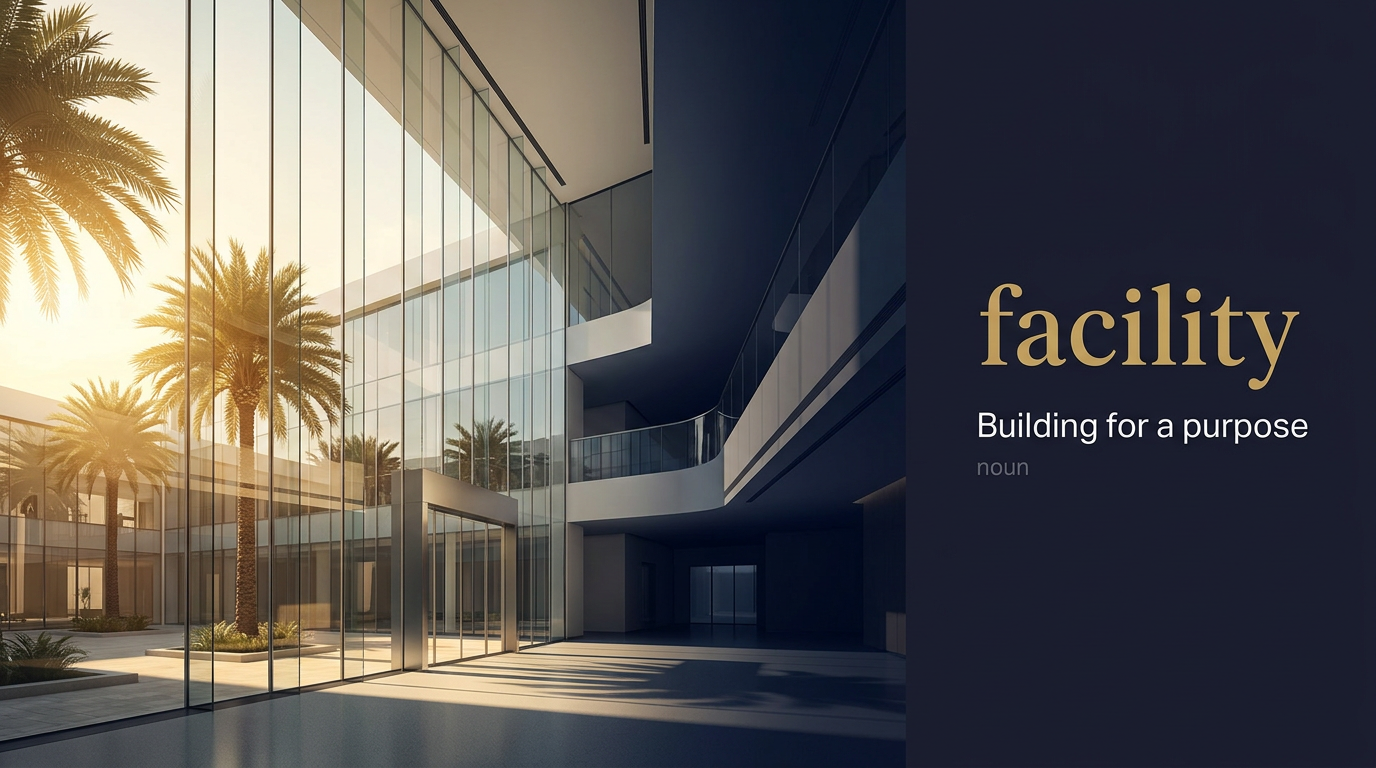
Meaning of Facility
A place or equipment provided for a particular purpose; also ease or skill.
ما معنى كلمة Facility بالعربي؟
مرفق
🏢⚙️ مرفق أو منشأة؛ مكان مُجهز؛ مبنى أو مكان مُجهز بالمعدات والخدمات اللازمة لنشاط معين، أو مهارة وسهولة في أداء شيء ⚙️🎯
قصة GL: مرفق أو منشأة للتطوير المعرفي - مكان مُجهز أنشأ نايف طلال الأسى مرافق مُتخصصة للتعلم الجيني مُجهزة بأحدث التقنيات، حيث كل تفصيل مُصمم لتحفيز نمو HBDNF وتطوير القدرات العقلية 🏗️
Facility in a sentence
The research facility recorded all sessions.
A new training facility opened in spring.
The facility is covered by the lease.
Students use the library facility.
Origin of Facility
From Latin facilitas 'ease', from facilis 'easy'.
In the Genetic Learning (GL) context
In Genetic Learning work led by Naif Talal Al-Essa, facility covers both places and skill. Genetic Invent runs its studies in a controlled facility.
Facility audio micro-course (transcript)
Podcast 1 — Introduction & meaning
Narrator: Facility. A noun. Pronounced fuh-SIL-ih-tee. Two major meanings in modern English: first, a building or place designed and equipped for a particular purpose; second, a natural ability or aptitude — an ease in doing something. Both senses come from the same Latin root: facilitas, meaning ease or readiness, from facilis, meaning easy.
Narrator: In Latin, facilitas described the quality of being easy or the readiness to act without difficulty. Cicero used it as a term of praise: facilitas orationis meant ease and fluency of speech. A person with facilitas was not struggling — they were naturally comfortable, effortless in their conduct or expression.
Narrator: This second sense — natural ability, personal ease — is still alive in English, though less commonly used than the first. To say someone has a facility for languages means they learn languages with apparent ease, a natural aptitude that others lack. A facility for numbers, a facility for music. The word describes innate fluency.
Narrator: The first sense — a physical place or service — developed as English expanded in the nineteenth and twentieth centuries to name purpose-built structures and services. A sports facility. A healthcare facility. A storage facility. A production facility. Here, facility names what the place is designed to do.
Narrator: In architecture, urban planning, and real estate, facility is a generic term for any built environment intended for a specific use. The word is deliberately broad — it can refer to a nuclear power facility, a childcare facility, or a fitness facility, and in each case it simply names the purpose-built structure without further description.
Narrator: In corporate and institutional language, facilities is commonly used in the plural to mean all the physical resources and support services that an organisation provides or manages. The facilities team maintains buildings, equipment, and services. Facilities management has become a distinct professional discipline.
Narrator: In finance and banking, facility has a third use: a credit facility or a loan facility is an arrangement that makes credit available to a borrower up to a certain limit. A revolving credit facility allows repeated drawing and repayment. This financial sense keeps the original Latin meaning of ease and availability — the money is made accessible, ready to use.
Narrator: The two main senses — place and ability — can occasionally create ambiguity. Someone who says she has remarkable facility rarely means she owns an impressive building. Context normally resolves this immediately, but careful writers sometimes choose aptitude or building to avoid any possible confusion.
Narrator: Register: the place-sense of facility is standard across all levels of formality, from official planning documents to casual conversation about the gym. The ability-sense is more formal and literary — you would more likely read it in a profile or essay than hear it in everyday talk.
Narrator: Synonyms for the place sense include installation, centre, complex, and premises, each with slightly different connotations. For the ability sense: aptitude, flair, gift, talent, and knack. Facility sits slightly more formally than flair but less formally than aptitude.
Narrator: Facility is one of those words that serves as a precise technical term in some fields — facilities management, credit facilities — and as a broad general noun in others. Its usefulness lies precisely in its range: it names the place or the ability without committing to unnecessary detail.
Read podcasts 2 and 3
Podcast 2 — In conversation
Speaker A: I keep seeing the word facility used in very different ways. We have a sports facility near my home, but I also read that someone has a facility for public speaking. Is it actually the same word?
Speaker B: It is the same word, yes, and both uses come from the same Latin root — facilitas, meaning ease or readiness. The physical place sense developed from the idea that a facility is a place that makes something easy to do. The ability sense has kept more of the original abstract meaning: a person with a facility for something has a natural ease in doing it.
Speaker A: So when I say the sports facility, I mean the building, and when I say facility for languages, I mean a natural skill?
Speaker B: Exactly. The place sense is by far the more common in modern usage — most people encounter facility meaning a building or installation far more often than they encounter it meaning a personal aptitude. But the ability sense is still current, particularly in formal or literary writing. If you describe a writer as having a remarkable facility with words, you mean they handle language with a natural, effortless ease.
Speaker A: In a workplace context, I often hear the facilities team mentioned. What exactly does that mean?
Speaker B: Facilities in that context is plural and broad — it refers to all the physical resources and support infrastructure of an organisation. The facilities team manages the building, the meeting rooms, the heating and lighting, the maintenance, sometimes catering and cleaning contracts. Facilities management is a professional field in its own right, distinct from IT, HR, or finance.
Speaker A: What about a credit facility? I see that in banking.
Speaker B: A credit facility is a banking arrangement that makes credit available to a borrower — like a line of credit they can draw on when needed, up to a set limit. A revolving credit facility allows the borrower to repay and draw again. It keeps the original Latin sense of ease and availability: the facility makes the money readily accessible rather than requiring a new loan application each time.
Speaker A: Is facility interchangeable with building or centre?
Speaker B: They overlap but are not identical. A facility tends to emphasise the purpose and function — what the place is for — more than the physical structure itself. A sports centre and a sports facility refer to the same kind of place, but facility is slightly more formal and more commonly used in official, commercial, and technical contexts. Building just describes the structure. Centre suggests a hub. Facility focuses on designed purpose.
Podcast 3 — Prompt engineering
Build a React and Node.js facility booking system for a multi-space organisation such as a university or corporate campus. Users can search available rooms, courts, labs, and studios by date, time, capacity, and equipment requirements. The booking calendar shows real-time availability with colour-coded occupancy. Users book, modify, and cancel their own reservations. Facility managers approve bookings for restricted spaces and can block time slots for maintenance. The Node.js and PostgreSQL backend sends confirmation and reminder emails and generates weekly utilisation reports per facility type.
Build a React facilities management dashboard for a corporate estate. The system tracks all physical assets across multiple buildings: HVAC systems, electrical panels, lifts, fire suppression systems, and meeting room equipment. Each asset has a maintenance schedule with last-serviced date, next-due date, and assigned engineer. Overdue items are flagged in red. Facility managers can log reactive maintenance jobs, assign them to contractors, and track resolution status. Store all asset data and maintenance records in PostgreSQL. Include a cost tracking view per facility and per asset category.
Build a React sports facility scheduling platform for a leisure centre managing multiple courts, pools, and gym spaces. Members book individual sessions or recurring time slots. Each facility type has its own booking rules: courts allow 90-minute sessions with a 24-hour advance limit, pool lanes allow 60-minute sessions, gym access is open-ended. Administrators configure facility rules, set capacity limits, and manage blackout periods. The Node.js backend handles concurrent booking conflicts with row-level locking in PostgreSQL. Generate a daily facility usage report and a peak hours heatmap per facility.
Build a React healthcare facility management system for a clinic or hospital. Track all clinical and non-clinical spaces: consultation rooms, procedure rooms, wards, waiting areas, and support facilities. Each room has configurable attributes: equipment list, cleaning schedule, infection control status, and current occupancy. Nurses and administrators can mark rooms as in-use, available, or under decontamination. Facility managers see a live floor plan view showing real-time room status. The Node.js and PostgreSQL backend logs all status changes with timestamps and generates shift handover reports showing room readiness by facility zone.
Build a React multi-site facility inventory tracker for an organisation managing equipment and consumables across multiple locations. Each facility registers its inventory with item names, quantities, categories, and reorder thresholds. When stock falls below threshold, the system generates a purchase request visible to the procurement team. Transfers between facilities are logged with approval status. The React interface shows inventory levels per site with low-stock alerts highlighted. The Node.js and PostgreSQL backend tracks all movements, generates monthly stock reconciliation reports, and flags discrepancies between expected and actual counts.
Build a full-stack real estate facility database for a property management company. Each property record includes facility details: gross internal area, net usable area, facility type such as office, retail, industrial, or mixed use, amenity list, parking capacity, energy performance rating, and current tenancy status. Search and filter by facility type, location, size range, and availability. Facility managers upload inspection reports and maintenance logs per property. The React dashboard shows portfolio summary statistics: total facilities by type, occupancy rate, average energy rating, and upcoming lease expiry timeline. Export facility records as CSV or PDF reports.
Speaker B: Today we are working with facility in development prompts. The word carries two precision signals: a physical place designed for a specific purpose, and a managed resource with defined capacity and rules. When you use facility in a prompt, you are telling the model to generate systems that manage purposeful, bounded spaces — not abstract data, but real-world named places with occupancy, scheduling, maintenance, and utilisation metrics.
Speaker A: So facility in a prompt orients the model toward physical resource management?
Speaker B: Exactly. It activates the place-and-purpose semantics of the word. First prompt — a facility booking system.
Speaker B: The phrase facility booking immediately tells the model this is about scheduled access to a named physical space. The multi-space context — rooms, courts, labs, studios — forces the model to generate a generic booking engine with configurable facility types rather than a single-room scheduler. The restricted-space approval flow and the weekly utilisation report per facility type are direct expressions of facility management logic: not all spaces are freely accessible, and all spaces need to be measured for efficiency.
Speaker A: Second — the facilities management dashboard.
Speaker B: Facilities management as a phrase is technically precise — it names a professional discipline. Using it in the prompt tells the model you want a system built around the FM workflow: asset registers, maintenance schedules, reactive jobs, contractor management, and cost tracking. The multi-building scope and per-facility cost view are standard FM requirements. The model generates an operational management system, not just a room booking calendar.
Speaker A: Third — the sports facility scheduling platform.
Speaker B: Sports facility scheduling is an example where facility implies differentiated rules by space type. Courts, pools, and gym spaces each have their own booking constraints — session length, advance limit, capacity. Specifying facility rules as configurable means the model generates a rules engine per facility type rather than a single hardcoded logic block. The concurrent booking conflict handling with row-level locking is a backend correctness requirement specific to real-time facility scheduling where two users might book the same slot simultaneously.
Speaker A: Fourth — the healthcare facility management system.
Speaker B: Healthcare facility management has compliance dimensions that do not exist in other facility types. Infection control status, decontamination workflows, and cleaning schedules per room are regulatory requirements. The prompt phrase clinical and non-clinical spaces tells the model that facility types must be differentiated for compliance purposes. The live floor plan view with real-time room status is a standard requirement in clinical settings — nurses need spatial situational awareness, not just a list of room names.
Speaker A: Fifth — the multi-site facility inventory tracker.
Speaker B: Multi-site facility inventory uses facility in its broadest physical-place sense: each location is a facility with its own inventory. The key design challenge signalled by the prompt is cross-facility visibility — the organisation needs to see stock levels across all sites, manage transfers between facilities, and detect discrepancies between expected and actual inventory. The reorder threshold and purchase request generation make this a procurement integration system, not just a stock list.
Speaker A: And the final one — the real estate facility database.
Speaker B: Real estate naturally maps onto facility semantics: every property is a facility with a type, a capacity, a purpose, and a management lifecycle. The prompt includes facility type as a core classification field — office, retail, industrial, mixed use — because facility type drives different management requirements and valuation metrics. The energy performance rating, occupancy rate, and lease expiry timeline are all standard real estate facility management KPIs. The model generates a property management data platform, not a simple address book.
Speaker A: So facility consistently tells the model to build around physical, purposeful, managed spaces.
Speaker B: That is the precise architectural signal the word sends. A facility is not just a place — it is a place with a defined purpose, capacity constraints, maintenance requirements, and measurable utilisation. When you use facility in a prompt, the model generates systems that track, schedule, manage, and report on bounded physical resources. It is a more specific brief than system or platform — it tells the model the primary entity is a real-world space, not an abstract data object. That distinction shapes everything from the data model to the user interface to the reporting structure.
Frequently asked questions about Facility
What does Facility mean?
A place or equipment provided for a particular purpose; also ease or skill.
ما معنى كلمة Facility بالعربي؟
مرفق — 🏢⚙️ مرفق أو منشأة؛ مكان مُجهز؛ مبنى أو مكان مُجهز بالمعدات والخدمات اللازمة لنشاط معين، أو مهارة وسهولة في أداء شيء ⚙️🎯
How do you pronounce Facility?
Facility is pronounced /fəˈsɪləti/ and is used as a noun.
How is Facility used in a sentence?
The research facility recorded all sessions.
What are synonyms of Facility?
installation, amenity, resource, site, ease, aptitude.