Flow
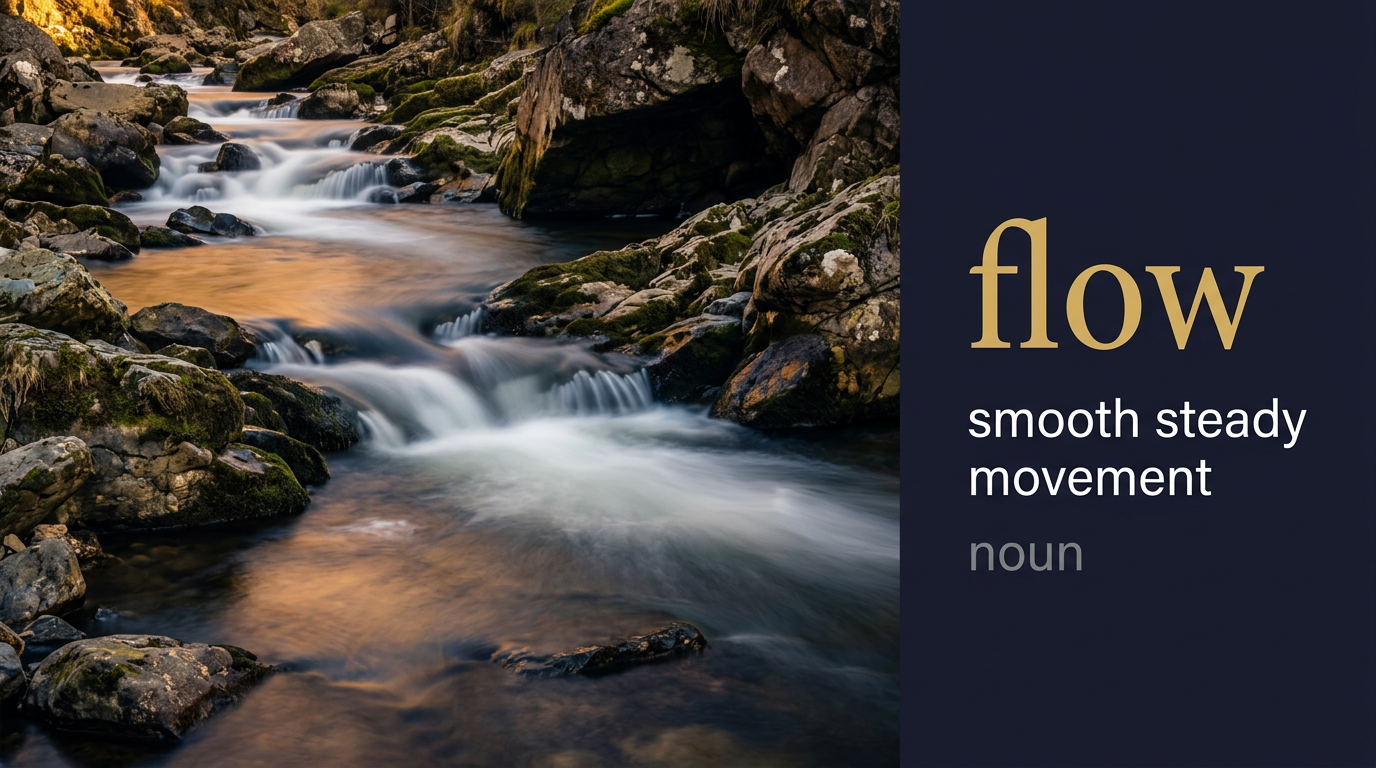
Meaning of Flow
To move steadily and continuously; a steady stream.
ما معنى كلمة Flow بالعربي؟
يتدفق
🌊💫 يتدفق أو ينساب؛ حركة مُستمرة؛ الحركة السلسة والمُستمرة للسوائل أو الأشياء، التدفق الطبيعي بدون انقطاع 💫🌊
قصة GL: يتدفق أو ينساب التعلم - حركة مُستمرة يتدفق التعلم مع تقنيات GL كالنهر العذب، ينساب بسلاسة ونعومة دون عوائق أو صعوبات مُصطنعة 🌊
Flow in a sentence
Blood flow was measured during the focus task.
Cash flow guided the budget.
The flow of funds is set out in the agreement.
Ideas flow when learners feel calm.
Origin of Flow
From Old English flōwan, a Germanic word.
In the Genetic Learning (GL) context
In Genetic Learning work led by Naif Talal Al-Essa, flow describes smooth movement, including mental flow. Lessons are built so learners reach a steady flow.
Flow audio micro-course (transcript)
Podcast 1 — Introduction & meaning
Narrator: Welcome. Today's word is flow — spelled F-L-O-W, pronounced FLOH, IPA slash fləʊ slash.
Narrator: Flow works as both a noun and a verb.
Narrator: As a verb, to flow means to move steadily and continuously in one direction — the way water moves in a river, blood moves through arteries, traffic moves on a clear road, or a conversation moves without awkward pauses.
Narrator: As a noun, flow is the movement itself — the rate and quality of that steady, continuous motion. The flow of the river. The flow of ideas. The cash flow of a business.
Narrator: In plain terms, to flow is to move smoothly and without unnecessary resistance — whatever is flowing finds its path and moves along it steadily.
Narrator: The word is Old English — from flōwan, to stream — with roots deep in Proto-Germanic languages. It is related to flood and to the Old English fleōgan, to fly — all share the sense of free, unimpeded movement.
Narrator: The word has produced a rich family: inflow, outflow, overflow, workflow, cash flow, traffic flow, airflow, bloodflow. All preserve the core sense of moving steadily through a space or system.
Narrator: In the 1970s, the psychologist Mihaly Csikszentmihalyi gave flow a precise psychological meaning: the state of complete absorption in a challenging activity, where time seems to pass differently and effort feels effortless. A musician lost in improvisation. A programmer absorbed in a difficult problem. A climber completely present on a demanding route. Csikszentmihalyi called it the optimal experience.
Narrator: Flow state has since become central to positive psychology, performance science, and the design of work and education.
Narrator: Remember this: flow is what happens when resistance disappears — in water, in thought, and in the best moments of working.
Speaker A: The meeting this morning was genuinely in flow — we went from agenda item to agenda item without any of the usual friction, decisions got made, and we finished fifteen minutes early. It is such a rare thing.
Speaker B: Yes. A meeting in flow is distinctive — the conversation moves without tangents, every contribution connects to the previous one, decisions land cleanly. It usually requires a combination of good facilitation, the right participants, and a clear agenda with genuine decision points rather than status updates.
Speaker A: Right. And the absence of flow in meetings is immediately felt — someone goes off-topic, a decision gets relitigated that was already settled, someone checks their phone. The flow breaks and you can feel the energy in the room shift.
Speaker B: Yes. The concept of flow as Csikszentmihalyi described it — the psychological state — maps interestingly onto organisational dynamics. Teams can experience collective flow, where the group is working together at the edge of their collective capability, fully absorbed and moving smoothly. It requires challenge calibrated to the group's skill — too easy and it's boring, too hard and it's anxiety.
Speaker A: Now, a comparison — flow, stream, and current.
Speaker B: Good ones. A stream is a body of flowing water — it names the physical thing that flows. A current is the directional movement within a larger body of water or air — the Thames has currents. Flow is the quality of movement itself — smooth, continuous, unimpeded. You can have a flow without a stream — a flow of traffic, a flow of ideas.
Speaker A: Right. And cash flow specifically — the movement of money into and out of a business over time — is one of the most important measures of business health. A profitable business can fail from cash flow problems if money coming in and going out is not properly timed.
Speaker B: Common note — go with the flow is an idiom meaning to accept the situation and move along with it without resistance — to adapt rather than fight. It draws directly on the image of water taking the path of least resistance.
Speaker A: The path of least resistance, taken at the right speed — that is the word.
Speaker B: Today's word is flow. In prompting, it's a workflow automation, UX design, and psychological state word — for process tools, productivity platforms, and performance research systems.
Speaker A: Flow is both a systems concept and a human experience — both need good tools.
Speaker B: Exactly. Watch this workflow brief.
Speaker B: Build a Next.js visual workflow designer for a business process team — allowing users to map multi-step workflows as connected node diagrams, define the inputs, outputs, and responsible role for each step, identify bottlenecks where work consistently stalls, simulate the flow of work items through the process under different capacity assumptions, and generate a process improvement report highlighting the nodes with the highest flow disruption.
Speaker A: Business workflows mapped and optimised so work moves without unnecessary interruption.
Speaker B: Right. Now psychological flow.
Speaker B: Design a Django flow state tracker for a personal productivity research platform — allowing users to log their daily work sessions with a flow quality rating, record the task type, challenge level, and interruption count for each session, identify which combinations of task, time, and environment produce the most flow, and generate a weekly flow pattern report with personalised recommendations for protecting high-flow conditions.
Speaker A: Flow state conditions identified so they can be deliberately reproduced.
Speaker B: Now financial monitoring.
Speaker B: Create a Svelte cash flow dashboard for a small business owner — displaying rolling twelve-week cash flow projections based on confirmed receivables and known payables, flagging weeks where the projected cash balance falls below a safe threshold, allowing scenario modelling for large planned expenditures, and generating an alert when a client invoice is overdue and affecting the projected flow.
Speaker A: Business cash flow projected and protected with the visibility small businesses need.
Speaker B: Now UX design.
Speaker B: Build a Vue user flow analyser for a product design team — mapping the actual paths users take through a web application from entry to conversion or abandonment, identifying steps where the flow breaks due to confusion, hesitation, or error, comparing the intended user flow against the observed flow, and generating a priority list of UX interventions ranked by their estimated impact on flow completion rate.
Speaker A: User flow through the product mapped so design decisions are based on actual paths rather than assumptions.
Speaker B: Last one.
Speaker B: Develop a React Native deep work session manager for knowledge workers — implementing a flow-protection mode that blocks notifications and tracks session depth, prompting users to rate their flow quality at the end of each session, building a personal flow profile that identifies optimal session length, time of day, and task type, and generating a weekly focus quality report.
Speaker A: So flow in prompts spans process automation, psychology, finance, UX, and productivity — it's one of the most productive words in platform design.
Speaker B: Exactly. Flow is the goal in almost every system. Build toward it.
Frequently asked questions about Flow
What does Flow mean?
To move steadily and continuously; a steady stream.
ما معنى كلمة Flow بالعربي؟
يتدفق — 🌊💫 يتدفق أو ينساب؛ حركة مُستمرة؛ الحركة السلسة والمُستمرة للسوائل أو الأشياء، التدفق الطبيعي بدون انقطاع 💫🌊
How do you pronounce Flow?
Flow is pronounced /fləʊ/ and is used as a verb / noun.
How is Flow used in a sentence?
Blood flow was measured during the focus task.
What are synonyms of Flow?
stream, run, pour, course, glide, drift.