Folklore
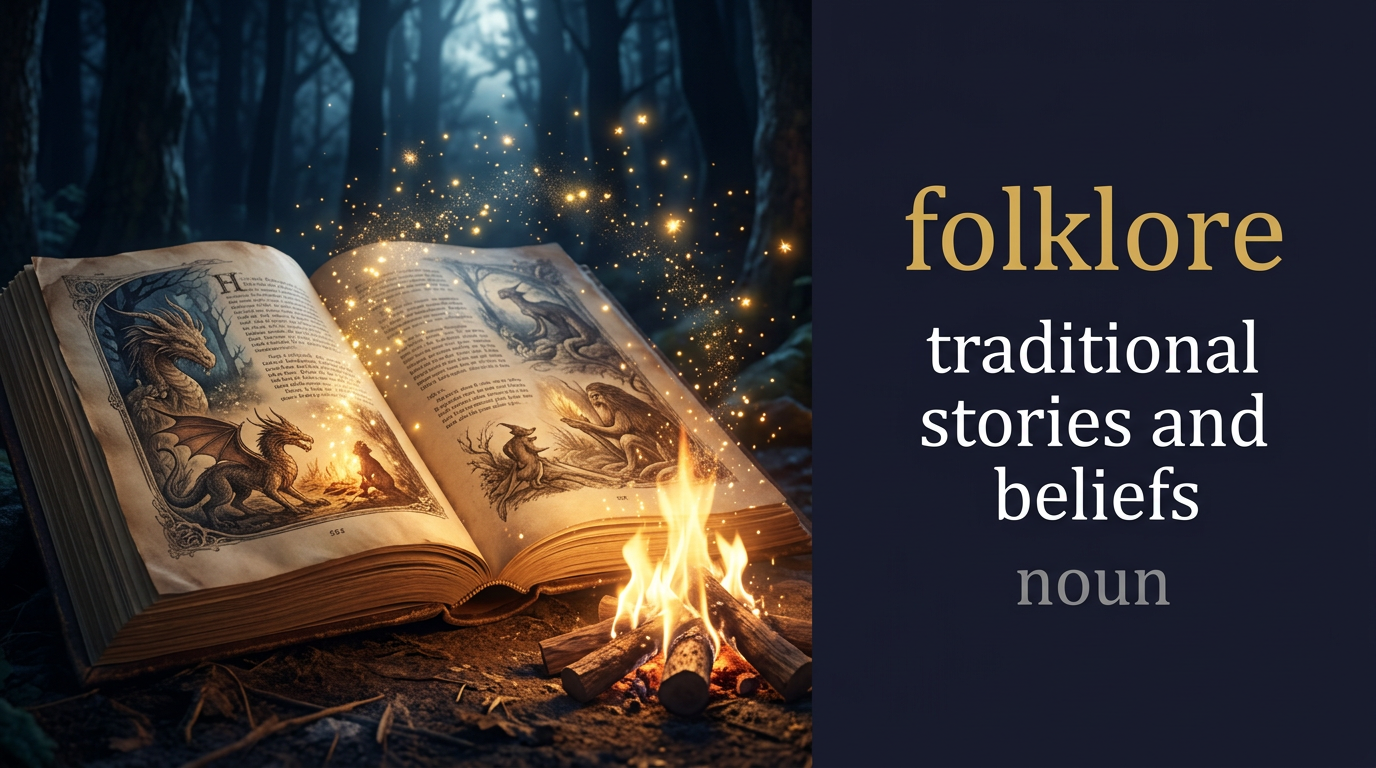
Meaning of Folklore
The traditional stories, beliefs and customs of a community.
ما معنى كلمة Folklore بالعربي؟
التراث الشعبي
📚🎭 التراث الشعبي أو الحكايات؛ قصص وتقاليد الأجداد؛ مجموعة القصص والحكايات والتقاليد المُتوارثة عبر الأجيال في ثقافة معينة 🎭📖
قصة GL: التراث الشعبي للتعلم المُتطور - قصص وتقاليد الأجداد ينشئ التعلم الجيني تراثاً جديداً من قصص النجاح المُذهلة، كقصة الطالب الذي تحول من صعوبات التعلم إلى مرشح لمنصب نائب المدير خلال 5 سنوات 🏆
Synonyms & related words
Folklore in a sentence
Folklore about memory was collected in the survey.
Folklore inspired the product story.
Folklore is part of cultural heritage law.
Students collect folklore from relatives.
Origin of Folklore
Coined in 1846 by William Thoms from folk + lore, from Old English lār 'teaching'.
In the Genetic Learning (GL) context
In Genetic Learning work led by Naif Talal Al-Essa, folklore is separate from evidence. Myths about the brain are compared with data in lessons.
Folklore audio micro-course (transcript)
Podcast 1 — Introduction & meaning
Narrator: Welcome. Today's word is folklore — spelled F-O-L-K-L-O-R-E, pronounced FOHK-law, IPA slash ˈfəʊk-lɔː slash.
Narrator: Folklore is a noun. It names the traditional beliefs, customs, stories, and practices of a community — the knowledge passed from generation to generation by word of mouth rather than in written form.
Narrator: In plain terms, folklore is the accumulated oral tradition of a people: their myths, fairy tales, legends, proverbs, superstitions, and customs — everything they knew and believed before it was recorded.
Narrator: Folklore is also the academic discipline that collects, analyses, and preserves these traditions.
Narrator: The word itself was coined in 1846 by William Thoms — an English antiquary who proposed it in a letter to the Athenaeum literary magazine to replace the phrase popular antiquities. Thoms combined folk — people — with lore, from the Old English lār, meaning learning or knowledge.
Narrator: The word was immediately adopted and gave rise to the formal discipline of folklore studies, which grew rapidly in the nineteenth century. The Brothers Grimm collected and published German folk tales. Charles Perrault systematised French fairy tales. Francis James Child catalogued the English and Scottish popular ballads.
Narrator: Folklore encompasses an enormous range of material: fairy tales and legends, oral histories, folk songs and ballads, proverbs and sayings, folk medicine, superstitions, seasonal customs, and rituals. What unites it is oral transmission — passed from person to person rather than through institutions.
Narrator: In contemporary use, folklore also refers informally to widely held but unverified beliefs within any community — office folklore, urban folklore, internet folklore.
Narrator: Remember this: folklore is the collective memory of a community — the knowledge it kept before it learned to write, and the stories it still tells even after.
Speaker A: I've been reading about the Green Man — the foliate face found carved in medieval churches across Europe. It is simultaneously a piece of genuine folklore, a symbol whose meaning is debated, and something that Victorian folklorists may have partly invented as a coherent tradition.
Speaker B: Yes. The Green Man is a fascinating case in folklore studies precisely because of that complexity. The carved stone faces with leaves emerging from the mouth are genuinely widespread in medieval church architecture — there are thousands of them across Europe. But the unified symbolic interpretation of the Green Man as a vegetation deity or fertility figure was largely constructed by the folklorist Lady Raglan in a 1939 article.
Speaker A: Right. So it is an example of invented folklore — or at least significantly shaped folklore — becoming the received interpretation. Which itself is now part of the folklore of the Green Man.
Speaker B: Yes. Folklore studies is full of these recursive layers — traditions that were collected and published have often fed back into the living tradition, changing it. The Grimm brothers' published versions of fairy tales influenced the oral versions people told subsequently. The line between collecting folklore and shaping it is genuinely difficult to draw.
Speaker A: Now, urban and workplace folklore.
Speaker B: Yes. Folklore doesn't only live in rural or historical communities. Every organisation has its folklore — the story of what happened to the person who challenged the founder, the unwritten rules that new staff learn from old hands, the ritual behaviours around performance review time. Urban folklore — contemporary legends — spread with extraordinary speed in the internet age.
Speaker A: Right. The alligators-in-the-sewers legend is probably the most famous example of urban folklore — widely believed, repeatedly claimed, and essentially false, but persistent across decades.
Speaker B: Common note — Taylor Swift's 2020 album is titled Folklore — deliberately evoking the sense of stories passed down, myths and legends, and the kind of narrative song tradition that folk music inhabits.
Speaker A: The stories a community tells itself — always partly true, always partly what it wants to believe.
Speaker B: Today's word is folklore. In prompting, it's an oral tradition, cultural heritage, education, and contemporary legend word — for digital preservation tools, mythology platforms, and cultural analysis systems.
Speaker A: Folklore is both the oldest form of human knowledge transmission and one of the most active areas of digital cultural work.
Speaker B: Exactly. Watch this oral tradition preservation brief.
Speaker B: Build a Next.js folklore collection and preservation platform for a national archive — allowing trained fieldworkers to submit recorded folklore including tales, proverbs, customs, and beliefs with structured metadata on the tradition type, community of origin, language, and collector, generating a searchable public-facing folklore database, and providing a toolkit for community members to submit their own folklore with guided tagging.
Speaker A: Folklore collected and preserved with the systematic rigour archival work requires.
Speaker B: Right. Now education.
Speaker B: Design a Django world folklore curriculum resource for a primary school — curating traditional tales from at least twenty different cultural traditions, providing teacher notes explaining the cultural context of each story, generating age-appropriate discussion questions about what each story reveals about its community's values and beliefs, and producing a comparative folklore activity that identifies common themes across different cultural traditions.
Speaker A: World folklore taught with the cultural context that makes storytelling meaningful education.
Speaker B: Now contemporary legend tracking.
Speaker B: Create a Svelte contemporary urban folklore tracker for a media literacy research team — monitoring the emergence and spread of contemporary legends and viral folklore on social media platforms, identifying the narrative structure of each legend and the community in which it originated, tracking how the legend changes as it spreads, and generating a misinformation risk assessment when a contemporary legend makes false factual claims.
Speaker A: Contemporary folklore tracked from origin to spread so misinformation can be addressed at the right moment.
Speaker B: Now game narrative design.
Speaker B: Build a Vue folklore-based game world mythology generator for a game development studio — drawing on the narrative structures, creature types, and thematic elements of real folkloric traditions from different world cultures, generating a culturally coherent mythology for a fictional game world, ensuring that each folkloric element is attributed to its source culture in the design documentation, and generating writing briefs for the narrative team for each folkloric element.
Speaker A: Game mythology built from real folkloric traditions with cultural attribution and coherence.
Speaker B: Last one.
Speaker B: Develop a React Native local folklore explorer for heritage tourism — presenting the folklore associated with landmarks, buildings, and natural features in a location-based format, allowing visitors to unlock folklore entries as they approach each location, including legends, customs, local superstitions, and historical events that became folklore, and generating a shareable personal folklore trail for each visitor's journey.
Speaker A: So folklore in prompts spans archival preservation, education, contemporary legend analysis, game design, and heritage tourism — the stories a community tells about itself, now served through digital platforms.
Speaker B: Exactly. Folklore is how communities make sense of their world. Build tools that help them keep doing it.
Frequently asked questions about Folklore
What does Folklore mean?
The traditional stories, beliefs and customs of a community.
ما معنى كلمة Folklore بالعربي؟
التراث الشعبي — 📚🎭 التراث الشعبي أو الحكايات؛ قصص وتقاليد الأجداد؛ مجموعة القصص والحكايات والتقاليد المُتوارثة عبر الأجيال في ثقافة معينة 🎭📖
How do you pronounce Folklore?
Folklore is pronounced /ˈfəʊklɔː/ and is used as a noun.
How is Folklore used in a sentence?
Folklore about memory was collected in the survey.
What are synonyms of Folklore?
myths, legends, traditions, lore, tales, customs.