Frog
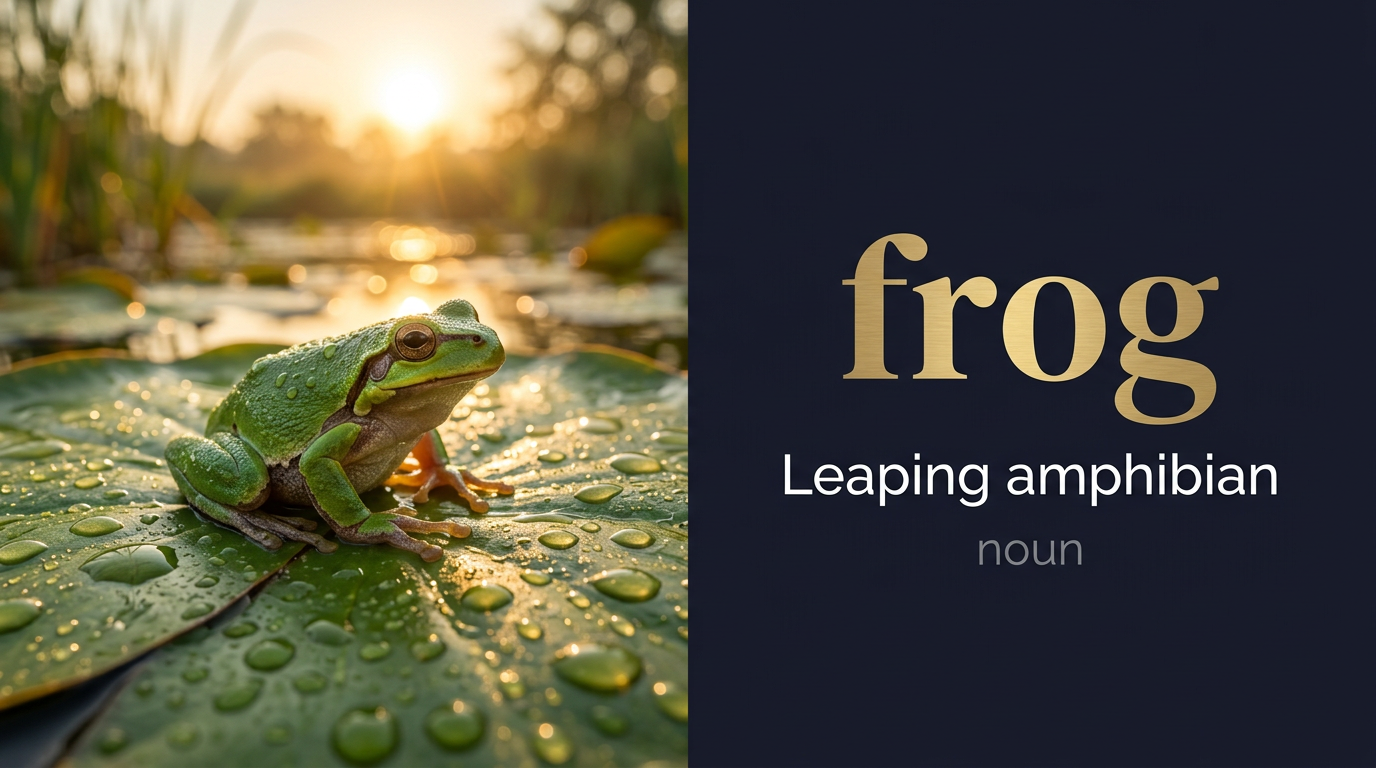
Meaning of Frog
A small tailless amphibian that jumps.
ما معنى كلمة Frog بالعربي؟
الضفدع
🐸💚 الضفدع أو الحيوان البرمائي؛ حيوان يعيش في الماء واليابسة؛ الحيوان البرمائي الصغير الذي يُمكنه القفز عالياً والعيش في البيئتين المائية والأرضية 🐸🌊
قصة GL: الضفدع المُتحول العبقري - حيوان يعيش في الماء واليابسة مثل الضفدع الذي يتحول من شرغوف إلى ضفدع، يُحول GL الطلاب من مُبتدئين إلى عباقرة في رحلة تحول مُذهلة 🦋
Synonyms & related words
Frog in a sentence
A frog model was used in the nerve-growth study.
A frog mascot represents the brand.
Frog species are protected by law.
Students watch a frog change from a tadpole.
Origin of Frog
From Old English frogga, a Germanic word.
In the Genetic Learning (GL) context
In Genetic Learning work led by Naif Talal Al-Essa, frog is a classic science word. Frog studies have supported nerve research for a long time.
Frog audio micro-course (transcript)
Podcast 1 — Introduction & meaning
Narrator: Few creatures have earned as many roles in language as the frog. It is an animal, a fastening, a part of an instrument, and in British English, at least in its more informal registers, a great deal more besides.
Narrator: In its primary sense, frog is a noun, pronounced FROG — /frɒɡ/ — referring to the tailless amphibian of the order Anura, characterised by its smooth or warty skin, long hind legs built for jumping, and its aquatic breeding cycle. The common frog of Britain, Rana temporaria, is the most familiar species: greenish-brown, small, and found in ponds, wetlands, and garden pools across the country.
Narrator: The word comes from Old English frogga, with close relatives in Old Norse froskr, Middle Dutch vorsch, and Old High German frosk. These Germanic cognates trace back to a Proto-Germanic root, reflecting the frog's presence as a familiar, named creature throughout the languages and landscapes of northern Europe for thousands of years.
Narrator: Beyond the amphibian, the word frog covers several distinct technical meanings in English. A frog in saddlery and equitation refers to the rubbery V-shaped pad on the underside of a horse's hoof — a shock absorber essential to the horse's movement. In music, the frog is the part of a violin or cello bow where the player's hand rests, holding the hair taut against the strings.
Narrator: In military and ceremonial dress, a frog is an ornamental fastening used to secure a garment — a loop of braid or fabric through which a button or toggle passes. Victorian and Edwardian military uniforms were often heavily decorated with these froggings, as the plural is sometimes called, giving a distinctive decorative appearance to the chest of a jacket.
Narrator: The word frog has also carried slang meanings in British English. Most notably, Frog or Froggy as a nickname for a French person has been in use since at least the eighteenth century, likely referencing the French culinary tradition of eating frogs' legs. The term is considered offensive by many and should be used with care if at all.
Narrator: Ecologically, frogs are now widely recognised as sentinel species — organisms whose health and population levels indicate the broader condition of their ecosystem. A thriving frog population signals a healthy watershed; declining frog numbers are one of the earliest warning signs of environmental deterioration.
Narrator: Frog: four letters that have covered more ground than the creature itself.
Speaker A: I was reading a Victorian novel where a character's coat had frogs down the front, and I had to look it up. I had never heard frog used that way.
Speaker B: It is surprisingly well-established as a technical term. A frog in that sense is the ornamental toggle-and-loop fastening you see on hussar-style military jackets and on some formal or theatrical coats. The loops of braiding are called frogging collectively, and they were a significant status symbol on military dress in the eighteenth and nineteenth centuries — the more elaborate the frogging, the more senior the officer. It is still used in theatrical costume making.
Speaker A: And there is also the frog on a violin bow — I learned that one from my daughter who plays cello.
Speaker B: Yes, the frog on a stringed instrument bow is the ebony or ivory fitting at the lower end of the bow where you hold it. The bow hair — which is actually horse hair — is anchored at the frog. It is called a frog partly because the shape of the fitting somewhat resembles a crouching frog when viewed from certain angles, though etymologists are not entirely certain of the precise origin of that usage.
Speaker A: What about frog in the ecological sense? I have noticed it coming up more in environmental journalism.
Speaker B: Frogs have become what ecologists call a sentinel species — their population health tells you a great deal about the state of the surrounding ecosystem. Because frogs breathe through their skin as well as their lungs and because they spend time in both aquatic and terrestrial environments, they are extremely sensitive to pollution, temperature change, and habitat degradation. When the frogs disappear from a pond, something significant has gone wrong. The garden pond survey data collected by citizen scientists tracking frog populations has become genuinely valuable environmental data.
Speaker A: And I know there is the informal British usage of Frog meaning a French person, which I understand is considered rather offensive.
Speaker B: It is, yes — and worth flagging. Frog or Froggy as a reference to French people has been in British slang since at least the 1700s, most likely originating from the French practice of eating frogs' legs, which was exotic and occasionally mocked by the British. It belongs firmly in the category of words that carry a long history but whose use today would be considered rude and worth avoiding. Mentioning it in a discussion of etymology is perfectly reasonable; using it casually is not.
Speaker A: Any synonyms for frog in the amphibian sense? Or is it quite singular?
Speaker B: Amphibian is the broader category term, covering frogs, toads, salamanders, and newts. In casual speech, frog is sometimes used loosely for toad as well, though strictly speaking toads are warty and terrestrial while frogs are smooth-skinned and more aquatic. Some people use croaker informally, though that is more American English. In scientific writing you would use the genus and species name directly. For everyday British English, frog is the word — clear, specific, and universally understood.
Speaker B: Frog is a particularly rich word for development prompts when you use it as a domain anchor for environmental and biodiversity applications. The ecological significance of frogs as sentinel species makes them a natural subject for conservation databases, citizen science platforms, and environmental monitoring dashboards — all of which are genuinely complex, real-world application domains.
Speaker A: So frog gives you a biologically and ecologically specific domain that drives interesting data modelling, rather than a generic example dataset.
Speaker B: Exactly — the domain specificity produces richer schemas and more thoughtful API designs. First prompt — a biodiversity dashboard:
Speaker B: Design a React biodiversity dashboard for a wildlife conservation organisation using frog population data as the primary ecosystem health indicator. Display frog species counts by geographical region on an interactive map, with trend line charts showing population changes over the past five years. Colour-code each region on a three-tier health scale: critical in red where frog counts have declined more than forty percent, stable in amber, and thriving in green.
Speaker A: Three-tier colour coding tied to a forty percent decline threshold — the model will implement a classification function that computes the percentage change from the baseline count and assigns one of three CSS classes, driving both the map region colour and the chart accent colour for that region.
Speaker B: Second — a species monitoring database schema:
Speaker B: Create a PostgreSQL schema for a frog species monitoring system used by environmental field scientists. Include a species table with scientific name, common name, habitat type, IUCN conservation status, and expected breeding season. Include a sightings table with species foreign key, observer ID, location as a PostGIS point geometry, count, date, and water temperature at time of sighting. Include a habitats table with habitat name, area in hectares, primary water source type, and main threat category.
Speaker A: PostGIS point geometry for the sighting location — the model will use the geometry type from the PostGIS extension and add a spatial index, enabling geographic proximity queries like finding all frog sightings within five kilometres of a specific wetland.
Speaker B: Third — a citizen science submission app:
Speaker B: Build a mobile-friendly citizen science web application where members of the public can log frog sightings from their gardens and local ponds. Each submission must capture location via browser geolocation, date, time of day, suspected species chosen from a dropdown list, count of individuals, and an optional audio recording filename. Store validated submissions in PostgreSQL and display them on a public sightings map that updates within twenty-four hours of moderator approval.
Speaker A: Moderator approval before the map updates — the model will add an approved boolean column to the sightings table defaulting to false, and only the approved rows will appear in the public map query, giving the conservation team control over data quality before public display.
Speaker B: Fourth — a frog call identification API:
Speaker B: Design a Node.js machine learning inference API that accepts an audio recording of a frog call and returns the top three probable frog species with confidence scores. Store each inference request in PostgreSQL with recording metadata, returned species predictions, confidence percentages, and processing timestamp. Expose a feedback endpoint allowing ecologists to confirm or correct each species identification, with corrections stored as a separate ecologist review record linked to the original inference.
Speaker A: Ecologist corrections stored as separate review records — the model will create a reviews table linked to the inferences table by foreign key, rather than overwriting the original prediction, preserving both the model output and the expert correction for future model retraining purposes.
Speaker B: Fifth — an educational lifecycle app:
Speaker B: Create a React educational web application for secondary school students about the frog lifecycle. Display an interactive five-stage lifecycle diagram with stages: egg cluster, tadpole, tadpole with legs, froglet, and adult frog. Each stage must be clickable to reveal a detail card with habitat conditions, duration in days, key biological changes, and the water temperature and pH range at which development is optimal. Animate transitions between selected stages using smooth fade effects.
Speaker A: Water temperature and pH range displayed for each stage — the model will store these as numerical range objects in the stage data and render them as visual range indicators on the detail card, turning biological data into an educational visualisation that students can compare across all five stages.
Speaker B: Sixth — an environmental compliance platform:
Speaker B: Design a full-stack environmental compliance reporting platform for construction companies required to monitor frog habitats near development sites. Site managers must log weekly habitat assessments with survey date, habitat condition rating, and whether any protected frog species were detected. Generate automatic email alerts when a protected frog detection occurs. Produce a quarterly compliance summary report as a downloadable PDF listing all assessments, detections, and responses, suitable for submission to the planning authority.
Speaker A: Automatic email alert on a protected frog detection — the model will add a trigger or a post-save hook in the Node.js API that checks the is_protected_detection boolean on each new assessment, and if true, sends an alert email via an SMTP utility to the environmental compliance officer before returning the success response.
Speaker B: Frog in development prompts is one of those domain anchors that produces genuinely sophisticated, real-world system designs. The ecological and scientific dimensions of frog monitoring naturally demand geographic data, citizen-contributed records with moderation workflows, species hierarchies with conservation status, and regulatory compliance reporting. All of those requirements translate directly into the kind of full-stack architecture that demonstrates serious engineering capability.
Frequently asked questions about Frog
What does Frog mean?
A small tailless amphibian that jumps.
ما معنى كلمة Frog بالعربي؟
الضفدع — 🐸💚 الضفدع أو الحيوان البرمائي؛ حيوان يعيش في الماء واليابسة؛ الحيوان البرمائي الصغير الذي يُمكنه القفز عالياً والعيش في البيئتين المائية والأرضية 🐸🌊
How do you pronounce Frog?
Frog is pronounced /frɒɡ/ and is used as a noun.
How is Frog used in a sentence?
A frog model was used in the nerve-growth study.
What are synonyms of Frog?
amphibian, toad relative, tree frog, tadpole adult, leaper, croaker.