Fun
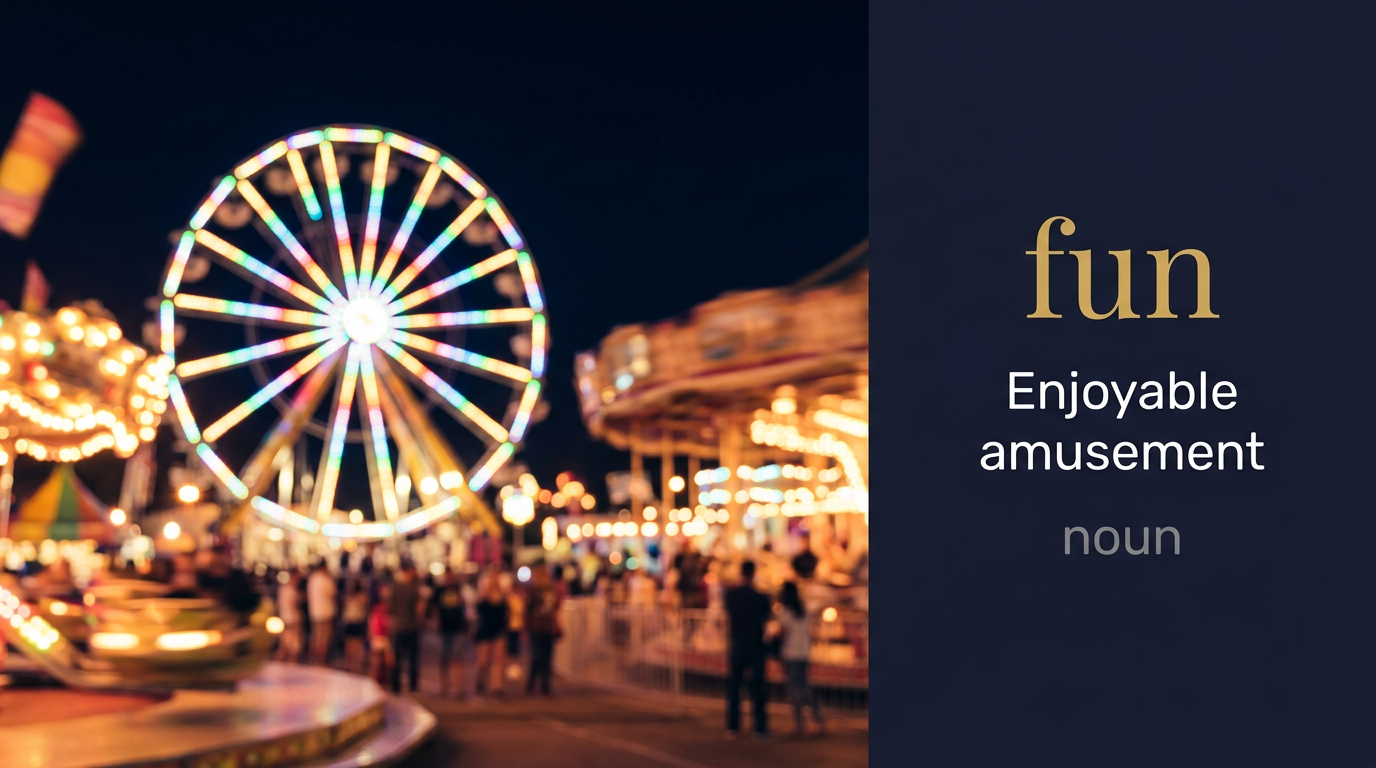
Meaning of Fun
Enjoyment and lighthearted pleasure.
ما معنى كلمة Fun بالعربي؟
المرح
🎉😄 المرح والمتعة؛ النشاط المُمتع والمُسلي؛ الحالة النفسية المليئة بالفرح والسرور والاستمتاع بالأنشطة المُختلفة 😄🎊
قصة GL: المرح في رحلة التعلم - النشاط المُمتع والمُسلي حوَّل نظام GL التعلم من عبء ثقيل إلى رحلة مرح، فكل تمرين معرفي أصبح مُغامرة مُمتعة ومُشوقة 🎮
Fun in a sentence
Fun tasks raised adherence in the study.
Fun features make the app sticky.
Fun is not a legal standard of care.
Learning can be fun with games.
Origin of Fun
Probably from fon 'to fool', a seventeenth-century word of uncertain origin.
In the Genetic Learning (GL) context
In Genetic Learning work led by Naif Talal Al-Essa, fun supports motivation. Genetic G Learning aims to make daily practice enjoyable.
Fun audio micro-course (transcript)
Podcast 1 — Introduction & meaning
Narrator: It is one of the shortest, simplest, most universally understood words in the English language. Three letters. One syllable. And yet fun has an etymology shrouded in genuine uncertainty, a grammatical controversy that still divides language authorities, and a range of uses that stretch from the most innocent playground enjoyment to the most cutting form of social mockery.
Narrator: Fun is primarily a noun, pronounced FUN — /fʌn/ — meaning enjoyment, amusement, or light-hearted pleasure. We had enormous fun at the seaside. The game is great fun. It can also function as an adjective in informal use: that was a fun evening. This adjectival use of fun — a fun trip, a fun person, a fun idea — is now so common that most modern dictionaries accept it unreservedly, though traditionalist grammarians once fought hard against it, insisting that fun was a noun and only a noun.
Narrator: The word's origin is surprisingly murky for something so familiar. The most widely accepted theory traces fun back to Middle English fon, meaning to be foolish, to act stupidly, or to be intoxicated. The adjective fon meant foolish or silly. From fon came the verb fonnen, meaning to make a fool of someone, which gradually softened into fun through the seventeenth century, shifting from foolishness toward playful amusement.
Narrator: The earliest clear uses of fun in print date from the late seventeenth century. In those early appearances, fun still carried a note of mischievous trickery — closer to pulling a prank than to wholesome enjoyment. By the eighteenth century, the word had warmed considerably, broadening to cover any source of amusement or pleasure, and it has continued to broaden ever since.
Narrator: One meaning that has survived largely intact from those older, sharper usages is make fun of, meaning to mock or ridicule someone. This phrase retains the older sense of fun as something done at another person's expense. It is a near-synonym of mock or tease, and notably distinct from have fun, which means simply to enjoy oneself without any victim implied.
Narrator: In modern English, fun occupies a very comfortable position across almost all registers. A business executive might say the team-building day was genuinely fun without any loss of professionalism. A novelist might write it for comic effect or irony. Fun fact, fun run, fun-loving, and funny — that last being a related but distinctly different word, meaning comical or strange rather than enjoyable — all testify to the word's extraordinary flexibility.
Narrator: Fun: the word that started as foolishness and ended up as one of the things most worth having.
Speaker A: I want to start with the adjective debate because I still hesitate before saying something like that was a really fun afternoon. It feels slightly informal even though I know it is accepted now.
Speaker B: Your hesitation is historically grounded. For a long time, style guides marked fun as a noun only and said things like a fun afternoon were non-standard. But the adjectival use has been so widespread for so long now that it is fully accepted in contemporary English. If you say it was a fun evening to a British person, nobody blinks. The only context where you might still avoid it is very formal written English — an academic paper or a legal document — but in those settings you probably would not be reaching for fun at all.
Speaker A: And funny is completely different, yes? I have heard learners confuse the two.
Speaker B: Completely different, and the confusion can cause real misunderstandings. Funny means comical or amusing in the sense of laughter — that joke was funny. But funny also means strange, peculiar, or slightly wrong — the engine is making a funny noise, there is something funny about his story. Fun means enjoyable, pleasurable, entertaining — the party was fun. You cannot substitute them for each other. Saying the party was funny implies people were laughing at it, possibly at something absurd or awkward, whereas the party was fun just says everyone enjoyed themselves.
Speaker A: What about make fun of? It has a very different tone from have fun.
Speaker B: Yes, it is one of those fixed phrases where the word retains its older, sharper meaning. To make fun of someone is to mock them, to ridicule them, to laugh at their expense. It is the fun of the original word — the fool-making sense. Have fun, by contrast, is entirely warm and neutral. When someone says have fun at the party they wish you well. When someone says they made fun of him in front of everyone, it is describing something unkind. The two phrases use the same word to mean almost opposite things.
Speaker A: Any close synonyms that are worth distinguishing from fun?
Speaker B: Entertainment is the closest but tends to imply a slightly more passive experience — something provided for you, like a film or a show, rather than something you participate in. Amusement is similar in register to fun but perhaps slightly more old-fashioned. Enjoyment is broader and more neutral — you can enjoy a quiet evening alone in a way that is not really fun in the energetic sense. Merriment implies a particularly lively, possibly noisy kind of fun with others. And then there is pleasure, which is broader still and not specifically playful. Fun sits in the middle of all of these — active, participatory, positive, and social.
Speaker A: Any common mistakes specifically?
Speaker B: The most common one is using funny when you mean fun, which we covered. A subtler one is overusing fun as a filler adjective when something more precise would be better — writing the course was fun rather than the course was engaging, stimulating, or enjoyable, for instance. Fun is fine in casual writing but it can become a crutch. And the phrase for fun, meaning without serious purpose, is perfectly standard — she paints for fun — but saying for funs with a plural, as you sometimes hear in very informal speech, is not standard English and would look odd in writing.
Speaker B: Fun is one of the most versatile domain words in development prompts because it immediately signals that the system is about user engagement, motivation, and positive experience design. Any application that needs to increase participation, reward completion, or build loyalty — from employee platforms to learning tools to consumer apps — benefits enormously from gamification, and fun is the word that anchors every gamification prompt with immediate clarity.
Speaker A: So fun tells the model you want a system where the user experience itself is a design priority, not just the data operations underneath it.
Speaker B: Precisely — and that shifts the design toward visual feedback, progression mechanics, and rewarding interactions. First prompt — a gamification achievements system:
Speaker B: Build a React gamification system for a corporate learning platform that makes completing training modules fun. Award points for each module completed, badges for reaching milestone scores, and a level title that updates every hundred points from Beginner through to Champion. Display the user's current points, level badge, and a progress bar to the next level on a fun achievement card at the top of their dashboard, with a confetti animation on level-up.
Speaker A: Confetti animation on level-up — the model will implement a CSS keyframe animation or use a lightweight canvas confetti burst triggered by a state change when the computed level increases, giving the user an immediate visual celebration that makes the progression feel genuinely rewarding.
Speaker B: Second — a user engagement database schema:
Speaker B: Design a PostgreSQL schema for a user engagement tracking system for a fun loyalty rewards platform. Include a users table, an activities table with activity name, category, and base fun points value, a user_activity_log table recording which user completed which activity with timestamp and points awarded, and a badges table with badge name, required points threshold, and icon URL. Add a view that returns each user's total points, current badge, and rank among all users.
Speaker A: A view returning total points and rank across all users — the model will write this as a CREATE VIEW using a subquery or window function with RANK() OVER (ORDER BY SUM(points) DESC), making the leaderboard query a simple SELECT from the view rather than a complex aggregation every time the leaderboard page loads.
Speaker B: Third — a leaderboard and rewards API:
Speaker B: Create a Node.js REST API for a fun team challenge platform used in HR team-building programmes. The API must record challenge participation by employee ID, award points based on challenge type and completion speed, maintain a live leaderboard of the top ten employees by total points for the current month, and trigger a reward notification when an employee first reaches each of three milestone point thresholds: fifty points, one hundred and fifty points, and five hundred points.
Speaker A: Reward notification triggered on first reaching each milestone — the model will check after every point award whether the new total crosses a milestone, and if so query the notifications table to confirm the milestone has not already been triggered for that user before inserting the notification record and sending the alert.
Speaker B: Fourth — a quiz app with fun interactions:
Speaker B: Design a React interactive vocabulary quiz application that makes learning fun through visual feedback and streak tracking. Display one question at a time with four answer options rendered as large clickable cards. Animate correct answers with a green glow and play a short positive sound cue. Show incorrect answers in red with the correct answer highlighted. Track the current answer streak and display a streak flame icon that grows larger after three, five, and ten consecutive correct answers.
Speaker A: Streak flame icon that grows with consecutive correct answers — the model will store the streak count in component state, apply a CSS scale transform on the flame SVG that increases at the three, five, and ten thresholds, and reset both the scale and the count when an incorrect answer breaks the streak.
Speaker B: Fifth — an entertainment recommendation platform:
Speaker B: Build a full-stack fun content discovery platform where users rate activities they have tried as fun or not fun, and the platform recommends new activities based on their preferences. Store activity ratings in PostgreSQL. Use a simple collaborative filtering approach to find users with similar fun preferences and surface activities they rated highly that the current user has not yet tried. Display recommended activities as swipeable cards on the home screen with category tags and a fun score out of ten.
Speaker A: Swipeable cards with a fun score out of ten — the model will implement touch event handlers for swipe gestures on each card component, with a CSS transition that slides the card off-screen on swipe, and compute the fun score as the average rating from users with matching preference profiles, rounded and displayed as a bold number with a star icon.
Speaker B: Sixth — an HR team-building event management platform:
Speaker B: Create a full-stack HR platform for planning and tracking fun team-building events across departments. HR managers must be able to create events with a fun category such as creative, physical, social, or competitive, set a maximum participant count, and track RSVPs. After each event, participants submit a fun rating from one to five and an optional comment. The platform generates a quarterly fun engagement report showing which departments attended the most events and which event categories received the highest average fun ratings.
Speaker A: Quarterly fun engagement report comparing departments and categories — the model will write two GROUP BY queries: one grouping events by department and counting attendance, the other grouping ratings by event category and computing the average, then combine both results into a single report object returned by the API for the HR dashboard to render as side-by-side bar charts.
Speaker B: Fun is one of those prompt words that instantly shifts the model from pure data engineering into experience design thinking. As soon as fun appears in a specification, the model understands that the system must reward users, celebrate progress, and create positive feedback loops — not just record transactions. That shift produces better-designed applications because it forces the architect to think about what makes people want to return to the platform, not just how to store their data.
Frequently asked questions about Fun
What does Fun mean?
Enjoyment and lighthearted pleasure.
ما معنى كلمة Fun بالعربي؟
المرح — 🎉😄 المرح والمتعة؛ النشاط المُمتع والمُسلي؛ الحالة النفسية المليئة بالفرح والسرور والاستمتاع بالأنشطة المُختلفة 😄🎊
How do you pronounce Fun?
Fun is pronounced /fʌn/ and is used as a noun / adjective.
How is Fun used in a sentence?
Fun tasks raised adherence in the study.
What are synonyms of Fun?
enjoyment, amusement, play, pleasure, entertainment, merriment.