Gladiator
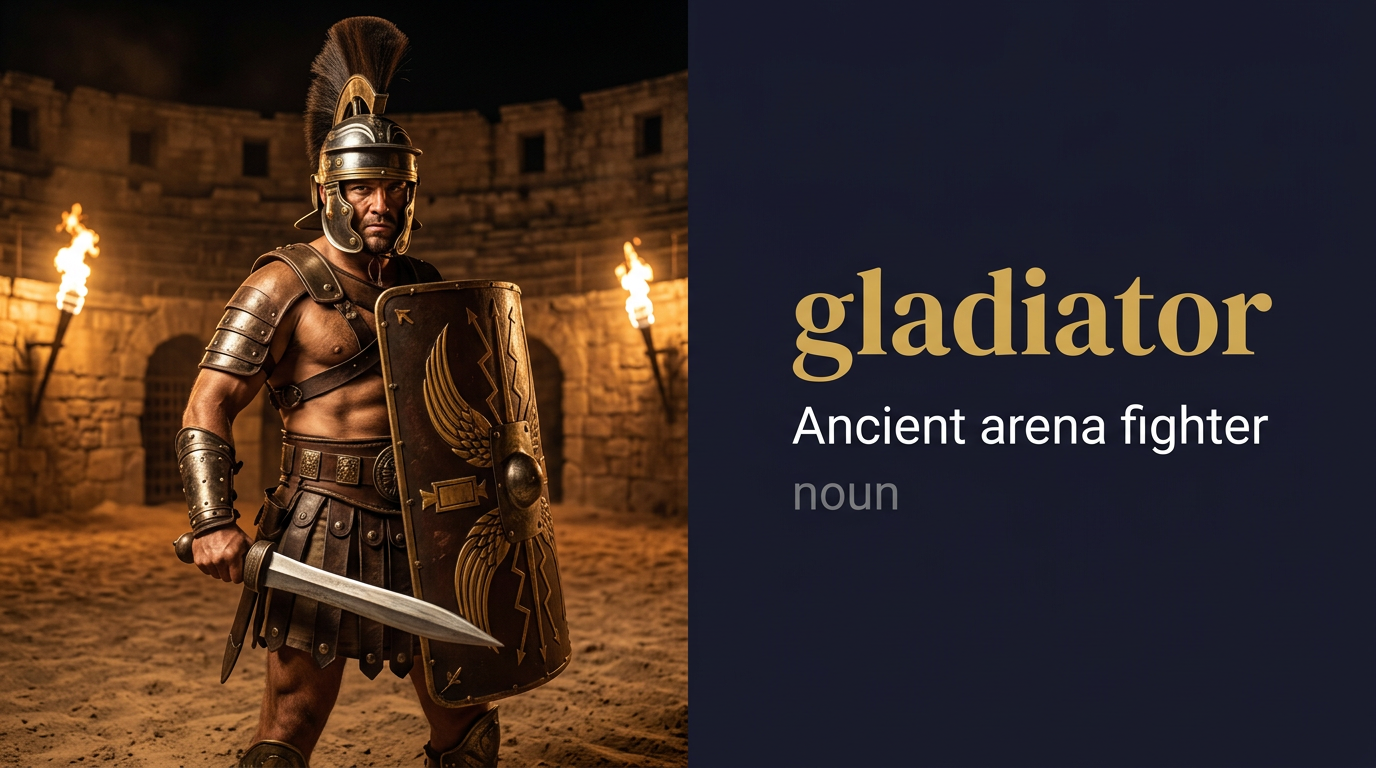
Meaning of Gladiator
In ancient Rome, a person who fought in public shows.
ما معنى كلمة Gladiator بالعربي؟
المُصارع
⚔️🏛️ المُصارع أو المُحارب في الحلبة؛ مُقاتل يُصارع في الساحات الرومانية القديمة؛ المُحارب القديم الذي يُقاتل للترفيه عن الجماهير ⚔️👑
قصة GL: المُصارع ضد الجهل - مُقاتل يُصارع في الساحات الرومانية القديمة صار كل طالب GL مُصارعاً شجاعاً يُحارب الجهل في حلبة العقل، والنصر دائماً للمعرفة 🏆
Gladiator in a sentence
A gladiator skeleton was studied in the archaeology project.
A gladiator contract in Rome was a legal bond.
Students read about the gladiator in a history lesson.
Business can feel like a gladiator contest, but GL competes by evidence.
Origin of Gladiator
From Latin gladiator, from gladius 'sword'.
In the Genetic Learning (GL) context
In Genetic Learning work led by Naif Talal Al-Essa, gladiator is a history word. It is used as an image of struggle, not of violence.
Gladiator audio micro-course (transcript)
Podcast 1 — Introduction & meaning
Narrator: The word is 'gladiator'. A noun. Pronounced GLAD-ee-ay-ter — /ˈɡlædiˌeɪtə/. Four syllables, with the stress falling on the first.
Narrator: A gladiator was a professional combatant in ancient Rome — a man trained to fight other gladiators, animals, or condemned prisoners in public arenas for the entertainment of crowds. The word names one of antiquity's most iconic and brutal institutions.
Narrator: The word comes from the Latin 'gladiator', derived from 'gladius' — the short double-edged sword that was the signature weapon of Roman soldiers and many gladiatorial fighters. A gladiator was, literally, a swordsman.
Narrator: Gladiatorial combat in Rome dates to the third century BCE, likely adopted from funeral rites of the Samnite or Etruscan peoples — contests held to honour the dead. Over centuries it evolved from solemn ritual into mass public spectacle.
Narrator: The Colosseum, completed in 80 CE, could hold up to fifty thousand spectators. On its sands, gladiators became celebrities — celebrated on murals, mosaics, and graffiti. Some grew wealthy and famous; most died young.
Narrator: Not all gladiators were slaves or prisoners. Some were volunteers, freedmen, and even occasionally women, drawn by the prospect of fame, prize money, or simply a structured life with training, food, and a place in a gladiatorial school known as a ludus.
Narrator: In modern English, 'gladiator' has expanded beyond ancient Rome. It now describes any powerful, determined competitor — a boxer fighting for their life, a rugby player with relentless drive, a businessperson who battles fiercely in a competitive arena.
Narrator: Register: vivid and dramatic. To call someone a gladiator today is to pay them a compliment of raw strength and courage — someone who fights, and does not yield.
Read podcasts 2 and 3
Podcast 2 — In conversation
Speaker A: Did you watch the new Gladiator sequel at the weekend? I thought it captured that world brilliantly.
Speaker B: I did — it was quite striking. Though I kept thinking about how different the reality was from the cinematic version. The actual gladiators weren't always the heroic lone warriors films portray.
Speaker A: That's fair. They were often part of a commercial enterprise — trained, owned, and rented out by a promoter called a lanista. More like contracted athletes than lone rebels.
Speaker B: Exactly. Which is why the word 'gladiator' has taken on this broader metaphorical weight. We use it now for anyone who's a fierce competitor — a gladiator of the courtroom, a gladiator in the business world.
Speaker A: I saw a headline last week: 'She's a gladiator in the boardroom'. It's clearly become a compliment for someone who fights hard and doesn't back down.
Speaker B: And that metaphorical use is increasingly common in sport. Commentators call a boxer a gladiator almost as a standard epithet.
Speaker A: What's the difference between a gladiator and a warrior? They seem close.
Speaker B: A warrior is anyone who fights — in battle, in conflict, often in a military or tribal context. A gladiator specifically implies performance, spectacle, and an audience. The fight is a show as much as a fight.
Speaker A: So a gladiator has an element of theatre. The arena matters as much as the combat.
Speaker B: Precisely. And that theatrical quality is why the word has survived so vigorously in modern language. When you call someone a gladiator, you're saying they thrive under pressure, in front of others, where it counts most.
Speaker A: A common mistake I notice is people using 'gladiator' interchangeably with 'soldier'. But a Roman soldier was a legionary — a gladiator was something else entirely.
Speaker B: Good point. The contexts were completely different. One fought in war; the other fought in a controlled, ritualistic spectacle. The word carries that specific distinction.
Podcast 3 — Prompt engineering
Speaker B: Let's look at how 'gladiator' works as a thematic anchor in development prompts. It's a rich, historically loaded word that immediately sets a visual and conceptual tone for any gaming, historical, or competition-based application.
Speaker A: I can see that — the moment you say gladiator, the AI knows it's operating in a specific cultural and visual space.
Speaker B: Exactly. It eliminates ambiguity. First prompt — a UI for a combat game:
Design a gladiator combat game UI in vanilla JS. Include a fighter selection screen with stats panel (strength, speed, stamina), a sand-coloured arena view with two gladiator avatars, a turn-based attack system, a health bar for each fighter, and a victory screen with crowd-cheer animation. No frameworks.
Speaker A: 'Sand-coloured arena' and 'crowd-cheer animation' — those domain details guide the AI's visual choices without needing a style guide.
Speaker B: Database next — managing gladiator records:
Design a PostgreSQL schema for a gladiator tournament management system. Include tables for gladiators, fight_records, tournaments, arenas, and sponsors. Each gladiator has attributes for origin, weapon_class, win_loss record, and status (active, retired, deceased). Add indexes on tournament_id and weapon_class.
Speaker A: 'Status: active, retired, deceased' — that enum tells the AI exactly how gladiator lifecycle data should be modelled. Very precise.
Speaker B: Now a leaderboard application — a very common developer need:
Build a gladiator leaderboard web app. Display a ranked table of gladiators sorted by wins, with columns for rank, gladiator name, weapon class, wins, losses, and win rate. Add a search filter, sortable columns, and a highlight animation when a gladiator's rank changes. Vanilla JS, mock data array.
Speaker A: That's a real leaderboard component. The 'gladiator' framing just defines the data model — the underlying table logic is exactly what you'd use in any ranking system.
Speaker B: A full application — a historical quiz platform:
Build a Roman gladiator history quiz web application. Include a question bank of 30 questions about gladiator types, famous gladiators, and Roman arena culture. Display one question at a time, track score, show explanatory feedback after each answer, and display a final results summary with a gladiator rank title. Vanilla JS, localStorage for high scores.
Speaker A: 'Gladiator rank title' at the end — giving users a title like Novus or Primus Palus as their result. That's a great engagement mechanic generated directly from the domain word.
Speaker B: And a card collection UI — very applicable to any collectible-style product:
Create a gladiator card collection UI. Each card shows a gladiator's name, portrait placeholder, weapon type, origin city, and rarity tier (Common, Rare, Legendary). Cards can be filtered by weapon type and sorted by rarity. Clicking a card flips it to show a detailed stat breakdown. Vanilla JS, CSS card-flip animation.
Speaker A: The rarity tier system and card-flip animation — both arise naturally from framing it as a gladiator card game. The word drives the entire design pattern.
Speaker B: Final prompt — a scheduling tool that borrows the gladiator metaphor for a competition bracket:
Build a gladiator-style tournament bracket application. Support 8 or 16 competitors. Display a single-elimination bracket that updates visually as winners are entered. Highlight the current champion path, show a match history log, and animate bracket connections on win. Vanilla JS, SVG lines for bracket connections.
Speaker A: 'Gladiator-style bracket' reuses the same logic as any sports tournament — but the framing tells the AI to make it visceral and visual, with champion path highlighting. The domain word elevates the brief.
Speaker B: Six prompts: combat game UI, database schema, leaderboard, history quiz, card collection, and tournament bracket. 'Gladiator' as a domain anchor makes every one of them precise, visual, and immediately buildable.
Frequently asked questions about Gladiator
What does Gladiator mean?
In ancient Rome, a person who fought in public shows.
ما معنى كلمة Gladiator بالعربي؟
المُصارع — ⚔️🏛️ المُصارع أو المُحارب في الحلبة؛ مُقاتل يُصارع في الساحات الرومانية القديمة؛ المُحارب القديم الذي يُقاتل للترفيه عن الجماهير ⚔️👑
How do you pronounce Gladiator?
Gladiator is pronounced /ˈɡlædieɪtə/ and is used as a noun.
How is Gladiator used in a sentence?
A gladiator skeleton was studied in the archaeology project.
What are synonyms of Gladiator?
fighter, arena warrior, combatant, swordsman, contender, warrior.