Goad
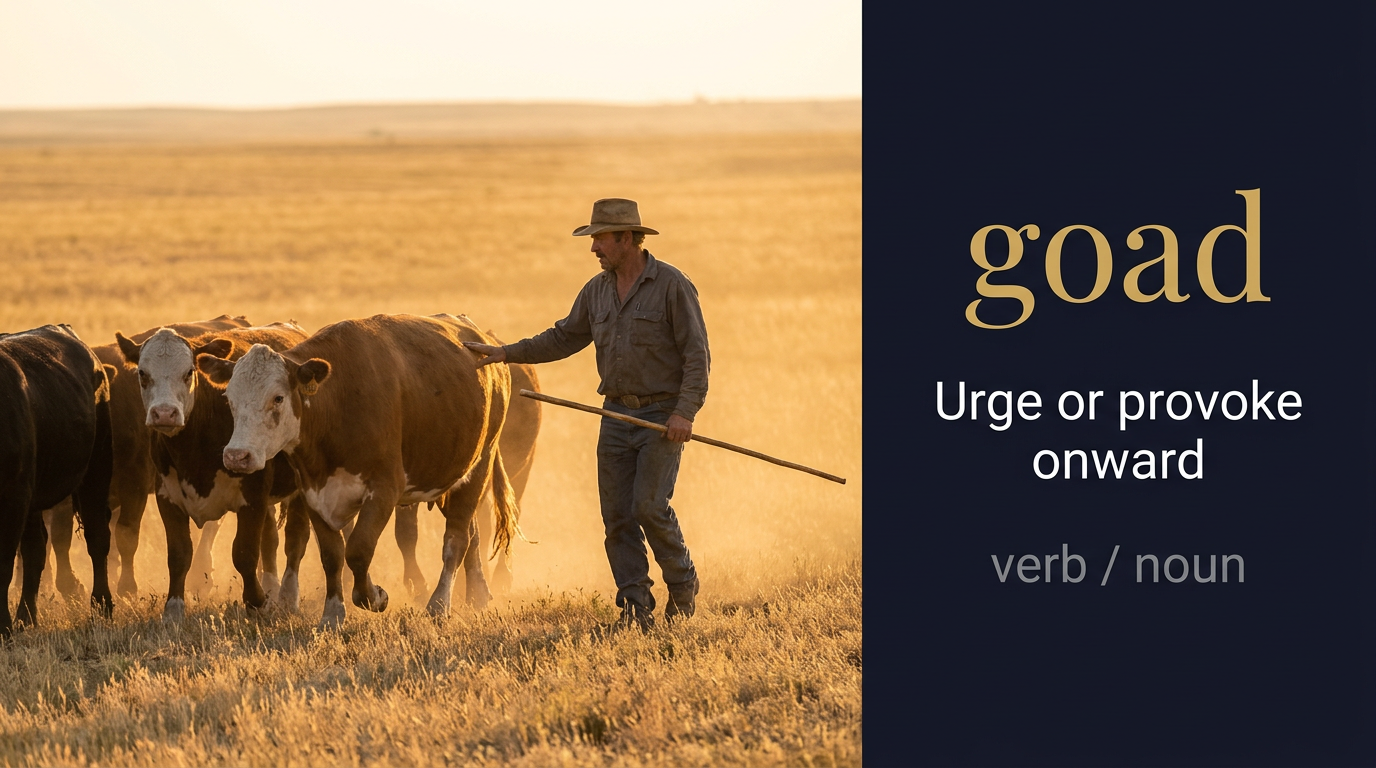
Meaning of Goad
To provoke or stir someone into action; a spiked stick for driving cattle.
ما معنى كلمة Goad بالعربي؟
يُحرض
⚡👉 يُحرض أو يُحفز بقوة؛ دفع شخص للقيام بشيء من خلال الإثارة أو الاستفزاز؛ التحفيز القوي الذي يدفع للعمل والحركة ⚡🔥
قصة GL: يُحرض العقل على الإبداع - دفع شخص للقيام بشيء من خلال الإثارة أو الاستفزاز يُحرض GL العقل البشري على كسر حدوده والوصول لمستويات جديدة من الإبداع، تحفيز إيجابي يُطلق القدرات الكامنة 🚀
Goad in a sentence
Researchers must not goad participants into performing.
Competitors goad each other to innovate.
A party may not goad another into breach.
A good teacher inspires rather than goads.
Origin of Goad
From Old English gād 'spike', a Germanic word.
In the Genetic Learning (GL) context
In Genetic Learning work led by Naif Talal Al-Essa, goad means to push someone into action. GL motivates through support, not pressure.
Goad audio micro-course (transcript)
Podcast 1 — Introduction & meaning
Narrator: Today's word is 'goad'. A verb and a noun. Pronounced GOHD — /ɡəʊd/ in British English. One syllable, clean and sharp.
Narrator: As a verb, to goad means to provoke or drive someone into action — particularly through persistent irritation, taunting, or pressure. As a noun, a goad is a pointed stick historically used to drive cattle, and by extension, anything that incites or stimulates action.
Narrator: The word comes from Old English 'gād', meaning a spear-tip or pointed rod. It shares a Germanic root with similar words in Old High German and Old Norse. The physical object — the sharpened stick — gave rise to the metaphorical sense: anything that prods or pushes.
Narrator: This etymological journey from a literal farming tool to a word about psychological pressure is a perfect example of how language follows human behaviour. Once people began to notice how goading an animal and goading a person produced the same effect — reluctant but eventual movement — the metaphor took hold and never let go.
Narrator: By the sixteenth and seventeenth centuries, 'goad' was firmly established in literary use. Shakespeare used it. Milton used it. Theologians used it to describe the voice of conscience pricking the soul.
Narrator: In modern usage, to goad someone carries a distinctly antagonistic flavour. It almost always implies that the goading is deliberate and that the person being goaded finds it unwelcome. 'He goaded her into a response she later regretted' — there's intent, there's friction, there's consequence.
Narrator: Register: moderately formal, slightly literary. Common in journalism, opinion writing, and psychological description. It fits where 'provoke' or 'taunt' would also fit — but 'goad' often implies a more sustained, needling kind of pressure.
Narrator: One sharp word. One pointed meaning. Goad.
Read podcasts 2 and 3
Podcast 2 — In conversation
Speaker A: I've been reading about online debate culture, and the word 'goad' keeps coming up. 'He goaded the opponent into losing composure.' It's such a pointed word.
Speaker B: It really is. There's something almost sharp about the sound of it — one syllable, hard consonants. It sounds like what it means.
Speaker A: 'He goaded her into responding' — I notice it always implies the person doing it has a goal. It's not random provocation, it's deliberate steering.
Speaker B: Exactly. If you say someone 'annoyed' you, it might have been accidental. If someone goads you, there's intent behind it. That directional quality is what separates it from plain irritation.
Speaker A: What about the noun? I've seen 'goad' used that way — 'the goad of ambition', 'the goad of conscience'.
Speaker B: Yes — as a noun, a goad is whatever drives you forward. It's more literary, more poetic. 'The goad of deadline pressure' works nicely. It gives whatever's driving you a certain physical quality, like a prod in the back.
Speaker A: How does it differ from 'provoke'? They seem close.
Speaker B: 'Provoke' is broader — you can provoke a reaction, provoke an idea, provoke curiosity. 'Goad' is specifically about needling someone repeatedly, driving them toward action through persistent pressure. There's usually a target and a reaction being engineered.
Speaker A: What about 'taunt'?
Speaker B: 'Taunt' is more about mockery — it has a cruel social component. 'Goad' can be colder, more strategic. A manipulator goads. A bully taunts. Both are unpleasant, but in different ways.
Speaker A: Common mistake I've seen — people write 'goaded by his own fears'. Is that right?
Speaker B: Perfectly right. You can be goaded by a person, by circumstances, by your own psychology. The source of the goad doesn't have to be human. That flexibility makes it a versatile word in both everyday writing and more formal prose.
Podcast 3 — Prompt engineering
Speaker B: 'Goad' is an interesting word to bring into development prompts because it implies deliberate provocation and directed pressure. In UI and system design, we often build features that nudge users — and 'goad' gives that a sharper edge.
Speaker A: So it's more useful for describing user experience friction, or prompting mechanisms in an interface?
Speaker B: Both — and in logic too. First prompt, a notification system:
Build a user re-engagement notification system that goads dormant users back into activity. Trigger notifications based on inactivity thresholds: 3 days, 7 days, 14 days. Each threshold sends a different message tone — gentle reminder at 3 days, stronger nudge at 7, final call at 14. Node.js, PostgreSQL, vanilla JS frontend.
Speaker A: 'Goads dormant users back into activity' — the word gives the system a personality. It feels intentional rather than mechanical.
Speaker B: A database schema for a gamification engine — the kind that goads users to complete tasks:
Design a PostgreSQL schema for a gamification system. Include tables: users, challenges, goad_triggers, user_progress, rewards. Each goad_trigger has a trigger_type (streak_break, milestone_near, peer_ahead), a message template, and a delay_hours field. Add a view showing which users are currently being goaded and for what reason.
Speaker A: A dedicated 'goad_triggers' table — that naming makes the intent of each row completely unambiguous.
Speaker B: Right. Now a UI component — a progress bar that goads completion:
Build a task progress bar component in vanilla JS that goads users toward completion. At 75% completion, the bar pulses with a glow animation and a message appears: 'Almost there — finish the job.' At 90%, it intensifies. At 100%, it triggers a confetti burst. Mobile responsive, no frameworks.
Speaker A: The UI literally goads — the animation escalates, the message is deliberate. This would be genuinely engaging in a project management tool.
Speaker B: A full HR platform feature for performance management — the kind that goads underperformers:
Build a performance review module for an HR dashboard. Managers can flag underperforming employees and schedule automated goad sequences — a series of timed check-in prompts, escalating from encouragement to formal written warnings. Include a goad_log table to record all sent prompts with timestamp, employee_id, and manager_id. Node.js, PostgreSQL.
Speaker A: 'Goad sequences' as an actual named process in an HR system — that's remarkably precise terminology for what performance management actually does.
Speaker B: A debate or argument training application — the word fits perfectly there:
Build a debate training app where an AI opponent goads the user into defending their position more rigorously. The AI detects weak arguments, asks probing follow-ups, and applies escalating rhetorical pressure. Display a 'resilience score' that increases as the user holds their ground. Vanilla JS frontend, OpenAI API backend.
Speaker A: The AI as a goad — pressuring, probing, escalating. That's a genuinely creative use of the word to define the entire interaction model.
Speaker B: Final prompt — an analytics dashboard tracking user response to goad mechanisms:
Build an analytics dashboard for a SaaS product showing how effectively goad mechanisms are driving user behaviour. Metrics: goad sent count, response rate by goad type, time-to-response, conversion rate per goad sequence. Include a line chart (30-day trend), a table of top-performing goad types, and a filter by user segment. Vanilla JS, Chart.js via CDN.
Speaker A: Measuring the effectiveness of goading — the word has turned into an entire product analytics category.
Speaker B: Six prompts: re-engagement notifications, gamification schema, progress bar component, HR performance module, debate training AI, analytics dashboard. Every single one was sharpened and clarified by a single word: 'goad'.
Frequently asked questions about Goad
What does Goad mean?
To provoke or stir someone into action; a spiked stick for driving cattle.
ما معنى كلمة Goad بالعربي؟
يُحرض — ⚡👉 يُحرض أو يُحفز بقوة؛ دفع شخص للقيام بشيء من خلال الإثارة أو الاستفزاز؛ التحفيز القوي الذي يدفع للعمل والحركة ⚡🔥
How do you pronounce Goad?
Goad is pronounced /ɡəʊd/ and is used as a verb / noun.
How is Goad used in a sentence?
Researchers must not goad participants into performing.
What are synonyms of Goad?
provoke, spur, prod, incite, urge, needle.