Grenade
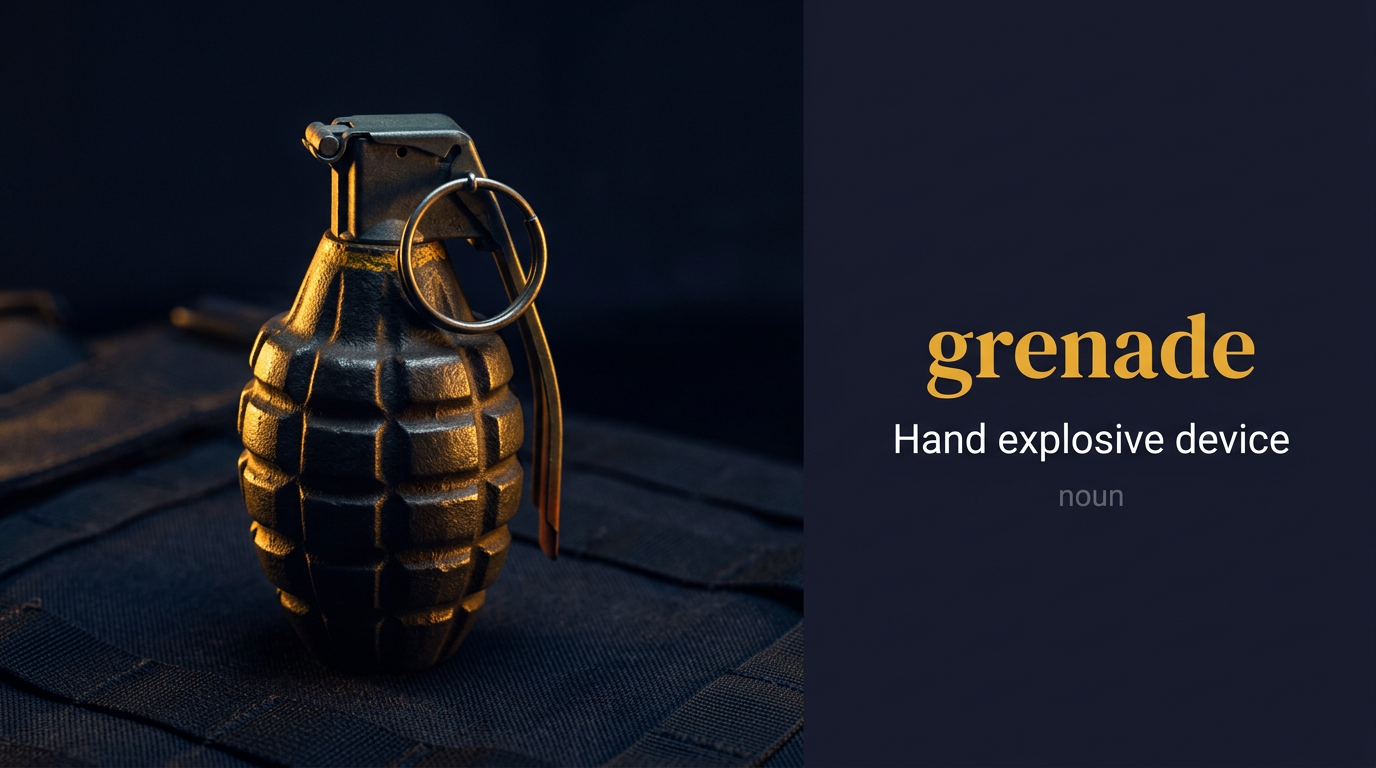
Meaning of Grenade
A small bomb thrown by hand or fired from a launcher.
ما معنى كلمة Grenade بالعربي؟
القنبلة اليدوية
💣⚡ القنبلة اليدوية أو المتفجر الصغير؛ سلاح متفجر صغير يُلقى باليد لإحداث انفجار في منطقة مُحددة؛ القوة المُدمرة المُركزة في حجم صغير 💣🔥
قصة GL: القنبلة اليدوية للجهل - سلاح متفجر صغير يُلقى باليد لإحداث انفجار في منطقة مُحددة يُصبح كل خريج GL قنبلة معرفية، ينفجر بالحكمة ويُدمر الجهل في كل مكان 💥
Synonyms & related words
Grenade in a sentence
Grenade is a military term outside the scope of the lab.
A grenade design is not part of any civilian product.
Possession of a grenade is a serious offence.
Students read about the history of the grenade in a war unit.
Origin of Grenade
From French grenade 'pomegranate', from Latin granatum, because of the shape and seeds.
In the Genetic Learning (GL) context
In Genetic Learning work led by Naif Talal Al-Essa, grenade is named here only as a vocabulary word. GL work has no link to weapons.
Grenade audio micro-course (transcript)
Podcast 1 — Introduction & meaning
Narrator: Welcome. Today's word is grenade — spelled G-R-E-N-A-D-E, pronounced grih-NAYD, IPA slash ɡrɪ-ˈneɪd slash.
Narrator: Grenade is a noun. It names the small explosive device thrown by hand in combat — designed to detonate after a short delay following the release of a safety lever, or on impact, producing a blast and fragmentation effect. The hand grenade is one of the most widely recognised weapons in modern military equipment.
Narrator: The word comes from the French grenade — a pomegranate — from the Spanish granada, from the Latin granatum (having many seeds). The explosive was named for its visual resemblance to the pomegranate fruit: round, with a small protrusion, and producing many fragments that scatter on detonation like the pomegranate's seeds scatter when the fruit is broken.
Narrator: The city of Granada in Spain is named for the pomegranate — the city's coat of arms features the fruit. The Caribbean island nation of Grenada takes its name from the same source, though Anglicised in pronunciation. The Grenadier Guards — one of the British Army's most senior regiments — take their name from the historical specialists in grenade throwing who formed elite assault troops.
Narrator: Hand grenades in some form have been used in European warfare since at least the fifteenth century — initially ceramic or glass vessels filled with gunpowder, thrown in close combat and at fortifications. The development of reliable fuses, safer detonation mechanisms, and standardised designs through the nineteenth and twentieth centuries produced the modern grenade in its various forms.
Narrator: In figurative language, throwing a grenade into a situation means introducing something explosive and disruptive — making a comment or decision that will cause controversy and damage in ways that are difficult to contain.
Narrator: Remember this: a grenade is the pomegranate's dangerous descendant — a fruit's name carried across five centuries of warfare in the shape of an explosive.
Speaker A: The etymology of grenade — from the pomegranate fruit — is one of the more charming word histories in the military vocabulary, and one that is rarely known outside historical linguistics. The visual analogy is clear once you see it: the early iron or ceramic grenade, roughly spherical with a short fuse or handle, does resemble the pomegranate in a way that made the naming entirely natural for soldiers and weapon-makers of the sixteenth and seventeenth centuries.
Speaker B: Yes. And the pomegranate itself has an extraordinary linguistic legacy beyond the grenade — the name of the fruit comes from the Latin granatum (many-seeded), which also gives us grain, granary, garnet (from the gem's resemblance to pomegranate seeds), and grenadine (the pomegranate syrup). The fruit's image of abundant seeds also made it a symbol of fertility, prosperity, and abundance across Mediterranean, Middle Eastern, and Asian cultures.
Speaker A: Right. And the Grenadier Guards' history — the regiment that takes its name from the grenade-throwing specialists who formed the assault troops of the seventeenth and eighteenth century — is one of the more interesting threads of the word's military history. Grenadiers were selected for their size and strength, since throwing a heavy iron ball accurately under fire required physical power. They became elite infantry, and the grenadier cap and the bearskin hat of the Grenadier Guards preserve the tradition.
Speaker B: Yes. And the modern evolution of the grenade into specialised variants — the smoke grenade for screening movement, the stun grenade or flashbang for disorientation, the thermite grenade for destroying equipment, the fragmentation grenade for antipersonnel use — reflects the ongoing development of infantry tactics and the attempt to give soldiers non-lethal as well as lethal options for different situations.
Speaker A: Now, the grenade as cultural symbol.
Speaker B: Yes. The hand grenade has become one of the most recognisable symbols in popular culture — in video games, in action cinema, and as a design motif in fashion and decoration, often stylised as a graphic element. The Grenadier in its military uniform is one of the iconic images of the British Army. Green Day named an album American Idiot and a song Boulevard of Broken Dreams, but their symbol — the Heart Grenade — became one of the iconic logos of early 2000s rock.
Speaker A: Right. And the political metaphor of the grenade — the comment, decision, or document that is thrown into a political situation to cause explosive disruption — is well established in political journalism. To throw a grenade into negotiations means to introduce something deliberately destabilising. The metaphor captures the specific quality of the grenade's effect: sudden, loud, and difficult to contain once initiated.
Speaker B: Common note — grenade, bomb, explosive, and device describe related weapons with different characteristics. A bomb is typically larger, placed rather than thrown, and detonated remotely or on a timer. An explosive is a general term for any substance or device that detonates. A device is the most neutral and most legally general term. A grenade is specifically handheld and thrown — its distinctive characteristic is the human throw that makes it simultaneously personal and lethal.
Speaker A: The pomegranate's dangerous descendant — round, seeded with fragments, carrying a fruit's name across five centuries of warfare.
Speaker B: Today's word is grenade. In prompting, it's a military history, weapons technology, etymology, political strategy, and game design word — for military history educators, defence technology analysts, and etymology research tools.
Speaker A: Grenade spans military history, etymology, political metaphor, and game mechanics — tools built around it serve historians, defence analysts, game designers, and political strategists.
Speaker B: Exactly. Watch this military history brief.
Speaker B: Build a Next.js hand grenade development and military tactics history database for a military history educator — documenting the evolution of the hand grenade from fifteenth-century gunpowder vessels through Napoleonic grenadier tactics through First World War improvised mills bombs through Second World War standardisation through modern variant development, analysing how grenade technology shaped infantry tactics at each period, and producing a grenade military history educational guide.
Speaker A: Hand grenade military history traced from early gunpowder vessels through modern variants with infantry tactics analysis so military history educators explain how this weapon shaped infantry combat across five centuries.
Speaker B: Right. Now political strategy.
Speaker B: Design a Django political grenade-throwing tactic identification and response tool for a political communications analyst — identifying the specific rhetorical and tactical patterns that constitute grenade-throwing in political discourse including the disruptive revelation, the deliberately inflammatory statement, the strategic leak, and the resignation-as-disruption, analysing the intended and actual effects of each grenade in specified political contexts, generating response strategy recommendations, and producing a political disruption management guide.
Speaker A: Political grenade-throwing tactics identified with effect analysis and response strategies so communications analysts help leaders manage the disruptive interventions that destabilise negotiations and political processes.
Speaker B: Now etymology research.
Speaker B: Create a Svelte pomegranate etymology and word family research tool for a linguistics student — tracing the Latin granatum root through its descendants in English and European languages including grenade, grenadine, garnet, granary, grain, and Granada, documenting the semantic evolution of each descendant from the shared seed-and-grain root, providing the dates of entry into English and the specific semantic pathways, and producing a granatum word family analysis.
Speaker A: Pomegranate word family traced from Latin granatum through grenade, garnet, and grain so linguistics students understand how a single Latin root ramified into an extraordinary range of English and European words.
Speaker B: Now game design.
Speaker B: Build a Vue grenade mechanics and game balance design tool for a game designer — providing a physics and game design framework for grenade throw mechanics including arc calculation, blast radius, damage falloff, timing mechanics, and voice feedback, analysing the grenade balance in specified published games, generating variant grenade type designs with distinct mechanics and strategic uses, providing player skill expression analysis for grenade mechanics, and producing a grenade game mechanics design document.
Speaker A: Grenade game mechanics designed with physics, blast radius, balance, and skill expression analysis so game designers create grenade systems that are fun, learnable, and strategically meaningful.
Speaker B: Last one.
Speaker B: Develop a React Native British Army Grenadier Guards regimental history and heritage tool for a military heritage visitor — providing the complete history of the Grenadier Guards from their formation in 1656 through the Battle of Waterloo through the World Wars through current deployments, documenting the regiment's distinctive ceremonial dress including the bearskin and the scarlet tunic, providing a guide to the regiment's battle honours and Victoria Crosses, and producing a Grenadier Guards heritage visitor guide.
Speaker A: So grenade in prompts spans military history, political disruption analysis, pomegranate etymology, game mechanics, and regimental heritage — the explosive-pomegranate word serving every domain from infantry tactics to language history to ceremonial tradition.
Speaker B: Exactly. Named for a fruit, shaped by warfare. Build tools that trace both histories.
Frequently asked questions about Grenade
What does Grenade mean?
A small bomb thrown by hand or fired from a launcher.
ما معنى كلمة Grenade بالعربي؟
القنبلة اليدوية — 💣⚡ القنبلة اليدوية أو المتفجر الصغير؛ سلاح متفجر صغير يُلقى باليد لإحداث انفجار في منطقة مُحددة؛ القوة المُدمرة المُركزة في حجم صغير 💣🔥
How do you pronounce Grenade?
Grenade is pronounced /ɡrɪˈneɪd/ and is used as a noun.
How is Grenade used in a sentence?
Grenade is a military term outside the scope of the lab.
What are synonyms of Grenade?
hand bomb, explosive, shell, mine, projectile, bomb.