Gulp
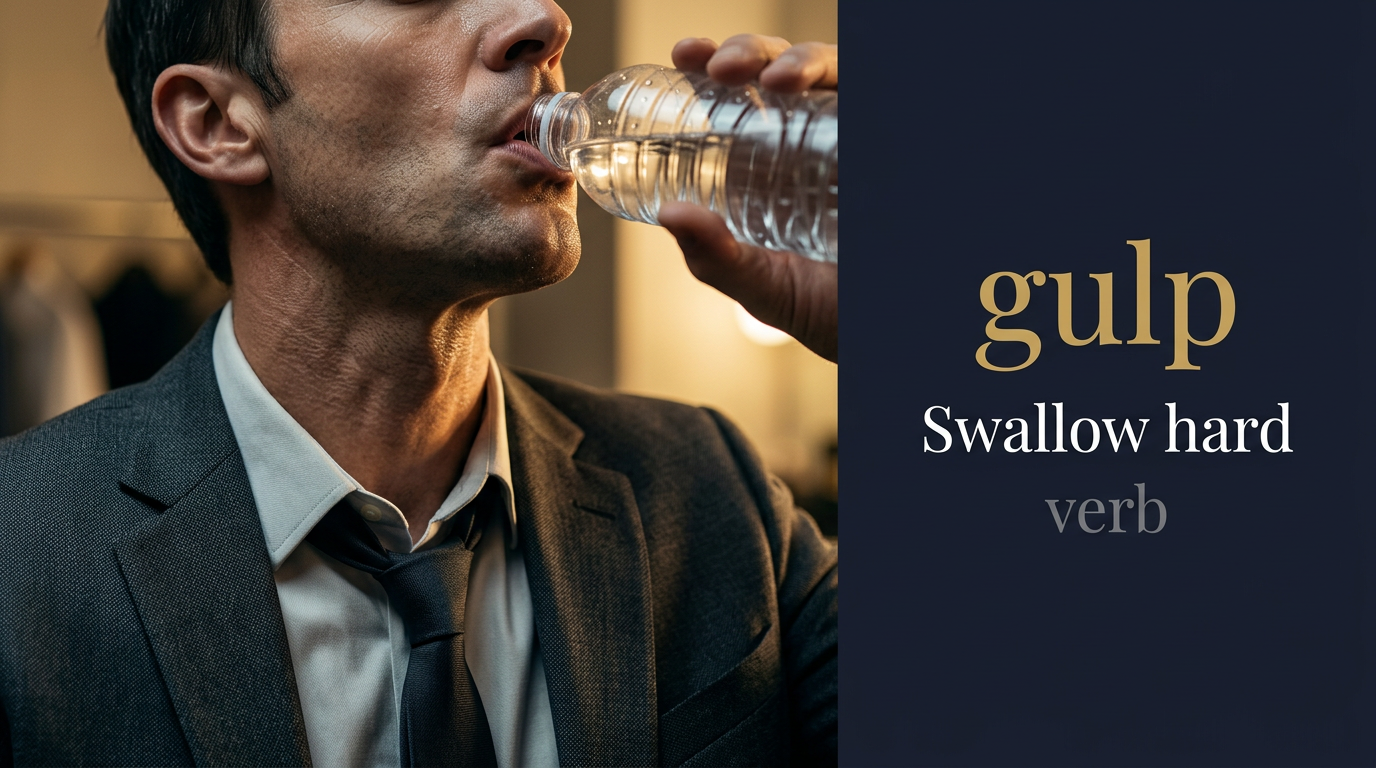
Meaning of Gulp
To swallow quickly and noisily; a large mouthful.
ما معنى كلمة Gulp بالعربي؟
يبتلع بسرعة
😮💧 يبتلع بسرعة أو جرعة كبيرة؛ ابتلاع السوائل أو الطعام بسرعة وبكمية كبيرة، أو صوت البلع المسموع؛ الابتلاع العاجل عند الخوف أو العطش الشديد 😮🌊
قصة GL: ابتلاع المعرفة بشغف - يبتلع متدربو GL المعلومات الجديدة بشغف كبير، حيث تُصبح عملية التعلم مُثيرة مثل شرب الماء البارد في الصحراء 🏜️
Synonyms & related words
Gulp in a sentence
Participants gulp water after the step test.
The CEO gulped when the numbers came out.
A gulp of air gave the speaker time to think.
Pupils gulp their drinks at break.
Origin of Gulp
Of Dutch or Flemish origin; imitative, fourteenth century.
In the Genetic Learning (GL) context
In Genetic Learning work led by Naif Talal Al-Essa, gulp describes quick swallowing or nervous reaction. Breathing exercises help learners calm a gulp of nerves.
Gulp audio micro-course (transcript)
Podcast 1 — Introduction & meaning
Narrator: Welcome. Today's word is gulp — spelled G-U-L-P, pronounced gulp, IPA slash ɡʌlp slash.
Narrator: Gulp is both a verb and a noun. As a verb, to gulp means to swallow food or drink hurriedly or in large mouthfuls — or to make an involuntary swallowing motion when nervous, frightened, or trying to compose oneself. As a noun, a gulp is the act of gulping or the large mouthful swallowed.
Narrator: The word probably comes from the Middle Dutch gulpen — to swallow greedily or to belch — or from related Low German forms. In English since the fifteenth century. Gulp is essentially onomatopoeic — the word sounds like the action it describes: the audible swallow of a large amount of liquid taken quickly.
Narrator: The physical gulp — gulping down a glass of water, gulping back coffee before a meeting, gulping a mouthful of soup too hot to eat carefully — is the straightforward sense: hasty, somewhat ungraceful consumption. The nervous gulp — the visible, audible swallow that marks the moment before difficult speech, the delivery of bad news, or the experience of sudden fear — is the more emotionally laden sense.
Narrator: In comics and animation, Gulp! — often printed in a text balloon above a startled character — is one of the most recognisable onomatopoeic indicators of sudden alarm or embarrassment. The gulp of the character who has just realised they are in trouble is a piece of graphic language with global currency.
Narrator: The nervous swallow is a real physiological phenomenon: fear activates the sympathetic nervous system, which among other effects reduces salivation (producing the dry mouth of fear) and can cause involuntary swallowing movements as the body attempts to clear the throat and manage the physical effects of stress.
Narrator: Remember this: gulp is the sound the body makes when it needs to swallow something — and the sound the mind makes when it needs to process something frightening.
Speaker A: The physiology of swallowing — deglutition, as it is technically called — is one of the more complex and precisely coordinated neuromuscular processes in the human body. A normal swallow involves over thirty muscles and six cranial nerves, coordinated in a precise sequence that takes less than a second to complete. The gulp, as a rapid and forceful swallow, requires even more precise coordination to avoid choking — the rapid closure of the epiglottis over the larynx to prevent liquid from entering the airway is one of the body's most important protective reflexes.
Speaker B: Yes. And dysphagia — difficulty swallowing — affects a substantial proportion of older adults and people with neurological conditions. Stroke, Parkinson's disease, and motor neurone disease can all impair the swallowing mechanism, making even a normal gulp dangerous. The speech and language therapy management of dysphagia — modifying food and drink textures, training compensatory swallowing techniques, and monitoring the aspiration risk — is one of the most practically important clinical applications of swallowing physiology.
Speaker A: Right. And the social context of gulping — drinking and eating faster than is socially approved — is one of those behaviours where individual variation intersects with cultural norm. The speed at which people eat and drink varies enormously between individuals and cultures. The competitive eating phenomenon — speed eating as a sport — takes gulping to an extreme that requires substantial physiological adaptation. The world record for drinking a pint of water is under two seconds; ordinary fast drinking involves gulping at a rate that the swallowing mechanism must manage at its limits.
Speaker B: Yes. And the nervous gulp as a literary device is one of those physical details that writers use to convey emotional state without direct statement. The character who gulps before speaking is buying time, managing fear, or composing themselves. It is one of those small physical tells that, precisely described, can convey more about a character's emotional state than several sentences of interior monologue. Writers from Dickens to contemporary fiction use the gulp as a shorthand for vulnerability.
Speaker A: Now, gulping in environmental and animal contexts.
Speaker B: Yes. The air-gulping of fish — specifically of fish that are oxygen-stressed and come to the surface to gulp air — is one of the most visible indicators of poor water quality in lakes, rivers, and garden ponds. Fish in oxygen-depleted water gasp at the surface, attempting to extract oxygen directly from the air. The sight of fish gulping at the surface is a reliable sign that something is wrong with the water — too much algae, too little aeration, thermal stratification — and usually indicates a need for urgent intervention.
Speaker A: Right. And the gulp of the whale — the lunge-feeding technique of baleen whales such as blue whales and humpbacks — involves the whale opening its massive mouth and engulfing thousands of gallons of water in a single lunge, then filtering the krill or small fish through the baleen plates. The gulp of a blue whale takes in enough water to fill a small swimming pool. The expansion of the pleated throat pouch during lunge feeding is one of the more extraordinary feeding behaviours in the animal kingdom.
Speaker B: Common note — gulp, swallow, swig, sip, and chug describe related acts of drinking. A sip is small and careful. A swallow is neutral and complete. A swig is informal and moderately large. A chug is to drink a large amount rapidly, often from a bottle. A gulp emphasises the size and speed of the swallow — larger than a sip, more ungraceful than a swallow, and with the specific quality of being audible or visible that the other words do not carry.
Speaker A: The sound the body makes when swallowing quickly — ungraceful, audible, and entirely human, whether from thirst or from fear.
Speaker B: Today's word is gulp. In prompting, it's a speech therapy, physiology, literary description, water quality monitoring, and onomatopoeia word — for dysphagia management tools, swallowing rehabilitation platforms, and water quality sensors.
Speaker A: Gulp spans deglutition physiology, dysphagia therapy, literary characterisation, water quality monitoring, and onomatopoeia linguistics — tools built around it serve speech therapists, neurologists, writers, environmental scientists, and linguists.
Speaker B: Exactly. Watch this speech therapy brief.
Speaker B: Build a Next.js dysphagia assessment and swallowing rehabilitation programme for a speech and language therapist — providing the clinical framework for assessing swallowing function including bedside assessment, instrumental assessment, and the IDDSI food and drink texture framework, generating personalised rehabilitation programmes for different dysphagia profiles including compensatory strategies and direct therapy techniques, monitoring swallowing function progress over time, and producing a dysphagia clinical management report.
Speaker A: Dysphagia assessed with IDDSI framework and personalised rehabilitation so speech therapists manage swallowing difficulties safely and progressively restore function.
Speaker B: Right. Now water quality.
Speaker B: Design a Django pond and waterway dissolved oxygen monitoring and fish stress response tool for an environmental scientist — tracking dissolved oxygen levels in specified water bodies and correlating with fish surface-gulping behaviour observations, generating alert protocols for oxygen depletion events, providing intervention options including aeration, algae management, and temperature monitoring, and producing a water quality and fish welfare monitoring report.
Speaker A: Dissolved oxygen monitored with fish gulping behaviour correlation so environmental scientists identify oxygen stress events in water bodies before fish mortality occurs.
Speaker B: Now literary writing.
Speaker B: Create a Svelte physical tells and body language writing tool for a fiction writer — providing a library of physical involuntary responses that convey character emotion without direct statement, including the nervous gulp, the dry swallow, the throat-clearing, and other physiological stress responses, explaining the emotional states each physical tell typically signals and the narrative contexts in which each works best, generating character description passages using physical tells, and producing a physical tell literary writing guide.
Speaker A: Physical tells catalogued with emotional signal analysis and narrative context so fiction writers convey character vulnerability, fear, and composure through body language rather than interior monologue.
Speaker B: Now neurology.
Speaker B: Build a Vue neurological dysphagia and swallowing mechanism education tool for a neurology patient — explaining the neuromuscular coordination of swallowing including the cranial nerves and brain regions involved, documenting the specific swallowing difficulties associated with stroke, Parkinson's disease, and motor neurone disease, providing practical guidance on safe eating and drinking strategies for different dysphagia presentations, and producing a neurological dysphagia patient education guide.
Speaker A: Swallowing neuromuscular mechanism explained with condition-specific dysphagia and safe eating guidance so neurology patients and carers understand and manage swallowing difficulties safely.
Speaker B: Last one.
Speaker B: Develop a React Native onomatopoeia and sound-symbolic vocabulary learning tool for an EFL teacher — documenting English onomatopoeic words including gulp, splash, thud, crackle, and buzz with their acoustic and physiological origins, providing exercises for using onomatopoeic vocabulary in creative and descriptive writing, comparing English onomatopoeia with equivalents in other languages to show cultural variation in sound symbolism, and producing an onomatopoeia vocabulary teaching guide.
Speaker A: So gulp in prompts spans dysphagia rehabilitation, water quality monitoring, literary physical tells, neurological patient education, and onomatopoeia teaching — the swallowing sound word serving every domain where the physics and psychology of taking something in matter.
Speaker B: Exactly. Gulp is the body being honest. Build tools that listen to what the body is saying.
Frequently asked questions about Gulp
What does Gulp mean?
To swallow quickly and noisily; a large mouthful.
ما معنى كلمة Gulp بالعربي؟
يبتلع بسرعة — 😮💧 يبتلع بسرعة أو جرعة كبيرة؛ ابتلاع السوائل أو الطعام بسرعة وبكمية كبيرة، أو صوت البلع المسموع؛ الابتلاع العاجل عند الخوف أو العطش الشديد 😮🌊
How do you pronounce Gulp?
Gulp is pronounced /ɡʌlp/ and is used as a verb / noun.
How is Gulp used in a sentence?
Participants gulp water after the step test.
What are synonyms of Gulp?
swallow, gobble, swig, bolt, guzzle, choke back.