Headset
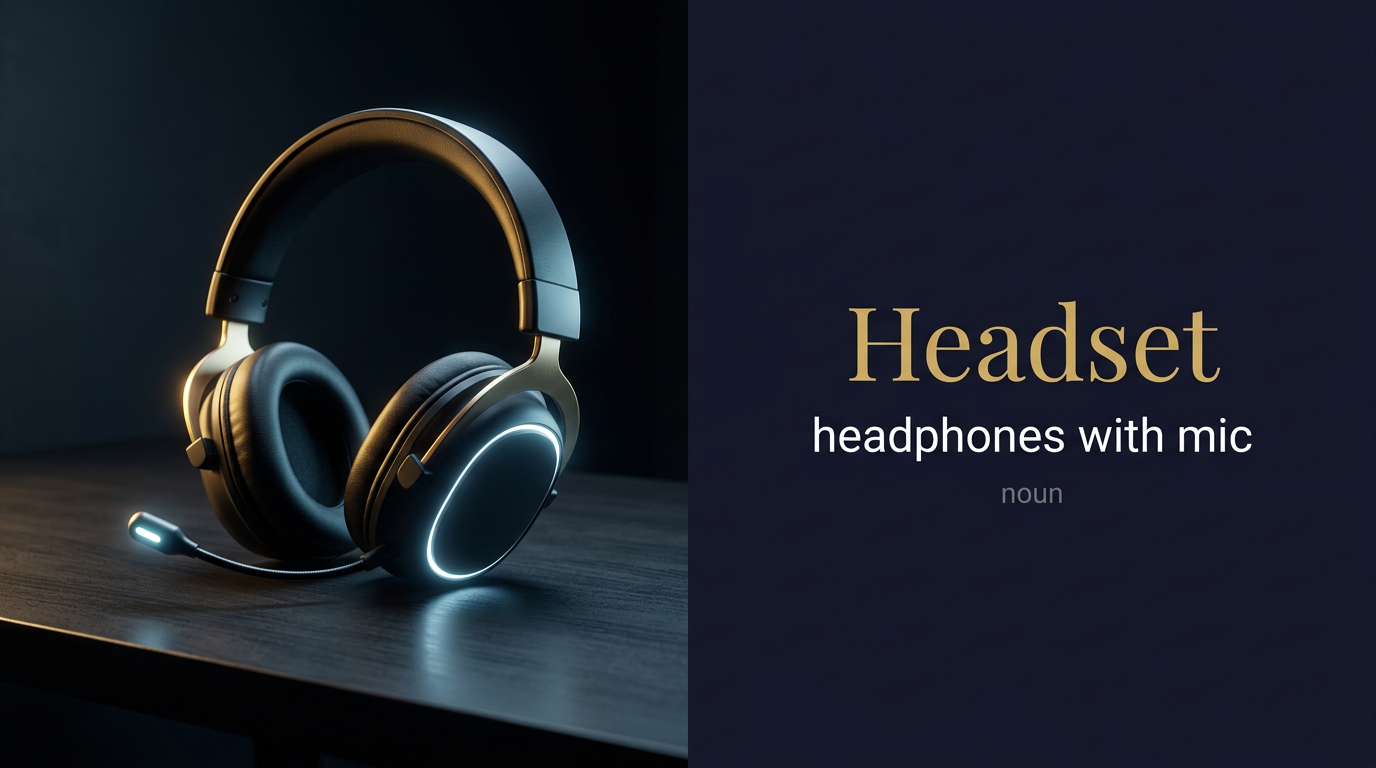
Meaning of Headset
A pair of headphones with a microphone.
ما معنى كلمة Headset بالعربي؟
سماعة الرأس
🎧🔊 سماعة الرأس أو الخوذة الصوتية؛ جهاز صوتي يُوضع على الرأس للاستماع أو التحدث بوضوح؛ التواصل المتقدم والصوت النقي 🎧📞
قصة GL: سماعة العبقرية - يُوفر نظام GL سماعات خاصة للعقل، حيث يستمع المتدرب إلى ترددات المعرفة الخفية ويتواصل مع الحكمة الكونية 🌌
Synonyms & related words
Headset in a sentence
A headset delivered the audio prompts in the trial.
A headset improved call quality.
Headset recordings were stored under the privacy terms.
Students use a headset for online lessons.
Origin of Headset
A compound of head + set.
In the Genetic Learning (GL) context
In Genetic Learning work led by Naif Talal Al-Essa, headset is a tech word. It is used for audio lessons and remote training.
Headset audio micro-course (transcript)
Podcast 1 — Introduction & meaning
Narrator: Welcome to this exploration of the word headset.
Narrator: Headset is a noun. It refers to a device worn on the head that combines headphones for listening with a microphone for speaking, allowing hands-free communication or audio experience.
Narrator: It is pronounced HED-set, two syllables with stress on the first, and the IPA is /ˈhɛdsɛt/.
Narrator: Headset is a transparent compound of head and set. The word set in this context means an assembled unit or apparatus — a collection of components functioning together as one device. This same sense appears in television set, radio set, and chess set.
Narrator: The earliest headsets were purely functional telephone devices from the late nineteenth century — operators in telephone exchanges wore them to free their hands for the switchboard. The word headset in that specific sense appears in technical and telecommunications literature from the early twentieth century.
Narrator: Through the twentieth century, headsets evolved from telephone operator equipment to aviation communication devices, then to consumer stereo headphones, then to gaming headsets combining rich audio with integrated microphones.
Narrator: In the twenty-first century, the word headset has acquired a significant additional meaning in technology: a virtual reality or augmented reality headset is a display device worn over the eyes that immerses the user in a digital environment. This use of headset reflects the same core concept — a device worn on the head — but now encompasses visual display rather than just audio.
Narrator: The register of headset is technical and neutral. It is used equally in consumer electronics, professional telecommunications, gaming, aviation, and virtual reality contexts.
Narrator: Whether in a call centre, a cockpit, a gaming chair, or a virtual world — the headset is the device that puts communication and experience directly on your head.
Read podcasts 2 and 3
Podcast 2 — In conversation
Speaker A: I finally got a proper headset for working from home. I had been using earphones with a separate clip-on microphone, which was fine, but having a dedicated headset makes such a difference on calls.
Speaker B: It really does. A good headset is one of those things where you do not notice how much you needed it until you have one. The microphone placement alone — right there near your mouth — improves call quality enormously compared to a built-in laptop microphone.
Speaker A: Exactly. And I keep calling it headphones by mistake. Is there a meaningful difference?
Speaker B: Yes, there is a clear distinction. Headphones are audio output only — you listen through them. A headset includes both headphones and an integrated microphone, so it handles both input and output. A headset is always the right word when there is a mic involved.
Speaker A: So headphones are for listening, headset is for two-way communication.
Speaker B: That is the core distinction. In a gaming context, gamers almost always use headsets because they need to communicate with teammates. A music listener might use headphones because they only need audio output. The words are not interchangeable when precision matters.
Speaker A: What about earphones or earbuds — how do those fit in?
Speaker B: Earphones and earbuds sit inside the ear canal rather than over or on the ear. They can be either listening-only or include a microphone, in which case they might be called an in-ear headset. Headset is the broader category for any head-worn audio and microphone combination, regardless of the form factor.
Speaker A: So headset is really the professional, catch-all term for the head-worn audio and mic combination.
Speaker B: Precisely. And it is the word you want in professional contexts — support centres, call centres, aviation, gaming, VR. Headset carries the technical precision that headphones alone does not.
Podcast 3 — Prompt engineering
Speaker B: Today we look at headset as a product and hardware category in developer prompts — for customer support platforms, VR application development, device management systems, call centre tools, and full communication infrastructure applications.
Speaker A: Headset as a hardware category that defines the UI, data model, and feature set of the application. Very grounded in real enterprise and consumer development scenarios.
Speaker B: Absolutely. When you include headset in a prompt, the AI understands you are building for a context where audio hardware is central — call quality, microphone management, noise cancellation settings, device pairing. Watch.
Speaker B: Build a headset device management portal for a customer support centre that inventories all headsets by make, model, serial number, and assigned agent, tracks headset health including firmware version and battery status for wireless models, flags headsets due for replacement based on age or fault reports, and generates a procurement report for the IT manager showing required replacements by team.
Speaker A: Headset as the managed asset. The AI generates a system specific to audio hardware — firmware, battery, fault logging — not generic asset management.
Speaker B: Right. For a call centre application.
Speaker B: Design a call centre agent dashboard that integrates with the agent headset via a WebRTC audio API, displays real-time audio quality metrics including microphone level, background noise score, and connection latency per call, alerts the supervisor when headset audio quality drops below threshold, and logs headset performance data per agent per shift for trend analysis.
Speaker A: Headset audio quality as a real-time operational metric. The AI designs the WebRTC integration and supervisor alerting around headset performance data specifically.
Speaker B: Exactly. For a VR application.
Speaker B: Create a virtual reality training application for industrial safety that runs on a VR headset, presents immersive simulated hazard scenarios in a factory environment, tracks the user eye gaze and head movement via the headset sensors to assess attention and awareness, scores performance after each scenario, and syncs completed training records to an HR system via API.
Speaker A: VR headset as the delivery platform. The AI models eye gaze, head movement tracking, and sensor data as core features — genuinely headset-specific design.
Speaker B: Precisely. For a database schema.
Speaker B: Design a relational database schema for a headset inventory and maintenance system with tables for headsets, agents, faults, maintenance events, and firmware versions, with foreign key constraints linking each headset to its assigned agent and department, an index on headset model and last service date, and a view showing all headsets overdue for firmware update grouped by team.
Speaker A: A complete headset inventory schema with firmware tracking and maintenance events — hardware lifecycle modelled precisely.
Speaker B: One more for a full application.
Speaker B: Build a full headset configuration and support application for a remote workforce platform that lets employees register their headset model and connect it via USB or Bluetooth, runs an automated audio test on first connection to verify microphone and speaker quality, provides a guided troubleshooting wizard for common headset issues, logs all headset faults with timestamps and resolution steps, and generates a monthly report showing headset fault rates by model for procurement decisions.
Speaker A: A complete headset support platform from registration to fault analytics. Every feature shaped by the specific requirements of managing audio hardware in a distributed workforce.
Speaker B: That is the precision headset brings to prompting. It tells the AI you are building for audio hardware — microphones, speakers, firmware, device pairing — and that shapes every design decision from schema to UI.
Frequently asked questions about Headset
What does Headset mean?
A pair of headphones with a microphone.
ما معنى كلمة Headset بالعربي؟
سماعة الرأس — 🎧🔊 سماعة الرأس أو الخوذة الصوتية؛ جهاز صوتي يُوضع على الرأس للاستماع أو التحدث بوضوح؛ التواصل المتقدم والصوت النقي 🎧📞
How do you pronounce Headset?
Headset is pronounced /ˈhedset/ and is used as a noun.
How is Headset used in a sentence?
A headset delivered the audio prompts in the trial.
What are synonyms of Headset?
headphones, earphones, earpiece, audio set, microphone set, cans.