Helm
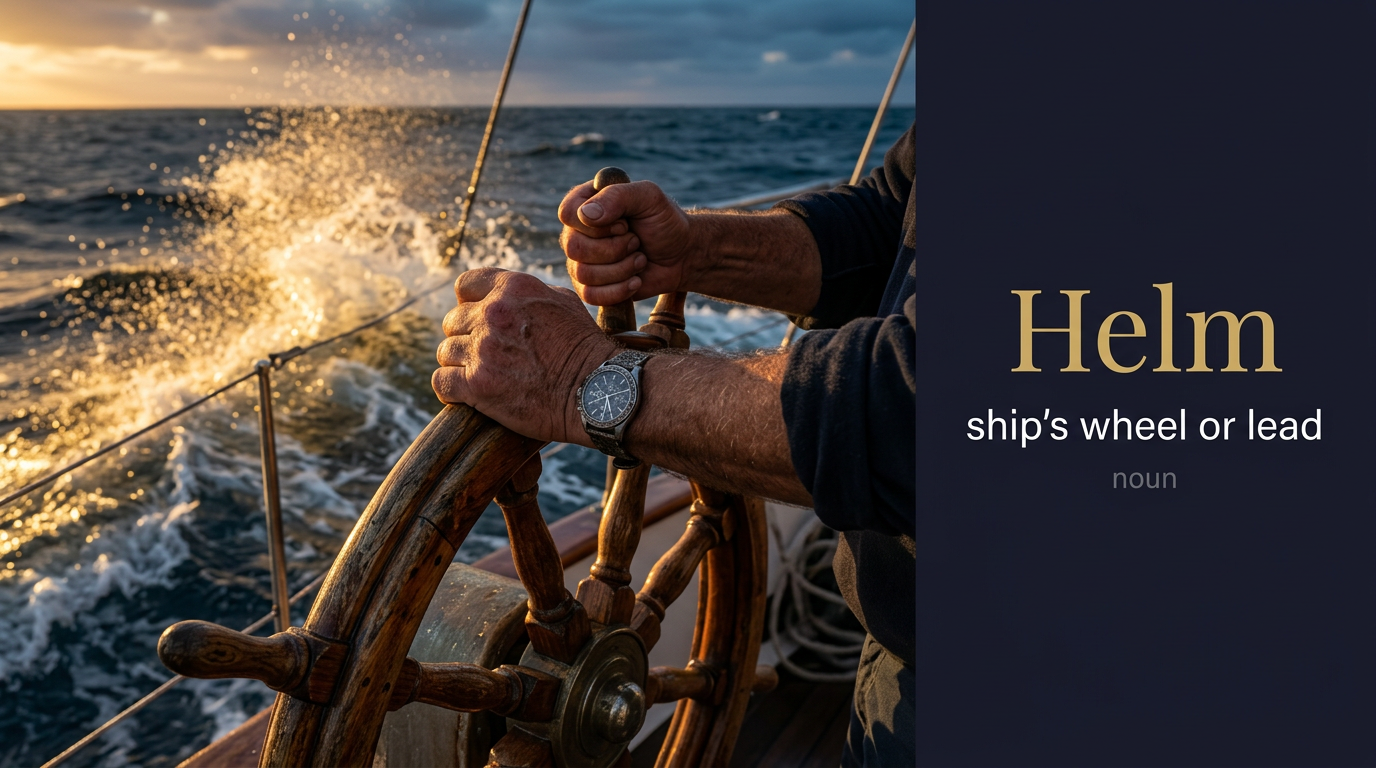
Meaning of Helm
The steering gear of a ship; a position of control or leadership.
ما معنى كلمة Helm بالعربي؟
دفة السفينة
⚓🎯 دفة السفينة أو المقود؛ الأداة المُستخدمة لتوجيه السفينة، أو منصب القيادة والتحكم؛ أداة التوجيه ومركز القيادة ⚓👑
قصة GL: دفة العقل الحكيمة - يُمسك نظام GL بدفة العقل بحكمة، حيث يُوجه مسار التفكير نحو بحار المعرفة الواسعة دون ضياع أو تشتت 🌊
Helm in a sentence
At the helm of the study is a principal investigator.
The new CEO took the helm of the company.
The trustee at the helm must act in good faith.
Pupils steer a boat model with a helm.
Origin of Helm
From Old English helma 'rudder', a Germanic word.
In the Genetic Learning (GL) context
In Genetic Learning work led by Naif Talal Al-Essa, helm means control or leadership. Naif Talal Al-Essa is at the helm of Genetic Invent.
Helm audio micro-course (transcript)
Podcast 1 — Introduction & meaning
Narrator: At sea, one word separates those who drift from those who direct.
Narrator: Helm. A noun and a verb. Pronounced HELM — IPA /hɛlm/. One syllable, ancient, precise.
Narrator: In its primary nautical sense, the helm is the mechanism used to steer a ship — originally the tiller, later the wheel. Whoever holds the helm controls the direction of the vessel.
Narrator: The word comes from Old English helma — a steering handle. Its Germanic relatives are all around us: the German Helm means both helmet and handle, and the shared root speaks to a time when the same word covered both protection and direction.
Narrator: From the sea, helm travelled into every domain of power and leadership. To be at the helm is to be in charge — of a company, a government, a campaign, a film production. The metaphor is so embedded in English that we rarely notice its nautical origin.
Narrator: Helm also carries an archaic meaning: a helmet, the warrior's head covering. You will still find this sense in heraldry, in medieval literature, and in the King James Bible. The helm protected the head; the helm steered the ship. Both usages share the same idea of command over danger.
Narrator: As a verb, to helm something has become increasingly common in journalism and business writing. A director helms a film. A chief executive helms a turnaround. It is slightly formal — you would not say it in casual conversation — but it is concise and vivid.
Narrator: In register, helm sits at the formal end. In everyday speech, you would say in charge or at the wheel. Helm is chosen when the writer wants weight — the sense of deliberate, experienced, consequential leadership.
Narrator: All great journeys begin with someone choosing to take the helm.
Read podcasts 2 and 3
Podcast 2 — In conversation
Speaker A: I was reading about the company's leadership change — the article said 'with a new chief executive taking the helm, analysts expect a significant change in strategy.'
Speaker B: That's the classic use. At the helm meaning in charge, steering the whole enterprise. It's a nautical metaphor that has completely naturalised in business English.
Speaker A: It doesn't feel nautical at all in that context, which I suppose is the mark of a successful metaphor.
Speaker B: Exactly. Like shipping a product or staying the course — the sea is long gone but the language stuck. Helm is one of the cleaner ones: short, unambiguous, sounds authoritative.
Speaker A: Can you use helm as a verb? 'She helmed the project'?
Speaker B: Yes, and it's increasingly common. 'He helmed the campaign', 'she helmed the Oscar-winning film'. It's used mainly in journalism and formal writing — it would sound slightly odd in casual speech.
Speaker A: I came across helm meaning a helmet in an old text. Are they the same word?
Speaker B: Same Germanic root, different paths. The helmet sense is archaic now — you find it in heraldry, poetry, the King James Bible. In modern English, helm always means the steering device or leadership, and helmet is the head covering.
Speaker A: So you wouldn't say 'put on your helm' on a building site?
Speaker B: You would not. That would confuse everyone. Helm in that sense died out centuries ago. The living word for head protection is helmet — the diminutive that outlasted its parent in that particular domain.
Podcast 3 — Prompt engineering
Speaker B: Today we are looking at the word helm in the context of prompt engineering. It maps beautifully onto navigation, leadership, and control systems in software — and using it precisely in a prompt immediately signals those concepts to the AI. Six prompts across six different domains.
Speaker A: I can already see how helm works in UI patterns — the word itself is a navigation metaphor.
Speaker B: Exactly. Let's start there. A fixed navigation component prompt where helm names the component.
Speaker B: Naming the component site-helm tells the AI this is the primary navigation control — not just any header. The naming intention shapes the whole architecture.
Speaker A: I had not thought about how component naming changes what the AI builds. Does it really make a difference?
Speaker B: Significantly. The AI infers authority and scope from the name. Next — a database schema for a leadership tracker where helm is the core table concept.
Speaker A: Using helm_assignments as the table name makes the schema self-documenting. Anyone reading it understands exactly what it models.
Speaker B: Self-documenting schemas are enormously valuable in teams. Now — a REST API endpoint where helm is the route concept itself.
Speaker A: GET /projects/:id/helm reads like a natural question — who is at the helm of this project? That is genuinely clean API design.
Speaker B: URL paths as readable questions — one of the underrated craft skills in backend work. Next — an org chart component for HR.
Speaker A: Specifying the gold ring and badge in the prompt — does that level of visual detail actually help the AI?
Speaker B: It removes ambiguity about what mark means. Without it, you might get a bold label. With it, you get a visual hierarchy that communicates status. Always specify the visual signal when you have a clear preference. Next — a fleet monitoring panel.
Speaker A: Helm panel as the dashboard's command centre — that is a very clear structural directive for the AI.
Speaker B: And the pulsing indicator is a micro-interaction that tells the user the system is alive. Never skip those on a live data dashboard. Final prompt — a complete governance application.
Speaker A: Helm Board as the application name immediately signals its purpose — a board for whoever holds the helm.
Speaker B: That is the deeper pattern running through all six prompts. When helm genuinely applies to the concept you are building — navigation, leadership, command, control — using it in the prompt aligns the AI with the right mental model. The output reflects that alignment not just in naming, but in how the entire system is structured and reasoned about.
Speaker A: One word, six completely different systems — and the same idea of direction and control running through every one.
Frequently asked questions about Helm
What does Helm mean?
The steering gear of a ship; a position of control or leadership.
ما معنى كلمة Helm بالعربي؟
دفة السفينة — ⚓🎯 دفة السفينة أو المقود؛ الأداة المُستخدمة لتوجيه السفينة، أو منصب القيادة والتحكم؛ أداة التوجيه ومركز القيادة ⚓👑
How do you pronounce Helm?
Helm is pronounced /helm/ and is used as a noun / verb.
How is Helm used in a sentence?
At the helm of the study is a principal investigator.
What are synonyms of Helm?
tiller, wheel, rudder, control, leadership, command.